PUBLISHER: Mordor Intelligence | PRODUCT CODE: 2114934

PUBLISHER: Mordor Intelligence | PRODUCT CODE: 2114934
Photoelectric Sensor - Market Share Analysis, Industry Trends & Statistics, Growth Forecasts (2026 - 2031)
According to Mordor Intelligence, the photoelectric sensor market size is expected to grow from USD 2.02 billion in 2025 to USD 2.16 billion in 2026 and is forecast to reach USD 3.05 billion by 2031 at 7.12% CAGR over 2026-2031.
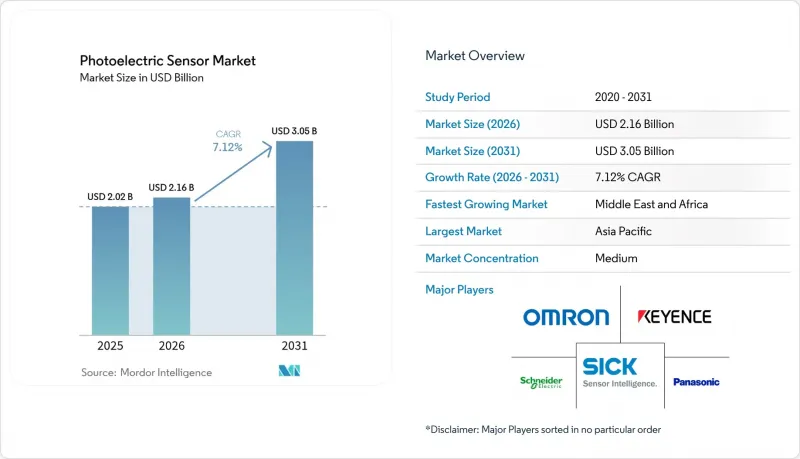
This report is Segmented by Type (Laser, Fiber-Optic, and More), Detection Technology (Through-Beam, Retro-Reflective and More), Housing / Mounting Style (Cylindrical (M8-M30), Rectangular / Cubic and More), End-User Industry (Consumer Electronics, Automotive and E-Mobility and More), and Geography. The Market Forecasts are Provided in Terms of Value (USD).
Global Photoelectric Sensor Market Trends and Insights
Accelerated Deployment of Industry 4.0 Production Lines
Factories are weaving dense networks of smart sensors that feed real-time data into edge controllers and cloud platforms, allowing predictive maintenance routines that slash unplanned downtime by as much as 30%. Photoelectric sensors furnish high-frequency positional feedback to robotic arms and conveyor systems, permitting adaptive control that limits waste and energy consumption. The IO-Link protocol has become a de-facto digital interface, making it possible to stream diagnostic parameters straight into ERP dashboards. Line installers in APAC report payback periods of less than 18 months on sensor upgrades because higher uptime compensates for initial hardware costs. Broader availability of "plug-and-produce" photoelectric devices further reduces commissioning effort, helping small and mid-size manufacturers adopt industrial automation.
Government Tax-Credit Programmed for Smart-Factory Retrofits
The United States continues to expand federal RandD credits and allows accelerated depreciation for automation hardware under Section 179D. Similar stimulus measures in the European Union funnel up to 20% of project spending into cash rebates when firms add energy-efficient, safety-rated sensors. Germany's BMBF-funded "Fusion 2040" programme set aside EUR 650 million to support integrated sensor platforms for advanced manufacturing. Local authorities in South Korea and Singapore follow suit with grant schemes that reimburse employee training tied to digital transformation. These incentives are bringing forward purchase decisions and supporting multi-line retrofits that might otherwise have been delayed.
Uptake of Low-Cost 3D ToF Cameras in Short-Range Picking
Time-of-flight arrays such as Teledyne's 832 X 600-pixel Hydra3D now deliver sub-millimetre depth accuracy and run at 416 fps, letting robotic cells identify irregular loads in chaotic bins. Their falling price narrows the gap with premium photoelectric sensors in logistics and warehouse operations. The ability to perceive full point clouds gives integrators freedom to cut sensor counts. Nonetheless, photoelectric sensors remain ahead in high-speed pass-fail detection on conveyor belts, keeping displacement risk confined to specific 3D-vision use cases.
Other drivers and restraints analyzed in the detailed report include:
- Falling ASP of High-Power Red-Laser Emitters
- Rapid Shift to Zero-Defect Packaging Lines in F and B
- Volatile Gallium-Arsenide Spot Prices
For complete list of drivers and restraints, kindly check the Table Of Contents.
Segment Analysis
Laser photoelectric sensors commanded a 33.58% photoelectric sensor market share in 2025, reflecting their unrivalled accuracy and long sensing ranges. The segment is forecast to record a 8.95% CAGR, raising the laser photoelectric sensor market size for this segment to USD 1.13 billion by 2031. Price erosion in high-power red-laser dies makes these devices viable even in cost-sensitive production cells. Automotive power-train lines deploy self-contained CMOS laser units with 500 mm detection distance to confirm gear-wheel seating. Fiber-optic variants secure positions in welding booths where electromagnetic noise threatens conventional electronics. The proliferation of IO-Link-enabled models means line operators collect live signal strength and contamination alarms for predictive cleaning schedules. Parallel structured light innovations offer multi-beam coverage that improves detection through dust, reducing false trips.
Emerging retro-reflective array sensors blend easy setup with wide beam reach, useful in carton-forming machines and palletizers. Miniaturization progresses each quarter as gallium arsenide nano-ridge emitters shrink optical packages and trim thermal loads. Suppliers introduce stainless-steel IP69K housings that withstand caustic wash-down cycles in dairy filling rooms. Combined, these advances underpin strong forward momentum and keep the laser category at the centre of the photoelectric sensor market.
Through-beam devices held 40.62% revenue in 2025, forming the backbone of high-speed press lines and canning operations. They remain favoured where open mounting is possible and total reliability is paramount. Background-suppression sensors will outpace rivals at 10.05% CAGR, enlarging their photoelectric sensor market size from USD 548 million in 2026 to USD 885 million by 2031. Their optical design isolates the target within a narrow distance window, preventing false positives from conveyors or enclosures. Robotics integrators specify these sensors on automated guided vehicles for docking accuracy within +-1 mm. Retro-reflective versions support space-restricted conveyors that permit only one-sided mounting, retaining their simplicity with their installation simplicity.
Ongoing R&D focuses on ASIC-driven adaptive thresholds that let background-suppression units learn surface finishes and compensate for ambient light drift. IO-Link channels expose hysteresis parameters to the PLC, letting control engineers fine-tune detection curves without manual potentiometer twists. Diffuse sensors survive where ambient light is stable, serving cost-oriented packaging OEMs that bundle sensors into entry-level machines. Across detection technologies, artificial intelligence algorithms increasingly prune false signals and report contaminant buildup, raising system reliability in dusty, high-speed settings.
Complete Report Scope:
- By Type
- Laser
- Fiber-optic
- LED/Infra-red
- Retro-reflective Array
- By Detection Technology
- Through-beam
- Retro-reflective
- Diffuse
- Background-suppression
- By Housing / Mounting Style
- Cylindrical (M8-M30)
- Rectangular / Cubic
- Slot / Fork
- Miniature PCB-mount
- By End-user Industry
- Consumer Electronics
- Automotive and E-Mobility
- Food and Beverages
- Packaging Machinery OEMs
- Pharmaceuticals and Medical Devices
- Building and Smart Infrastructure
- By Geography
- North America
- United States
- Canada
- Mexico
- Europe
- United Kingdom
- Germany
- France
- Italy
- Rest of Europe
- Asia-Pacific
- China
- Japan
- India
- South Korea
- Rest of Asia-Pacific
- Middle East
- Israel
- Saudi Arabia
- United Arab Emirates
- Turkey
- Rest of Middle East
- Africa
- South Africa
- Egypt
- Rest of Africa
- South America
- Brazil
- Argentina
- Rest of South America
- North America
Geography Analysis
APAC controlled 47.40% of revenue in 2025 as China, Japan, and South Korea invested heavily in intelligent factories. Government incentives, especially China's "Made in China 2025" programme, repay up to 50% of capital expenses on smart equipment, accelerating sensor adoption. Domestic robot makers embed photoelectric detection in pick-and-place modules for smartphone assembly. Japan's precision machinery builders rely on high-end laser models that discern micron-level edges on semiconductor wafers.
The Middle East will grow fastest at 13.12% CAGR. Saudi Arabia's Vision 2030 supports fresh metal-processing and chemical complexes that specify Industry 4.0 connectivity from day one. Emerson's 13,000 m2 Dammam hub now manufactures control systems with integrated measurement instrumentation, including photoelectric sensors. UAE smart-city pilots deploy outdoor-rated retro-reflective sensors to automate parking guidance and waste-handling chutes, opening non-industrial revenue channels.
North America and Europe post steady gains as reshoring of critical supply chains and sustainability mandates drive upgrades. US food processors increase inline inspection to meet FSMA regulations. German automotive OEMs embrace predictive maintenance on assembly lines, embedding IO-Link sensors that stream diagnostics into MES platforms. South America and Africa remain nascent but rising industrial wages push firms to install basic automation, presenting long-term potential for cost-competitive diffuse sensors.
- Omron Corporation
- Keyence Corporation
- Sick AG
- Panasonic Holdings Corporation
- Rockwell Automation Inc.
- Schneider Electric SE
- Pepperl+Fuchs SE
- Banner Engineering Corp.
- Leuze electronic GmbH + Co. KG
- SensoPart Industrie-sensorik GmbH
- HTM Sensors Inc.
- Balluff GmbH
- Autonics Corporation
- IFM Electronic gmbh
- Datasensing S.p.A.
- Fargo Controls Inc.
- Baumer Holding AG
- Contrinex AG
- Eaton Corporation plc
- Wenglor Sensoric GmbH
Additional Benefits:
- The market estimate (ME) sheet in Excel format
- 3 months of analyst support
TABLE OF CONTENTS
1 INTRODUCTION
- 1.1 Study Assumptions and Market Definition
- 1.2 Scope of the Study
2 RESEARCH METHODOLOGY
3 EXECUTIVE SUMMARY
4 MARKET LANDSCAPE
- 4.1 Market Overview
- 4.2 Market Drivers
- 4.2.1 Accelerated deployment of Industry 4.0 production lines
- 4.2.2 Government tax-credit programmes for smart-factory retrofits
- 4.2.3 Falling ASP of high-power red-laser emitters
- 4.2.4 Rapid shift to zero-defect packaging lines in FandB
- 4.2.5 New IEC 61496-5 safety-rated photoelectric standards
- 4.2.6 AI-enabled self-calibration reducing maintenance labour
- 4.3 Market Restraints
- 4.3.1 Uptake of low-cost 3-D ToF cameras in short-range picking
- 4.3.2 High replacement rate in wash-down environments
- 4.3.3 Volatile gallium-arsenide spot prices
- 4.3.4 Fragmented OEM interface protocols
- 4.4 Value/Supply-Chain Analysis
- 4.5 Regulatory Landscape
- 4.6 Technological Outlook
- 4.7 Porter's Five Forces Analysis
- 4.7.1 Bargaining Power of Suppliers
- 4.7.2 Bargaining Power of Buyers
- 4.7.3 Threat of New Entrants
- 4.7.4 Threat of Substitutes
- 4.7.5 Intensity of Competitive Rivalry
5 MARKET SIZE AND GROWTH FORECASTS (VALUE)
- 5.1 By Type
- 5.1.1 Laser
- 5.1.2 Fiber-optic
- 5.1.3 LED/Infra-red
- 5.1.4 Retro-reflective Array
- 5.2 By Detection Technology
- 5.2.1 Through-beam
- 5.2.2 Retro-reflective
- 5.2.3 Diffuse
- 5.2.4 Background-suppression
- 5.3 By Housing / Mounting Style
- 5.3.1 Cylindrical (M8-M30)
- 5.3.2 Rectangular / Cubic
- 5.3.3 Slot / Fork
- 5.3.4 Miniature PCB-mount
- 5.4 By End-user Industry
- 5.4.1 Consumer Electronics
- 5.4.2 Automotive and E-Mobility
- 5.4.3 Food and Beverages
- 5.4.4 Packaging Machinery OEMs
- 5.4.5 Pharmaceuticals and Medical Devices
- 5.4.6 Building and Smart Infrastructure
- 5.5 By Geography
- 5.5.1 North America
- 5.5.1.1 United States
- 5.5.1.2 Canada
- 5.5.1.3 Mexico
- 5.5.2 Europe
- 5.5.2.1 United Kingdom
- 5.5.2.2 Germany
- 5.5.2.3 France
- 5.5.2.4 Italy
- 5.5.2.5 Rest of Europe
- 5.5.3 Asia-Pacific
- 5.5.3.1 China
- 5.5.3.2 Japan
- 5.5.3.3 India
- 5.5.3.4 South Korea
- 5.5.3.5 Rest of Asia-Pacific
- 5.5.4 Middle East
- 5.5.4.1 Israel
- 5.5.4.2 Saudi Arabia
- 5.5.4.3 United Arab Emirates
- 5.5.4.4 Turkey
- 5.5.4.5 Rest of Middle East
- 5.5.5 Africa
- 5.5.5.1 South Africa
- 5.5.5.2 Egypt
- 5.5.5.3 Rest of Africa
- 5.5.6 South America
- 5.5.6.1 Brazil
- 5.5.6.2 Argentina
- 5.5.6.3 Rest of South America
- 5.5.1 North America
6 COMPETITIVE LANDSCAPE
- 6.1 Market Concentration
- 6.2 Strategic Moves
- 6.3 Market Share Analysis
- 6.4 Company Profiles (includes Global-level Overview, Market-level Overview, Core Segments, Financials, Strategic Info, Market Rank/Share, Products and Services, Recent Developments)
- 6.4.1 Omron Corporation
- 6.4.2 Keyence Corporation
- 6.4.3 Sick AG
- 6.4.4 Panasonic Holdings Corporation
- 6.4.5 Rockwell Automation Inc.
- 6.4.6 Schneider Electric SE
- 6.4.7 Pepperl+Fuchs SE
- 6.4.8 Banner Engineering Corp.
- 6.4.9 Leuze electronic GmbH + Co. KG
- 6.4.10 SensoPart Industrie-sensorik GmbH
- 6.4.11 HTM Sensors Inc.
- 6.4.12 Balluff GmbH
- 6.4.13 Autonics Corporation
- 6.4.14 IFM Electronic gmbh
- 6.4.15 Datasensing S.p.A.
- 6.4.16 Fargo Controls Inc.
- 6.4.17 Baumer Holding AG
- 6.4.18 Contrinex AG
- 6.4.19 Eaton Corporation plc
- 6.4.20 Wenglor Sensoric GmbH
7 MARKET OPPORTUNITIES AND FUTURE OUTLOOK
- 7.1 White-space and Unmet-need Assessment

