PUBLISHER: Mordor Intelligence | PRODUCT CODE: 2114936

PUBLISHER: Mordor Intelligence | PRODUCT CODE: 2114936
Diatomite - Market Share Analysis, Industry Trends & Statistics, Growth Forecasts (2026 - 2031)
According to Mordor Intelligence, the diatomite market size is expected to grow from 2.01 Million tons in 2025 to 2.12 Million tons in 2026 and is forecast to reach 2.74 Million tons by 2031 at 5.23% CAGR over 2026-2031.
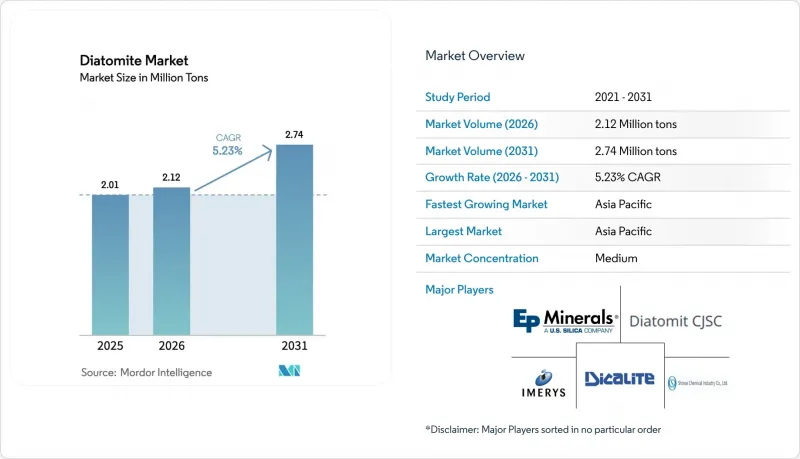
This report is Segmented by Source (Fresh-Water Diatomite and Salt-Water Diatomite), Process (Natural Grades, Calcined Grades, and More), Application (Filter Media, Absorbent, and More), End-Use Industry (Food and Beverage, Building and Construction, and More), and Geography (Asia-Pacific, North America, Europe, South America, and Middle-East and Africa). Market Forecasts are Provided in Terms of Volume (Tons).
Global Diatomite Market Trends and Insights
Rising Demand for Diatomite as Filter Media in Beverages and Water Treatment
Breweries and wineries specify diatomite because its multi-level pore structure removes yeast, bacteria, and haze while preserving flavor and operating at low pressure. The U.S. FDA continues to affirm the material as GRAS for food filtration, and the International Organisation of Vine and Wine maintains its approval, giving producers regulatory certainty. Municipal utilities employ diatomite precoat filters that meet the U.S. EPA's 3-log protozoan-removal standard, and India's Jal Jeevan Mission allocates more than USD 50 billion for rural schemes that mandate low-maintenance filtration media. Lower sludge generation than coagulation methods further reduces disposal cost in water-scarce regions.
Expansion of Water and Wastewater Treatment Infrastructure Worldwide
Programs such as India's AMRUT 2.0, China's rural wastewater mandate, and Middle East desalination upgrades collectively underpin long-cycle demand. Diatomite filters suit decentralized plants serving smaller populations because they require minimal energy and short replacement intervals, creating a stable offtake for producers. Pilot data from Saudi Arabia show a reduction in reverse-osmosis fouling that cuts the levelized water cost up to 12%.
Substitution Threat from Expanded Perlite, Silica Sand and Synthetic Media
Expanded perlite offers similar insulation at lower density, while silica sand undercuts diatomite on price in filler applications. Ceramic and polymer membranes lure pharmaceutical users needing sterile, closed systems that reduce batch variability. These pressures are strongest in mature Western markets that emphasize lifecycle cost and sealed operation.
Other drivers and restraints analyzed in the detailed report include:
- Growing Use of Calcined Grades in Lightweight Concrete and Cement Additives
- Increasing Consumption as Absorbent in Agricultural and Pet-Litter Products
- Limited Availability of High-Purity Deposits Drives Cost Inflation
For complete list of drivers and restraints, kindly check the Table Of Contents.
Segment Analysis
Freshwater deposits held 64.38% of the 2025 volume, reflecting their superior purity and well-documented performance in beverage filtration. Marine resources are expanding at a 5.84% CAGR as high-purity inland basins mature. Investors are funding coastal projects in Peru, Turkey, and Mexico to reduce inland haulage, despite extra USD 20-35 per-ton beneficiation charges. Species variation demands tight beneficiation to match pore-size profiles required by long-standing customer specifications.
Marine producers can leverage port proximity to ship directly to Asian buyers, offsetting higher processing costs. Standardizing quality remains the main barrier; breweries conduct rigorous validation, and any deviation from legacy grades risks production downtime. Suppliers integrating on-site labs and ISO-certified protocols are the first to win approvals. Long-term, broader adoption of saltwater material could rebalance regional supply and stabilize pricing.
Calcined material accounted for 46.27% of the 2025 supply because of its mechanical strength and low turbidity in the filtrate. Flux-calcined grades are the fastest-growing slice, climbing 6.18% yearly as breweries seek 30-50% lower pressure drop. Soda-ash addition during firing partially fuses frustules, producing wider channels without collapsing the structure. Producers must monitor residual sodium to keep it below 0.5% for wine compliance, which requires precise flux control and washing.
Capital intensity restricts flux-calcination to a few multinationals equipped with automated kilns and real-time XRD. These firms command premium margins by bundling technical support that improves throughput at customer sites. Smaller players focus on natural grades for absorbents and fillers where price, not pore architecture, dictates purchase choices.
Complete Report Scope:
- By Source
- Fresh-Water Diatomite
- Salt-Water Diatomite
- By Process
- Natural Grades
- Calcined Grades
- Flux-Calcined Grades
- By Application
- Filter Media
- Cement Additive
- Filler
- Absorbent
- Insecticides
- Other Applications (Abrasives, Insulation, etc.)
- By End-Use Industry
- Food and Beverage
- Water and Waste-Water Treatment
- Building and Construction
- Agriculture and Horticulture
- Industrial and Chemical Processing
- Geography
- Asia-Pacific
- China
- India
- Japan
- South Korea
- Rest of Asia-Pacific
- North America
- United States
- Canada
- Mexico
- Europe
- Germany
- United Kingdom
- Italy
- France
- Spain
- Russia
- Rest of Europe
- South America
- Brazil
- Argentina
- Rest of South America
- Middle-East and Africa
- Saudi Arabia
- South Africa
- Rest of Middle-East and Africa
- Asia-Pacific
Geography Analysis
Asia-Pacific supplied 47.63% of 2025 demand and is forecast to expand 5.91% CAGR to 2031 as China mines roughly 1.5 million tons yearly and ramps wastewater spending under the 14th Five-Year Plan. India's Jal Jeevan Mission and AMRUT 2.0 contribute repeat orders for filter media, while Japan and South Korea pilot diatomite-based silicon for batteries. Southeast Asia adopts diatomite for textile-sector effluent polishing where low energy and moderate capital outlay fit cluster economics.
North America grows slower because mature users switch to membranes. U.S. Silica's Lovelock, Nevada mine remains the world's largest, and recent operational gains delivered segment revenue of USD 142.8 million in Q1 2024. Canada imports for oil-sands filtration, and Mexico consumes for tequila clarification, two niche uses that reward consistent pore profiles.
Europe's share faces compliance headwinds. Imerys' 2025 purchase of Chemviron's assets consolidates regional supply with three new sites in France and Italy and about EUR 50 million (USD 56.53 million) revenue, allowing closer-to-customer delivery and perlite cross-selling. Ultrahigh energy-performance building codes encourage calcined pozzolan blends, but free fly ash and slag limit growth. Strict crystalline-silica exposure proposals may further elevate costs.
South America and the Middle East and Africa remain emerging. Brazilian housing adopts diatomite-lightened panels for thermal relief, and Argentina's wine sector imports for clarification. Saudi Arabia studies diatomite as a supplementary cementitious material to reduce clinker in its 52.4 million-ton cement industry. South African mineral processors use diatomite absorbents, but local perlite and vermiculite temper volumes.
- American Diatomite Inc.
- Calgon Carbon Corporation
- Calgon Carbon Corporation
- Caltron Clays
- Chuanshan International
- Diatomit CJSC
- Diatomite Direct
- Dicalite Management Group, LLC
- Domolin
- EP Minerals
- Imerys
- Jilin Yuan Tong Mineral Co., Ltd.
- Nova Filtration Technologies Inc.
- Perma-Guard, Inc.
- Qingdao Best Diatomite Co., Ltd.
- Reade
- Seema Minerals & Metals
- Shengzhou Huali Diatomite Products Co., Ltd
- Shenzhou Xinglong Products of Diatomite Co,.Ltd
- Showa Chemical Industry Co., Ltd.
Additional Benefits:
- The market estimate (ME) sheet in Excel format
- 3 months of analyst support
TABLE OF CONTENTS
1 Introduction
- 1.1 Study Assumptions & Market Definition
- 1.2 Scope of the Study
2 Research Methodology
3 Executive Summary
4 Market Landscape
- 4.1 Market Overview
- 4.2 Market Drivers
- 4.2.1 Rising demand for diatomite as filter media in beverages and water treatment
- 4.2.2 Expansion of water and wastewater treatment infrastructure worldwide
- 4.2.3 Growing use of calcined grades in lightweight concrete and cement additives
- 4.2.4 Increasing consumption as absorbent in agricultural and pet-litter products
- 4.2.5 Scale-up of diatomite-derived silicon for Li-ion battery anodes
- 4.3 Market Restraints
- 4.3.1 Substitution threat from expanded perlite, silica sand and synthetic media
- 4.3.2 Limited availability of high-purity deposits drives cost inflation
- 4.3.3 Rising ESG-driven controls on crystalline-silica exposure
- 4.4 Value Chain Analysis
- 4.5 Porter's Five Forces Analysis
- 4.5.1 Bargaining Power of Suppliers
- 4.5.2 Bargaining Power of Buyers
- 4.5.3 Threat of New Entrants
- 4.5.4 Threat of Substitutes
- 4.5.5 Degree of Competition
5 Market Size & Growth Forecasts (Volume)
- 5.1 By Source
- 5.1.1 Fresh-Water Diatomite
- 5.1.2 Salt-Water Diatomite
- 5.2 By Process
- 5.2.1 Natural Grades
- 5.2.2 Calcined Grades
- 5.2.3 Flux-Calcined Grades
- 5.3 By Application
- 5.3.1 Filter Media
- 5.3.2 Cement Additive
- 5.3.3 Filler
- 5.3.4 Absorbent
- 5.3.5 Insecticides
- 5.3.6 Other Applications (Abrasives, Insulation, etc.)
- 5.4 By End-Use Industry
- 5.4.1 Food and Beverage
- 5.4.2 Water and Waste-Water Treatment
- 5.4.3 Building and Construction
- 5.4.4 Agriculture and Horticulture
- 5.4.5 Industrial and Chemical Processing
- 5.5 Geography
- 5.5.1 Asia-Pacific
- 5.5.1.1 China
- 5.5.1.2 India
- 5.5.1.3 Japan
- 5.5.1.4 South Korea
- 5.5.1.5 Rest of Asia-Pacific
- 5.5.2 North America
- 5.5.2.1 United States
- 5.5.2.2 Canada
- 5.5.2.3 Mexico
- 5.5.3 Europe
- 5.5.3.1 Germany
- 5.5.3.2 United Kingdom
- 5.5.3.3 Italy
- 5.5.3.4 France
- 5.5.3.5 Spain
- 5.5.3.6 Russia
- 5.5.3.7 Rest of Europe
- 5.5.4 South America
- 5.5.4.1 Brazil
- 5.5.4.2 Argentina
- 5.5.4.3 Rest of South America
- 5.5.5 Middle-East and Africa
- 5.5.5.1 Saudi Arabia
- 5.5.5.2 South Africa
- 5.5.5.3 Rest of Middle-East and Africa
- 5.5.1 Asia-Pacific
6 Competitive Landscape
- 6.1 Market Concentration
- 6.2 Strategic Moves
- 6.3 Market Share/Ranking Analysis
- 6.4 Company Profiles (includes Global level Overview, Market level overview, Core Segments, Financials as available, Strategic Information, Market Rank/Share for key companies, Products & Services, and Recent Developments)
- 6.4.1 American Diatomite Inc.
- 6.4.2 Calgon Carbon Corporation
- 6.4.3 Calgon Carbon Corporation
- 6.4.4 Caltron Clays
- 6.4.5 Chuanshan International
- 6.4.6 Diatomit CJSC
- 6.4.7 Diatomite Direct
- 6.4.8 Dicalite Management Group, LLC
- 6.4.9 Domolin
- 6.4.10 EP Minerals
- 6.4.11 Imerys
- 6.4.12 Jilin Yuan Tong Mineral Co., Ltd.
- 6.4.13 Nova Filtration Technologies Inc.
- 6.4.14 Perma-Guard, Inc.
- 6.4.15 Qingdao Best Diatomite Co., Ltd.
- 6.4.16 Reade
- 6.4.17 Seema Minerals & Metals
- 6.4.18 Shengzhou Huali Diatomite Products Co., Ltd
- 6.4.19 Shenzhou Xinglong Products of Diatomite Co,.Ltd
- 6.4.20 Showa Chemical Industry Co., Ltd.
7 Market Opportunities and Future Outlook
- 7.1 White-space and Unmet-need Assessment

