PUBLISHER: Mordor Intelligence | PRODUCT CODE: 2114937

PUBLISHER: Mordor Intelligence | PRODUCT CODE: 2114937
Melatonin - Market Share Analysis, Industry Trends & Statistics, Growth Forecasts (2026 - 2031)
According to Mordor Intelligence, the melatonin market size was valued at USD 1.89 billion in 2025 and estimated to grow from USD 2.07 billion in 2026 to reach USD 3.22 billion by 2031, at a CAGR of 9.28% during the forecast period (2026-2031).
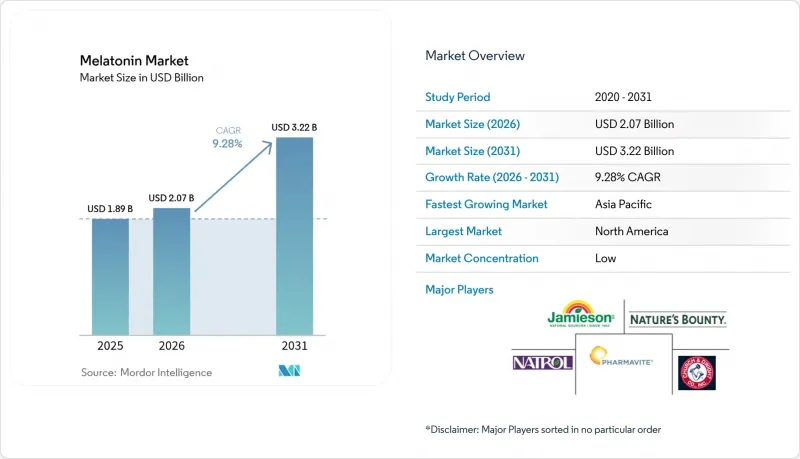
This report is Segmented by Type (Natural Melatonin and Synthetic Melatonin), Dosage Form (Tablets, Capsules, Gummies, Liquid Drops, and Others), Formulation (Immediate-Release and Extended-Release), Application (Medical, Dietary Supplement, Veterinary and Aquaculture, and Post-Harvest Agriculture), and Geography (Asia-Pacific, North America, Europe, South America, and Middle-East and Africa).
Global Melatonin Market Trends and Insights
Prescription Uptake for Circadian-Rhythm Disorders
Accelerating prescription volumes validate melatonin's transition from over-the-counter supplement to reimbursable pharmaceutical solution. Pediatric prescriptions in the United Kingdom rose 245% over nine years, mirroring FDA orphan-drug designations for non-24-hour sleep-wake disorder that expand insurance coverage pathways. European guidance now names melatonin first-line therapy for childhood sleep-onset insomnia, and products such as tasimelteon highlight pipelines targeting blind patients and shift-work populations.
Pediatric ASD Sleep-Management Protocols
Randomized trials consistently show that melatonin shortens sleep-onset latency and raises total sleep time in autism spectrum disorder cohorts with minimal adverse reactions. The prolonged-release product Slenyto earned EU approval for children with ASD, while Stanford clinical guidelines recommend 3-10 mg dosages before bedtime. This therapeutic confidence accelerates adoption across pediatric neurology practices, reinforcing long-term medical demand across the melatonin market.
Tightening Maximum-Dosage Regulations
The Council for Responsible Nutrition now requires child-deterrent packaging after pediatric emergency-room visits tied to melatonin rose 420% from 2009 to 2020. France's ANSES caps daily dosage at 2 mg and advises high-risk groups to avoid supplements, while an emerging EU framework seeks harmonized labeling. These measures increase compliance costs and may slow new-product timelines, especially for gummy formats favored by children.
Other drivers and restraints analyzed in the detailed report include:
- Demand for "Clean-Label" Plant-Derived Melatonin
- Synthetic-Biology Cost Breakthroughs
- Clinical Safety Concerns in Long-Term Use
For complete list of drivers and restraints, kindly check the Table Of Contents.
Segment Analysis
Synthetic melatonin accounted for a 55.02% melatonin market share in 2025 as pharmaceutical buyers prioritize batch-to-batch consistency and price advantages. Synthetic-biology gains, such as E. coli fermentation that halves manufacturing costs, support a 9.96% CAGR outlook, maintaining scale economies integral to the melatonin market. Natural melatonin, although pricier, appeals to consumers pursuing "clean-label" positioning and may see upside as agricultural biotechnology improves crop yields.
The melatonin industry continues investing in precision fermentation lines that limit solvent use and shrink carbon footprints. Regulatory bodies, keen on sustainability metrics, increasingly view microbial methods favorably. Meanwhile, phytomelatonin supply chains experiment with enzyme-assisted extraction to lift purity, yet still struggle to match synthetic volumes.
Tablets delivered 45.10% of 2025 revenue as clinicians prefer fixed-dose accuracy and established pharmacopoeia standards. Gummies, however, grow 9.74% annually, propelled by flavor, chewability, and rising pediatric demand. The melatonin market size for gummies is on track to double by 2030, though new child-proof mandates elevate packaging expenses.
Liquid drops and capsules meet niche needs such as titratable pediatric dosing and vegetarian shell preferences. Extended-release tablets, featuring dual-layer designs, mitigate melatonin's short half-life to enhance sleep maintenance and could shift share away from immediate-release presentations.
Complete Report Scope:
- By Type
- Natural Melatonin
- Synthetic Melatonin
- By Dosage Form
- Tablets
- Capsules
- Gummies
- Liquid Drops
- Others
- By Formulation
- Immediate-Release
- Extended-Release
- By Application
- Medical
- Dietary Supplement
- Veterinary and Aquaculture
- Post-Harvest Agriculture
- By Geography
- Asia-Pacific
- China
- India
- Japan
- South Korea
- Rest of Asia-Pacific
- North America
- United States
- Canada
- Mexico
- Europe
- Germany
- United Kingdom
- France
- Italy
- Rest of Europe
- South America
- Brazil
- Argentina
- Rest of South America
- Middle-East and Africa
- Saudi Arabia
- South Africa
- Rest of Middle-East and Africa
- Asia-Pacific
Geography Analysis
North America retained a 38.20% melatonin market share in 2025, thanks to mature retail infrastructure and payer acceptance of prescription formulations. Rising pediatric prescribing and OTC uptake sustain steady revenue, though new CRN labeling rules raise cost overhead. Extended-release innovations and ASD protocols are key catalysts that help offset compliance spend.
Asia-Pacific is the fastest-growing territory, posting a 9.88% CAGR. China's revised health-food code now fast-tracks melatonin claims for sleep support, spurring domestic brand launches and cross-border e-commerce. Japan links higher dietary melatonin intake to lower liver cancer risk, feeding functional-food product pipelines. Regulatory openness plus middle-class wellness spending positions the region as the next volume driver within the melatonin market.
Europe presents a mixed picture: Germany and Austria welcomed pediatric ADHD formulation Mellozzan, while France's ANSES remains cautious, capping dosage and advising susceptible groups to abstain. New Zealand's 2025 OTC decision, allowing up to 5 mg pharmacy sales, signals gradual liberalization in other OECD states.
- Aspen
- Aurobindo
- B. Joshi Agrochem Pharma
- Biotics Research
- Church & Dwight Co., Inc.
- Jamieson Vitamins
- Life Extension
- Natrol
- Nature's Bounty
- NCFI
- Pfizer
- Pharmavite
- Puritan's Pride
- Rexall Sundown, Inc.
- Solgar Inc.
Additional Benefits:
- The market estimate (ME) sheet in Excel format
- 3 months of analyst support
TABLE OF CONTENTS
1 Introduction
- 1.1 Study Assumptions and Market Definition
- 1.2 Scope of the Study
2 Research Methodology
3 Executive Summary
4 Market Landscape
- 4.1 Market Overview
- 4.2 Market Drivers
- 4.2.1 Prescription Uptake for Circadian-Rhythm Disorders
- 4.2.2 Pediatric Atrial Septal Defect (ASD) Sleep-Management Protocols
- 4.2.3 Demand for "Clean-Label" Plant-Derived Melatonin
- 4.2.4 Synthetic-Biology Cost Breakthroughs
- 4.2.5 Agricultural Post-Harvest Anti-Bruising Use Cases
- 4.3 Market Restraints
- 4.3.1 Tightening Maximum-Dosage Regulations
- 4.3.2 Clinical Safety Concerns in Long-Term Use
- 4.3.3 Raw-Material Price Spikes for Indole Feedstocks
- 4.4 Value Chain Analysis
- 4.5 Porter's Five Forces
- 4.5.1 Threat of New Entrants
- 4.5.2 Bargaining Power of Buyers
- 4.5.3 Bargaining Power of Suppliers
- 4.5.4 Threat of Substitutes
- 4.5.5 Degree of Competition
5 Market Size and Growth Forecasts (Value)
- 5.1 By Type
- 5.1.1 Natural Melatonin
- 5.1.2 Synthetic Melatonin
- 5.2 By Dosage Form
- 5.2.1 Tablets
- 5.2.2 Capsules
- 5.2.3 Gummies
- 5.2.4 Liquid Drops
- 5.2.5 Others
- 5.3 By Formulation
- 5.3.1 Immediate-Release
- 5.3.2 Extended-Release
- 5.4 By Application
- 5.4.1 Medical
- 5.4.2 Dietary Supplement
- 5.4.3 Veterinary and Aquaculture
- 5.4.4 Post-Harvest Agriculture
- 5.5 By Geography
- 5.5.1 Asia-Pacific
- 5.5.1.1 China
- 5.5.1.2 India
- 5.5.1.3 Japan
- 5.5.1.4 South Korea
- 5.5.1.5 Rest of Asia-Pacific
- 5.5.2 North America
- 5.5.2.1 United States
- 5.5.2.2 Canada
- 5.5.2.3 Mexico
- 5.5.3 Europe
- 5.5.3.1 Germany
- 5.5.3.2 United Kingdom
- 5.5.3.3 France
- 5.5.3.4 Italy
- 5.5.3.5 Rest of Europe
- 5.5.4 South America
- 5.5.4.1 Brazil
- 5.5.4.2 Argentina
- 5.5.4.3 Rest of South America
- 5.5.5 Middle-East and Africa
- 5.5.5.1 Saudi Arabia
- 5.5.5.2 South Africa
- 5.5.5.3 Rest of Middle-East and Africa
- 5.5.1 Asia-Pacific
6 Competitive Landscape
- 6.1 Market Concentration
- 6.2 Strategic Moves
- 6.3 Market Share Analysis
- 6.4 Company Profiles (includes Global level Overview, Market level overview, Core Segments, Financials as available, Strategic Information, Market Rank/Share for key companies, Products and Services, and Recent Developments)
- 6.4.1 Aspen
- 6.4.2 Aurobindo
- 6.4.3 B. Joshi Agrochem Pharma
- 6.4.4 Biotics Research
- 6.4.5 Church & Dwight Co., Inc.
- 6.4.6 Jamieson Vitamins
- 6.4.7 Life Extension
- 6.4.8 Natrol
- 6.4.9 Nature's Bounty
- 6.4.10 NCFI
- 6.4.11 Pfizer
- 6.4.12 Pharmavite
- 6.4.13 Puritan's Pride
- 6.4.14 Rexall Sundown, Inc.
- 6.4.15 Solgar Inc.
7 Market Opportunities and Future Outlook
- 7.1 White-Space and Unmet-Need Assessment

