PUBLISHER: Mordor Intelligence | PRODUCT CODE: 2114950

PUBLISHER: Mordor Intelligence | PRODUCT CODE: 2114950
Riflescopes - Market Share Analysis, Industry Trends & Statistics, Growth Forecasts (2026 - 2031)
According to Mordor Intelligence, the riflescopes market size is expected to grow from USD 7.62 billion in 2025 to USD 8.22 billion in 2026 and is forecasted to reach USD 12.05 billion by 2031 at a 7.95% CAGR over 2026-2031.
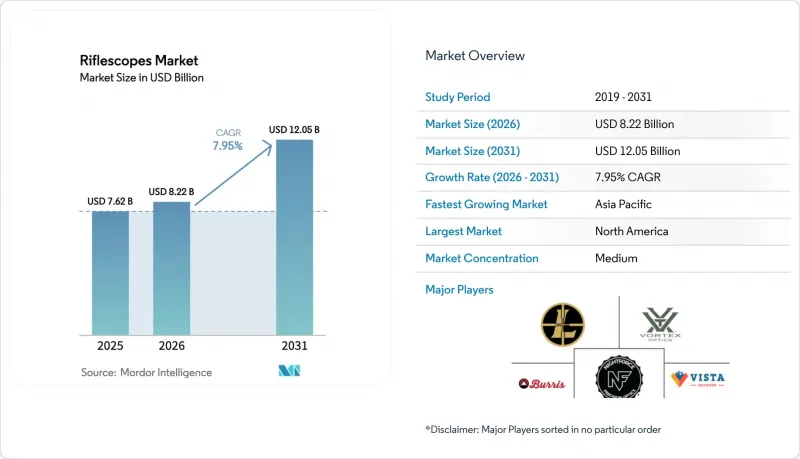
This report is Segmented by Application (Sporting and Hunting, Law-Enforcement, Military), Sight Type (Telescopic, Reflex/Red-Dot), Magnification Range (Less Than 8X, 8X To 15X, Greater Than 15X), Technology (Electro-Optical, Thermal Imaging, Laser), and Geography (North America, South America, Europe, Asia-Pacific, Middle East and Africa). The Market Forecasts are Provided in Terms of Value (USD).
Global Riflescopes Market Trends and Insights
Growing Participation in Recreational Shooting Sports
US target-shooting participation stabilized at 47 million enthusiasts in 2022, creating a dependable upgrade cycle for mid-range and premium scopes. Many shooters are transitioning from entry-level 3-9x glass to higher-magnification first-focal-plane models that support precision rifle disciplines. In Europe, Germany's 1.4 million licensed shooters face recurring permit renewals, motivating them to spend more on optics to maximize the value of a limited firearms fleet. Consequently, the riflescopes market sees robust demand for premium European glass in Central Europe, while North American volume sustains competitive mid-tier brands. Growing female participation and collegiate-shooting programs add new customer cohorts who favor lighter, low-power variable optics. These factors collectively lift average selling prices and unit volumes across the riflescopes market.
Rising Global Defense Spending and Infantry Modernization Programs
World military outlays surged to USD 2,718 billion in 2024, the steepest annual increase since records began, and a sizable portion is earmarked for soldier-borne optics. The US Army's XM157 program demonstrates a doctrinal appetite for electro-optical fire control systems that blend laser range-finding with atmospheric sensing. Allied nations are following suit: Japan lifted its 2025 defense allocation by 16.4%, India is channeling USD 130 billion into domestically designed gear, and Australia's 2024-2025 budget prioritizes AUKUS-aligned rifle-optic upgrades. Multi-spectral solutions that merge day, thermal, and laser channels are now standard requirements in special-operations solicitations, guaranteeing high-margin follow-on orders for firms with prior NATO stock numbers. These procurement waves not only boost immediate sales but also drive long-tail revenue through spares, training, and lifecycle upgrades.
Stringent Firearm-Ownership and Hunting Regulations
Obtaining a German hunting license requires a 120-hour course and fees exceeding EUR 2,000 (USD 2,328.42), thereby narrowing the pool of potential optics buyers. France levies annual license costs of EUR 150-390 (USD 174.63-454.04) and caps magazine capacity at three rounds, thereby curbing demand for tactical-style scopes. The EU's 2017/853 directive harmonizes stricter renewals and medical checks, further tightening civilian access. These administrative and financial barriers reduce unit volumes but encourage remaining buyers to opt for high-end optics, thereby cushioning revenue while limiting the expansion of the riflescopes market.
Other drivers and restraints analyzed in the detailed report include:
- Rapid Optical Technology Upgrades (HD Glass, Integrated Range-Finding)
- Expansion of E-Commerce Channels for Hunting Optics
- Proliferation of Low-Cost Counterfeit Scopes from East Asia
For complete list of drivers and restraints, kindly check the Table Of Contents.
Segment Analysis
Law enforcement demand for electro-optical and thermal fusion sights is forecasted to grow at a 9.78% CAGR between 2026 and 2031, surpassing the broader riflescopes market. Sporting and hunting still account for 43.78% of the riflescopes market share in 2025, driven by 47 million US recreational shooters and Europe's 1.5 million licensed hunters. Agency procurements bundle optics with new service rifles, illustrated by a USD 1.29 million NYPD package that included Nightforce scopes. Military contracts remain lumpy yet lucrative; SOCOM's USD 96 million multi-application scope award in 2024 evidences premium pricing.
The riflescopes market size gains in law enforcement reflect modernization budgets that prioritize low-power variable and clip-on thermal devices for active-shooter scenarios. Sporting optics bifurcate: cost-sensitive buyers opt for scopes under USD 500 from China, while affluent hunters purchase scopes costing USD 2,000 or more. Government sales pipelines favor vendors with GSA schedules and proven durability metrics, creating barriers to entry for newer brands. Consequently, optics makers balancing civilian volume with institutional contracts will capture outsize market share gains in the riflescopes market.
Telescopic models still accounted for 74.78% of the riflescopes market revenue in 2025; however, reflex and red-dot platforms are projected to grow at a 10.94% CAGR through 2031. Aimpoint's factory collaboration with Glock introduces enclosed red dots on service pistols, signaling institutional confidence in unmagnified optics. Meanwhile, Holosun's solar-charging dots, priced at USD 235, reduce maintenance burdens.
Traditional scopes retain the lion's share of the riflescopes market size for hunting and long-range target sports. Still, entry-level 3X to 9X SKUs are bleeding volume to 1X to 8X low-power variable optics and budget red dots. Market leaders, therefore, diversify with hybrid designs that embed fiber-optic illumination and quick-throw levers to stay relevant. The telescopic segment's premium sub-category, however, enjoys insulated demand among precision rifle competitors and high-end hunters who value rugged turrets and lifetime warranties.
Complete Report Scope:
- By Application
- Sporting and Hunting
- Law-Enforcement
- Military
- By Sight Type
- Telescopic
- Reflex/Red-Dot
- By Magnification Range
- Less than 8X
- 8X to 15X
- Greater than 15X
- By Technology
- Electro-Optical
- Thermal Imaging
- Laser
- By Geography
- North America
- United States
- Canada
- Mexico
- South America
- Brazil
- Rest of South America
- Europe
- Germany
- United Kingdom
- France
- Russia
- Italy
- Rest of Europe
- Asia-Pacific
- China
- Japan
- India
- Australia
- Rest of Asia-Pacific
- Middle East and Africa
- Middle East
- Saudi Arabia
- UAE
- Rest of Middle East
- Africa
- South Africa
- Rest of Africa
- Middle East
- North America
Geography Analysis
North America's 40.12% of the riflescopes market in 2025 rested on the US' defense-procurement pipeline and 47 million recreational shooters. The US Army's XM157 rollout from 2026 ensures recurring spares demand, while SOCOM's USD 96 million night-scope award in 2024 underscores appetite for multi-spectral systems. Canada's 8% drop in license sales reflects demographic shifts, yet premium optics sales remain stable due to a committed core of hunters. Mexico's consumer market is negligible due to stringent ownership rules, which limit optics demand to official agencies.
Asia-Pacific will chart a 9.54% CAGR to 2031, fueled by India's USD 130 billion defense budget, Japan's 16.4% spending hike, and Australia's AUKUS-aligned modernization. South Korea directs part of its USD 44.9 billion allocation to advanced fire-control systems, boosting local optical manufacturing. China's domestic night-vision market surpassed RMB 1 billion (USD 143.10 million) in 2019 and continues to grow at an annual rate of over 20% backed by localized detector production.
Europe's riflescopes market expansion is tempered by strict licensing; Germany counts 400,000 hunters, France 1.1 million, and a preference for premium optics that rationalize high compliance costs. Thermal-scope uptake is climbing after Finland's regulatory shift and Germany's state derogations, while competitive-shooting circuits in the UK sustain high-magnification demand despite only 710,000 firearm certificates. Beyond Europe, the UAE and Saudi Arabia earmarked USD 28 billion and USD 75.8 billion, respectively, for defense in 2024, with infantry optics high on their procurement lists. South America remains nascent, though Brazil's regulatory softening modestly lifts law-enforcement optics purchases. Africa's fragmented economies limit broader adoption, aside from niche hunting-tourism demand in South Africa.
- Leupold & Stevens, Inc.
- Sheltered Wings, Inc. d/b/a Vortex Optics
- Burris Company (Beretta Holding S.A.)
- Nightforce Optics
- HENSOLDT AG
- SIG SAUER, Inc.
- Carl Zeiss AG
- Swarovski-Optik AG & Co KG
- Steiner Optik GmbH (Beretta Holding S.A.)
- Trijicon, Inc.
- Aimpoint AB
- Holosun Technologies, Inc.
- KAHLES GmbH
- Meopta s.r.o.
- BSA Optics
- Revelyst (Vista Outdoor Operations LLC)
- The Kinetic Group (Czechoslovak Group)
Additional Benefits:
- The market estimate (ME) sheet in Excel format
- 3 months of analyst support
TABLE OF CONTENTS
1 INTRODUCTION
- 1.1 Study Assumptions and Market Definition
- 1.2 Scope of the Study
2 RESEARCH METHODOLOGY
3 EXECUTIVE SUMMARY
4 MARKET LANDSCAPE
- 4.1 Market Overview
- 4.2 Market Drivers
- 4.2.1 Growing participation in recreational shooting sports
- 4.2.2 Rapid optical technology upgrades (HD glass, integrated range-finding)
- 4.2.3 Rising global defense spending and infantry modernization programs
- 4.2.4 Expansion of e-commerce channels for hunting optics
- 4.2.5 Escalating wild-boar populations driving night-hunting demand
- 4.2.6 Emergence of AI-enabled "smart rifle" platforms
- 4.3 Market Restraints
- 4.3.1 Stringent firearm ownership and hunting regulations
- 4.3.2 Proliferation of low-cost counterfeit scopes from East Asia
- 4.3.3 Shift toward unmagnified red-dot sights on modern sporting rifles
- 4.3.4 Stricter lead-glass environmental directives raising production costs
- 4.4 Regulatory Landscape
- 4.5 Technological Outlook
- 4.6 Porter's Five Forces Analysis
- 4.6.1 Bargaining Power of Suppliers
- 4.6.2 Bargaining Power of Buyers
- 4.6.3 Threat of New Entrants
- 4.6.4 Threat of Substitutes
- 4.6.5 Intensity of Competitive Rivalry
5 MARKET SIZE AND GROWTH FORECASTS (VALUE)
- 5.1 By Application
- 5.1.1 Sporting and Hunting
- 5.1.2 Law-Enforcement
- 5.1.3 Military
- 5.2 By Sight Type
- 5.2.1 Telescopic
- 5.2.2 Reflex/Red-Dot
- 5.3 By Magnification Range
- 5.3.1 Less than 8X
- 5.3.2 8X to 15X
- 5.3.3 Greater than 15X
- 5.4 By Technology
- 5.4.1 Electro-Optical
- 5.4.2 Thermal Imaging
- 5.4.3 Laser
- 5.5 By Geography
- 5.5.1 North America
- 5.5.1.1 United States
- 5.5.1.2 Canada
- 5.5.1.3 Mexico
- 5.5.2 South America
- 5.5.2.1 Brazil
- 5.5.2.2 Rest of South America
- 5.5.3 Europe
- 5.5.3.1 Germany
- 5.5.3.2 United Kingdom
- 5.5.3.3 France
- 5.5.3.4 Russia
- 5.5.3.5 Italy
- 5.5.3.6 Rest of Europe
- 5.5.4 Asia-Pacific
- 5.5.4.1 China
- 5.5.4.2 Japan
- 5.5.4.3 India
- 5.5.4.4 Australia
- 5.5.4.5 Rest of Asia-Pacific
- 5.5.5 Middle East and Africa
- 5.5.5.1 Middle East
- 5.5.5.1.1 Saudi Arabia
- 5.5.5.1.2 UAE
- 5.5.5.1.3 Rest of Middle East
- 5.5.5.2 Africa
- 5.5.5.2.1 South Africa
- 5.5.5.2.2 Rest of Africa
- 5.5.5.1 Middle East
- 5.5.1 North America
6 COMPETITIVE LANDSCAPE
- 6.1 Market Concentration
- 6.2 Strategic Moves
- 6.3 Market Share Analysis
- 6.4 Company Profiles (includes Global level Overview, Market level overview, Core Segments, Financials as available, Strategic Information, Market Rank/Share, Products and Services, and Recent Developments)
- 6.4.1 Leupold & Stevens, Inc.
- 6.4.2 Sheltered Wings, Inc. d/b/a Vortex Optics
- 6.4.3 Burris Company (Beretta Holding S.A.)
- 6.4.4 Nightforce Optics
- 6.4.5 HENSOLDT AG
- 6.4.6 SIG SAUER, Inc.
- 6.4.7 Carl Zeiss AG
- 6.4.8 Swarovski-Optik AG & Co KG
- 6.4.9 Steiner Optik GmbH (Beretta Holding S.A.)
- 6.4.10 Trijicon, Inc.
- 6.4.11 Aimpoint AB
- 6.4.12 Holosun Technologies, Inc.
- 6.4.13 KAHLES GmbH
- 6.4.14 Meopta s.r.o.
- 6.4.15 BSA Optics
- 6.4.16 Revelyst (Vista Outdoor Operations LLC)
- 6.4.17 The Kinetic Group (Czechoslovak Group)
7 MARKET OPPORTUNITIES AND FUTURE OUTLOOK
- 7.1 White-Space and Unmet-Need Assessment

