PUBLISHER: Mordor Intelligence | PRODUCT CODE: 2114951

PUBLISHER: Mordor Intelligence | PRODUCT CODE: 2114951
Soft Magnetic Material - Market Share Analysis, Industry Trends & Statistics, Growth Forecasts (2026 - 2031)
According to Mordor Intelligence, the soft magnetic material market size is estimated at 11.43 million tons in 2026, and is expected to reach 15.97 million tons by 2031, at a CAGR of 6.92% during the forecast period (2026-2031).
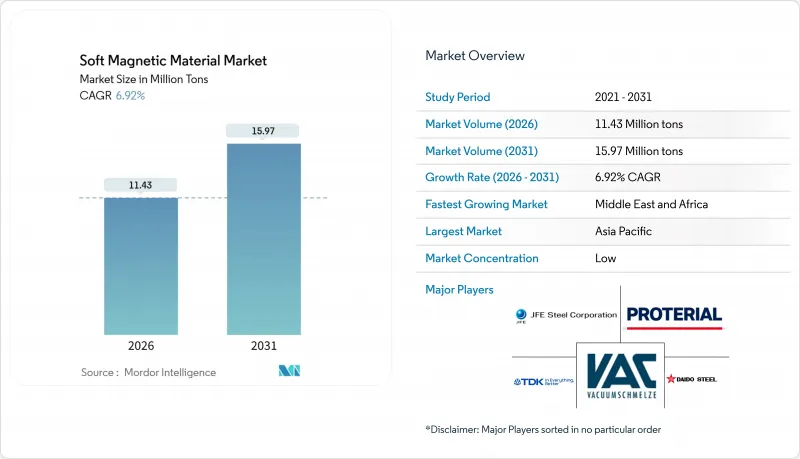
This report is Segmented by Material Type (Electric Steel, Cobalt, Iron, Nickel, and Other Material Types), End-User Industry (Electronics, Automotive, Energy, Industrial, and Other End-User Industries), and Geography (Asia-Pacific, North America, Europe, South America, and Middle-East and Africa). The Market Forecasts are Provided in Terms of Volume (Tons).
Global Soft Magnetic Material Market Trends and Insights
Electronics-Miniaturization Demand Surge
As demand surges for ultra-compact inductors in smartphones, wearables, and edge-AI servers, designers are increasingly gravitating towards switching frequencies exceeding 1 MHz. At these frequencies, laminated silicon steel faces significant eddy-current losses. In the realm of DC-DC converters under 100 W, ferrite beads, powder cores, and soft magnetic composites have taken the lead. Within rack-level power-delivery networks, point-of-load converters are now seeking magnetic components under 5 mm3. This preference has led to a rise in distributed-gap powder cores, known for maintaining inductance even under DC bias. Suppliers are innovating by co-firing nickel-zinc ferrite with low-temperature co-fired ceramic substrates. This integration allows for the embedding of capacitors and magnetics within modules just 1 mm thick, marking a decisive move away from conventional laminated cores. The outcome? Enhanced performance characterized by increased power density and reduced EMI, solidifying the position of advanced ferrites and composites in the soft magnetic materials market.
Electrification of Transformers and Motors
Regulators have aggressively targeted loss reductions for transformers and industrial motors. Under IEC 60034-30-1, the IE4 and IE5 classes are mandated, achieving significant cuts in no-load losses. To comply, grain-oriented electric steel is needed, boasting a high flux density at 50 Hz. Additionally, non-oriented grades must be optimized for high-frequency traction motors. The EU's Ecodesign extension is now encompassing sub-0.75 kW motors. This shift is channeling additional volumes into fractional-horsepower drives, which traditionally relied on lower-grade cold-rolled steel. On another front, there's ongoing experimentation with amorphous metal stators. These hold the potential for a remarkable reduction in core losses, though their brittleness poses a challenge in manufacturing. As a result of these regulatory pushes, there's a sustained baseline demand for electric steel. Simultaneously, these developments are carving out niches for amorphous and nanocrystalline alternatives in the soft magnetic materials market.
Raw-Material Price Volatility (Fe, Ni, Co)
Nickel prices swung during 2024-2025, while cobalt also experienced significant fluctuations, compressing margins for nickel permalloy producers. Silicon-metal surcharges for electrical steel spiked in early 2025 after power-curtailment policies in Yunnan and Sichuan provinces, further unsettling cost structures. Several western mills idled capacity or reformulated toward iron-cobalt alloys, creating supply uncertainty that encourages OEMs to dual-source or backward-integrate. Although iron ore stayed relatively stable, the nickel and cobalt volatility introduced a drag on the soft magnetic materials market CAGR.
Other drivers and restraints analyzed in the detailed report include:
- Rapid EV/HEV Power-Train Adoption
- Additive Manufacturing of Custom Cores
- Substitute Competition and EMC Compliance Cost Escalation
For complete list of drivers and restraints, kindly check the Table Of Contents.
Segment Analysis
Electric steel captured 52.46% of 2025 volume, buoyed by grain-oriented grades achieving high flux density and low core losses. To cater to the rising demand for traction motors, manufacturers bolstered their cold-rolling capacity during 2024 and 2025. Cobalt alloys, prized in aerospace, maintain Curie points exceeding 900 °C. While iron-based powder cores cater to mid-frequency inductors, their permeability is capped at sub-200 values. On the other hand, soft magnetic composites and advanced ferrites are advancing at a 7.34% CAGR through 2031. Dominating EMC suppression, nickel-zinc and manganese-zinc ferrites saw widespread adoption. This landscape positions electric steel as the volume cornerstone, while composites and nanocrystalline alloys command premium margins, highlighting a strategic investment landscape in the soft magnetic materials market from 2026 to 2031.
Complete Report Scope:
- By Material Type
- Electric Steel
- Cobalt
- Iron
- Nickel
- Other Material Types (Soft Magnetic Composites (SMC), Soft Ferrite, Silicon Ferrite, Permalloy, Supermalloy, etc.)
- By End-user Industry
- Electronics
- Automotive
- Energy
- Industrial
- Other End-user Industries (Telecommunication, Medical, Industrial Transformers, etc.)
- By Geography
- Asia-Pacific
- China
- India
- Japan
- South Korea
- ASEAN Countries
- Rest of Asia-Pacific
- North America
- United States
- Canada
- Mexico
- Europe
- Germany
- United Kingdom
- France
- Italy
- Spain
- Russia
- Rest of Europe
- South America
- Brazil
- Argentina
- Rest of South America
- Middle-East and Africa
- Saudi Arabia
- South Africa
- Rest of Middle-East and Africa
- Asia-Pacific
Geography Analysis
Asia-Pacific held 49.37% of global volume in 2025, accounting for a significant share of the total volume. China's output of electrical steel and Japan's expertise in nanocrystalline ribbons were pivotal. India, with its consumption of grain-oriented steel for transformers, is ramping up local mill capacities to reduce imports. During 2024-2025, ASEAN nations drew in substantial foreign direct investment for magnetic-materials manufacturing, as producers shifted closer to automotive assembly hubs.
North America, capturing a notable portion of the 2025 demand, was driven by sectors like EV powertrains, data-center expansions, and aerospace electrification. Thanks to the Inflation Reduction Act, new electrical-steel lines are emerging, highlighted by Arnold Magnetic Technologies' addition of capacity in 2025. Europe, with its consumption of electrical steel, is navigating strict Ecodesign regulations, especially with many of its industrial motors set for IE4 upgrades by 2027.
The Middle-East and Africa are on track for a 7.22% CAGR, bolstered by renewable-grid projects in Saudi Arabia, the UAE, and South Africa, all of which have a pressing need for low-loss transformer cores. In South America, the market is predominantly Brazilian, where the production of automotive and white goods propels the demand for non-oriented steel. While Gerdau and Aperam cater to local motor manufacturers, grain-oriented grades still find their way through imports. This geographic dispersion in both demand and capacity highlights the critical need for regionalized supply chains in the soft magnetic materials market.
- Acme Electronics Corporation
- Advanced Technology & Materials Co., Ltd.
- Arnold Magnetic Technologies
- Daido Steel Co., Ltd.
- DMEGC Magnetics Co., Ltd.
- Ferroxcube.
- JFE Steel Corporation
- Mate Co. Ltd.
- Mk Magnetics Inc
- PROTERIAL, Ltd.
- Sg Technologies
- Steward Advanced Materials LLC
- Sumitomo Metal Mining Co., Ltd
- TDK Corporation
- Toshiba Materials Co., Ltd
- VACUUMSCHMELZE GmbH & Co. KG
Additional Benefits:
- The market estimate (ME) sheet in Excel format
- 3 months of analyst support
TABLE OF CONTENTS
1 Introduction
- 1.1 Study Assumptions and Market Definition
- 1.2 Scope of the Study
2 Research Methodology
3 Executive Summary
4 Market Landscape
- 4.1 Market Overview
- 4.2 Market Drivers
- 4.2.1 Electronics-miniaturization demand surge
- 4.2.2 Electrification of transformers and motors
- 4.2.3 Rapid EV/HEV power-train adoption
- 4.2.4 Additive-manufacturing of custom cores
- 4.2.5 Nanocrystalline and amorphous cores for SiC/GaN power electronics
- 4.3 Market Restraints
- 4.3.1 Raw-material price volatility (Fe, Ni, Co)
- 4.3.2 Substitute competition (laminated alloys, powder cores)
- 4.3.3 EMC and safety compliance cost escalation
- 4.4 Value Chain Analysis
- 4.5 Porter's Five Forces
- 4.5.1 Bargaining Power of Suppliers
- 4.5.2 Bargaining Power of Buyers
- 4.5.3 Threat of New Entrants
- 4.5.4 Threat of Substitutes
- 4.5.5 Degree of Competition
5 Market Size and Growth Forecasts (Volume)
- 5.1 By Material Type
- 5.1.1 Electric Steel
- 5.1.2 Cobalt
- 5.1.3 Iron
- 5.1.4 Nickel
- 5.1.5 Other Material Types (Soft Magnetic Composites (SMC), Soft Ferrite, Silicon Ferrite, Permalloy, Supermalloy, etc.)
- 5.2 By End-user Industry
- 5.2.1 Electronics
- 5.2.2 Automotive
- 5.2.3 Energy
- 5.2.4 Industrial
- 5.2.5 Other End-user Industries (Telecommunication, Medical, Industrial Transformers, etc.)
- 5.3 By Geography
- 5.3.1 Asia-Pacific
- 5.3.1.1 China
- 5.3.1.2 India
- 5.3.1.3 Japan
- 5.3.1.4 South Korea
- 5.3.1.5 ASEAN Countries
- 5.3.1.6 Rest of Asia-Pacific
- 5.3.2 North America
- 5.3.2.1 United States
- 5.3.2.2 Canada
- 5.3.2.3 Mexico
- 5.3.3 Europe
- 5.3.3.1 Germany
- 5.3.3.2 United Kingdom
- 5.3.3.3 France
- 5.3.3.4 Italy
- 5.3.3.5 Spain
- 5.3.3.6 Russia
- 5.3.3.7 Rest of Europe
- 5.3.4 South America
- 5.3.4.1 Brazil
- 5.3.4.2 Argentina
- 5.3.4.3 Rest of South America
- 5.3.5 Middle-East and Africa
- 5.3.5.1 Saudi Arabia
- 5.3.5.2 South Africa
- 5.3.5.3 Rest of Middle-East and Africa
- 5.3.1 Asia-Pacific
6 Competitive Landscape
- 6.1 Market Concentration
- 6.2 Strategic Moves
- 6.3 Market Share(%)/Ranking Analysis
- 6.4 Company Profiles (includes Global level Overview, Market level overview, Core Segments, Financials as available, Strategic Information, Products and Services, and Recent Developments)
- 6.4.1 Acme Electronics Corporation
- 6.4.2 Advanced Technology & Materials Co., Ltd.
- 6.4.3 Arnold Magnetic Technologies
- 6.4.4 Daido Steel Co., Ltd.
- 6.4.5 DMEGC Magnetics Co., Ltd.
- 6.4.6 Ferroxcube.
- 6.4.7 JFE Steel Corporation
- 6.4.8 Mate Co. Ltd.
- 6.4.9 Mk Magnetics Inc
- 6.4.10 PROTERIAL, Ltd.
- 6.4.11 Sg Technologies
- 6.4.12 Steward Advanced Materials LLC
- 6.4.13 Sumitomo Metal Mining Co., Ltd
- 6.4.14 TDK Corporation
- 6.4.15 Toshiba Materials Co., Ltd
- 6.4.16 VACUUMSCHMELZE GmbH & Co. KG
7 Market Opportunities and Future Outlook
- 7.1 White-space and Unmet-Need Assessment

