PUBLISHER: Mordor Intelligence | PRODUCT CODE: 2114955

PUBLISHER: Mordor Intelligence | PRODUCT CODE: 2114955
Laminated Glass - Market Share Analysis, Industry Trends & Statistics, Growth Forecasts (2026 - 2031)
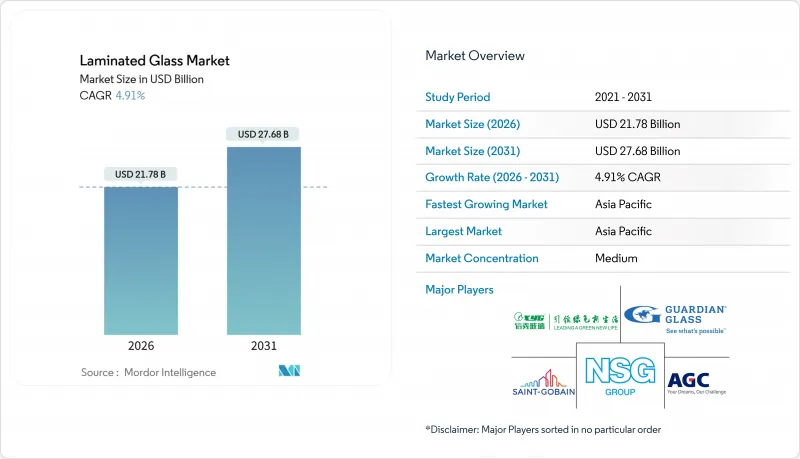
According to Mordor Intelligence, the laminated glass market size is estimated at USD 21.78 billion in 2026, and is expected to reach USD 27.68 billion by 2031, at a CAGR of 4.91% during the forecast period (2026-2031).
This report is Segmented by Type (Polyvinyl Butyral (PVB), Ethylene-Vinyl Acetate (EVA), and More), Application (Architectural Exteriors, Automotive Windshields, Automotive Sunroofs, and More), End-User Industry (Building and Construction, Automotive, and More), and Geography (Asia-Pacific, North America, Europe, South America, and Middle East and Africa). Market Forecasts are Provided in Value (USD).
Global Laminated Glass Market Trends and Insights
Urban Skyscraper Boom in Asia-Pacific Demanding Hurricane-Grade Facades
Cyclone-exposed coastal cities from Shenzhen to Manila now specify impact-resistant laminates in towers above 50 m to cut glass fallout risks. Ionoplast interlayers supply five-fold tear strength versus standard PVB, which lets designers trim pane thickness and reduce facade dead load by up to 15%. India's 2024 building code revision extended similar rules to buildings taller than 15 stories along its eastern and western coastlines, adding more than 40,000 new residential units yearly. Dubai mirrored the shift in its 2025 Fire and Life Safety Code that obliges laminated balustrades for balconies in sand-storm zones. Thailand and Vietnam still lack local ionoplast extrusion, driving 10-12 week import lead times that inflate costs by 20-30%. As a result, regional capacity additions from Kuraray and AGC remain likely through 2028.
Mandated HUD-Ready Laminated Windshields in Premium EVs
Head-up-display (HUD) functions in luxury electric cars need wedge-shaped interlayers with refractive tolerances tighter than 0.0005 to avoid double images. Eastman combined acoustic damping and optical precision in its 0.76 mm Saflex DG film, commercialized in 2024. EU rule ECE R43 amendment 05, effective 2025, obliges laminated windshields in all passenger vehicles, abolishing the toughened-glass option in low-cost models. General Motors adopted HUD-compatible glass across its Ultium EV range during 2025, shaving warranty claims on stress cracks by about 30%. Tier-2 fabricators without precision calendaring now face steep capital hurdles, consolidating supply around AGC, NSG Pilkington, and Fuyao.
Volatile Soda-Ash and PVB Feedstock Prices
Spot soda-ash jumped from USD 220/t in late 2024 to USD 260/t in early 2025 after environmental shutdowns idled 1.5 million t of Chinese capacity. PVB resin cost followed suit when butyraldehyde feedstock climbed 12% year on year, forcing Kuraray and Eastman to raise list prices by up to 10% in January 2025. Laminators on fixed building contracts see 200-bp margin hits during the pass-through lag. Currency shifts add pain; a weaker rupee and baht increased imported PVB bills 5% in 2025 for Indian and Thai processors.
Other drivers and restraints analyzed in the detailed report include:
- EU-27 Compulsory Safety Glazing in Public Infrastructure
- BIPV Mandates in China's Zero-Energy Codes
- Lengthy European Union Fire-Rated Certification Cycles
For complete list of drivers and restraints, kindly check the Table Of Contents.
Segment Analysis
Polyvinyl butyral maintained 53.13% of 2025 revenue, anchoring the laminated glass market thanks to entrenched use in cars and office partitions. SentryGlas Plus, however, is forecast to post a 5.92% CAGR and seize share as coastal regions impose hurricane standards. The laminated glass market size for ionoplast could top USD 5 billion by 2031 if current code trajectories hold. Ionoplast's 30 MPa tear strength lets facades slim down while meeting impact tests, saving up to 15% structural steel. Pricing premia of 12-15% narrowed in 2025 as new extrusion lines in Guangdong and Dubai improved supply.
Adoption spreads fastest in Southeast Asia and the Gulf, where cyclone and sandstorm loads converge. Developers also favor ionoplast for blast resistance that satisfies insurer guidelines for assets within 500 m of shorelines. Fire-rated gels stay niche, constrained to European public infrastructure, while EVA owns BIPV modules by lowering lamination temperature to protect cells. Other interlayers, such as TPU and polycarbonate, address sunroofs, while security glazing will stay specialized through 2031.
Complete Report Scope:
- By Type
- Polyvinyl Butyral (PVB)
- SentryGlas Plus
- Ethylene-Vinyl Acetate (EVA)
- Others (Ionoplast, Fire-Rated Laminated Glass)
- By Application
- Architectural Exteriors (Curtain Walls and Facades)
- Architectural Interiors (Partitions and Balustrades)
- Automotive Windshields
- Automotive Sunroofs and Body Glazing
- Solar / BIPV Modules
- Electronics and Smart Devices
- Security and Defense Glazing
- By End-user Industry
- Building and Construction
- Automotive
- Electronics
- Other End-user Industries (Security and Defense)
- By Geography
- Asia-Pacific
- China
- India
- Japan
- South Korea
- Thailand
- Malaysia
- Indonesia
- Vietnam
- Rest of Asia-Pacific
- North America
- United States
- Canada
- Mexico
- Europe
- Germany
- United Kingdom
- France
- Italy
- Spain
- Turkey
- Russia
- Nordic Countries
- Rest of Europe
- South America
- Brazil
- Argentina
- Colombia
- Rest of South America
- Middle-East and Africa
- Saudi Arabia
- United Arab Emirates
- Qatar
- South Africa
- Nigeria
- Egypt
- Rest of Middle-East and Africa
- Asia-Pacific
Geography Analysis
Asia Pacific held 48.25% of 2025 revenue and is growing at a 6.03% CAGR, making it the clear volume and growth leader in the laminated glass market. China consumed about 440 million m2 in 2025, helped by Jiangsu and Guangdong subsidies that cover 30% of BIPV capital costs. India's USD 1.4 trillion infrastructure plan adds 25 million m2 of curtain walls per year, yet local laminating capacity lags demand by 20%.
In North America, FMVSS 205 already requires laminated windshields, but HUD adoption lifts PVB unit value by USD 8-12. Canada's 2025 code now calls for overhead safety glass in public spaces, adding close to 1 million m2 of annual need. Mexico's Vitro and Guardian plants ship 20 million windshields yearly to US assembly lines, anchoring regional exports.
In Europe, Eurocode 10 drove 2 million m2 extra demand for public-building atriums, yet long certification waits restrain smaller suppliers. Nordic nations top per-capita consumption due to triple-glazed units with laminated outer panes that fight ice shedding. South America and the Middle East share the remaining 9%, with Saudi megaprojects specifying ionoplast facades able to withstand 100 km/h sand storms.
- AGC Inc.
- Asahi India Glass Limited
- CARDINAL GLASS INDUSTRIES, INC
- Central Glass Co., Ltd.
- CSG HOLDING CO.,LTD.
- Eastman Chemical Company
- Fuyao Glass Industry Group Co., Ltd.
- Guardian Industries
- Jinjing (Group) Co., Ltd.
- KURARAY CO., LTD.
- Nippon Sheet Glass Co., Ltd
- PGW Auto Glass, LLC
- PPG Industries, Inc.
- Saint-Gobain
- Schott AG
- SEKISUI CHEMICAL CO., LTD.
- Shanghai Shine Glass Co.,Ltd
- Sisecam
- TAIWAN GLASS IND. CORP
- Trulite
- Vitro
- Xinyi Glass Holdings Limited
Additional Benefits:
- The market estimate (ME) sheet in Excel format
- 3 months of analyst support
TABLE OF CONTENTS
1 Introduction
- 1.1 Study Assumptions and Market Definition
- 1.2 Scope of the Study
2 Research Methodology
3 Executive Summary
4 Market Landscape
- 4.1 Market Overview
- 4.2 Market Drivers
- 4.2.1 Urban skyscraper boom in Asia-Pacific demanding hurricane-grade facades
- 4.2.2 Mandated HUD-ready laminated windshields in premium EVs
- 4.2.3 EU-27 compulsory safety-glazing in public infrastructure
- 4.2.4 BIPV mandates in China's "Zero-Energy Building" codes
- 4.2.5 Rapid growth of ultra-quiet high-rise housing (acoustic laminates)
- 4.3 Market Restraints
- 4.3.1 Volatile soda-ash and PVB feedstock prices
- 4.3.2 Lengthy European Union fire-rated certification cycles
- 4.3.3 End-of-life laminated glass recycling bottlenecks
- 4.4 Value Chain Analysis
- 4.5 Porter's Five Forces
- 4.5.1 Bargaining Power of Suppliers
- 4.5.2 Bargaining Power of Buyers
- 4.5.3 Threat of New Entrants
- 4.5.4 Threat of Substitutes
- 4.5.5 Degree of Competition
5 Market Size and Growth Forecasts (Value)
- 5.1 By Type
- 5.1.1 Polyvinyl Butyral (PVB)
- 5.1.2 SentryGlas Plus
- 5.1.3 Ethylene-Vinyl Acetate (EVA)
- 5.1.4 Others (Ionoplast, Fire-Rated Laminated Glass)
- 5.2 By Application
- 5.2.1 Architectural Exteriors (Curtain Walls and Facades)
- 5.2.2 Architectural Interiors (Partitions and Balustrades)
- 5.2.3 Automotive Windshields
- 5.2.4 Automotive Sunroofs and Body Glazing
- 5.2.5 Solar / BIPV Modules
- 5.2.6 Electronics and Smart Devices
- 5.2.7 Security and Defense Glazing
- 5.3 By End-user Industry
- 5.3.1 Building and Construction
- 5.3.2 Automotive
- 5.3.3 Electronics
- 5.3.4 Other End-user Industries (Security and Defense)
- 5.4 By Geography
- 5.4.1 Asia-Pacific
- 5.4.1.1 China
- 5.4.1.2 India
- 5.4.1.3 Japan
- 5.4.1.4 South Korea
- 5.4.1.5 Thailand
- 5.4.1.6 Malaysia
- 5.4.1.7 Indonesia
- 5.4.1.8 Vietnam
- 5.4.1.9 Rest of Asia-Pacific
- 5.4.2 North America
- 5.4.2.1 United States
- 5.4.2.2 Canada
- 5.4.2.3 Mexico
- 5.4.3 Europe
- 5.4.3.1 Germany
- 5.4.3.2 United Kingdom
- 5.4.3.3 France
- 5.4.3.4 Italy
- 5.4.3.5 Spain
- 5.4.3.6 Turkey
- 5.4.3.7 Russia
- 5.4.3.8 Nordic Countries
- 5.4.3.9 Rest of Europe
- 5.4.4 South America
- 5.4.4.1 Brazil
- 5.4.4.2 Argentina
- 5.4.4.3 Colombia
- 5.4.4.4 Rest of South America
- 5.4.5 Middle-East and Africa
- 5.4.5.1 Saudi Arabia
- 5.4.5.2 United Arab Emirates
- 5.4.5.3 Qatar
- 5.4.5.4 South Africa
- 5.4.5.5 Nigeria
- 5.4.5.6 Egypt
- 5.4.5.7 Rest of Middle-East and Africa
- 5.4.1 Asia-Pacific
6 Competitive Landscape
- 6.1 Market Concentration
- 6.2 Strategic Moves
- 6.3 Market Share(%)/Ranking Analysis
- 6.4 Company Profiles (includes Global level Overview, Market-level overview, Core Segments, Financials, Strategic Information, Products and Services, and Recent Developments)
- 6.4.1 AGC Inc.
- 6.4.2 Asahi India Glass Limited
- 6.4.3 CARDINAL GLASS INDUSTRIES, INC
- 6.4.4 Central Glass Co., Ltd.
- 6.4.5 CSG HOLDING CO.,LTD.
- 6.4.6 Eastman Chemical Company
- 6.4.7 Fuyao Glass Industry Group Co., Ltd.
- 6.4.8 Guardian Industries
- 6.4.9 Jinjing (Group) Co., Ltd.
- 6.4.10 KURARAY CO., LTD.
- 6.4.11 Nippon Sheet Glass Co., Ltd
- 6.4.12 PGW Auto Glass, LLC
- 6.4.13 PPG Industries, Inc.
- 6.4.14 Saint-Gobain
- 6.4.15 Schott AG
- 6.4.16 SEKISUI CHEMICAL CO., LTD.
- 6.4.17 Shanghai Shine Glass Co.,Ltd
- 6.4.18 Sisecam
- 6.4.19 TAIWAN GLASS IND. CORP
- 6.4.20 Trulite
- 6.4.21 Vitro
- 6.4.22 Xinyi Glass Holdings Limited
7 Market Opportunities and Future Outlook
- 7.1 White-Space and Unmet-Need Assessment

