PUBLISHER: Mordor Intelligence | PRODUCT CODE: 2114959

PUBLISHER: Mordor Intelligence | PRODUCT CODE: 2114959
Bitumen Membranes - Market Share Analysis, Industry Trends & Statistics, Growth Forecasts (2026 - 2031)
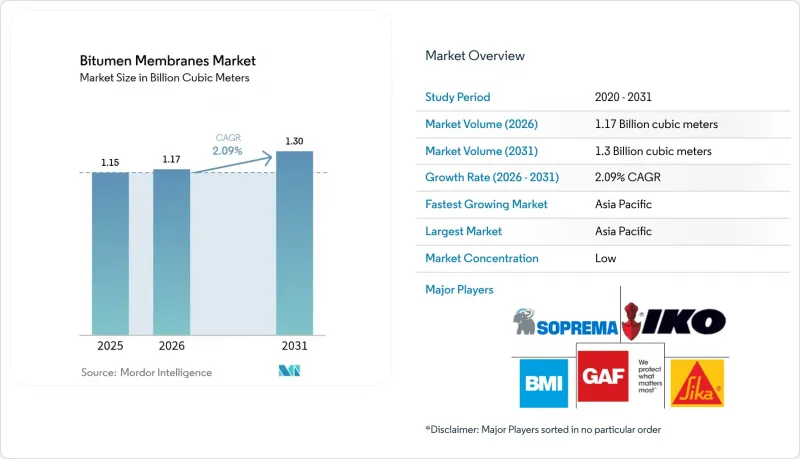
According to Mordor Intelligence, the bitumen membranes market size is expected to grow from 1.15 billion cubic meters in 2025 to 1.17 billion cubic meters in 2026 and is forecast to reach 1.3 billion cubic meters by 2031 at 2.09% CAGR over 2026-2031.
This report is Segmented by Grade (Atactic Polypropylene, Styrene-Butadiene-Styrene, and More), Product Type (Sheets, Liquids), Application (Roofing, Below-Grade Waterproofing, and More), Reinforcement Material (Polyester, Fiberglass, and More), Installation Technology (Torch-Applied, Self-Adhesive and More), End-User Industry (Residential, Commercial, and More), and Geography.
Global Bitumen Membranes Market Trends and Insights
Surge in Infrastructure Spending Across APAC Megacities
Large-scale capital programs exceeding USD 9 trillion keep the bitumen membrane market firmly oriented toward Asia-Pacific growth. India's FY 2025 budget earmarks Rs 11.11 lakh crore for transport corridors, industrial parks, and metro lines, each requiring extensive waterproofing. China's USD 741.5 billion road outlays similarly sustain bridge-deck and tunnel membrane demand. Continual urban rail, airport, and logistics hub construction across ASEAN widens the specification base. The pipeline creates steady volume visibility for manufacturers investing in regional capacity, buffering them against cyclical housing dips.
Extreme-Rainfall Resilience Retrofits in Mature Economies
North American and European building codes increasingly reference hydrostatic head performance and seam integrity in response to intensifying rainfall patterns. Retrofit programs targeting roofs, foundations, and podium decks treat high-grade membranes as risk-mitigation assets. Insurers correlate water ingress claims with envelope failures, incentivizing owners to upgrade before loss events. Municipal resilience mandates widen the addressable retrofit pool, while extended warranties become critical differentiators among suppliers.
Occupational HSE Concerns During Torch-On Installation
National fire codes and insurer guidelines now regard torch application as a high-hazard activity. UK HSE advisories underscore flash-over and fume exposure risks that escalate when untrained labor uses open flame on combustible substrates. Contractors absorb higher insurance premiums, fire-watch staffing, and ventilation costs, eroding the historical cost advantage of torch-on membranes. Training gaps intensify as skilled installers retire, leading builders to specify self-adhesive alternatives.
Other drivers and restraints analyzed in the detailed report include:
- Energy-Code Compliance via Cool-Roof Bitumen Membranes
- Growth of Torch-Free Self-Adhesive Membrane Systems
- Crude-Oil Price Volatility Impacting Bitumen Costs
For complete list of drivers and restraints, kindly check the Table Of Contents.
Segment Analysis
APP held 36.28% of the 2025 volume, underpinned by established sourcing and installer familiarity. The bitumen membrane market size for SBS grades is forecast to advance at a 2.22% CAGR, reflecting superior elasticity in freeze-thaw climates and better flow resistance in hot zones. Manufacturers incorporating bio-circular styrenic block copolymers address sustainability goals without diluting performance. Specification engineers increasingly trade modest upfront premiums for reduced crack-propagation risk over 20-year life cycles, reinforcing SBS momentum.
APP retains primacy in cost-sensitive public bids and regions with milder thermal cycling. Blends integrating recycled polymers help mitigate asphalt cost swings and respond to circular-economy procurement clauses. Specialty polymer variants serve bridge decks and chemical-exposure sites where mechanical and chemical endurance outweigh price. The grade split illustrates how performance-driven segments carve incremental gains while commodity volumes anchor plant utilization.
Factory-produced sheets delivered a 63.85% share in 2025, thanks to tight thickness tolerances that underpin long warranty terms. Liquids, expanding at a 2.31% CAGR, suit irregular geometries, podium landscaping, and roof refurbishments requiring seamless detailing. Cold-applied liquids avoid kettle heating and carry lower smell footprints, a growing advantage in urban retrofits.
Hybrid assemblies pairing sheet field coverage with liquid flashings achieve both speed and detail robustness. Sheets remain preferred for high-traffic roofs due to puncture-resistant reinforcements, whereas liquids dominate planter boxes and vertical wall transitions. Producers marketing integrated primer-membrane-topcoat systems lock in chemical compatibility and widen aftermarket revenue streams.
Complete Report Scope:
- By Grade
- Atactic Polypropylene (APP)
- Styrene-Butadiene-Styrene (SBS)
- Other Polymer-Modified Bitumen
- By Product Type
- Sheets
- Liquids
- By Application
- Roofing
- Below-Grade Waterproofing
- Bridge and Parking Decks
- Other Structural Waterproofing
- By Reinforcement Material
- Polyester
- Fiberglass
- Composite (Polyester/Fiberglass)
- Others
- By Installation Technology
- Torch-Applied
- Self-Adhesive (Peel and Stick)
- Cold-Applied (Liquid)
- Heat-Welded / Hot-Mop
- By End-User Industry
- Residential Construction
- Commercial Construction
- Industrial Construction
- Infrastructure (Roads, Bridges, Tunnels)
- Automotive
- Others
- By Geography
- Asia-Pacific
- China
- India
- Japan
- South Korea
- Malaysia
- Thailand
- Indonesia
- Vietnam
- Rest of Asia-Pacific
- North America
- United States
- Canada
- Mexico
- Europe
- Germany
- United Kingdom
- France
- Italy
- Spain
- Nordic Countries
- Turkey
- Russia
- Rest of Europe
- South America
- Brazil
- Argentina
- Colombia
- Rest of South America
- Middle-East and Africa
- Saudi Arabia
- Qatar
- United Arab Emirates
- South Africa
- Nigeria
- Egypt
- Rest of Middle-East and Africa
- Asia-Pacific
Geography Analysis
Asia-Pacific captured 39.85% 2025 volume and leads with a 2.21% CAGR as India and China push megaproject pipelines. India's Rs 11.11 lakh crore allocation spans highways, dedicated freight corridors, and 14 metro systems, each funneling roofing and sub-surface membrane orders. China's USD 741.5 billion road modernization sustains bridge-deck volumes, while ASEAN manufacturing zones lift warehouse roofing needs.
North America's cyclical replacement cycles and stringent cool-roof codes deliver predictable volume and margin. Plant investments-IKO's USD 390 million dual builds, Atlas Roofing's USD 200 million Iowa line, and Owens Corning's southeastern plant-shorten lead times and localize asphalt sourcing. California's Title 24 shapes formulations nationwide as other states mirror its reflectance and VOC thresholds.
Europe maintains balanced demand through renovation incentives and the pending 2026 Circular Economy Act. High-performance SBS sheets dominate flat-roof refurbishments in Germany and the Nordics, while Mediterranean rebuilds weigh cool-roof liquids to combat urban heat islands. Middle East and Africa gain traction via airport and desalination projects, yet political risk caps mega-project momentum. South America's commodity-driven booms lift demand sporadically, with exchange-rate swings challenging import economics.
- ARDEX Group
- BASF SE
- BMI Group
- Bondall
- Carlisle SynTec Systems
- Derbigum
- Firestone Building Products Company, LLC
- GAF Materials LLC
- IKO PLC
- Isoltema SpA
- Johns Manville
- Oriental Yuhong
- Polyglass S.p.A.
- RENOLIT SE
- Sika AG
- SOPREMA Group
- TECHNONICOL
- Tiki Tar Industries India Ltd
- TotalEnergies
Additional Benefits:
- The market estimate (ME) sheet in Excel format
- 3 months of analyst support
TABLE OF CONTENTS
1 Introduction
- 1.1 Study Assumptions and Market Definition
- 1.2 Scope of the Study
2 Research Methodology
3 Executive Summary
4 Market Landscape
- 4.1 Market Overview
- 4.2 Market Drivers
- 4.2.1 Surge in infrastructure spending across APAC megacities
- 4.2.2 Extreme-rainfall resilience retrofits in mature economies
- 4.2.3 Energy-code compliance via cool-roof bitumen membranes
- 4.2.4 Growth of torch-free self-adhesive membrane systems
- 4.2.5 Predictive-maintenance contracts enabled by digital leak-detection
- 4.3 Market Restraints
- 4.3.1 Occupational HSE concerns during torch-on installation
- 4.3.2 Crude-oil price volatility impacting bitumen costs
- 4.3.3 Substitution threat from bio-based and TPO/EPDM membranes
- 4.4 Value Chain Analysis
- 4.5 Regulatory Landscape
- 4.6 Porter's Five Forces
- 4.6.1 Bargaining Power of Suppliers
- 4.6.2 Bargaining Power of Buyers
- 4.6.3 Threat of New Entrants
- 4.6.4 Threat of Substitutes
- 4.6.5 Industry Rivalry
5 Market Size and Growth Forecasts (Volume)
- 5.1 By Grade
- 5.1.1 Atactic Polypropylene (APP)
- 5.1.2 Styrene-Butadiene-Styrene (SBS)
- 5.1.3 Other Polymer-Modified Bitumen
- 5.2 By Product Type
- 5.2.1 Sheets
- 5.2.2 Liquids
- 5.3 By Application
- 5.3.1 Roofing
- 5.3.2 Below-Grade Waterproofing
- 5.3.3 Bridge and Parking Decks
- 5.3.4 Other Structural Waterproofing
- 5.4 By Reinforcement Material
- 5.4.1 Polyester
- 5.4.2 Fiberglass
- 5.4.3 Composite (Polyester/Fiberglass)
- 5.4.4 Others
- 5.5 By Installation Technology
- 5.5.1 Torch-Applied
- 5.5.2 Self-Adhesive (Peel and Stick)
- 5.5.3 Cold-Applied (Liquid)
- 5.5.4 Heat-Welded / Hot-Mop
- 5.6 By End-User Industry
- 5.6.1 Residential Construction
- 5.6.2 Commercial Construction
- 5.6.3 Industrial Construction
- 5.6.4 Infrastructure (Roads, Bridges, Tunnels)
- 5.6.5 Automotive
- 5.6.6 Others
- 5.7 By Geography
- 5.7.1 Asia-Pacific
- 5.7.1.1 China
- 5.7.1.2 India
- 5.7.1.3 Japan
- 5.7.1.4 South Korea
- 5.7.1.5 Malaysia
- 5.7.1.6 Thailand
- 5.7.1.7 Indonesia
- 5.7.1.8 Vietnam
- 5.7.1.9 Rest of Asia-Pacific
- 5.7.2 North America
- 5.7.2.1 United States
- 5.7.2.2 Canada
- 5.7.2.3 Mexico
- 5.7.3 Europe
- 5.7.3.1 Germany
- 5.7.3.2 United Kingdom
- 5.7.3.3 France
- 5.7.3.4 Italy
- 5.7.3.5 Spain
- 5.7.3.6 Nordic Countries
- 5.7.3.7 Turkey
- 5.7.3.8 Russia
- 5.7.3.9 Rest of Europe
- 5.7.4 South America
- 5.7.4.1 Brazil
- 5.7.4.2 Argentina
- 5.7.4.3 Colombia
- 5.7.4.4 Rest of South America
- 5.7.5 Middle-East and Africa
- 5.7.5.1 Saudi Arabia
- 5.7.5.2 Qatar
- 5.7.5.3 United Arab Emirates
- 5.7.5.4 South Africa
- 5.7.5.5 Nigeria
- 5.7.5.6 Egypt
- 5.7.5.7 Rest of Middle-East and Africa
- 5.7.1 Asia-Pacific
6 Competitive Landscape
- 6.1 Market Concentration
- 6.2 Strategic Moves
- 6.3 Market Share/Ranking Analysis
- 6.4 Company Profiles (includes Global level Overview, Market level overview, Core Segments, Financials as available, Strategic Information, Market Rank/Share for key companies, Products and Services, and Recent Developments)
- 6.4.1 ARDEX Group
- 6.4.2 BASF SE
- 6.4.3 BMI Group
- 6.4.4 Bondall
- 6.4.5 Carlisle SynTec Systems
- 6.4.6 Derbigum
- 6.4.7 Firestone Building Products Company, LLC
- 6.4.8 GAF Materials LLC
- 6.4.9 IKO PLC
- 6.4.10 Isoltema SpA
- 6.4.11 Johns Manville
- 6.4.12 Oriental Yuhong
- 6.4.13 Polyglass S.p.A.
- 6.4.14 RENOLIT SE
- 6.4.15 Sika AG
- 6.4.16 SOPREMA Group
- 6.4.17 TECHNONICOL
- 6.4.18 Tiki Tar Industries India Ltd
- 6.4.19 TotalEnergies
7 Market Opportunities and Future Outlook
- 7.1 White-space and Unmet-Need Assessment

