PUBLISHER: Mordor Intelligence | PRODUCT CODE: 2114977

PUBLISHER: Mordor Intelligence | PRODUCT CODE: 2114977
Wire And Cable Compounds - Market Share Analysis, Industry Trends & Statistics, Growth Forecasts (2026 - 2031)
According to Mordor Intelligence, wire and cable compounds market size in 2026 is estimated at USD 16.05 billion, growing from 2025 value of USD 15.26 billion with 2031 projections showing USD 20.64 billion, growing at 5.17% CAGR over 2026-2031.
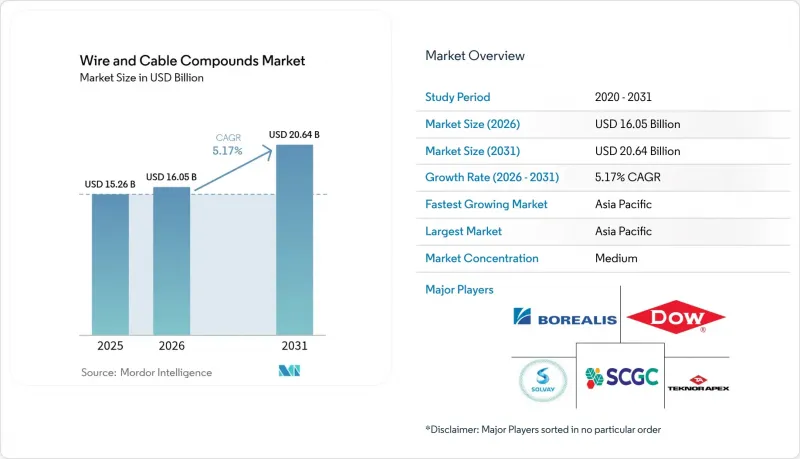
This report is Segmented by Product Type (Fiber Optic Cable, Coaxial Cable, and More), Polymer Type (PVC, TPO, and More), Functional Class (Insulation Compounds, Sheathing/Jacketing Compounds, and More), End-User Industry (Power, Construction, and More), and Geography (Asia-Pacific, North America, and More). The Market Forecasts are Provided in Terms of Value (USD).
Global Wire And Cable Compounds Market Trends and Insights
Accelerating Renewable-Energy Grid Upgrades
National decarbonization targets are pushing utilities toward offshore wind farms and distributed solar arrays that require HVDC export and inter-array cables rated up to 525 kV. Compounders are responding with peroxide-cross-linked XLPE and low-smoke, halogen-free TPE grades engineered for prolonged immersion, extreme thermal cycling, and ultraviolet exposure. The United States Department of Energy highlights compound durability as a priority in its harsh-environment materials roadmap, reinforcing demand for formulations that couple high dielectric strength with corrosion resistance. Increasing smart-grid sensor density also necessitates electromagnetic-compatibility-enhanced semiconductive layers, cementing long-run upside for the wire and cable compounds market.
5G and FTTH Broadband Roll-Out
Hyperscale data-center operators and telecom carriers are migrating from copper to optical links as artificial-intelligence workloads elevate throughput targets beyond 224 Gbps. Bend-insensitive, low-attenuation fiber-optic compounds incorporating nano-silica and advanced UV stabilizers enable tighter bend radii without signal loss, supporting rollable ribbon constructions that pack 3,456 fibers in a single cable. The United States BEAD program's USD 42.5 billion funding boosts last-mile fiber builds, sustaining consumption of outdoor-rated jacketing compounds that endure moisture ingress, rodent attack, and wide temperature swings. Prysmian's USD 30 million Tennessee line expansion underscores confidence in long-term FTTH demand and fortifies competition in the wire and cable compounds market.
Petrochemical Feed-Stock Price Volatility
Ethylene and vinyl-chloride monomer price swings tied to geopolitical disruptions and refinery outages compress compounder margins, especially for small and mid-sized firms lacking hedging capacity. Aluminum cost escalation linked to vehicle lightweighting simultaneously inflates conductor bills, prompting some cable makers to renegotiate supply contracts or defer expansion plans. Long-term offtake agreements and backward integration into cracker assets by leading resin suppliers partially insulate larger players, yet volatility remains a structural headwind for the wire and cable compounds market.
Other drivers and restraints analyzed in the detailed report include:
- EV High-Voltage Cable Demand Surge
- Increasing Demand from Construction Industry
- Phthalate and Heavy-Metal Regulatory Bans
For complete list of drivers and restraints, kindly check the Table Of Contents.
Segment Analysis
Fiber-optic cable compounds accounted for 53.78% of global revenues in 2025, and this slice of the wire and cable compounds market size is forecast to enlarge at a 6.03% CAGR to 2031 as data-center and FTTH networks supplant legacy copper backbones. Subsea interconnect cables for offshore wind export and transoceanic routes further amplify demand for water-blocking gels, thixotropic fillers, and hydrophobic jacketing compounds that ensure optical-signal integrity under 6,000-meter hydrostatic pressure.
Demand for coaxial and specialty cable compounds endures in aerospace, test-equipment, and RF-shielded environments where attenuation control outweighs bandwidth constraints. Self-healing polyurethane jackets employing microcapsule technology are being piloted for mission-critical data halls, promising lower mean-time-to-repair and bolstering competitiveness within the wire and cable compounds market.
PVC retained 38.21% of 2025 revenues, securing the largest wire and cable compounds market share thanks to cost competitiveness, broad processability, and flame-retardant synergies with mineral fillers. Nonetheless, upcoming bans on lead stabilizers and high-phthalate plasticizers elevate transition risk and propel other polymer types (fluoropolymers, etc.) to a projected 6.34% CAGR through 2031.
Emerging non-halogenated materials such as polyetheretherketone (PEEK) and liquid-crystal polymers cater to ultra-high-frequency, low-loss applications in advanced computing and spaceflight. Avient's bio-derived, halogen-free TPE portfolio demonstrates how sustainability credentials can unlock premium price points and capture incremental share in the wire and cable compounds market.
Complete Report Scope:
- By Product Type
- Fiber Optic Cable
- Coaxial Cable
- Other Products (Specialty cables, etc.)
- By Polymer Type
- Polyvinyl Chloride (PVC)
- Thermoplastic Olefins (TPO)
- Thermoplastic Elastomer (TPE)
- Thermoplastic Polyurethane (TPU)
- Other Polymer Types (Fluoropolymers, etc.)
- By Functional Class
- Insulation Compounds
- Sheathing/Jacketing Compounds
- Bedding and Filling Compounds
- Shielding and Semiconductive Compounds
- By End-User Industry
- Power
- Construction
- Automotive
- Telecommunications
- Electrical and Electronics
- Healthcare
- Other End-user Industries (Industrial, etc.)
- By Geography
- Asia-Pacific
- China
- Japan
- India
- South Korea
- ASEAN Countries
- Rest of Asia-Pacific
- North America
- United States
- Canada
- Mexico
- Europe
- Germany
- United Kingdom
- France
- Italy
- Spain
- Russia
- NORDIC Countries
- Rest of Europe
- South America
- Brazil
- Argentina
- Rest of South America
- Middle East and Africa
- Saudi Arabia
- South Africa
- Rest of Middle East and Africa
- Asia-Pacific
Geography Analysis
Asia-Pacific dominated global consumption with a 45.88% share in 2025, equivalent to the largest regional slice of the wire and cable compounds market size, and is forecast to progress at a 6.14% CAGR as China ramps wind-turbine grid connections and India accelerates 5G roll-outs. Government incentives for domestic EV supply chains are driving localized compound sourcing, particularly high-voltage orange sheathing materials that comply with GB/T standards. Japanese and South Korean electronics clusters further stimulate high-purity fluoropolymer and liquid-crystal-polymer demand.
North America constitutes a mature yet innovation-intensive arena where infrastructure-law funding, BEAD broadband grants, and fast-growing EV charging networks sustain premium material uptake. Compliance with the Inflation Reduction Act's Buy-America clauses channels investment toward U.S. extrusion lines, an effect evidenced by Prysmian's Jackson and AFL's South Carolina capacity expansions. Canada's stricter hazardous-substance limits, effective 2025, expedite migration to PFAS-free and recycled-content compounds, reinforcing sustainable differentiation within the wire and cable compounds market.
Europe prioritizes circular-economy and decarbonization goals, propelling demand for lead-free, bio-plasticized PVC and halogen-free formulations that meet Construction Products Regulation (CPR) EuroClass B2ca requirements. Germany's EV output and the United Kingdom's offshore wind surge underpin high-voltage and subsea cable projects, respectively. Eastern European extrusion hubs exploit lower labor costs to serve regional construction booms, while Norway supports deepwater HVDC cable programs through Nexans' 200-meter tower expansion. Despite geopolitical friction, select Russian grid-modernization projects still secure specialty compounds from European suppliers owing to performance mandates.
- AFL
- Arkema
- Borealis GmbH
- BUSS AG
- Cabot Corporation
- ChemCeed
- Dow
- Electric Cable Compounds Inc.
- Hanwha Solutions Chemical Division Corporation
- Jiangsu Dewei New Materials Co., Ltd
- Melos GmbH
- Nexans
- Orbia
- Prysmian
- Relicab Cable
- SABIC
- SCG Chemicals Public Company Limited
- Solvay
- Teknor Apex
- Trelleborg AB
Additional Benefits:
- The market estimate (ME) sheet in Excel format
- 3 months of analyst support
TABLE OF CONTENTS
1 Introduction
- 1.1 Study Assumptions and Market Definition
- 1.2 Scope of the Study
2 Research Methodology
3 Executive Summary
4 Market Landscape
- 4.1 Market Overview
- 4.2 Market Drivers
- 4.2.1 Accelerating Renewable-Energy Grid Upgrades
- 4.2.2 5G And FTTH Broadband Roll-Out
- 4.2.3 EV High-Voltage Cable Demand Surge
- 4.2.4 Increasing Demand from Construction Industry
- 4.2.5 Recyclable TPE Substitution of Thermosets
- 4.3 Market Restraints
- 4.3.1 Petrochemical Feed-Stock Price Volatility
- 4.3.2 Phthalate and Heavy-Metal Regulatory Bans
- 4.3.3 Skilled-Labour Deficit for Fluoropolymer Compounding
- 4.4 Value Chain Analysis
- 4.5 Porter's Five Forces Analysis
- 4.5.1 Threat of New Entrants
- 4.5.2 Bargaining Power of Buyers
- 4.5.3 Bargaining Power of Suppliers
- 4.5.4 Threat of Substitute Products
- 4.5.5 Degree of Competition
5 Market Size and Growth Forecasts (Value)
- 5.1 By Product Type
- 5.1.1 Fiber Optic Cable
- 5.1.2 Coaxial Cable
- 5.1.3 Other Products (Specialty cables, etc.)
- 5.2 By Polymer Type
- 5.2.1 Polyvinyl Chloride (PVC)
- 5.2.2 Thermoplastic Olefins (TPO)
- 5.2.3 Thermoplastic Elastomer (TPE)
- 5.2.4 Thermoplastic Polyurethane (TPU)
- 5.2.5 Other Polymer Types (Fluoropolymers, etc.)
- 5.3 By Functional Class
- 5.3.1 Insulation Compounds
- 5.3.2 Sheathing/Jacketing Compounds
- 5.3.3 Bedding and Filling Compounds
- 5.3.4 Shielding and Semiconductive Compounds
- 5.4 By End-User Industry
- 5.4.1 Power
- 5.4.2 Construction
- 5.4.3 Automotive
- 5.4.4 Telecommunications
- 5.4.5 Electrical and Electronics
- 5.4.6 Healthcare
- 5.4.7 Other End-user Industries (Industrial, etc.)
- 5.5 By Geography
- 5.5.1 Asia-Pacific
- 5.5.1.1 China
- 5.5.1.2 Japan
- 5.5.1.3 India
- 5.5.1.4 South Korea
- 5.5.1.5 ASEAN Countries
- 5.5.1.6 Rest of Asia-Pacific
- 5.5.2 North America
- 5.5.2.1 United States
- 5.5.2.2 Canada
- 5.5.2.3 Mexico
- 5.5.3 Europe
- 5.5.3.1 Germany
- 5.5.3.2 United Kingdom
- 5.5.3.3 France
- 5.5.3.4 Italy
- 5.5.3.5 Spain
- 5.5.3.6 Russia
- 5.5.3.7 NORDIC Countries
- 5.5.3.8 Rest of Europe
- 5.5.4 South America
- 5.5.4.1 Brazil
- 5.5.4.2 Argentina
- 5.5.4.3 Rest of South America
- 5.5.5 Middle East and Africa
- 5.5.5.1 Saudi Arabia
- 5.5.5.2 South Africa
- 5.5.5.3 Rest of Middle East and Africa
- 5.5.1 Asia-Pacific
6 Competitive Landscape
- 6.1 Market Concentration
- 6.2 Strategic Moves
- 6.3 Market Share(%)/Ranking Analysis
- 6.4 Company Profiles (includes Global Overview, Market Overview, Core Segments, Financials, Strategic Information, Market Rank/Share, Products and Services, Recent Developments)
- 6.4.1 AFL
- 6.4.2 Arkema
- 6.4.3 Borealis GmbH
- 6.4.4 BUSS AG
- 6.4.5 Cabot Corporation
- 6.4.6 ChemCeed
- 6.4.7 Dow
- 6.4.8 Electric Cable Compounds Inc.
- 6.4.9 Hanwha Solutions Chemical Division Corporation
- 6.4.10 Jiangsu Dewei New Materials Co., Ltd
- 6.4.11 Melos GmbH
- 6.4.12 Nexans
- 6.4.13 Orbia
- 6.4.14 Prysmian
- 6.4.15 Relicab Cable
- 6.4.16 SABIC
- 6.4.17 SCG Chemicals Public Company Limited
- 6.4.18 Solvay
- 6.4.19 Teknor Apex
- 6.4.20 Trelleborg AB
7 Market Opportunities and Future Outlook
- 7.1 White-space and Unmet-Need Assessment

