PUBLISHER: Mordor Intelligence | PRODUCT CODE: 2114988

PUBLISHER: Mordor Intelligence | PRODUCT CODE: 2114988
Hybrid Fabric - Market Share Analysis, Industry Trends & Statistics, Growth Forecasts (2026 - 2031)
According to Mordor Intelligence, the hybrid fabric market size is expected to grow from USD 428.19 million in 2025 to USD 458.59 million in 2026 and is forecast to reach USD 646.2 million by 2031 at 7.10% CAGR over 2026-2031.
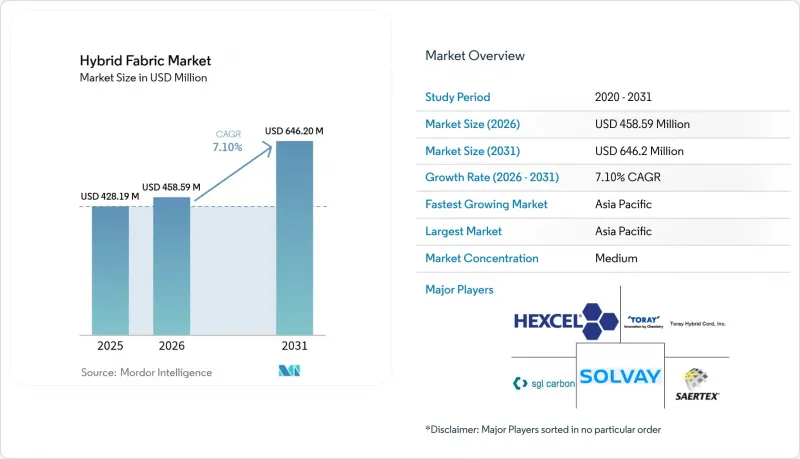
This report is Segmented by Fiber-Type Combination (Glass & Carbon, Carbon & Aramid, and More), Resin Matrix (Thermoset, Thermoplastic), End-User Industry (Automotive & Aerospace, Industrial, and More), Manufacturing Technology (Prepreg & Autoclave, Vacuum Infusion/RTM, and More), and Geography (Asia-Pacific, North America, Europe, and More). The Market Forecasts are Provided in Terms of Value (USD).
Global Hybrid Fabric Market Trends and Insights
Automotive Light-weighting Demand for Glass and Carbon Hybrids
Automotive OEMs are accelerating adoption of hybrid reinforcements to comply with the European Union rule that requires a 15% vehicle mass reduction by 2027. Ford's composite C-brace for the Bronco Raptor shows how a glass-carbon fabric raises torsional rigidity while trimming weight. Battery-electric platforms use the same hybrid fabric market solutions inside structural battery enclosures that must insulate high-voltage packs and absorb crash energy. As OEMs migrate from steel to modular composite architectures, design studios gain freedom to mold complex ribs and nodes that were formerly welded, boosting demand for positional fiber placement technologies. The driver is most pronounced in China and Germany, where high electric-vehicle penetration coincides with public-sector fuel-economy targets.
Rise in Demand from Wind Turbine Blade Manufacturing
Blade makers need longer rotors to extract more energy per tower, yet aerodynamic loads soar with each additional meter. LM Wind Power solved this dilemma with an 88.4 meter blade that uses carbon-glass hybrid spar caps for stiffness without punitive mass. Offshore installations magnify the need for fatigue tolerance because salt spray and yaw cycles erode surface layers over a 25-year duty life. SAERTEX responded with an H-modulus glass fabric and self-adhesive non-crimp product family that cuts lay-up time by 30%. Hybrid fabric market orders are therefore booked several quarters in advance, giving fiber suppliers visibility that supports capacity expansion in Jiangsu, Gujarat, and Schleswig-Holstein.
High Production & Qualification Costs
Hybrid fabric production involves precise tension control, dual-fiber impregnation, and multi-stage cure cycles that raise capital needs. An aerospace qualification campaign can last five years and cost USD 15 million per fabric system according to NASA studies. Smaller mills therefore hesitate to enter the hybrid fabric market, restricting supplier diversity. Autoclave units add USD 10 million of fixed assets per line; out-of-autoclave methods exist yet still require complex tooling and data acquisition. These economics make price-sensitive segments, such as mid-class passenger cars, slower adopters despite evident weight savings.
Other drivers and restraints analyzed in the detailed report include:
- Growing Demand for High Durability and Thermal Resistant Fabrics
- Increasing Applications for Carbon Fiber Fabrics
- Absent Recycling Standards for Multi-Material Fabrics
For complete list of drivers and restraints, kindly check the Table Of Contents.
Segment Analysis
Glass-carbon hybrids held 38.02% hybrid fabric market share in 2025, underscoring their sweet-spot blend of stiffness, fatigue endurance, and moderate raw-material cost. Turbine spar caps remain the flagship use case because carbon boosts bending rigidity while glass handles cyclic loading in the web region. Other combinations such as aramid-carbon address niche programs in ballistic armor and helicopter rotors where impact absorption is critical. Researchers at the University of Michigan increased flax-carbon modulus by 33% using a supercritical CO2 treatment that cleans and roughens fiber surfaces, a result that has drawn interest from electric vehicle interiors. Market participants capitalize on this spectrum through modular product catalogs that offer the same weave in multiple fiber ratios. Pricing strategies reward volume commitments that stabilize loom scheduling and resin-mix forecasting. OEMs compare total-part costs rather than raw-fabric costs alone, validating the glass-carbon route whenever weight reduction brings downstream benefits like smaller propulsion units or simplified assembly hardware.
Thermoset chemistries accounted for 61.88% of hybrid fabric market size in 2025, with epoxy leading due to trusted flight-critical pedigrees and wide supplier availability. These resins cure at temperatures below 180 °C and accept accelerators that match production takt times. In contrast, thermoplastic matrices such as PEEK and PEKK need melt processing above 340 °C yet shorten press cycles to 3 minutes, a boon for high-volume structures. Thermoplastic scrap is also remeltable, giving fabricators a recycling pathway that reduces landfill fees. Adoption still faces tooling-price hurdles because matched-metal molds are required, and part-cool rates must be tuned to avoid crystallinity gradients. Nevertheless, battery enclosure projects at European gigafactories have locked in thermoplastic-hybrid laminates because heat resistance above 150 °C ensures integrity during thermal runaway events. Process lines increasingly feature induction heating and in-mold monitoring to secure repeatability, and these investments will cascade to marine deck panels and rail carbody shells during the forecast horizon.
Complete Report Scope:
- By Fiber-Type Combination
- Glass and Carbon
- Carbon and Aramid
- Glass and Aramid
- Other Fiber Types (Natural (Flax) and Carbon, etc.)
- By Resin Matrix
- Thermoset (Epoxy, Polyester, Vinyl-Ester)
- Thermoplastic (PP, PA, PEEK, PEKK)
- By End-User Industry
- Automotive and Aerospace
- Industrial
- Marine and Defense
- Sports Equipment
- Other End-user Industries (Construction and Infrastructure, etc.)
- By Manufacturing Technology
- Prepreg and Autoclave
- Vacuum Infusion/RTM
- Braiding and Filament Winding
- Geography
- Asia-Pacific
- China
- Japan
- India
- South Korea
- Rest of Asia-Pacific
- North America
- United States
- Canada
- Mexico
- Europe
- Germany
- United Kingdom
- France
- Italy
- Rest of Europe
- South America
- Brazil
- Argentina
- Rest of South America
- Middle East and Africa
- Saudi Arabia
- South Africa
- Rest of Middle East and Africa
- Asia-Pacific
Geography Analysis
Asia-Pacific captured 42.61% hybrid fabric market share in 2025. China installed 75 GW of wind capacity in 2024 and ordered corresponding glass-carbon fabric volumes eighteen months ahead of blade production slots. Beijing's Made-in-China 2025 plan earmarks advanced composite fabrication as a strategic pillar, which grants tax breaks to firms that localize value chains. India is following with a production-linked incentive scheme that reimburses 4% of free-on-board value for composite exports, prompting global tier-ones to twin plant footprints in Gujarat and Tamil Nadu. North America demonstrates strong revenue generation driven by its aerospace and defense hubs in Washington, Kansas, and Alabama. The HiCAM project at NASA Langley aims to quadruple composite airframe build rates, and Toray engineers supply customized prepreg systems that cure in under four hours. Canada cooperates through a national advanced materials supercluster that co-funds pilot lines, while Mexico strengthens the automotive base with duty-free composite parts under the USMCA, improving cost competitiveness even when raw fiber is imported. Europe maintains a robust position despite energy-price spikes. Offshore wind farms in the North Sea rely on hybrid spar caps shipped from German and Danish converters, and regional automakers have mandated an average 10% composite content for next-generation battery electric vehicles. Brussels also drives the regulatory frontier, with circular-economy directives forcing OEMs to confirm recycling pathways before product launch. This environment motivates R&D into natural fiber hybrids and low-temperature thermoplastic resins, ensuring Europe stays relevant on intellectual property even as production volumes drift toward Asia.
- BGF Industries
- dsm-firmenich
- Exel Composites Plc
- FTS S.P.A
- Gurit Holding AG
- Haufler Composites GmbH & Co KG
- Hexcel Corporation
- Owens Corning
- SAERTEX GmbH & Co.KG
- SGL Carbon
- Solvay
- Teijin Frontier Co., Ltd.
- Toray Hybrid Cord,Inc
Additional Benefits:
- The market estimate (ME) sheet in Excel format
- 3 months of analyst support
TABLE OF CONTENTS
1 Introduction
- 1.1 Study Assumptions and Market Definition
- 1.2 Scope of the Study
2 Research Methodology
3 Executive Summary
4 Market Landscape
- 4.1 Market Overview
- 4.2 Market Drivers
- 4.2.1 Automotive light-weighting demand for glass and carbon hybrids
- 4.2.2 Rise in demand from wind turbine blade manufacturing
- 4.2.3 Growing demand for high durability and thermal resistant fabrics
- 4.2.4 Increasing applications for carbon fiber fabrics
- 4.2.5 Commercialisation of recycled-carbon and glass hybrid textiles
- 4.3 Market Restraints
- 4.3.1 High production and qualification costs
- 4.3.2 Carbon-fiber supply-chain tightness
- 4.3.3 Absent recycling standards for multi-material fabrics
- 4.4 Value Chain Analysis
- 4.5 Porter's Five Forces
- 4.5.1 Threat of New Entrants
- 4.5.2 Bargaining Power of Buyers
- 4.5.3 Bargaining Power of Suppliers
- 4.5.4 Threat of Substitute Products
- 4.5.5 Degree of Competition
5 Market Size and Growth Forecasts (Value)
- 5.1 By Fiber-Type Combination
- 5.1.1 Glass and Carbon
- 5.1.2 Carbon and Aramid
- 5.1.3 Glass and Aramid
- 5.1.4 Other Fiber Types (Natural (Flax) and Carbon, etc.)
- 5.2 By Resin Matrix
- 5.2.1 Thermoset (Epoxy, Polyester, Vinyl-Ester)
- 5.2.2 Thermoplastic (PP, PA, PEEK, PEKK)
- 5.3 By End-User Industry
- 5.3.1 Automotive and Aerospace
- 5.3.2 Industrial
- 5.3.3 Marine and Defense
- 5.3.4 Sports Equipment
- 5.3.5 Other End-user Industries (Construction and Infrastructure, etc.)
- 5.4 By Manufacturing Technology
- 5.4.1 Prepreg and Autoclave
- 5.4.2 Vacuum Infusion/RTM
- 5.4.3 Braiding and Filament Winding
- 5.5 Geography
- 5.5.1 Asia-Pacific
- 5.5.1.1 China
- 5.5.1.2 Japan
- 5.5.1.3 India
- 5.5.1.4 South Korea
- 5.5.1.5 Rest of Asia-Pacific
- 5.5.2 North America
- 5.5.2.1 United States
- 5.5.2.2 Canada
- 5.5.2.3 Mexico
- 5.5.3 Europe
- 5.5.3.1 Germany
- 5.5.3.2 United Kingdom
- 5.5.3.3 France
- 5.5.3.4 Italy
- 5.5.3.5 Rest of Europe
- 5.5.4 South America
- 5.5.4.1 Brazil
- 5.5.4.2 Argentina
- 5.5.4.3 Rest of South America
- 5.5.5 Middle East and Africa
- 5.5.5.1 Saudi Arabia
- 5.5.5.2 South Africa
- 5.5.5.3 Rest of Middle East and Africa
- 5.5.1 Asia-Pacific
6 Competitive Landscape
- 6.1 Market Concentration
- 6.2 Strategic Moves
- 6.3 Market Share(%)/Ranking Analysis
- 6.4 Company Profiles (includes Global level Overview, Market level overview, Core Segments, Financials as available, Strategic Information, Market Rank/Share for key companies, Products and Services, and Recent Developments)
- 6.4.1 BGF Industries
- 6.4.2 dsm-firmenich
- 6.4.3 Exel Composites Plc
- 6.4.4 FTS S.P.A
- 6.4.5 Gurit Holding AG
- 6.4.6 Haufler Composites GmbH & Co KG
- 6.4.7 Hexcel Corporation
- 6.4.8 Owens Corning
- 6.4.9 SAERTEX GmbH & Co.KG
- 6.4.10 SGL Carbon
- 6.4.11 Solvay
- 6.4.12 Teijin Frontier Co., Ltd.
- 6.4.13 Toray Hybrid Cord,Inc
7 Market Opportunities and Future Outlook
- 7.1 White-space and Unmet-Need Assessment

