PUBLISHER: Mordor Intelligence | PRODUCT CODE: 2114999

PUBLISHER: Mordor Intelligence | PRODUCT CODE: 2114999
Curing Agent - Market Share Analysis, Industry Trends & Statistics, Growth Forecasts (2026 - 2031)
According to Mordor Intelligence, the curing agent market size is expected to grow from USD 7.54 billion in 2025 to USD 7.92 billion in 2026 and is forecast to reach USD 10.16 billion by 2031 at 5.09% CAGR over 2026-2031.
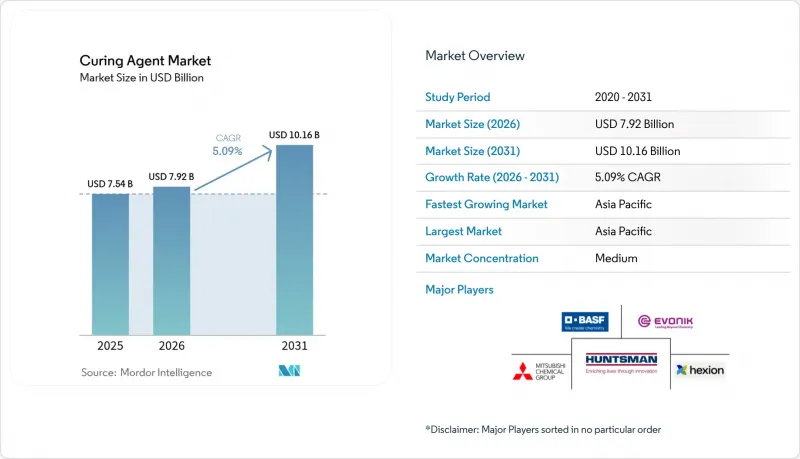
This report Segments the Industry by (Epoxy, Polyurethane, Rubber, Acrylic, and Other Types), Application (Paints and Coatings, Building and Construction, Adhesives and Sealants, Composites, Electrical and Electronics, and Other Applications), and Geography (Asia-Pacific, North America, Europe, South America, and Middle-East and Africa). The Market Forecasts are Provided in Terms of Value (USD).
Global Curing Agent Market Trends and Insights
Surging Demand from Paints and Coatings
Low-VOC and waterborne coatings now dominate procurement specifications for architectural and protective layers, prompting formulators to specify curing agents that deliver hardness, UV resistance, and corrosion protection without breaching emission caps. New waterborne polyamide chemistries like EPIKURE 6874-WZ-50 simplify dispersion stability while maintaining salt-spray performance. Infrastructure refurbishment raises volumes for anti-corrosion primers, and IoT-enabled surface diagnostics accelerate renovation cycles, driving additional throughput. Growing consumer awareness of sustainability pushes resin producers to leverage bio-based hardeners that match mechanical performance. These factors continue to lift demand across the global curing agent market.
Infrastructure Boom Driving Building and Construction Composites
Government-backed megaprojects in Asia Pacific favor fiber-reinforced polymers for bridge decks, facades, and rebar, as these materials reduce installation labor and mitigate corrosion costs. In the United States, bipartisan infrastructure funding has opened grants for composite girder replacement, increasing purchase orders for reactive amine systems optimized for high-humidity cure schedules. India's push for USD 300 billion chemical output by 2025 strengthens the domestic supply of specialty amines and accelerators, reinforcing regional self-sufficiency. Rapid urbanization sustains consumption of structural adhesives, further lifting the curing agent market.
Stringent VOC and REACH Regulations on Amines and Anhydrides
Europe's 2025 REACH revision extends PFAS curbs and lowers emission thresholds, compelling formulators to redesign epoxy and polyurethane systems around safer accelerators. Diisocyanate training mandates add indirect cost, and the January 2025 SVHC update tightens documentation for amine derivatives. Similar moves by the U.S. EPA on NMP heighten complexity for coatings exporters. Downstream, automotive OEMs now screen full material disclosures, elevating switching pressure toward bio-based or ultra-low-odor alternatives. Compliance expenses weigh on smaller producers, but integrated majors with green portfolios gradually consolidate share inside the curing agent market.
Other drivers and restraints analyzed in the detailed report include:
- Rapid Expansion of Wind-Energy Blade Production
- Ultra-Fast Curing Agents Enabling 3D-Printing Resins
- Volatility in Petro-Derived Raw-Material Costs
For complete list of drivers and restraints, kindly check the Table Of Contents.
Segment Analysis
Epoxy systems generated the largest revenue within the curing agent market in 2025, and their 6.29% CAGR through 2031 outpaces every other chemistry category. Within this segment, aliphatic amine blends enable thin-film cure at temperatures below 10 °C, while polyamides contribute moisture tolerance for marine primers. Huntsman, BASF, and Evonik combine backward-integrated amine chains with regional mixing plants, sustaining their cost edge and technical support.
Polyurethane hardeners continue to hold strong positions in flexible flooring and spray foams, yet isocyanate regulation encourages hybrid epoxy-polyurethane routes with blocked functionality that releases under heat. Silicone and phenolic curing agents remain indispensable for aerospace and high-temperature electronics, where dielectric stability is critical. Rubber and acrylic formulations address niche sealing, tire, and UV-cure needs, contributing steady but slower growth.
Complete Report Scope:
- By Type
- Epoxy
- Polyurethane
- Rubber
- Acrylic
- Other Types (Silicone, Phenolic, etc.)
- By Application
- Paints and Coatings
- Building and Construction
- Adhesives and Sealants
- Composites (Wind, Marine, Sports)
- Electrical and Electronics (Potting, PCB, EV batteries)
- Other Applications (3D-printing, Flooring, etc.)
- By Geography
- Asia-Pacific
- China
- India
- Japan
- South Korea
- Rest of Asia-Pacific
- North America
- United States
- Canada
- Mexico
- Europe
- Germany
- United Kingdom
- France
- Italy
- Rest of Europe
- South America
- Brazil
- Argentina
- Rest of South America
- Middle-East and Africa
- Saudi Arabia
- South Africa
- Rest of Middle-East and Africa
- Asia-Pacific
Geography Analysis
Asia Pacific dominates on both volume and value, holding 44.75% of global sales in 2025 and riding a 6.46% CAGR to 2031. Regional supply chains feature integrated amine synthesis, competitive labor, and proximity to downstream users, giving local producers agility in pricing and lead time. China's Made-in-China 2025 initiative upgrades domestic output from commodity epoxy diluents toward specialty crosslinkers, supporting local turbine and semiconductor customers simultaneously. India's production-linked incentive framework attracts multinational capital into polyetheramine and phenalkamine facilities, cutting import dependency and propelling the curing agent market in South Asia.
North America benefits from shale gas feedstock and high wind-capacity additions, yet stricter VOC proposals and PFAS scrutiny raise research and development outlays. Leading formulators move toward mass-balance bio-attribution models and circular end-of-life options to maintain differentiation and secure grants. Europe confronts elevated electricity prices and evolving REACH thresholds, compelling operators to migrate toward high-margin custom solutions while scaling green hydrogen-powered plants to lower Scope 2 emissions.
- Alfa Chemicals
- Atul Ltd.
- BASF
- Cardolite Corporation
- DIC Corporation
- Evonik Industries, AG
- Hexion Inc.
- Huntsman International LLC
- Incorez Ltd.
- Kukdo Chemical Co.
- Mitsubishi Chemical Corporation
- Olin Corporation
- Palmer International
- Supreme Polytech Pvt Ltd.
- Wanhua Chemical Group
Additional Benefits:
- The market estimate (ME) sheet in Excel format
- 3 months of analyst support
TABLE OF CONTENTS
1 Introduction
- 1.1 Study Assumptions
- 1.2 Scope of the Study
2 Research Methodology
3 Executive Summary
4 Market Landscape
- 4.1 Market Overview
- 4.2 Market Drivers
- 4.2.1 Surging Demand from Paints and Coatings
- 4.2.2 Infrastructure Boom Driving Building and Construction Composites
- 4.2.3 Rapid Expansion of Wind-Energy Blade Production
- 4.2.4 Shift to Bio-Based Cashew Nutshell Liquid (CNSL) and Lignin Curing Chemistries
- 4.2.5 Ultra-Fast Curing Agents Enabling 3D-Printing Resins
- 4.3 Market Restraints
- 4.3.1 Stringent VOC and REACH Regulations on Amines and Anhydrides
- 4.3.2 Volatility in Petro-Derived Raw-Material Costs
- 4.3.3 Supply-Chain Concentration of Specialty Amines in Asia Pacific
- 4.4 Value Chain Analysis
- 4.5 Porter's Five Forces
- 4.5.1 Bargaining Power of Suppliers
- 4.5.2 Bargaining Power of Buyers
- 4.5.3 Threat of New Entrants
- 4.5.4 Threat of Substitutes
- 4.5.5 Degree of Competition
5 Market Size and Growth Forecasts (Value)
- 5.1 By Type
- 5.1.1 Epoxy
- 5.1.2 Polyurethane
- 5.1.3 Rubber
- 5.1.4 Acrylic
- 5.1.5 Other Types (Silicone, Phenolic, etc.)
- 5.2 By Application
- 5.2.1 Paints and Coatings
- 5.2.2 Building and Construction
- 5.2.3 Adhesives and Sealants
- 5.2.4 Composites (Wind, Marine, Sports)
- 5.2.5 Electrical and Electronics (Potting, PCB, EV batteries)
- 5.2.6 Other Applications (3D-printing, Flooring, etc.)
- 5.3 By Geography
- 5.3.1 Asia-Pacific
- 5.3.1.1 China
- 5.3.1.2 India
- 5.3.1.3 Japan
- 5.3.1.4 South Korea
- 5.3.1.5 Rest of Asia-Pacific
- 5.3.2 North America
- 5.3.2.1 United States
- 5.3.2.2 Canada
- 5.3.2.3 Mexico
- 5.3.3 Europe
- 5.3.3.1 Germany
- 5.3.3.2 United Kingdom
- 5.3.3.3 France
- 5.3.3.4 Italy
- 5.3.3.5 Rest of Europe
- 5.3.4 South America
- 5.3.4.1 Brazil
- 5.3.4.2 Argentina
- 5.3.4.3 Rest of South America
- 5.3.5 Middle-East and Africa
- 5.3.5.1 Saudi Arabia
- 5.3.5.2 South Africa
- 5.3.5.3 Rest of Middle-East and Africa
- 5.3.1 Asia-Pacific
6 Competitive Landscape
- 6.1 Market Concentration
- 6.2 Strategic Moves (Mergers and Acquisitions, JVs, Partnerships)
- 6.3 Market Share Analysis
- 6.4 Company Profiles (includes Global level Overview, Market level overview, Core Segments, Financials as available, Strategic Information, Market Rank/Share for key companies, Products and Services, and Recent Developments)
- 6.4.1 Alfa Chemicals
- 6.4.2 Atul Ltd.
- 6.4.3 BASF
- 6.4.4 Cardolite Corporation
- 6.4.5 DIC Corporation
- 6.4.6 Evonik Industries, AG
- 6.4.7 Hexion Inc.
- 6.4.8 Huntsman International LLC
- 6.4.9 Incorez Ltd.
- 6.4.10 Kukdo Chemical Co.
- 6.4.11 Mitsubishi Chemical Corporation
- 6.4.12 Olin Corporation
- 6.4.13 Palmer International
- 6.4.14 Supreme Polytech Pvt Ltd.
- 6.4.15 Wanhua Chemical Group
7 Market Opportunities and Future Outlook
- 7.1 Development of Environmental Friendly Low or Non-VOC Curing Agents
- 7.2 White-space and unmet-need assessment

