PUBLISHER: Mordor Intelligence | PRODUCT CODE: 2115003

PUBLISHER: Mordor Intelligence | PRODUCT CODE: 2115003
Elastomeric Membrane - Market Share Analysis, Industry Trends & Statistics, Growth Forecasts (2026 - 2031)
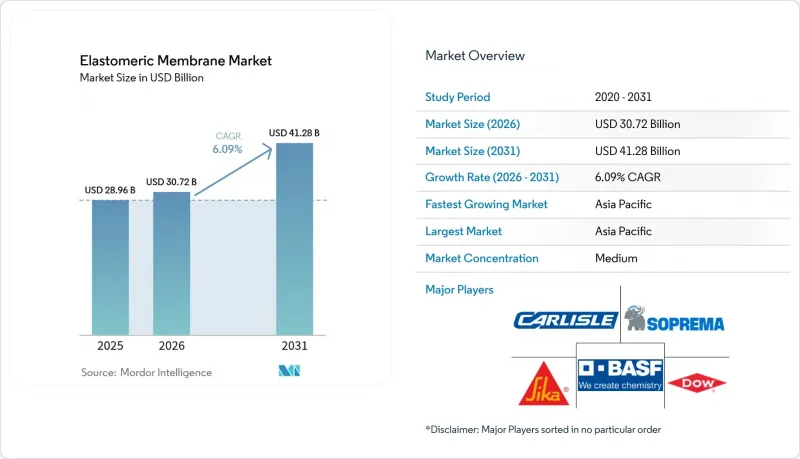
According to Mordor Intelligence, the elastomeric membrane market size is expected to grow from USD 28.96 billion in 2025 to USD 30.72 billion in 2026 and is forecast to reach USD 41.28 billion by 2031 at 6.09% CAGR over 2026-2031.
This report is Segmented by Type (Polyurethane, Acrylic, Silicone, Other Types), End-User Industry (Residential, Non-Residential), Application (Roofs, Walls, Wet Areas, Other Applications), and Geography (Asia-Pacific, North America, Europe, South America, Middle East and Africa). The Market Forecasts are Provided in Terms of Value (USD).
Global Elastomeric Membrane Market Trends and Insights
Surging Demand for Durable Waterproofing in Infrastructure Rehabilitation
Infrastructure rehabilitation dominates procurement agendas as owners replace membranes installed in the 1980s and 1990s. Sika AG recorded 13.5% sales growth in EMEA and 15.1% in the Americas during 2024, largely from rehabilitation work that specified high-performance coatings over concrete structures. Liquid-applied elastomeric systems benefit because they form seamless barriers across irregular substrates without full tear-off, reducing downtime on bridges, tunnels, and parking decks. Climate volatility further raises the stakes: membranes must tolerate more intense freeze-thaw and storm events without splitting. Because failures can trigger costly litigation, specifiers increasingly demand 20- to 30-year warranty cover backed by field performance data. Suppliers that can certify adhesion to damp substrates earn preference in fast-track repair programs where surfaces cannot always be fully dried.
Rapid Urban & Commercial Construction Growth
Asia-Pacific's building boom is stretching beyond sheer volume into technical sophistication. Smart-city master plans require membranes that integrate moisture protection, heat reflectivity, and, in some cases, photovoltaic compatibility. High-rise developers specify elastomeric membranes able to accommodate structural sway without cracking, a performance envelope that traditional bituminous sheets rarely meet. Contractors running concurrent projects across multiple provinces favor systems with standardized application protocols to minimize retraining, boosting preference for single-component polyurethanes and silicones supplied with manufacturer-certified installer programs. Spill-over demand is visible in Gulf Cooperation Council countries where large commercial complexes mirror Asian design templates.
Cost-Effective Bituminous Alternatives
Built-up felt and asphaltic rubber membranes can undercut elastomeric material costs by up to 50%, a gap persuasive to cash-constrained owners. In emerging economies, labor remains inexpensive, and crews are already trained on torch-applied systems, reducing switching incentives. However, rising energy-performance penalties and carbon taxes are eroding this price advantage because bituminous roofs often fail cool-roof criteria. Commodity suppliers respond with reflective mineral granules, but these coatings degrade faster under UV, reopening lifecycle-cost debates and indirectly supporting elastomerics.
Other drivers and restraints analyzed in the detailed report include:
- Stringent Energy-Efficiency & Green-Building Codes
- Adoption of Liquid-Applied Membranes in Modular Off-Site Builds
- Installation-Skill Shortages Delaying Projects
For complete list of drivers and restraints, kindly check the Table Of Contents.
Segment Analysis
Polyurethane held 33.10% of the elastomeric membrane market share in 2025, confirming its status as the workhorse for commercial roofs and parking decks. Widespread availability, balanced tensile strength, and chemical resistance keep volume high, especially in refurbishment where adhesion to aged bitumen is critical. Yet silicone grades are accelerating at a 6.44% CAGR as designers prioritize superior UV stability and service temperatures from -50 °C to +200 °C, qualities essential in desert or alpine climates. The elastomeric membrane market size for silicone is therefore projected to close rapidly on polyurethane, buoyed by demand for long-life cool roofs that retain solar reflectance beyond ten years. Suppliers differentiate through one-part moisture-cure chemistries that simplify application and extend open-time in humid conditions.
Innovation also surfaces in bio-content and hybrid chemistries. Dow's NORDEL REN EPDM line, manufactured with bio-residues under ISCC PLUS, exemplifies how the elastomeric membrane industry is aligning with net-zero targets while preserving mechanical performance. Acrylic dispersions gain niche traction in residential repaint programs where odor restrictions rule out solvent systems, though their lower elongation limits structural applications. Overall, competition is shifting from raw tensile strength to demonstrated service-life data under accelerated-weathering protocols, encouraging transparent third-party testing and longer warranty offers.
Complete Report Scope:
- By Type
- Polyurethane
- Acrylic
- Silicone
- Other Types
- By End-user Industry
- Residential
- Non-Residential
- Commercial
- Industrial
- Infrastructure
- By Application
- Roofs
- Walls
- Wet Areas
- Other Applications
- By Geography
- Asia-Pacific
- China
- India
- Japan
- South Korea
- Australia and New Zealand
- ASEAN
- Rest of Asia-Pacific
- North America
- United States
- Canada
- Mexico
- Europe
- Germany
- United Kingdom
- France
- Italy
- Spain
- Russia
- Rest of Europe
- South America
- Brazil
- Argentina
- Rest of South America
- Middle East and Africa
- Saudi Arabia
- United Arab Emirates
- Qatar
- South Africa
- Rest of Middle East and Africa
- Asia-Pacific
Geography Analysis
Asia-Pacific maintained 35.40% of global spending in 2025 and is advancing at 6.30% CAGR to 2031, making the region the primary engine of the elastomeric membrane market. National programs-from India's Smart Cities Mission to Australia's Resilient Buildings Package-embed waterproofing and heat-island mitigation criteria in public-works tenders, thereby standardizing high-performance membranes. Local producers rapidly climb the technology ladder, licensing European formulations while engineering cost-down versions tailored to tropical or monsoon climates. Singapore's green-roof mandates encourage cool roof membranes with root-inhibitor additives, a niche where APAC firms now export know-how globally.
North America remains a premium market focused on refurbishment and code-driven upgrades. Consolidation is reshaping supply: Carlisle Companies invested more than USD 2 billion between 2024 and 2025 to add Henry Company, MTL Holdings, and Plasti-Fab, linking membranes with insulation and sealants to deliver complete envelope packages. Energy codes such as ASHRAE 90.1 push cool-roof adoption, while insurance providers reward high-impact-resistance ratings; these features sustain elastomeric adoption despite competition from cheaper modified bitumen.
Europe's mature construction scene drives innovation in sustainability. Architects specify EPDM systems advertised to last 50+ years and be fully recyclable, aligning with circular-economy regulations. Net-zero directives under the EU Green Deal are ratcheting up reflectivity and VOC limits. Growth rates lag APAC but value per square metre is highest worldwide. Meanwhile, the Middle East and Africa leverage investment in mega-projects and climate-resilient infrastructure. The UAE and Saudi Arabia together consume over half of regional sealants and membranes, stimulated by decision-makers seeking LEED or Estidama certification. Hot-climate performance and sand-abrasion resistance become critical selling points.
- Barrett Company
- BASF SE
- Carlisle Companies Inc.
- Covestro AG
- Dow
- Fosroc Inc.
- GAF Materials LLC
- Hempel A/S
- Holcim
- IKO Group
- Johns Manville
- KEMPER SYSTEM AMERICA Inc.
- Lapolla Industries, Inc.
- Malarkey Roofing
- POLYGLASS S.p.A
- Saint-Gobain
- Sika AG
- Soprema Group
- Triton Inc
- Uniflex
Additional Benefits:
- The market estimate (ME) sheet in Excel format
- 3 months of analyst support
TABLE OF CONTENTS
1 Introduction
- 1.1 Study Assumptions and Market Definition
- 1.2 Scope of the Study
2 Research Methodology
3 Executive Summary
4 Market Landscape
- 4.1 Market Overview
- 4.2 Market Drivers
- 4.2.1 Surging demand for durable waterproofing in infrastructure rehabilitation
- 4.2.2 Rapid urban and commercial construction growth
- 4.2.3 Stringent energy-efficiency and green-building codes
- 4.2.4 Aging roof stock driving refurbishment activities
- 4.2.5 Adoption of liquid-applied membranes in modular off-site builds
- 4.3 Market Restraints
- 4.3.1 Cost-effective bituminous alternatives
- 4.3.2 Installation-skill shortages delaying projects
- 4.3.3 Fire-performance regulatory scrutiny on some polymers
- 4.4 Value Chain Analysis
- 4.5 Porter's Five Forces Analysis
- 4.5.1 Bargaining Power of Suppliers
- 4.5.2 Bargaining Power of Buyers
- 4.5.3 Threat of New Entrants
- 4.5.4 Threat of Substitutes
- 4.5.5 Degree of Competition
5 Market Size and Growth Forecasts (Value)
- 5.1 By Type
- 5.1.1 Polyurethane
- 5.1.2 Acrylic
- 5.1.3 Silicone
- 5.1.4 Other Types
- 5.2 By End-user Industry
- 5.2.1 Residential
- 5.2.2 Non-Residential
- 5.2.2.1 Commercial
- 5.2.2.2 Industrial
- 5.2.2.3 Infrastructure
- 5.3 By Application
- 5.3.1 Roofs
- 5.3.2 Walls
- 5.3.3 Wet Areas
- 5.3.4 Other Applications
- 5.4 By Geography
- 5.4.1 Asia-Pacific
- 5.4.1.1 China
- 5.4.1.2 India
- 5.4.1.3 Japan
- 5.4.1.4 South Korea
- 5.4.1.5 Australia and New Zealand
- 5.4.1.6 ASEAN
- 5.4.1.7 Rest of Asia-Pacific
- 5.4.2 North America
- 5.4.2.1 United States
- 5.4.2.2 Canada
- 5.4.2.3 Mexico
- 5.4.3 Europe
- 5.4.3.1 Germany
- 5.4.3.2 United Kingdom
- 5.4.3.3 France
- 5.4.3.4 Italy
- 5.4.3.5 Spain
- 5.4.3.6 Russia
- 5.4.3.7 Rest of Europe
- 5.4.4 South America
- 5.4.4.1 Brazil
- 5.4.4.2 Argentina
- 5.4.4.3 Rest of South America
- 5.4.5 Middle East and Africa
- 5.4.5.1 Saudi Arabia
- 5.4.5.2 United Arab Emirates
- 5.4.5.3 Qatar
- 5.4.5.4 South Africa
- 5.4.5.5 Rest of Middle East and Africa
- 5.4.1 Asia-Pacific
6 Competitive Landscape
- 6.1 Market Concentration
- 6.2 Strategic Moves
- 6.3 Market Share(%)/Ranking Analysis
- 6.4 Company Profiles (includes Global level Overview, Market level overview, Core Segments, Financials as available, Strategic Information, Market Rank/Share for key companies, Products and Services, and Recent Developments)
- 6.4.1 Barrett Company
- 6.4.2 BASF SE
- 6.4.3 Carlisle Companies Inc.
- 6.4.4 Covestro AG
- 6.4.5 Dow
- 6.4.6 Fosroc Inc.
- 6.4.7 GAF Materials LLC
- 6.4.8 Hempel A/S
- 6.4.9 Holcim
- 6.4.10 IKO Group
- 6.4.11 Johns Manville
- 6.4.12 KEMPER SYSTEM AMERICA Inc.
- 6.4.13 Lapolla Industries, Inc.
- 6.4.14 Malarkey Roofing
- 6.4.15 POLYGLASS S.p.A
- 6.4.16 Saint-Gobain
- 6.4.17 Sika AG
- 6.4.18 Soprema Group
- 6.4.19 Triton Inc
- 6.4.20 Uniflex
7 Market Opportunities and Future Outlook
- 7.1 White-space and Unmet-need Assessment

