PUBLISHER: Mordor Intelligence | PRODUCT CODE: 2115007

PUBLISHER: Mordor Intelligence | PRODUCT CODE: 2115007
Phenolic Resin - Market Share Analysis, Industry Trends & Statistics, Growth Forecasts (2026 - 2031)
According to Mordor Intelligence, the phenolic resin market size is expected to grow from 9.09 Million tons in 2025 to 9.49 Million tons in 2026 and is forecast to reach 11.79 Million tons by 2031 at 4.42% CAGR over 2026-2031.
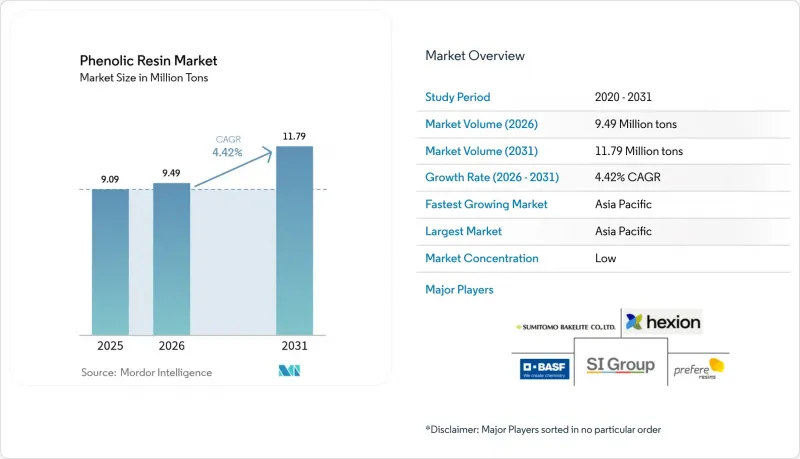
This report is Segmented by Product Type (Novolac and Resol), Application (Molding, Adhesives, Insulation, and Others), End-User Industry (Automotive and Transportation, Building and Construction, Consumer Electronics, Oil and Gas, Furniture, and Others), and Geography (Asia-Pacific, North America, Europe, South America, and Middle-East and Africa). The Market Forecasts are Provided in Terms of Volume (Tons).
Global Phenolic Resin Market Trends and Insights
Lightweight Composites Support Electric-Mobility Scale-Up
Automakers pursuing vehicle weight reduction are specifying phenolic-based sheet-molding compounds for battery enclosures, underbodies, and structural braces. SABIC's multi-material battery housing recorded a 20% weight cut while maintaining thermal-runaway containment at 1,100 °C, illustrating the material's superior heat and flame resistance. Higher voltage 800-V architectures intensify requirements for comparative tracking index performance, an attribute where phenolic formulations outperform epoxy and polyester alternatives. Hydrogen fuel-cell vehicles widen the addressable market as phenolic composites enable lightweight, chemically inert pressure-vessel shelves and ancillary housings
Modular Construction Accelerates Phenolic-Foam Adoption
The move toward factory-built walls and volumetric modules benefits phenolic foam, whose low smoke generation and Class A flame rating satisfy stricter North American and European codes. Prefabricated facade panels equipped with 30 mm phenolic boards deliver U-values below 0.15 W/m2-K, meeting near-zero-energy building targets without thick cavities. Installation speed is another appeal: contractors report up to 25% labor savings because phenolic foam boards combine insulation and fire barrier in a single layer. Rail operators follow a similar logic, EN 45545-2 compliance drives phenolic sandwich panels for interior linings, lowering refurbishment downtime while guaranteeing R1 HL3 classification
Feedstock Volatility Challenges Margin Stability
Phenol accounts for roughly 50% of the cash cost in standard resol production, exposing manufacturers to swings tied to benzene and propylene. Asian suppliers benefit from surplus BPA capacity that releases unreacted phenol back into the merchant market, cushioning regional price shocks. Forward-buying strategies and indexed contracts partly mute risk, yet smaller converters lack hedging scale.
Other drivers and restraints analyzed in the detailed report include:
- Automotive Friction-Material Rebound Sustains Resin Orders
- Fire-Safety Regulations Expand Addressable Sectors
- Emission Regulations Tighten Compliance Budgets
For complete list of drivers and restraints, kindly check the Table Of Contents.
Segment Analysis
Resol formulations generated 55.35% of the phenolic resin market share in 2025, thanks to self-curing behavior that eliminates hardeners in plywood and oriented-strand-board lines. Novolac variants are growing at a CAGR of 4.87% CAGR to 2031, outpacing resol as electronic-laminate and friction-material applications expand. Around 68 kt of novolac capacity is slated to come onstream in India and Vietnam by 2027, targeting export markets that demand low-free-phenol performance.
Resols employ an F:P ratio above 1.0, forming methylene linkages that set at 120-140 °C. This mechanism favours continuous press lines where cycle time dictates profitability. Conversely, novolac resins, synthesized under acidic conditions with F:P below 1.0, demand hexamine curing agents but yield finer cross-link topology, which boosts viscosity stability during long storage. Brake-pad formulators prefer novolac because thermal decomposition begins near 480 °C, 60 °C higher than typical resols, ensuring fade resistance. High-frequency circuit-board makers also choose novolac-epoxy hybrids for low moisture uptake below 0.2% at 23 °C/50% RH, critical to avoid delamination under reflow soldering.
Complete Report Scope:
- By Product Type (Volume)
- Novolac
- Resol
- By Application
- Molding
- Adhesives
- Insulation
- Others
- By End-user Industry
- Automotive and Transportation
- Building and Construction
- Consumer Electronics
- Oil, and Gas
- Furniture
- Others
- By Geography
- Asia-Pacific
- China
- India
- Japan
- South Korea
- Malaysia
- Thailand
- Indonesia
- Vietnam
- Rest of Asia-Pacific
- North America
- United States
- Canada
- Mexico
- Europe
- Germany
- United Kingdom
- France
- Italy
- Spain
- NORDIC Countries
- Turkey
- Russia
- Rest of Europe
- South America
- Brazil
- Argentina
- Colombia
- Rest of South America
- Middle-East and Africa
- Saudi Arabia
- United Arab Emirates
- Nigeria
- South Africa
- Rest of Middle-East and Africa
- Asia-Pacific
Geography Analysis
Asia Pacific controlled 48.60% of the global phenolic resin market volume in 2025 and is expanding at a 5.03% CAGR through 2031. India offers the fastest incremental lift as domestic plywood makers convert from urea-formaldehyde to phenolic adhesive systems in response to Bureau of Indian Standards revisions. Indonesia and Vietnam, buoyed by foreign direct investment into furniture clusters, are emerging buyers of liquid resin imports.
North America is anchored by a resilient housing-start pipeline and re-shoring of electric-vehicle supply chains. Recent US Inflation Reduction Act tax credits accelerate battery-plant construction, creating pull-through demand for phenolic composite battery boxes and insulation components.
Europe is constrained by subdued construction activity, yet sees bright spots in railway refurbishment and high-speed train carriage production. EN 45545-2 upgrades mandated by several national operators advance phenolic panel adoption.
Gulf petrochemical players are evaluating downstream phenolic integration to monetise benzene streams, which could stimulate local supply. South Africa is trialling phenolic foam in public-hospital retrofits to meet energy-efficiency targets, presenting a beachhead for niche imports.
- BAKELIGHT SYNTHESIS
- Aica Kogyo Co. Ltd
- ASAHI YUKIZAI CORPORATION
- ASK Chemicals
- BASF
- Capital Resin Corporation
- DIC Corportaion
- Hexcel Corporation
- Hexion Inc.
- Kolon Industries Inc.
- NANPAO RESINS CHEMICAL GROUP
- Plastics Engineering Company (Plenco)
- Prefere Resins Holding GmbH
- Romit Resins Pvt. Ltd
- Shandong Laiwu Runda New Material Co. Ltd
- SHENGQUAN GROUP
- SI Group
- Sumitomo Bakelite Co. Ltd
- Sundow Polymers Co. Ltd
- Taiwan PU Corporation
- UPM
Additional Benefits:
- The market estimate (ME) sheet in Excel format
- 3 months of analyst support
TABLE OF CONTENTS
1 Introduction
- 1.1 Study Assumptions and Market Definition
- 1.2 Scope of the Study
2 Research Methodology
3 Executive Summary
4 Market Landscape
- 4.1 Market Overview
- 4.2 Market Drivers
- 4.2.1 Lightweight, Heat-Resistant Composites Demand from EV and Hydrogen Vehicles
- 4.2.2 Modular and Prefab Construction Adopting Phenolic-Foam Insulation
- 4.2.3 Recovery of Automotive Friction-Material Production
- 4.2.4 Stricter Fire-Safety Norms in Public Transport Interiors
- 4.2.5 Expansion of 5G PCB Laminates Needing Low-Loss Phenolics
- 4.3 Market Restraints
- 4.3.1 Volatile Phenol and Formaldehyde Feedstock Prices
- 4.3.2 Stricter Formaldehyde-Emission Regulations
- 4.3.3 Limited Recycling and End-of-Life Options
- 4.4 Value Chain Analysis
- 4.5 Porter's Five Forces Analysis
- 4.5.1 Bargaining Power of Suppliers
- 4.5.2 Bargaining Power of Buyers
- 4.5.3 Threat of New Entrants
- 4.5.4 Threat of Substitutes
- 4.5.5 Competitive Rivalry
5 Market Size and Growth Forecasts
- 5.1 By Product Type (Volume)
- 5.1.1 Novolac
- 5.1.2 Resol
- 5.2 By Application
- 5.2.1 Molding
- 5.2.2 Adhesives
- 5.2.3 Insulation
- 5.2.4 Others
- 5.3 By End-user Industry
- 5.3.1 Automotive and Transportation
- 5.3.2 Building and Construction
- 5.3.3 Consumer Electronics
- 5.3.4 Oil, and Gas
- 5.3.5 Furniture
- 5.3.6 Others
- 5.4 By Geography
- 5.4.1 Asia-Pacific
- 5.4.1.1 China
- 5.4.1.2 India
- 5.4.1.3 Japan
- 5.4.1.4 South Korea
- 5.4.1.5 Malaysia
- 5.4.1.6 Thailand
- 5.4.1.7 Indonesia
- 5.4.1.8 Vietnam
- 5.4.1.9 Rest of Asia-Pacific
- 5.4.2 North America
- 5.4.2.1 United States
- 5.4.2.2 Canada
- 5.4.2.3 Mexico
- 5.4.3 Europe
- 5.4.3.1 Germany
- 5.4.3.2 United Kingdom
- 5.4.3.3 France
- 5.4.3.4 Italy
- 5.4.3.5 Spain
- 5.4.3.6 NORDIC Countries
- 5.4.3.7 Turkey
- 5.4.3.8 Russia
- 5.4.3.9 Rest of Europe
- 5.4.4 South America
- 5.4.4.1 Brazil
- 5.4.4.2 Argentina
- 5.4.4.3 Colombia
- 5.4.4.4 Rest of South America
- 5.4.5 Middle-East and Africa
- 5.4.5.1 Saudi Arabia
- 5.4.5.2 United Arab Emirates
- 5.4.5.3 Nigeria
- 5.4.5.4 South Africa
- 5.4.5.5 Rest of Middle-East and Africa
- 5.4.1 Asia-Pacific
6 Competitive Landscape
- 6.1 Market Concentration
- 6.2 Strategic Moves
- 6.3 Market Share(%)/Ranking Analysis
- 6.4 Company Profiles (includes Global level Overview, Market level overview, Core Segments, Financials as available, Strategic Information, Market Rank/Share for key companies, Products and Services, and Recent Developments)
- 6.4.1 BAKELIGHT SYNTHESIS
- 6.4.2 Aica Kogyo Co. Ltd
- 6.4.3 ASAHI YUKIZAI CORPORATION
- 6.4.4 ASK Chemicals
- 6.4.5 BASF
- 6.4.6 Capital Resin Corporation
- 6.4.7 DIC Corportaion
- 6.4.8 Hexcel Corporation
- 6.4.9 Hexion Inc.
- 6.4.10 Kolon Industries Inc.
- 6.4.11 NANPAO RESINS CHEMICAL GROUP
- 6.4.12 Plastics Engineering Company (Plenco)
- 6.4.13 Prefere Resins Holding GmbH
- 6.4.14 Romit Resins Pvt. Ltd
- 6.4.15 Shandong Laiwu Runda New Material Co. Ltd
- 6.4.16 SHENGQUAN GROUP
- 6.4.17 SI Group
- 6.4.18 Sumitomo Bakelite Co. Ltd
- 6.4.19 Sundow Polymers Co. Ltd
- 6.4.20 Taiwan PU Corporation
- 6.4.21 UPM
7 Market Opportunities and Future Outlook
- 7.1 White-space and Unmet-Need Assessment
- 7.2 Bio-based phenolic innovations (lignin, cardanol)

