PUBLISHER: Mordor Intelligence | PRODUCT CODE: 2115019

PUBLISHER: Mordor Intelligence | PRODUCT CODE: 2115019
Identity As A Service - Market Share Analysis, Industry Trends & Statistics, Growth Forecasts (2026 - 2031)
According to Mordor Intelligence, the identity-as-a-Service market size is expected to grow from USD 11.22 billion in 2025 to USD 13.48 billion in 2026 and is forecast to reach USD 33.79 billion by 2031 at 20.18% CAGR over 2026-2031.
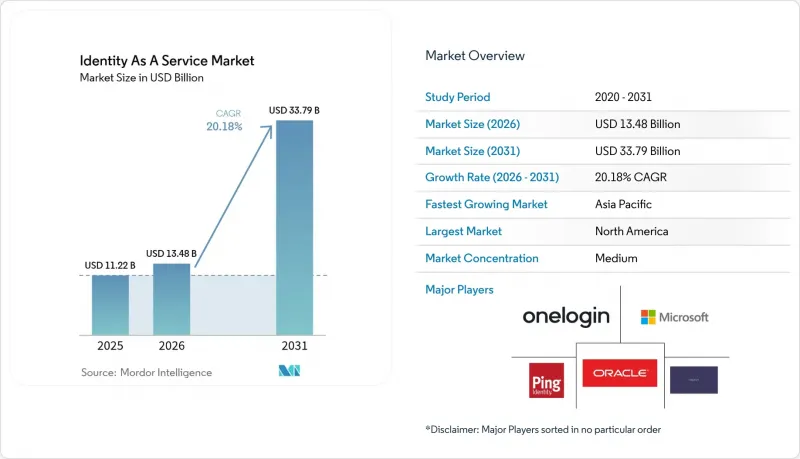
This report is Segmented by Component (Provisioning, Directory Services, and More), Authentication Type (Single-Factor, Multi-Factor, and More), Deployment Mode (Public Cloud, and More), User Type (Workforce Identity, and More), Organization Size (Large Enterprise, and More), End-User Vertical (BFSI, Telecom and IT, and More), and by Geography. The Market Forecasts are Provided in Terms of Value (USD).
Global Identity As A Service Market Trends and Insights
Cloud-native zero-trust adoption in regulated U.S. sectors
Executive Order 14028 requires U.S. federal agencies to implement zero-trust architectures, making identity verification the first line of defense. NIST's draft practice guide codifies an interoperable blueprint that cuts deployment risk for private and public stakeholders.Hospitals, insurers, and capital-markets firms are leveraging the guidance to shift from perimeter controls to continuous verification, turning Identity-as-a-Service market subscriptions into essential operating expenditure.
Proliferation of API-based micro-services requiring CI/CD identity controls
European adoption of micro-services has outpaced legacy IAM capabilities. The EU Digital Identity Regulation obliges Member States to issue cross-border digital wallets by 2026, creating uniform APIs for authentication. DevOps teams now require platforms that auto-provision tokens during each CI/CD run, positioning Identity-as-a-Service market providers that specialize in machine-identity governance for outsized growth.
Legacy mainframe entanglement in Tier-1 banks
Tier-1 financial institutions face significant technical debt from mainframe systems that resist integration with modern IDaaS platforms, creating migration timelines that extend beyond typical enterprise deployment cycles. ING's migration of 1.5 million COBOL lines illustrates the complexity of decoupling IAM logic trapped inside core banking systems softwaremining.com. Hybrid coexistence with mainframes prolongs testing cycles, tempering Identity-as-a-Service market acceleration among global banks.
Other drivers and restraints analyzed in the detailed report include:
- Asia-Pacific digital public-goods programs (eKYC, Aadhaar, Singpass)
- Enterprise-wide passwordless FIDO2 roll-outs in financial services
- Fragmented Middle-East data-residency statutes
For complete list of drivers and restraints, kindly check the Table Of Contents.
Segment Analysis
The provisioning segment generated 29.12% of Identity-as-a-Service market revenue in 2025, underlining the universal need for automated joiner-mover-leaver workflows across hybrid cloud estates. Directory services and single sign-on remain table stakes, yet adoption now concentrates on suites that orchestrate lifecycle controls for both human and machine principals.
Multi-factor and passwordless authentication services are forecast to grow 21.96% annually as regulatory guidance rewards phishing-resistant mechanisms. Vendors such as CyberArk are integrating biometric passkey orchestration following the USD 1.66 billion Venafi acquisition, signaling that unified suites will outpace isolated toolsets investors.
Single-factor methods retained 45.62% revenue share in 2025, largely due to legacy workloads that cannot yet support modern protocols. Passwordless mechanisms, however, are set to outgrow the Identity-as-a-Service market at a 21.34% CAGR as FIDO2 certification becomes table stakes for regulated industries. The Federal Reserve Bank of Boston attributes USD 35 billion in 2024 fraud losses to synthetic identities, a statistic that spurs enterprises to prioritize continuous biometric and behavioral authentication.
Multi-factor tools serve as transitional safeguards, but board-level risk committees now favor passkeys that eliminate shared secrets entirely. This pivot reinforces a structural shift from occasional to continuous identity assurance.
Complete Report Scope:
- By Component
- Provisioning
- Directory Services
- Single Sign-On (SSO)
- Password Management
- Advanced / Multi-factor Authentication
- Access Governance and Compliance
- By Authentication Type
- Single-Factor (Password-based)
- Multi-Factor (Token, OTP, Mobile Push)
- Passwordless (Biometric, FIDO2)
- By Deployment Mode
- Public Cloud
- Private Cloud
- Hybrid Cloud
- By User Type
- Workforce Identity
- Customer / Consumer Identity (CIAM)
- By Organization Size
- Large Enterprise
- Small and Medium Enterprise (SME)
- By End-User Vertical
- BFSI
- Telecom and IT
- Public Sector and Government
- Healthcare and Life-Sciences
- Energy and Utilities
- Manufacturing
- Retail and E-commerce
- Education
- Others
- By Geography
- North America
- United States
- Canada
- Mexico
- South America
- Brazil
- Argentina
- Rest of South America
- Europe
- Germany
- United Kingdom
- France
- Nordic Countries
- Rest of Europe
- Asia Pacific
- China
- India
- Japan
- South Korea
- Australia
- New Zealand
- Rest of Asia Pacific
- Middle East and Africa
- Middle East
- Africa
- North America
Geography Analysis
North America accounted for 38.35% of Identity-as-a-Service market revenue in 2025. Federal zero-trust edicts and early passwordless roll-outs among tier-one banks sustain spending momentum. Canada's cloud-first program and Mexico's cross-border trade platforms add incremental demand, all underpinned by mature hyperscaler infrastructure.
Asia-Pacific is the fastest-growing region at 23.02% CAGR. National digital ID frameworks, coupled with accelerated public-cloud adoption in Indonesia, India, and Vietnam, multiply workforce and citizen-access use cases. Enterprises leverage government-issued credentials to bind employees and contractors, compressing onboarding time and reducing KYC costs.
Europe exhibits steady expansion, catalyzed by the EU Digital Identity Regulation that obliges members to deploy interoperable wallets by 2026. Germany's EUDI pilot and France's health-data localization rules drive joint procurement models between ministries and enterprises. Providers able to guarantee regional data residency while integrating cross-border workflows will consolidate gains.
- Microsoft Corporation
- Okta Inc.
- Ping Identity Corporation
- IBM Corporation
- IDaptive LLC
- CyberArk Software Ltd.
- SailPoint Technologies
- ForgeRock Inc.
- One Identity LLC
- Oracle Corporation
- Amazon Web Services (AWS Cognito)
- Google LLC (Cloud Identity)
- Thales Group (Gemalto)
- SAP SE
- Cisco Systems Duo Security
- Auth0 (now Okta)
- OneLogin Inc.
- Saviynt
- Simeio Solutions
- Entrust Corporation
- Transmit Security
Additional Benefits:
- The market estimate (ME) sheet in Excel format
- 3 months of analyst support
TABLE OF CONTENTS
1 INTRODUCTION
- 1.1 Study Assumptions and Market Definition
- 1.2 Scope of the Study
2 RESEARCH METHODOLOGY
3 EXECUTIVE SUMMARY
4 MARKET LANDSCAPE
- 4.1 Market Overview
- 4.2 Market Drivers
- 4.2.1 Cloud-native Zero-Trust Adoption in U.S.-Centric Highly Regulated Sectors
- 4.2.2 Proliferation of API-based Micro-Services Accelerating CI/CD IDaaS Demand in Europe
- 4.2.3 Asia's Digital Public Goods (eKYC, Aadhaar, Singpass) Triggering Country-wide Workforce IDaaS Roll-outs
- 4.2.4 Passwordless FIDO2 Pilots Converting to Enterprise-wide Licences in Financial Services
- 4.2.5 Vendor-bundled IAM Analytics Using Generative-AI for Real-time Risk Scoring
- 4.2.6 MandA-Driven Horizontal Suite-Building by Hyperscalers (Azure, AWS) Boosting Integrated IDaaS Uptake
- 4.3 Market Restraints
- 4.3.1 Legacy Mainframe Entanglement Slowing IDaaS Migration in Tier-1 Banks
- 4.3.2 Fragmented Data-Residency Statutes in the Middle East Inflating Compliance Costs
- 4.3.3 High Latency Concerns Among IIoT Users for Cloud-hosted Authentication
- 4.3.4 Vendor-lock-in Fears around Proprietary SSO Protocol Extensions
- 4.4 Value / Supply-Chain Analysis
- 4.5 Regulatory Landscape
- 4.6 Technological Outlook
- 4.7 Porter's Five Forces
- 4.7.1 Threat of New Entrants
- 4.7.2 Bargaining Power of Buyers
- 4.7.3 Bargaining Power of Suppliers
- 4.7.4 Threat of Substitutes
- 4.7.5 Intensity of Competitive Rivalry
5 MARKET SIZE AND GROWTH FORECASTS (VALUE)
- 5.1 By Component
- 5.1.1 Provisioning
- 5.1.2 Directory Services
- 5.1.3 Single Sign-On (SSO)
- 5.1.4 Password Management
- 5.1.5 Advanced / Multi-factor Authentication
- 5.1.6 Access Governance and Compliance
- 5.2 By Authentication Type
- 5.2.1 Single-Factor (Password-based)
- 5.2.2 Multi-Factor (Token, OTP, Mobile Push)
- 5.2.3 Passwordless (Biometric, FIDO2)
- 5.3 By Deployment Mode
- 5.3.1 Public Cloud
- 5.3.2 Private Cloud
- 5.3.3 Hybrid Cloud
- 5.4 By User Type
- 5.4.1 Workforce Identity
- 5.4.2 Customer / Consumer Identity (CIAM)
- 5.5 By Organization Size
- 5.5.1 Large Enterprise
- 5.5.2 Small and Medium Enterprise (SME)
- 5.6 By End-User Vertical
- 5.6.1 BFSI
- 5.6.2 Telecom and IT
- 5.6.3 Public Sector and Government
- 5.6.4 Healthcare and Life-Sciences
- 5.6.5 Energy and Utilities
- 5.6.6 Manufacturing
- 5.6.7 Retail and E-commerce
- 5.6.8 Education
- 5.6.9 Others
- 5.7 By Geography
- 5.7.1 North America
- 5.7.1.1 United States
- 5.7.1.2 Canada
- 5.7.1.3 Mexico
- 5.7.2 South America
- 5.7.2.1 Brazil
- 5.7.2.2 Argentina
- 5.7.2.3 Rest of South America
- 5.7.3 Europe
- 5.7.3.1 Germany
- 5.7.3.2 United Kingdom
- 5.7.3.3 France
- 5.7.3.4 Nordic Countries
- 5.7.3.5 Rest of Europe
- 5.7.4 Asia Pacific
- 5.7.4.1 China
- 5.7.4.2 India
- 5.7.4.3 Japan
- 5.7.4.4 South Korea
- 5.7.4.5 Australia
- 5.7.4.6 New Zealand
- 5.7.4.7 Rest of Asia Pacific
- 5.7.5 Middle East and Africa
- 5.7.5.1 Middle East
- 5.7.5.2 Africa
- 5.7.1 North America
6 COMPETITIVE LANDSCAPE
- 6.1 Market Concentration
- 6.2 Strategic Moves (MandA, Alliances, Funding)
- 6.3 Market Share Analysis
- 6.4 Company Profiles {(includes Global level Overview, Market level overview, Core Segments, Financials as available, Strategic Information, Market Rank/Share for key companies, Products and Services, and Recent Developments)}
- 6.4.1 Microsoft Corporation
- 6.4.2 Okta Inc.
- 6.4.3 Ping Identity Corporation
- 6.4.4 IBM Corporation
- 6.4.5 IDaptive LLC
- 6.4.6 CyberArk Software Ltd.
- 6.4.7 SailPoint Technologies
- 6.4.8 ForgeRock Inc.
- 6.4.9 One Identity LLC
- 6.4.10 Oracle Corporation
- 6.4.11 Amazon Web Services (AWS Cognito)
- 6.4.12 Google LLC (Cloud Identity)
- 6.4.13 Thales Group (Gemalto)
- 6.4.14 SAP SE
- 6.4.15 Cisco Systems Duo Security
- 6.4.16 Auth0 (now Okta)
- 6.4.17 OneLogin Inc.
- 6.4.18 Saviynt
- 6.4.19 Simeio Solutions
- 6.4.20 Entrust Corporation
- 6.4.21 Transmit Security
7 MARKET OPPORTUNITIES AND FUTURE OUTLOOK
- 7.1 White-space and Unmet Need Analysis

