PUBLISHER: Mordor Intelligence | PRODUCT CODE: 2115024

PUBLISHER: Mordor Intelligence | PRODUCT CODE: 2115024
Bioactive Wound Dressing - Market Share Analysis, Industry Trends & Statistics, Growth Forecasts (2026 - 2031)
According to Mordor Intelligence, bioactive wound dressing market size in 2026 is estimated at USD 4.27 billion, growing from 2025 value of USD 3.87 billion with 2031 projections showing USD 6.99 billion, growing at 10.36% CAGR over 2026-2031.
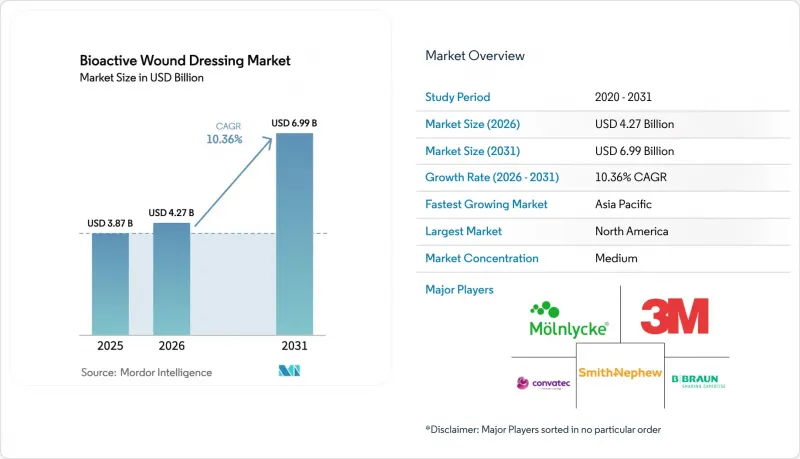
This report is Segmented by Product (Hydrocolloids, Alginate Dressing, Skin Substitutes, Antimicrobial Dressing, and More), Application (Surgical and Traumatic Wounds, Burns, and More), End User (In-Patient Facilities, Out-Patient / Ambulatory Settings, and Home-Healthcare) and Geography. The Market Sizes and Forecasts are Provided in Terms of Value (USD).
Global Bioactive Wound Dressing Market Trends and Insights
Growing burden of chronic wounds & diabetes
Global diabetes now affects more than 537 million adults, and diabetic foot ulcers reach 15-25% of that population, creating persistent demand for advanced solutions that can cut healing time by 30-40% compared with gauze. Chronic wounds afflict 6.7 million Americans and drive USD 50 billion in direct annual treatment costs; evidence shows platelet-rich plasma dressings achieve 65% complete closure in 12 weeks versus 40% with standard care. Clinical superiority supports premium pricing and drives physician adoption, especially among older patients whose healing capacity declines with age.
Rapid innovation in biomaterial science (hydrogels, alginate composites)
Next-generation hydrogels possess self-healing properties that restore up to 90% structural integrity within hours, while high-purity alginate extraction improves biocompatibility and addresses earlier supply bottlenecks. Smart-responsive polymers now adjust moisture, pH, and glucose gradients on the wound bed, accelerating epithelialization by 25% in clinical studies. Antimicrobial nanofibers containing silver or copper mitigate infection without compromising tissue regeneration, and nanodiamond additives add mechanical strength for chronic cases.
High product cost vs. traditional dressings
Advanced dressings range from USD 50-200 per unit, while standard gauze costs under USD 5, creating hurdles for cost-sensitive providers. The 2025 Physician Fee Schedule trimmed average reimbursement by 2.93%, pushing hospitals to justify premium selections; adoption rates in low-income countries trail by up to 70% despite documented 30-40% savings over an entire treatment episode.
Other drivers and restraints analyzed in the detailed report include:
- Rising geriatric population & surgery volumes
- Wider reimbursement of bioactive dressings in OECD countries
- Emergence of smart bio-electronic dressings with in-situ sensors
- Defense & remote-trauma adoption of fish-skin grafts
- Supply-chain fragility for marine/biologic raw materials
For complete list of drivers and restraints, kindly check the Table Of Contents.
Segment Analysis
Smart bio-electronic dressings are the fastest-growing product group, expanding at an 10.95% CAGR and gradually lifting their share of the bioactive wound dressing market . Skin substitutes, however, retained a 42.78% bioactive wound dressing market share in 2025 owing to broad clinical familiarity and reimbursement coverage. The bioactive wound dressing market size for skin substitutes reached USD 1.66 billion in 2025 and continues to advance on the back of favorable clinical trials.
Traditional hydrocolloid and alginate sheets remain workhorses in high-volume surgical cases but face commoditization and margin squeeze. Collagen and chitosan dressings win favor for regenerative outcomes, particularly in reconstructive surgery. Sustainability concerns amplify interest in bacterial-cellulose and plant-based alternatives, while combination products that embed antimicrobials or growth factors secure higher price points because they shorten dressing cycles.
Complete Report Scope:
- By Product
- Hydrocolloids
- Alginate Dressings
- Collagen-based Dressings
- Skin Substitutes (Acellular & Living)
- Antimicrobial/Silver Dressings
- Chitosan & Bacterial-Cellulose Dressings
- Growth-Factor / Stem-Cell Impregnated
- Smart Bio-electronic Dressings
- By Application
- Surgical & Traumatic Wounds
- Burns
- Diabetic Foot Ulcers
- Pressure Ulcers
- Venous & Arterial Ulcers
- Donor-Site & Other Chronic Wounds
- By End User
- In-patient Facilities
- Out-patient / Ambulatory Settings
- Home-Healthcare
- By Geography
- North America
- United States
- Canada
- Mexico
- Europe
- Germany
- United Kingdom
- France
- Italy
- Spain
- Rest of Europe
- Asia-Pacific
- China
- Japan
- India
- Australia
- South Korea
- Rest of Asia-Pacific
- Middle East & Africa
- GCC
- South Africa
- Rest of Middle East & Africa
- South America
- Brazil
- Argentina
- Rest of South America
- North America
Geography Analysis
North America led with 42.30% of bioactive wound dressing market share in 2025, buoyed by Medicare coverage expansion and robust clinical-evidence demands that reward differentiated technologies. Regional innovations such as Solventum's V.A.C. Peel and Place Dressing have cut application time by 61% and overall costs by 41%, cementing provider confidence . Despite a 2.93% Medicare payment reduction in 2025, the region's aging populace and high diabetes incidence sustain long-run demand; Department of Defense contracts worth USD 75 million underscore continued government backing for trauma solutions.
Asia-Pacific is the fastest-growing territory at 11.55% CAGR through 2031, propelled by rising incomes, insurance coverage, and modernizing regulatory frameworks. India's updated marketing code for medical devices signals tighter compliance and smoother entry for foreign brands, while local manufacturing capacity drives competitive pricing. Clinical studies reveal biodegradable temporizing matrices achieve 94.6% healing rates across Asian cohorts, reinforcing clinician trust .
Europe records steady progress, supported by rigorous health-technology assessments that reward proven efficacy. HARTMANN reported EUR 608.9 million wound-care revenue in 2024, up 4.4% organically, reflecting demand for silicone super-absorbents that manage complex exudate scenarios. Sustainability priorities boost alginate and chitosan uptake, while post-Brexit regulatory alignment remains a moving target but is unlikely to derail continental adoption. Emerging markets in Latin America and Africa present long-term upside yet demand lower-cost variants and infrastructure-friendly supply chains.
- 3M (incl. KCI/Acelity)
- Smiths Group
- Molnlycke Health Care
- ConvaTec Group plc
- B. Braun
- Coloplast
- Organogenesis Holdings
- Kerecis Ltd
- Medtronic
- Johnson & Johnson
- Covalon Technologies
- Hollister
- Integra LifeSciences
- Medline Industries
- Urgo Medical
- Human Biosciences
- Derma Sciences (Integra)
- DermaRite Industries
- Advanced Medical Solutions Group
- Adynxx Inc.
Additional Benefits:
- The market estimate (ME) sheet in Excel format
- 3 months of analyst support
TABLE OF CONTENTS
1 Introduction
- 1.1 Study Assumptions & Market Definition
- 1.2 Scope of the Study
2 Research Methodology
3 Executive Summary
4 Market Landscape
- 4.1 Market Overview
- 4.2 Market Drivers
- 4.2.1 Growing burden of chronic wounds & diabetes
- 4.2.2 Rapid innovation in biomaterial science (hydrogels, alginate composites)
- 4.2.3 Rising geriatric population & surgery volumes
- 4.2.4 Wider reimbursement of bioactive dressings in OECD countries
- 4.2.5 Emergence of smart bio-electronic dressings with in-situ sensors
- 4.2.6 Defence & remote-trauma adoption of fish-skin grafts
- 4.3 Market Restraints
- 4.3.1 High product cost vs. traditional dressings
- 4.3.2 Reimbursement gaps in emerging markets
- 4.3.3 Supply-chain fragility for marine/biologic raw materials
- 4.3.4 Regulatory ambiguity around living-cell/IoT combination dressings
- 4.4 Value / Supply-Chain Analysis
- 4.5 Regulatory Landscape
- 4.6 Technological Outlook
- 4.7 Porter's Five Forces Analysis
- 4.7.1 Threat of New Entrants
- 4.7.2 Bargaining Power of Buyers
- 4.7.3 Bargaining Power of Suppliers
- 4.7.4 Threat of Substitutes
- 4.7.5 Intensity of Competitive Rivalry
5 Market Size & Growth Forecasts (Value)
- 5.1 By Product
- 5.1.1 Hydrocolloids
- 5.1.2 Alginate Dressings
- 5.1.3 Collagen-based Dressings
- 5.1.4 Skin Substitutes (Acellular & Living)
- 5.1.5 Antimicrobial/Silver Dressings
- 5.1.6 Chitosan & Bacterial-Cellulose Dressings
- 5.1.7 Growth-Factor / Stem-Cell Impregnated
- 5.1.8 Smart Bio-electronic Dressings
- 5.2 By Application
- 5.2.1 Surgical & Traumatic Wounds
- 5.2.2 Burns
- 5.2.3 Diabetic Foot Ulcers
- 5.2.4 Pressure Ulcers
- 5.2.5 Venous & Arterial Ulcers
- 5.2.6 Donor-Site & Other Chronic Wounds
- 5.3 By End User
- 5.3.1 In-patient Facilities
- 5.3.2 Out-patient / Ambulatory Settings
- 5.3.3 Home-Healthcare
- 5.4 By Geography
- 5.4.1 North America
- 5.4.1.1 United States
- 5.4.1.2 Canada
- 5.4.1.3 Mexico
- 5.4.2 Europe
- 5.4.2.1 Germany
- 5.4.2.2 United Kingdom
- 5.4.2.3 France
- 5.4.2.4 Italy
- 5.4.2.5 Spain
- 5.4.2.6 Rest of Europe
- 5.4.3 Asia-Pacific
- 5.4.3.1 China
- 5.4.3.2 Japan
- 5.4.3.3 India
- 5.4.3.4 Australia
- 5.4.3.5 South Korea
- 5.4.3.6 Rest of Asia-Pacific
- 5.4.4 Middle East & Africa
- 5.4.4.1 GCC
- 5.4.4.2 South Africa
- 5.4.4.3 Rest of Middle East & Africa
- 5.4.5 South America
- 5.4.5.1 Brazil
- 5.4.5.2 Argentina
- 5.4.5.3 Rest of South America
- 5.4.1 North America
6 Competitive Landscape
- 6.1 Market Concentration
- 6.2 Market Share Analysis
- 6.3 Company Profiles (includes Global level Overview, Market level overview, Core Segments, Financials as available, Strategic Information, Market Rank/Share for key companies, Products & Services, and Recent Developments)
- 6.3.1 3M (incl. KCI/Acelity)
- 6.3.2 Smith & Nephew plc
- 6.3.3 Molnlycke Health Care AB
- 6.3.4 ConvaTec Group plc
- 6.3.5 B. Braun SE
- 6.3.6 Coloplast A/S
- 6.3.7 Organogenesis Holdings
- 6.3.8 Kerecis Ltd
- 6.3.9 Medtronic plc
- 6.3.10 Johnson & Johnson (Ethicon)
- 6.3.11 Covalon Technologies Ltd
- 6.3.12 Hollister Incorporated
- 6.3.13 Integra LifeSciences
- 6.3.14 Medline Industries LP
- 6.3.15 Urgo Medical
- 6.3.16 Human Biosciences
- 6.3.17 Derma Sciences (Integra)
- 6.3.18 DermaRite Industries LLC
- 6.3.19 Advanced Medical Solutions Group
- 6.3.20 Adynxx Inc.
7 Market Opportunities & Future Outlook
- 7.1 White-space & Unmet-need Assessment

