PUBLISHER: Mordor Intelligence | PRODUCT CODE: 2115032

PUBLISHER: Mordor Intelligence | PRODUCT CODE: 2115032
India Connected Car - Market Share Analysis, Industry Trends & Statistics, Growth Forecasts (2026 - 2031)
According to Mordor Intelligence, the India connected car market size is expected to grow from USD 150 million in 2025 to USD 186.42 million in 2026 and is forecast to reach USD 551.62 million by 2031 at 24.28% CAGR over 2026-2031.
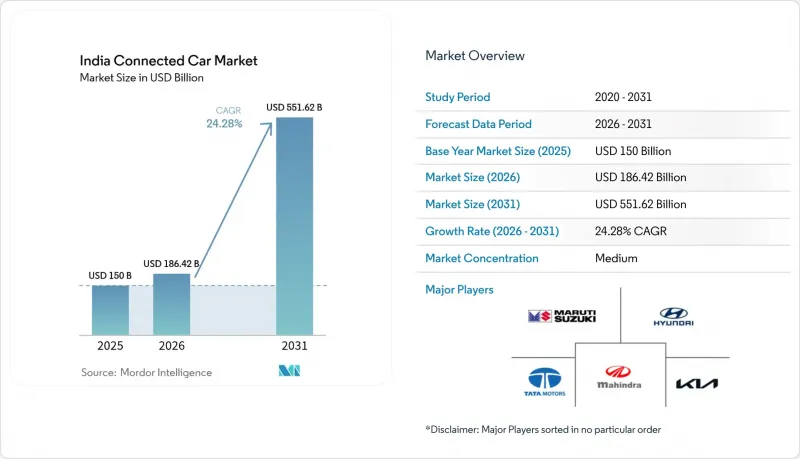
This report is Segmented by Application Type (Navigation, Remote Diagnostics, and More), Connectivity Type (Embedded, Integrated, and More), Communication Model (Vehicle-To-Vehicle and More), Vehicle Type (Passenger Cars, Light Commercial Vehicles, and More), and Sales Channel (OEM-Factory-Fit, Aftermarket Retrofit). The Market Forecasts are Provided in Terms of Value (USD) and Volume (Units).
India Connected Car Market Trends and Insights
Rapid Smartphone and 4G/5G Penetration
India's 5G user base touched 365 million as of July 2025, creating a ready canvas for vehicle-smartphone fusion that steers the India connected car market toward mass adoption . Majority of shoppers now cite connected features as pivotal when selecting a new vehicle, and OEMs respond by equipping even compact SUVs with integrated eSIMs and mobile apps. Kia's 2024 launch of the Syros model bundled an Airtel eSIM, letting owners access live traffic, geo-fencing, and theft alerts. The India connected car market also benefits because cloud transactions ride on existing telco billing rails, keeping subscription costs near mobile-data parity. As consumer expectations migrate from phones to dashboards, infotainment and safety applications move from nice-to-have to deal-breakers, accelerating standard-fit connectivity across model lines.
Government's AIS-140 and AV-NEXT Mandates
AIS-140 demands tracking and emergency buttons on commercial vehicles, while the AV-NEXT draft roadmap insists on NavIC integration in passenger cars, making compliance the main door-opener to the India connected car market. Bharat NCAP 2.0 scoring further elevates connected safety by awarding additional stars for telematics-enabled e-call and crash notification. The predictable demand curve allows Tier-1 suppliers to scale ECUs locally, which trims unit costs and increases domestic value addition. Over time, mandatory compliance morphs into a competitive differentiator as brands that exceed the bare minimum tout higher safety scores.
Data-breach and Cyber-attack Concerns
Ransomware attacks on global infotainment systems raised red flags among Indian buyers who now hesitate to share driving data. While startups like SecureThings offer anomaly-detection software, uptake stays uneven because no India-specific regulation mirrors the EU WP.29 cyber-security clause. Without mandatory standards, small OEMs treat cyber spend as optional, opening gaps that erode trust. High-profile hacks would slow the India connected car market if consumers begin disabling SIM modules or refuse consent for data collection.
Other drivers and restraints analyzed in the detailed report include:
- OEM-Telco Revenue-Share Models
- Rising Disposable Income and Aspirational Spend
- Patchy LTE Coverage on Rural Corridors
For complete list of drivers and restraints, kindly check the Table Of Contents.
Segment Analysis
Navigation accounted for 27.20% of the India connected car market share in 2025 as clogged city grids and mixed-quality road signs made live rerouting vital. Local mapping partners like MapMyIndia curate pothole alerts and fuel-station data that resonate with daily commuters. In contrast, over-the-air updates log a 26.15% CAGR to 2031 as OEMs realize a single remote fix avoids thousands of service-bay visits. The India connected car market size for OTA upgrades is projected to rise significantly by 2031, a gain that highlights software's growing share of vehicle value. Remote diagnostics and multimedia streaming follow, fueled by telco bundling of in-car data plans with family mobiles. Emergency e-call adoption ticks upward under Bharat NCAP 2.0, reinforcing safety as a selling theme.
The second wave of application adoption centers on personalization. Cabin climate presets sync through cloud profiles while voice assistants learn local dialects. Such evolutions will further cement the India connected car market as a software arena in which continuous delivery outranks model-year refresh cycles.
Embedded eSIM modules shipped in 46.55% of new connected vehicles during 2025 because OEMs want lifecycle control over diagnostics, firmware, and data routing. Integrated connectivity, which piggybacks on smartphone data, grows quickest at 25.1% CAGR as supply-chain costs lift and consumers push back against rising MSRPs. The hybrid approach often lands in mid-trim variants where buyers bring their own data but the car retains a low-bandwidth fallback eSIM for critical safety traffic.
Tethered systems remain niche in penetration, used mainly by aftermarket dongles. Yet the low hardware bill keeps them alive for fleet retrofits. Over the forecast horizon, the India connected car industry will likely settle on a dual-core strategy: embedded for high-value or regulatory-heavy use cases, integrated for budget lines.
Complete Report Scope:
- By Application Type
- Navigation
- Remote Diagnostics
- Multimedia Streaming
- Social Media and Other Apps
- OTA Update
- On-Road Assistance
- E-call and SOS Assitance
- Remote Operation
- Auto Parking/Connected Parking
- Autopilot
- Home Integration
- Stolen Vehicle Recovery/Warning
- By Connectivity Type
- Embedded
- Integrated
- Tethered
- By Communication Model
- Vehicle-to-Vehicle (V2V)
- Vehicle-to-Infrastructure (V2I)
- Vehicle-to-Pedestrian (V2P)
- Vehicle-to-Cloud (V2C)
- By Vehicle Type
- Passenger Cars
- Light Commercial Vehicles
- Heavy Commercial Vehicles
- By Sales Channel
- OEM-Factory-Fit
- After-Market Retrofit
List of Companies Covered in this Report:
- Maruti Suzuki India Ltd
- Hyundai Motor India Ltd
- Tata Motors Ltd
- Mahindra & Mahindra Ltd
- Kia India Pvt Ltd
- Toyota Kirloskar Motor
- MG Motor India
- Nissan Motor India
- Honda Cars India
- Skoda-VW India
- Renault India
- Volvo Eicher Commercial Vehicles
- Ashok Leyland Ltd
- Daimler India Commercial Vehicles
- Force Motors
- Bosch India
- Trimble India
Additional Benefits:
- The market estimate (ME) sheet in Excel format
- 3 months of analyst support
TABLE OF CONTENTS
1 Introduction
- 1.1 Study Assumptions & Market Definition
- 1.2 Scope of the Study
2 Research Methodology
3 Executive Summary
4 Market Landscape
- 4.1 Market Overview
- 4.2 Market Drivers
- 4.2.1 Rapid Smartphone and 4G/5G Penetration
- 4.2.2 Government's AIS-140 and AV-NEXT Mandates
- 4.2.3 OEM-Telco Revenue-Share Models
- 4.2.4 Rising Disposable Income and Aspirational Spend
- 4.2.5 On-board NavIC Compliance
- 4.2.6 Pay-per-use Insurance Pilots
- 4.3 Market Restraints
- 4.3.1 Data-breach and Cyber-attack Concerns
- 4.3.2 Patchy LTE Coverage on Rural Corridors
- 4.3.3 Low ARPU on Connected-services Subscriptions
- 4.3.4 Legacy Fleet Unable to Retrofit Advanced ECUs
- 4.4 Value / Supply-Chain Analysis
- 4.5 Regulatory Landscape
- 4.6 Technological Outlook
- 4.7 Porter's Five Forces
- 4.7.1 Threat of New Entrants
- 4.7.2 Bargaining Power of Buyers
- 4.7.3 Bargaining Power of Suppliers
- 4.7.4 Threat of Substitutes
- 4.7.5 Intensity of Competitive Rivalry
5 Market Size & Growth Forecasts (Value (USD) and Volume (Units))
- 5.1 By Application Type
- 5.1.1 Navigation
- 5.1.2 Remote Diagnostics
- 5.1.3 Multimedia Streaming
- 5.1.4 Social Media and Other Apps
- 5.1.5 OTA Update
- 5.1.6 On-Road Assistance
- 5.1.7 E-call and SOS Assitance
- 5.1.8 Remote Operation
- 5.1.9 Auto Parking/Connected Parking
- 5.1.10 Autopilot
- 5.1.11 Home Integration
- 5.1.12 Stolen Vehicle Recovery/Warning
- 5.2 By Connectivity Type
- 5.2.1 Embedded
- 5.2.2 Integrated
- 5.2.3 Tethered
- 5.3 By Communication Model
- 5.3.1 Vehicle-to-Vehicle (V2V)
- 5.3.2 Vehicle-to-Infrastructure (V2I)
- 5.3.3 Vehicle-to-Pedestrian (V2P)
- 5.3.4 Vehicle-to-Cloud (V2C)
- 5.4 By Vehicle Type
- 5.4.1 Passenger Cars
- 5.4.2 Light Commercial Vehicles
- 5.4.3 Heavy Commercial Vehicles
- 5.5 By Sales Channel
- 5.5.1 OEM-Factory-Fit
- 5.5.2 After-Market Retrofit
6 Competitive Landscape
- 6.1 Strategic Moves
- 6.2 Market Share Analysis
- 6.3 Company Profiles (includes Global Level Overview, Market Level Overview, Core Segments, Financials as Available, Strategic Information, Market Rank/Share for Key Companies, Products and Services, SWOT Analysis, and Recent Developments)
- 6.3.1 Maruti Suzuki India Ltd
- 6.3.2 Hyundai Motor India Ltd
- 6.3.3 Tata Motors Ltd
- 6.3.4 Mahindra & Mahindra Ltd
- 6.3.5 Kia India Pvt Ltd
- 6.3.6 Toyota Kirloskar Motor
- 6.3.7 MG Motor India
- 6.3.8 Nissan Motor India
- 6.3.9 Honda Cars India
- 6.3.10 Skoda-VW India
- 6.3.11 Renault India
- 6.3.12 Volvo Eicher Commercial Vehicles
- 6.3.13 Ashok Leyland Ltd
- 6.3.14 Daimler India Commercial Vehicles
- 6.3.15 Force Motors
- 6.3.16 Bosch India
- 6.3.17 Trimble India
7 Market Opportunities & Future Outlook
- 7.1 White-space & Unmet-Need Assessment
- 7.1.1 Bespoke connected-service bundles for tier-2/3 cities
- 7.1.2 EV-specific predictive-maintenance APIs
- 7.1.3 In-car payments & commerce integration
- 7.1.4 Customized solutions by emerging players

