PUBLISHER: Mordor Intelligence | PRODUCT CODE: 2115040

PUBLISHER: Mordor Intelligence | PRODUCT CODE: 2115040
China EV Charging Infrastructure - Market Share Analysis, Industry Trends & Statistics, Growth Forecasts (2026 - 2031)
According to Mordor Intelligence, the China's EV charging infrastructure market size market is expected to grow from USD 25.60 billion in 2025 to USD 37.61 billion in 2026 and is forecast to reach USD 257.1 billion by 2031 at 46.9% CAGR over 2026-2031.
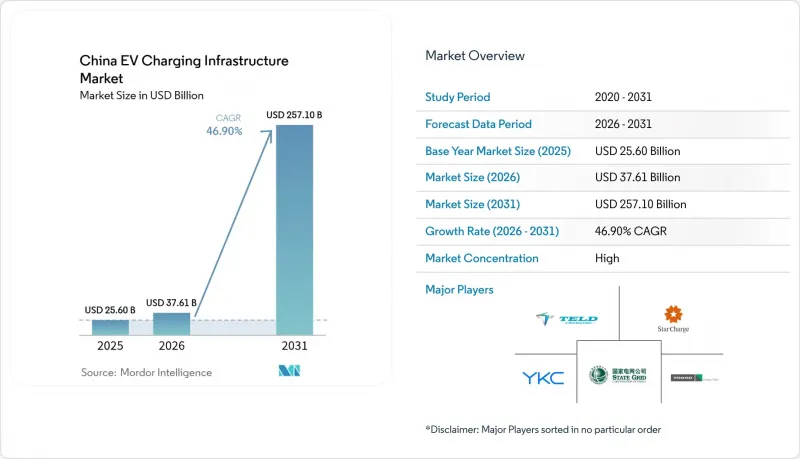
This report is Segmented by Charging Station Type (AC Charging Station, DC Charging Station, and More), Power Output (Less Than 7 KW, 7. 1 To 22 KW, and More), Installation Site (Residential, Workplace, and More), User Application (Private Infrastructure, Public Infrastructure, and More), Connector Standard, Vehicle Type and Geography. The Market Forecasts are Provided in Terms of Value (USD).
China EV Charging Infrastructure Market Trends and Insights
Aggressive NEV Dual-Credit Mandate Accelerating Charger Demand
China's NEV dual-credit policy, which combines fuel consumption credits with NEV production quotas, has become a powerful driver for charging infrastructure expansion. The policy requires automakers to achieve specific NEV production targets or purchase credits from other manufacturers, creating a structural incentive for EV adoption. As of 2024, the policy mandates that NEVs represent at least 28% of an automaker's production, with this percentage set to increase to 40% by 2030 HEV TCP. This regulatory framework has catalyzed demand for charging infrastructure, particularly in urban centers where EV adoption is highest. The mandate's impact extends beyond passenger vehicles to commercial fleets, with requirements for public transportation and logistics companies to achieve electrification targets. This comprehensive approach has created a robust ecosystem for charging infrastructure development, with the government aiming to establish a vehicle-to-charging station ratio of 2:1 by 2025 and 1:1 by 2030.
Central "New Infrastructure" Stimulus and Subsidies for Ultra-Fast Hubs
The Chinese government's designation of EV charging infrastructure as part of the "New Infrastructure" initiative has unlocked significant funding and policy support. This strategic categorization, alongside 5G networks and data centers, has elevated charging infrastructure to a national priority, attracting both public and private investments. In 2024, China added 4.222 million EV charging points, a 25% increase from 2023, with 830,000 public and 3.368 million private point. The focus has shifted toward ultra-fast charging hubs, with subsidies specifically targeting high-power installations above 150 kW. These hubs are strategically positioned along highways and in urban centers to address range anxiety and improve charging convenience. The government's financial support includes direct subsidies, tax incentives, and preferential land allocation, creating a favorable environment for infrastructure expansion. This approach has been particularly effective in accelerating the deployment of charging infrastructure in less developed regions, helping to address the urban-rural disparity in charging access.
Urban Distribution-Grid Transformer Constraints Delaying Permits
High-power hubs in mature city cores are hitting the ceiling of local transformer capacity, extending permitting cycles and inflating grid-connection costs. Utilities are upgrading hardware, yet construction timelines lag charger demand, especially in legacy downtown grids. Operators are countering with on-site battery storage to shave peaks, but such hybrid systems raise capital intensity and challenge near-term returns, temporarily tempering expansion of the China EV charging infrastructure market.
Other drivers and restraints analyzed in the detailed report include:
- Ride-Hailing and Logistics EV-Fleet Boom Requiring Depot Fast-Charging
- Grid-Edge Digitalization and V2G Pilots Promoting Smart Charger Roll-outs
- Low Public-Charger Utilization Squeezing Operator Margins
For complete list of drivers and restraints, kindly check the Table Of Contents.
Segment Analysis
AC chargers retained a 57.21% share of the China EV charging infrastructure market in 2025, reflecting cost-efficient deployment in residential and workplace garages. However, high-power DC stations above 150 kW posted a 26.41% CAGR and now anchor state-backed highway corridors and urban hubs. Government subsidies for ultra-fast terminals and BYD's introduction of 1,000 kW systems underscore the momentum toward refueling-like charge times. Wireless curbside pads remain niche yet are viable for taxi queues and bus layovers where zero-touch convenience offsets capex. Competitive intensity is rising as automakers integrate proprietary DC networks, challenging utilities and independent operators to upgrade existing AC footprints.
DC momentum is also reshaping revenue mixes. Higher tariffs and value-added services, such as vehicle preconditioning, battery health checks, and onsite retail, enable operators to lift yield per session. Grid-interactive inverters in next-generation DC gear support V2G pilots, creating ancillary income and boosting project bankability. As demand consolidates around high-power formats, AC installations will shift toward slow-charge settings, while DC stations define the public face of the China EV charging infrastructure market.
Level 2 units (7.1 to 22 kW) represented 43.67% of the China EV charging infrastructure market size in 2025, providing overnight home charging and workplace top-ups. Growth pivots to the more than 350 kW class, expanding at 37.21% CAGR as electric trucks and intercity coaches require swift turnaround. Thermal-management breakthroughs allow liquid-cooled cables and power electronics to safely deliver megawatt levels, while buffer batteries offset grid peaks. The 151-350 kW tier is scaling inside urban fast-charge plazas, balancing cost and speed for passenger EVs.
Megawatt charging co-locates with solar canopies and onsite storage, turning logistics depots into integrated energy hubs. State Grid's expressway sites have tested 700 kW connectors for long-haul freight, confirming grid-side feasibility. Heavy-duty transport could redefine capacity planning as standards mature and create another capex cycle, cementing high-output formats as a core growth axis for the China EV charging infrastructure market.
Complete Report Scope:
- By Charging Station Type
- AC Charging Station
- DC Charging Station
- Wireless/Inductive Pad
- By Power Output
- Less Than 7 kW (Slow AC)
- 7.1 to 22 kW (Level 2)
- 23 to 50 kW (Rapid DC)
- 51 to 150 kW (Fast)
- 151 to 350 kW (Ultra-fast)
- More than 350 kW (Megawatt/Heavy-Duty)
- By Installation Site
- Residential (Home)
- Workplace
- Public Urban (Retail and Parking)
- Highway/Inter-city Corridor
- Fleet Depot and Logistics Hub
- Bus and Truck Terminal
- By User Application
- Private Infrastructure
- Public Infrastructure
- Fleet/Commercial
- By Connector Standard
- GB/T AC
- GB/T DC
- CCS2 (Imports)
- CHAdeMO
- Tesla NACS (Adapter)
- By Vehicle Type
- Passenger Vehicles
- Commercial Light-duty (LCVs)
- Heavy-duty Truck and Bus
- Electric Two- and Three-wheelers
- By Geography (China)
- North China
- East China
- South-Central China
- Northeast China
- Southwest China
- Northwest China
- Hong Kong and Macau
List of Companies Covered in this Report:
- State Grid Corporation of China
- TELD
- StarCharge (Wanbang Digital Energy Co. Ltd.)
- Southern Power Grid EV Service
- TGood
- Potevio New Energy
- YKC
- EV Power (EV P)
- ShenZhen CarEnergy Net
- Hooenergy
- Wancheng Wanchong
- Winlands
- XCharge
- NIO Power
- SAIC Anyo Charging
- BAIC Blue Park Charging
- Shell Recharge China
- BP Pulse China
- Tesla Supercharger China
- Xpeng Pengyun Charging
Additional Benefits:
- The market estimate (ME) sheet in Excel format
- 3 months of analyst support
TABLE OF CONTENTS
1 Introduction
- 1.1 Study Assumptions and Market Definition
- 1.2 Scope of the Study
2 Research Methodology
3 Executive Summary
4 Market Landscape
- 4.1 Market Overview
- 4.2 Market Drivers
- 4.2.1 Aggressive NEV Dual-Credit Mandate Accelerating Charger Demand
- 4.2.2 Central "New Infrastructure" Stimulus and Subsidies for Ultra-Fast Hubs
- 4.2.3 Ride-Hailing and Logistics EV-Fleet Boom Requiring Depot Fast-Charging
- 4.2.4 Battery-Swap Compatible EV Models Driving Hybrid Swap-Charge Stations
- 4.2.5 Grid-Edge Digitalization and V2G Pilots Promoting Smart Charger Roll-Outs
- 4.2.6 Provincial Green Corridors Prioritizing Highway Ultra-Fast Charger Buildouts
- 4.3 Market Restraints
- 4.3.1 Urban Distribution-Grid Transformer Constraints Delaying Permits
- 4.3.2 Low Public-Charger Utilization (Less Than 10%) Squeezing Operator Margins
- 4.3.3 Fire-Safety and Land-Use Rules Inflating CapEx for High-Power Sites
- 4.3.4 Fragmented E-Roaming and Payment Standards Despite National Platform
- 4.4 Value / Supply-Chain Analysis
- 4.5 Regulatory Outlook
- 4.6 Technological Outlook
- 4.7 Porter's Five Forces
- 4.7.1 Bargaining Power of Suppliers
- 4.7.2 Bargaining Power of Buyers
- 4.7.3 Threat of New Entrants
- 4.7.4 Threat of Substitutes
- 4.7.5 Intensity of Competitive Rivalry
5 Market Size and Growth Forecasts (Value, USD)
- 5.1 By Charging Station Type
- 5.1.1 AC Charging Station
- 5.1.2 DC Charging Station
- 5.1.3 Wireless/Inductive Pad
- 5.2 By Power Output
- 5.2.1 Less Than 7 kW (Slow AC)
- 5.2.2 7.1 to 22 kW (Level 2)
- 5.2.3 23 to 50 kW (Rapid DC)
- 5.2.4 51 to 150 kW (Fast)
- 5.2.5 151 to 350 kW (Ultra-fast)
- 5.2.6 More than 350 kW (Megawatt/Heavy-Duty)
- 5.3 By Installation Site
- 5.3.1 Residential (Home)
- 5.3.2 Workplace
- 5.3.3 Public Urban (Retail and Parking)
- 5.3.4 Highway/Inter-city Corridor
- 5.3.5 Fleet Depot and Logistics Hub
- 5.3.6 Bus and Truck Terminal
- 5.4 By User Application
- 5.4.1 Private Infrastructure
- 5.4.2 Public Infrastructure
- 5.4.3 Fleet/Commercial
- 5.5 By Connector Standard
- 5.5.1 GB/T AC
- 5.5.2 GB/T DC
- 5.5.3 CCS2 (Imports)
- 5.5.4 CHAdeMO
- 5.5.5 Tesla NACS (Adapter)
- 5.6 By Vehicle Type
- 5.6.1 Passenger Vehicles
- 5.6.2 Commercial Light-duty (LCVs)
- 5.6.3 Heavy-duty Truck and Bus
- 5.6.4 Electric Two- and Three-wheelers
- 5.7 By Geography (China)
- 5.7.1 North China
- 5.7.2 East China
- 5.7.3 South-Central China
- 5.7.4 Northeast China
- 5.7.5 Southwest China
- 5.7.6 Northwest China
- 5.7.7 Hong Kong and Macau
6 Competitive Landscape
- 6.1 Market Concentration
- 6.2 Strategic Moves
- 6.3 Market Share Analysis
- 6.4 Company Profiles (Includes Global Level Overview, Market Level Overview, Core Segments, Financials as Available, Strategic Information, Market Rank/Share for Key Companies, Products and Services, SWOT Analysis, and Recent Developments)
- 6.4.1 State Grid Corporation of China
- 6.4.2 TELD
- 6.4.3 StarCharge (Wanbang Digital Energy Co. Ltd.)
- 6.4.4 Southern Power Grid EV Service
- 6.4.5 TGood
- 6.4.6 Potevio New Energy
- 6.4.7 YKC
- 6.4.8 EV Power (EV P)
- 6.4.9 ShenZhen CarEnergy Net
- 6.4.10 Hooenergy
- 6.4.11 Wancheng Wanchong
- 6.4.12 Winlands
- 6.4.13 XCharge
- 6.4.14 NIO Power
- 6.4.15 SAIC Anyo Charging
- 6.4.16 BAIC Blue Park Charging
- 6.4.17 Shell Recharge China
- 6.4.18 BP Pulse China
- 6.4.19 Tesla Supercharger China
- 6.4.20 Xpeng Pengyun Charging
7 Market Opportunities and Future Outlook
- 7.1 White-space and Unmet-Need Assessment

