PUBLISHER: Mordor Intelligence | PRODUCT CODE: 2115058

PUBLISHER: Mordor Intelligence | PRODUCT CODE: 2115058
Automotive Fasteners - Market Share Analysis, Industry Trends & Statistics, Growth Forecasts (2026 - 2031)
According to Mordor Intelligence, the automotive fasteners market size is expected to grow from USD 58.89 billion in 2025 to USD 61.37 billion in 2026 and is forecast to reach USD 75.42 billion by 2031 at a 4.21% CAGR over 2026-2031.
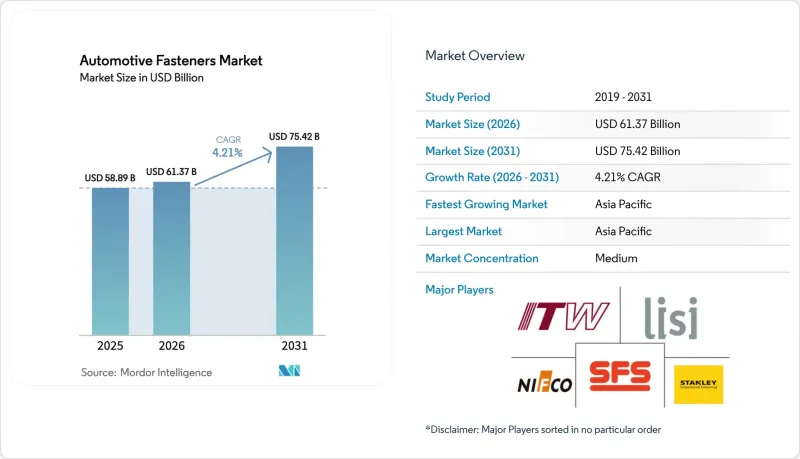
This report is Segmented by Fastener Type (Threaded and More), Vehicle Type (Two-Wheelers and More), Propulsion (ICE Vehicles and More), Function (Detachable and Non-Detachable), Material, Coating/Finish, Application, Distribution Channel, and Geography. Market Forecasts are Provided in Value (USD) and Volume (Units).
Global Automotive Fasteners Market Trends and Insights
Lightweighting Accelerating Demand for Advanced Fasteners
In response to the U.S. Corporate Average Fuel Economy (CAFE) updates and the European Union's 2025 fleet-average CO2 targets, automakers are under pressure to significantly reduce vehicle weight. This focus on weight reduction has brought attention to fasteners, which contribute a small but notable percentage of a vehicle's curb weight. While aluminum bolts offer substantial weight savings compared to steel, they require isolation sleeves or zinc-nickel coatings to prevent galvanic corrosion. These additional measures slightly increase the cost of each fastener. On the other hand, titanium fasteners, which are considerably more expensive than Grade 8.8 steel, are making their way from the world of Formula E racing to high-end luxury electric vehicles (EVs). Here, the appeal lies in the significant weight reduction that justifies the higher cost. Furthermore, the complexity of fastener requirements has increased: a body-in-white that previously relied on a few steel bolt sizes now demands a wider variety of SKUs. These include aluminum, stainless steel, and coated steel options. This expansion has led to a notable rise in working capital needs for tier-2 vendors, with requirements increasing considerably .
Recovery of Global Vehicle Production
In 2024, light-vehicle output experienced a significant rebound and is projected to grow further by 2026. This resurgence signals a restoration of baseline demand in the automotive fasteners market, following the semiconductor shortfall of recent years. During this period, China emerged as a major contributor, with India and Southeast Asia also playing substantial roles in driving demand for fasteners. Together, these regions accounted for a considerable share of the increased demand. Buoyed by an infrastructure stimulus in India and emissions mandates in California, commercial-vehicle production saw notable growth, particularly in heavy-duty segments. This surge benefits Asian suppliers, who boast rapid delivery windows, giving them a distinct advantage over European mills that rely on pre-positioned inventory. While Europe's production remained steady, the global momentum in unit builds serves as a supportive tailwind .
EV Architecture Reducing Fastener Count Per Vehicle
Battery-electric vehicles (BEVs) shed components like engine blocks, transmissions, exhaust systems, and fuel tanks. This change results in a significant reduction in the number of fasteners per unit when compared to traditional internal-combustion vehicles. For instance, Tesla's Model Y employs fewer fasteners than a gasoline crossover, marking a notable reduction. Additionally, structural battery designs further decrease the number of fasteners required. While the value of high-strength Grade 10.9 bolts in BEVs has increased, partially compensating for the reduced volume, the overall impact on the automotive fasteners market remains negative.
Other drivers and restraints analyzed in the detailed report include:
- Growing Electronics Content Requiring Micro-Fasteners
- Modular Vehicle Architectures Boosting Platform-Based Demand
- Adhesive Bonding and Laser Welding Substitution
For complete list of drivers and restraints, kindly check the Table Of Contents.
Segment Analysis
Threaded fasteners held 53.41% of 2025 revenue, underlining their versatility in chassis, powertrain, and interior systems. Specialty and safety-critical units, including torque-to-yield bolts and self-locking nuts, will post a 4.23% CAGR to 2031 as stringent crash-test protocols make them indispensable for seat-belt anchorages and battery-pack retention. Commodity threaded parts face gradual volume erosion in BEVs, yet their absolute demand in hybrids and traditional internal-combustion cars keeps the automotive fasteners market size substantial for this segment.
Specialty fasteners command 2-5X higher prices by integrating thread-locking compounds or captive washers that cut warranty claims and line rework. Non-threaded clips and rivets, while essential in interior trim, grow slower as adhesives gain favor in premium body-in-white. The premium attached to specialty items shields margins even in a platform-standardized procurement environment.
Passenger cars consumed 67.73% of all units in 2025, reflecting higher fastener intensity and global builds of 68 million vehicles. Two-wheelers, however, will log the fastest 4.37% CAGR through 2031 as India and China electrify scooter fleets, adding threaded bolts for battery enclosures and motor mounts. Light commercial vehicles and heavy trucks together account for 18% of volume, supported by last-mile delivery electrification.
Average fastener content per electric scooter is climbing exponentially, while electric passenger cars lose 220-280 bolts versus ICE models. Fleet operators adopting modular cargo bed designs standardize fastener SKUs across 3-5 payload classes, lowering parts inventories by up to two-fifths.
Internal-combustion vehicles still generated 81.15% of fastener demand in 2025, yet BEVs will expand at a 4.35% CAGR due to zero-emission rules in China and the EU. Although BEVs use fewer fasteners per vehicle, the shift toward Grade 10.9 bolts and stainless-steel variants lifts value per unit. Hybrid cars occupy a transitional niche, keeping most ICE fasteners while adding 40-60 new battery-related joints.
Tesla's 4680 pack, for instance, employs 112 M8 zinc-nickel-coated bolts torqued to 25 Nm to prevent hydrogen embrittlement, illustrating value-rich opportunities even as counts decline.
Complete Report Scope:
- By Fastener Type
- Threaded
- Non-threaded
- Specialty/Safety-critical
- By Vehicle Type
- Two-Wheelers
- Passenger Cars
- Light Commercial Vehicles
- Medium and Heavy Commercial Vehicles
- Off-Highway Vehicles
- By Propulsion
- IC Engine Vehicles
- Battery Electric Vehicles
- Hybrid and Fuel-Cell Vehicles
- By Function
- Detachable
- Non-detachable
- By Material
- Steel
- Stainless Steel
- Aluminum
- Brass
- Plastics and Composites
- By Coating/Finish
- Zinc
- Phosphate
- Nickel and Chrome
- Organic and Dry Film
- By Application
- Body and Exterior
- Chassis and Suspension
- Powertrain and Engine
- Interior and Seating
- Electronics and Electrical
- By Distribution Channel
- OEM
- Aftermarket
- By Geography
- North America
- United States
- Canada
- Rest of North America
- South America
- Brazil
- Argentina
- Rest of South America
- Europe
- Germany
- United Kingdom
- France
- Italy
- Spain
- Rest of Europe
- Asia Pacific
- China
- India
- Japan
- South Korea
- Rest of Asia Pacific
- Middle East and Africa
- United Arab Emirates
- Saudi Arabia
- South Africa
- Turkey
- Rest of Middle East and Africa
- North America
Geography Analysis
Asia Pacific held 37.86% of global demand in 2025 and is expected to grow at a 4.31% CAGR to 2031. China's significant automotive output, coupled with India's rapid growth, underscores the region's automotive prowess. Southeast Asia, with its growing vehicle production, is becoming a magnet for new fastener plants as OEMs pivot their sourcing strategies away from China. Notably, domestic suppliers in China are now meeting nearly half of local OEM demands, boasting swift delivery times and competitive pricing compared to their European counterparts. India's booming electric two-wheeler market has further solidified Asia's dominance in the automotive fasteners arena.
Europe, which represented a substantial portion of global demand in 2025, experienced a slower growth rate, attributed to production stagnation and a shift by premium brands towards adhesive bonding. In Germany, with its significant automotive output, a large volume of fasteners was consumed, predominantly high-strength grades supplied by industry leaders KAMAX and Bossard. The revision of the End-of-Life Vehicles Directive continues to favor detachable joints, bolstering the demand for threaded fasteners, even as body-shop volumes wane. Meanwhile, Stellantis's consolidation of legacy brands under the STLA platform has led to a notable reduction in SKUs and a more streamlined supplier roster.
North America, accounting for a significant share of global demand in 2025, is set to achieve steady growth through 2031. U.S. production of light trucks and SUVs has been robust, with the Inflation Reduction Act's content stipulations channeling fastener orders towards domestic suppliers like Illinois Tool Works and Stanley Engineered Fastening. Additionally, anti-dumping duties have shifted imports from China to Vietnam and Mexico, resulting in increased landed costs. Mexico's burgeoning automotive output has attracted significant investment in new fastener capacity, while Ontario's plants in Canada are heavily dependent on efficient cross-border supply chains.
- Illinois Tool Works Inc.
- LISI Group
- Nifco Inc.
- SFS Group AG
- Stanley Black & Decker Inc. (Stanley Engineered Fastening)
- Bulten AB
- KAMAX Holding GmbH & Co. KG
- Bossard Group
- Trifast plc (TR Fastenings Ltd.)
- Sundram Fasteners Limited
- ARaymond
- Shanghai Tianbao Fastener Manufacturing Co. Ltd.
- KOVA Fasteners Pvt. Ltd.
- The Phillips Screw Company
- Jiangsu Xing Chang Jiang International Co. Ltd.
- Penn Engineering & Manufacturing Corp.
- Aoyama Seisakusho Co. Ltd. (Indiana Automotive Fasteners)
Additional Benefits:
- The market estimate (ME) sheet in Excel format
- 3 months of analyst support
TABLE OF CONTENTS
1 Introduction
- 1.1 Study Assumptions & Market Definition
- 1.2 Scope of the Study
2 Research Methodology
3 Executive Summary
4 Market Landscape
- 4.1 Market Overview
- 4.2 Market Drivers
- 4.2.1 Lightweighting Accelerating Demand for Advanced Fasteners
- 4.2.2 Recovery of Global Vehicle Production
- 4.2.3 Growing Electronics Content Requiring Micro-Fasteners
- 4.2.4 Modular Vehicle Architectures Boosting Platform-Based Demand
- 4.2.5 Ageing Vehicle PARC Driving Aftermarket Replacements
- 4.2.6 Re-Use and Circular-Economy Mandates Spurring Demand for Removable Fasteners
- 4.3 Market Restraints
- 4.3.1 EV Architecture Reducing Fastener Count Per Vehicle
- 4.3.2 Adhesive Bonding and Laser Welding Substitution
- 4.3.3 Raw-Material Price Volatility and Supply Disruptions
- 4.3.4 Trade-Defense Measures and Anti-Dumping Duties Disrupting Supply Chains
- 4.4 Value / Supply-Chain Analysis
- 4.5 Regulatory Landscape
- 4.6 Technological Outlook
- 4.7 Porter's Five Forces
- 4.7.1 Bargaining Power of Suppliers
- 4.7.2 Bargaining Power of Buyers
- 4.7.3 Threat of New Entrants
- 4.7.4 Threat of Substitutes
- 4.7.5 Competitive Rivalry
5 Market Size & Growth Forecasts (Value (USD) and Volume (Units))
- 5.1 By Fastener Type
- 5.1.1 Threaded
- 5.1.2 Non-threaded
- 5.1.3 Specialty/Safety-critical
- 5.2 By Vehicle Type
- 5.2.1 Two-Wheelers
- 5.2.2 Passenger Cars
- 5.2.3 Light Commercial Vehicles
- 5.2.4 Medium and Heavy Commercial Vehicles
- 5.2.5 Off-Highway Vehicles
- 5.3 By Propulsion
- 5.3.1 IC Engine Vehicles
- 5.3.2 Battery Electric Vehicles
- 5.3.3 Hybrid and Fuel-Cell Vehicles
- 5.4 By Function
- 5.4.1 Detachable
- 5.4.2 Non-detachable
- 5.5 By Material
- 5.5.1 Steel
- 5.5.2 Stainless Steel
- 5.5.3 Aluminum
- 5.5.4 Brass
- 5.5.5 Plastics and Composites
- 5.6 By Coating/Finish
- 5.6.1 Zinc
- 5.6.2 Phosphate
- 5.6.3 Nickel and Chrome
- 5.6.4 Organic and Dry Film
- 5.7 By Application
- 5.7.1 Body and Exterior
- 5.7.2 Chassis and Suspension
- 5.7.3 Powertrain and Engine
- 5.7.4 Interior and Seating
- 5.7.5 Electronics and Electrical
- 5.8 By Distribution Channel
- 5.8.1 OEM
- 5.8.2 Aftermarket
- 5.9 By Geography
- 5.9.1 North America
- 5.9.1.1 United States
- 5.9.1.2 Canada
- 5.9.1.3 Rest of North America
- 5.9.2 South America
- 5.9.2.1 Brazil
- 5.9.2.2 Argentina
- 5.9.2.3 Rest of South America
- 5.9.3 Europe
- 5.9.3.1 Germany
- 5.9.3.2 United Kingdom
- 5.9.3.3 France
- 5.9.3.4 Italy
- 5.9.3.5 Spain
- 5.9.3.6 Rest of Europe
- 5.9.4 Asia Pacific
- 5.9.4.1 China
- 5.9.4.2 India
- 5.9.4.3 Japan
- 5.9.4.4 South Korea
- 5.9.4.5 Rest of Asia Pacific
- 5.9.5 Middle East and Africa
- 5.9.5.1 United Arab Emirates
- 5.9.5.2 Saudi Arabia
- 5.9.5.3 South Africa
- 5.9.5.4 Turkey
- 5.9.5.5 Rest of Middle East and Africa
- 5.9.1 North America
6 Competitive Landscape
- 6.1 Market Concentration
- 6.2 Strategic Moves
- 6.3 Market Share Analysis
- 6.4 Company Profiles (includes Global Level Overview, Market Level Overview, Core Segments, Financials as Available, Strategic Information, Market Rank/Share for Key Companies, Products and Services, SWOT Analysis, and Recent Developments)
- 6.4.1 Illinois Tool Works Inc.
- 6.4.2 LISI Group
- 6.4.3 Nifco Inc.
- 6.4.4 SFS Group AG
- 6.4.5 Stanley Black & Decker Inc. (Stanley Engineered Fastening)
- 6.4.6 Bulten AB
- 6.4.7 KAMAX Holding GmbH & Co. KG
- 6.4.8 Bossard Group
- 6.4.9 Trifast plc (TR Fastenings Ltd.)
- 6.4.10 Sundram Fasteners Limited
- 6.4.11 ARaymond
- 6.4.12 Shanghai Tianbao Fastener Manufacturing Co. Ltd.
- 6.4.13 KOVA Fasteners Pvt. Ltd.
- 6.4.14 The Phillips Screw Company
- 6.4.15 Jiangsu Xing Chang Jiang International Co. Ltd.
- 6.4.16 Penn Engineering & Manufacturing Corp.
- 6.4.17 Aoyama Seisakusho Co. Ltd. (Indiana Automotive Fasteners)
7 Market Opportunities & Future Outlook
- 7.1 White-space & Unmet-need Assessment

