PUBLISHER: Mordor Intelligence | PRODUCT CODE: 2115065

PUBLISHER: Mordor Intelligence | PRODUCT CODE: 2115065
Automotive Bushing - Market Share Analysis, Industry Trends & Statistics, Growth Forecasts (2026 - 2031)
According to Mordor Intelligence, the automotive bushing market size is expected to grow from USD 172.48 billion in 2025 to USD 180.43 billion in 2026 and is forecast to reach USD 226.1 billion by 2031 at 4.62% CAGR over 2026-2031.
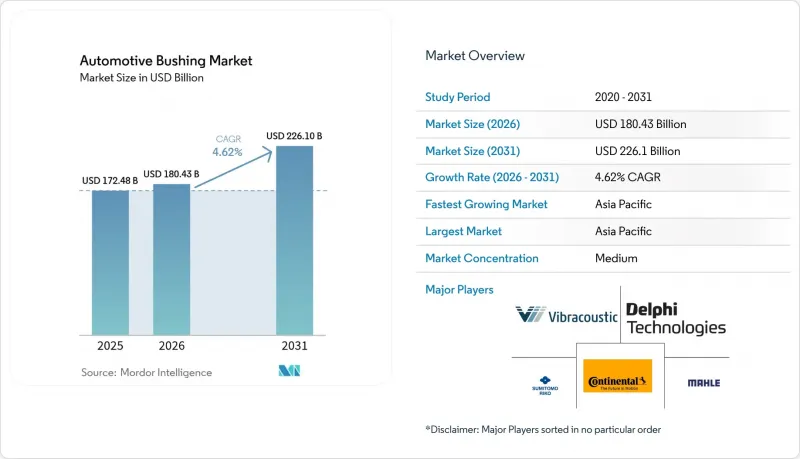
This report is Segmented by Vehicle Type (Passenger Car, Light Commercial Vehicle, and More), Application Type (Suspension System Bushings, Engine Mount Bushings, and More), Material Type (Natural Rubber, Synthetic Rubber, and More), Sales Channel (OEM and Aftermarket), Electric Vehicle Type (BEV, and More), and Geography. The Market Forecasts are Provided in Terms of Value (USD).
Global Automotive Bushing Market Trends and Insights
Surging EV and Hybrid Volumes Requiring Bespoke Bushings
Electric vehicle adoption is accelerating globally, with China leading in new vehicle sales being electrified in 2024, while the battery electric vehicle market share is projected to rise globally in 2024. This transition demands specialized bushing solutions to address unique challenges, including increased vehicle weight from battery packs, altered weight distribution, and different vibration characteristics compared to internal combustion engines. Electric vehicles contain significantly more plastics and polymer composites than traditional vehicles, with a mid-size EV potentially containing 450 pounds of plastics compared to 426 pounds in average vehicles, indicating substantial opportunities for advanced bushing materials. The chemistry value in EVs is estimated to be 85% higher than in internal combustion engine vehicles, reflecting the premium pricing potential for specialized bushing technologies. ASEAN markets are witnessing a surge in Chinese OEM investments in electric vehicle production, with companies like BYD and Chery establishing manufacturing facilities that will drive regional demand for EV-specific bushing solutions.
Increasing Global Light-Vehicle Production Rebound
Global automotive production recovery is creating sustained demand for bushing technologies, though the trajectory remains cautious with modest growth projections. Global vehicle sales growth, influenced by high vehicle prices and consumer debt levels. The recovery pattern varies significantly by region, with Sub-Saharan Africa expected to outperform at 4.7% growth while North America and MENA regions lag at 2.4% each. This uneven recovery creates opportunities for bushing suppliers to optimize regional capacity allocation and develop market-specific product portfolios. The production rebound benefits suspension and chassis bushing segments, as automakers prioritize vehicle dynamics and comfort features to justify premium pricing in a cost-conscious market environment.
Raw-Material Price Volatility (Synthetic Rubber / PU)
Global rubber supply constraints are creating significant cost pressures across the automotive bushing supply chain, with a looming rubber shortfall expected in 2025 due to stagnant output from major producing regions. The Thai rubber industry, a major global supplier, faces challenges from labor shortages, disease outbreaks, and geopolitical tensions affecting input costs, despite projected growth driven by automotive sector demand. Synthetic rubber markets are experiencing additional pressure from US tariffs affecting tire manufacturers, with 25% tariffs on imports complicating supply chains for SBR-based products, particularly from Europe and Indonesia. The volatility particularly impacts smaller bushing manufacturers with limited hedging capabilities and forces strategic decisions about material substitution and supply chain diversification.
Other drivers and restraints analyzed in the detailed report include:
- OEM Focus on NVH Reduction for Ride Comfort
- Shift to Lightweight Multi-Material Bushings for Battery-Heavy Vehicles
- Regulatory Scrutiny on Micro-Plastic Shedding from Rubber Parts
For complete list of drivers and restraints, kindly check the Table Of Contents.
Segment Analysis
Passenger cars maintain market leadership with 60.86% share of the automotive bushing technologies market in 2025, reflecting the segment's volume dominance across global markets, while the segment emerges as the fastest-growing segment at 7.52% CAGR through 2031. The passenger car segment benefits from consistent replacement demand and expanding model portfolios, particularly in emerging markets where vehicle ownership continues rising. Light commercial vehicles represent a stable secondary segment driven by e-commerce growth and last-mile delivery requirements. In contrast, heavy commercial vehicles demand specialized high-durability bushing solutions for extended service intervals. Though smaller in value, two-wheeler applications offer growth opportunities in Asia-Pacific markets where motorcycle and scooter adoption remains strong.
The electric vehicle transition is reshaping bushing requirements across all vehicle types, with battery electric vehicles demanding specialized solutions for weight management, thermal isolation, and enhanced NVH control. Off-highway vehicles in agriculture and construction applications present niche opportunities for heavy-duty bushing technologies designed for extreme operating conditions and extended maintenance intervals. The segmentation reflects the industry's dual challenge of serving traditional internal combustion engine requirements while developing next-generation solutions for electrified powertrains, creating opportunities for suppliers with diversified product portfolios and advanced material capabilities.
Suspension system bushings command 45.21% market share of the automotive bushing technologies market in 2025, reflecting their critical role in vehicle dynamics, ride comfort, and handling precision across all vehicle platforms. The transmission and driveline bushings segment exhibits the fastest growth at 8.76% CAGR through 2031, driven by increasing sophistication in suspension designs and the need for enhanced vibration isolation in electric vehicles. Engine mount bushings face transformation as the industry transitions to electric powertrains, with traditional applications declining while new opportunities emerge in electric motor mounting and battery pack isolation. Transmission and driveline bushings adapt to electric vehicle architectures, with simplified drivetrains creating different vibration characteristics and mounting requirements.
Chassis and body bushings benefit from increasing vehicle complexity and the need for precise component isolation, particularly in premium segments where manufacturers prioritize refinement and durability. Steering system bushings represent a specialized segment requiring high precision and reliability, with growth driven by advanced driver assistance systems and evolving steering technologies. The application segmentation reveals the industry's evolution from traditional mechanical isolation to integrated solutions combining vibration control with thermal management, electrical isolation, and sensor integration capabilities.
Complete Report Scope:
- By Vehicle Type
- Passenger Car
- Light Commercial Vehicle
- Heavy Commercial Vehicle
- Two-Wheeler
- Off-Highway Vehicle (Agriculture and Construction)
- By Application Type
- Suspension System Bushings
- Control-Arm
- Stabilizer-Bar
- Strut-Mount
- Engine Mount Bushings
- Transmission and Driveline Bushings
- Chassis and Body Bushings
- Steering System Bushings
- Suspension System Bushings
- By Material Type
- Natural Rubber
- Synthetic Rubber (SBR/EPDM/NBR)
- Polyurethane
- Thermoplastics (PTFE, Delrin)
- Metal-Polymer Composites
- By Sales Channel
- OEM
- Aftermarket
- By Electric Vehicle Type
- Battery Electric Vehicle (BEV)
- Hybrid Electric Vehicle (HEV)
- Plug-in Hybrid Electric Vehicle (PHEV)
- Fuel-Cell Electric Vehicle (FCEV)
- By Geography
- North America
- United States
- Canada
- Rest of North America
- South America
- Brazil
- Argentina
- Rest of South America
- Europe
- Germany
- United Kingdom
- France
- Italy
- Spain
- Russia
- Rest of Europe
- Asia-Pacific
- China
- India
- Japan
- South Korea
- Rest of Asia-Pacific
- Middle East and Africa
- Saudi Arabia
- United Arab Emirates
- Egypt
- Turkey
- South Africa
- Rest of Middle East and Africa
- North America
Geography Analysis
Asia-Pacific led the automotive bushing technologies market with 46.05% revenue in 2025, owing to China's scale and rising ASEAN production. Automakers localizing battery-electric lines to capture incentive programs in Thailand and Indonesia buoyed the regional CAGR of 5.63%. Investment examples include BYD and Chery greenfield plants that intensify the local sourcing pull. Suppliers locate compounding units near these clusters to skirt tariff exposure and shorten lead times.
North America follows as a mature yet stable arena. Replacement cycles and stringent safety standards uphold baseline demand even as economic headwinds temper new-vehicle sales. Federal incentives under the Inflation Reduction Act accelerate localized EV assembly, stimulating fresh tooling orders for high-durometer battery-pack bushings.
Europe contends with production contraction and incoming Euro 7 compliance. OEMs pivot to premium EVs to protect margins, elevating demand for high-spec bushings that meet NVH and sustainability targets. Potential tariffs on Chinese EV imports may return sourcing toward intra-EU suppliers, partially offsetting volume decline. At the same time, research funding under Horizon Europe channels grants toward bio-based elastomer projects, positioning the region as a test bed for low-emission bushing materials.
- Delphi Technologies Inc. (BorgWarner)
- Continental AG
- Sumitomo Riko Co. Ltd.
- Vibracoustic SE
- Boge Rubber and Plastics
- Hyundai Polytech India
- Cooper-Standard Holdings Inc.
- DuPont Inc.
- Mahle GmbH
- Tenneco Inc. (DRiV)
- ZF Friedrichshafen AG
- Federal-Mogul (DRiV)
- Oiles Corporation
- Freudenberg Group
- KYB Corporation
- Hutchinson SA
- SKF Group
- EPTG Ltd (Powerflex)
- GJ Bush Industrial
Additional Benefits:
- The market estimate (ME) sheet in Excel format
- 3 months of analyst support
TABLE OF CONTENTS
1 Introduction
- 1.1 Study Assumptions and Market Definition
- 1.2 Scope of the Study
2 Research Methodology
3 Executive Summary
4 Market Landscape
- 4.1 Market Overview
- 4.2 Market Drivers
- 4.2.1 Surging EV and Hybrid Volumes Requiring Bespoke Bushings
- 4.2.2 Increasing Global Light-Vehicle Production Rebound
- 4.2.3 OEM Focus on NVH Reduction for Ride Comfort
- 4.2.4 Shift to Lightweight Multi-Material Bushings for Battery-Heavy Vehicles
- 4.2.5 Use of Recyclable or Bio-Based Materials in Bushing Manufacturing
- 4.2.6 Embedded Health-Sensor Bushings Enabling Predictive Aftermarket Sales
- 4.3 Market Restraints
- 4.3.1 Raw-material price volatility (synthetic rubber / PU)
- 4.3.2 Regulatory scrutiny on micro-plastic shedding from rubber parts
- 4.3.3 Adoption of maintenance-free solid mounts in performance vehicles
- 4.3.4 Increasing environmental regulations on automotive component waste
- 4.4 Value / Supply-Chain Analysis
- 4.5 Regulatory Landscape
- 4.6 Technological Outlook
- 4.7 Porter's Five Forces
- 4.7.1 Threat of New Entrants
- 4.7.2 Bargaining Power of Buyers
- 4.7.3 Bargaining Power of Suppliers
- 4.7.4 Threat of Substitutes
- 4.7.5 Intensity of Competitive Rivalry
5 Market Size & Growth Forecasts (Value (USD))
- 5.1 By Vehicle Type
- 5.1.1 Passenger Car
- 5.1.2 Light Commercial Vehicle
- 5.1.3 Heavy Commercial Vehicle
- 5.1.4 Two-Wheeler
- 5.1.5 Off-Highway Vehicle (Agriculture and Construction)
- 5.2 By Application Type
- 5.2.1 Suspension System Bushings
- 5.2.1.1 Control-Arm
- 5.2.1.2 Stabilizer-Bar
- 5.2.1.3 Strut-Mount
- 5.2.2 Engine Mount Bushings
- 5.2.3 Transmission and Driveline Bushings
- 5.2.4 Chassis and Body Bushings
- 5.2.5 Steering System Bushings
- 5.2.1 Suspension System Bushings
- 5.3 By Material Type
- 5.3.1 Natural Rubber
- 5.3.2 Synthetic Rubber (SBR/EPDM/NBR)
- 5.3.3 Polyurethane
- 5.3.4 Thermoplastics (PTFE, Delrin)
- 5.3.5 Metal-Polymer Composites
- 5.4 By Sales Channel
- 5.4.1 OEM
- 5.4.2 Aftermarket
- 5.5 By Electric Vehicle Type
- 5.5.1 Battery Electric Vehicle (BEV)
- 5.5.2 Hybrid Electric Vehicle (HEV)
- 5.5.3 Plug-in Hybrid Electric Vehicle (PHEV)
- 5.5.4 Fuel-Cell Electric Vehicle (FCEV)
- 5.6 By Geography
- 5.6.1 North America
- 5.6.1.1 United States
- 5.6.1.2 Canada
- 5.6.1.3 Rest of North America
- 5.6.2 South America
- 5.6.2.1 Brazil
- 5.6.2.2 Argentina
- 5.6.2.3 Rest of South America
- 5.6.3 Europe
- 5.6.3.1 Germany
- 5.6.3.2 United Kingdom
- 5.6.3.3 France
- 5.6.3.4 Italy
- 5.6.3.5 Spain
- 5.6.3.6 Russia
- 5.6.3.7 Rest of Europe
- 5.6.4 Asia-Pacific
- 5.6.4.1 China
- 5.6.4.2 India
- 5.6.4.3 Japan
- 5.6.4.4 South Korea
- 5.6.4.5 Rest of Asia-Pacific
- 5.6.5 Middle East and Africa
- 5.6.5.1 Saudi Arabia
- 5.6.5.2 United Arab Emirates
- 5.6.5.3 Egypt
- 5.6.5.4 Turkey
- 5.6.5.5 South Africa
- 5.6.5.6 Rest of Middle East and Africa
- 5.6.1 North America
6 Competitive Landscape
- 6.1 Market Concentration
- 6.2 Strategic Moves
- 6.3 Market Share Analysis
- 6.4 Company Profiles (includes Global-level Overview, Market-level Overview, Core Segments, Financials as available, Strategic Information, Market Rank/Share, Products and Services, Recent Developments)
- 6.4.1 Delphi Technologies Inc. (BorgWarner)
- 6.4.2 Continental AG
- 6.4.3 Sumitomo Riko Co. Ltd.
- 6.4.4 Vibracoustic SE
- 6.4.5 Boge Rubber and Plastics
- 6.4.6 Hyundai Polytech India
- 6.4.7 Cooper-Standard Holdings Inc.
- 6.4.8 DuPont Inc.
- 6.4.9 Mahle GmbH
- 6.4.10 Tenneco Inc. (DRiV)
- 6.4.11 ZF Friedrichshafen AG
- 6.4.12 Federal-Mogul (DRiV)
- 6.4.13 Oiles Corporation
- 6.4.14 Freudenberg Group
- 6.4.15 KYB Corporation
- 6.4.16 Hutchinson SA
- 6.4.17 SKF Group
- 6.4.18 EPTG Ltd (Powerflex)
- 6.4.19 GJ Bush Industrial
7 Market Opportunities and Future Outlook
- 7.1 White-space and Unmet-Need Assessment

