PUBLISHER: Mordor Intelligence | PRODUCT CODE: 2115066

PUBLISHER: Mordor Intelligence | PRODUCT CODE: 2115066
Automotive Wheel - Market Share Analysis, Industry Trends & Statistics, Growth Forecasts (2026 - 2031)
According to Mordor Intelligence, the automotive wheel market size was USD 61.49 billion in 2026 and is projected to reach USD 80.17 billion by 2031, growing at a 5.45% CAGR.
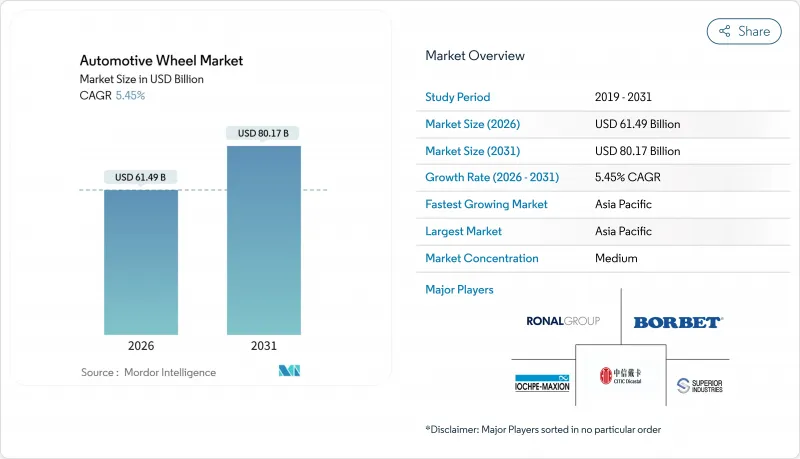
This report is Segmented by Vehicle Type (Passenger Car, Light Commercial Vehicle and More), Material Type (Steel, Aluminum Alloy and More), Manufacturing Process (Casting, Forging, and More), Rim Size (13-15 Inch, 16-18 Inch, and More), Coating (Powder-Coated and More), Vehicle Propulsion, Sales Channel, and Geography. The Market Forecasts are Provided in Terms of Value (USD) and Volume (Units).
Global Automotive Wheel Market Trends and Insights
EV Lightweighting Needs Accelerating Forged-Aluminum and Carbon-Fiber Rim Adoption in Asia-Pacific
Battery-electric platforms prompt OEMs to reduce unsprung mass to enhance efficiency, range, and ride quality. Chinese and Japanese producers have therefore scaled forged-aluminum lines and invested in carbon-fiber rim technology, which delivers significant weight savings compared to steel. Regional OEM supply contracts covering multi-year model cycles shield suppliers from commodity volatility and anchor capacity utilization. Flow-formed aluminum wheels, validated in urban drive-cycle studies, demonstrated significantly lower energy consumption, thereby bolstering the business case. Academic collaborations have shown that magnesium wheels now meet ISO impact standards, suggesting a pipeline of further weight-reduction options. Asia-Pacific's growth rate underscores how material science aligns with regional BEV demand.
EU CO2 Compliance Forcing OEM Shift from Steel to Flow-Formed Alloy Wheels
Europe's fleet-average CO2 ceiling of 93.6 g/km from 2025 to 2029 and 49.5 g/km from 2030 to 2034 has compelled automakers to reduce curb weight. Flow-formed designs can reduce wheel mass versus conventional cast/steel designs, supporting efficiency gains. Major OEMs have awarded multi-year supply deals to alloy specialists who can validate durability at a lower cost than forging. Euro 7 also introduces tighter non-exhaust limits; brake particle emissions (PM10) are tightened to 3 mg/km per vehicle from January 2035. Suppliers expanded flow-forming capacity across Germany and Eastern Europe to localize production for premium EV lines.
Volatile Aluminum and Magnesium Commodity Prices Hurting OEM Margin Planning
Aluminum prices swung between USD 2,200 and USD 2,900 per ton during 2024-2025, driven by shifts in Chinese power policy and bauxite supply risk. Magnesium shortages amplified the challenge as China controls more than 80% of global output. Tier-1 suppliers rarely hedge long-term magnesium exposure, forcing dual-sourcing and higher working-capital needs. Reported margin erosion of 150 basis points prompted acquisitions aimed at securing regional metal supply. The resulting cost variability deters OEMs from signing fixed-price wheel contracts, tempering near-term growth.
Other drivers and restraints analyzed in the detailed report include:
- Custom-Wheel Aftermarket Boom in North America Driven by Pick-ups and SUVs
- Cost-Efficient Low-Pressure Casting Scaling Out of China
- EU Particulate-Abrasion Norms Adding Compliance Cost to Wheel Surface Coatings
For complete list of drivers and restraints, kindly check the Table Of Contents.
Segment Analysis
Passenger cars generated 71.87% of automotive wheel market revenue in 2025 and are on track for a 5.96% CAGR through 2031. Growth is concentrated in SUVs and crossovers that integrate 19-21-inch flow-formed rims to accommodate larger brake packages, house sensor hardware, and reinforce upscale styling cues. Within these body styles, wheel diameters are increasing as ride-height preferences intersect with regenerative braking requirements that favor larger calipers. Light commercial vehicles move more gradually because fleet buyers emphasize life-cycle costs, which discourages premium wheel upgrades, even when lightweighting would marginally reduce fuel use. Heavy trucks and buses remain deeply rooted in steel designs, while off-highway equipment follows infrastructure cycles that dictate a steady but gradual replacement demand.
The popularity of SUVs and crossovers amplifies demand for forged-aluminum wheels that offset the mass of batteries in hybrid trims, and OEM platform standardization ensures larger diameters across multiple nameplates, simplifying sourcing. In the aftermarket, these same body styles invite style-driven upgrades that funnel additional volume into 20-22 inch forged or flow-formed SKUs, reinforcing a virtuous circle for suppliers able to serve both channels. Commercial fleet managers continue to prioritize durability over weight, making steel the default despite higher fuel costs per mile, while municipal procurement rules add another layer of conservatism. Off-highway users, such as quarry and agricultural operators, specify corrosion-resistant coatings and reinforced flanges, yet overall unit demand remains relatively small.
Aluminum alloy held 64.99% of the automotive wheel market share in 2025, due to mature scrap recycling networks, well-understood metallurgy, and the broad availability of low-pressure casting capacity. Magnesium alloys progress cautiously; even with recent fire-safety milestones, insurers and homologation agencies still require additional validation before green-lighting volume programs. Carbon-fiber rims, however, are projected to post an 11.56% CAGR by 2031, as autoclave-free resin transfer molding reduces costs enough for premium BEVs to recoup the price delta in range or acceleration gains. Hybrid composite formats that bond aluminum centers to carbon barrels provide a middle ground, capturing buyers who demand significant weight savings without absorbing the complete sticker shock of a full-carbon product.
Producer strategies mirror these material dynamics. Large Tier-1 suppliers invest in capital expenditures (capex) for low-carbon aluminum smelters to stabilize input costs. In contrast, emerging specialists focus on automated carbon preform placement or rapid-cure resin systems that aim to achieve cycle-time parity with metal forming. As OEMs set stricter lifecycle CO2 targets, the use of recycled aluminum ingots continues to climb, aided by closed-loop agreements that guarantee scrap returns. Carbon-fiber plants invest heavily in robotic trimming and non-destructive inspection to slash labor minutes per wheel, aligning overhead structures with auto-grade volume expectations. The overall mix suggests aluminum remains the baseline, but composite adoption will steadily expand as regulatory and performance pressures intensify.
Casting processes represented 59.02% of the automotive wheel market size in 2025 and continue to dominate because tooling is inexpensive, foundry footprints scale easily, and cycle-time improvements keep narrowing the performance gap with more advanced routes. Low-pressure casting is the standout within this family, posting faster growth than gravity or high-pressure variants due to significant weight reductions that satisfy mainstream OEM emissions targets at nominal cost uplift. Forging sustains its elite status in luxury coupes and performance sedans, where customers accept a significant premium for finer microstructures that enhance fatigue strength. Flow-forming, meanwhile, advances at an 8.75% CAGR by 2031, eroding the gravity-cast share by thinning barrel walls after initial casting or forging while preserving structural integrity.
Competitive positioning hinges on mastering multiple processes. Chinese suppliers lean on low-pressure casting for cost leadership, yet several are adding flow-forming cells to chase incremental content per wheel as EV platforms proliferate. European incumbents defend brand equity with forged and flow-formed portfolios backed by ISO-grade quality systems, while North American players weigh consolidation to fund re-tooling. Forgers invest in servo presses and heated-die lubrication to shave seconds off cycle times, whereas casting lines deploy AI vision to cull porosity defects before machining.
Complete Report Scope:
- By Vehicle Type
- Passenger Car
- Hatchback
- Sedan
- SUV / Crossover
- Sports and Luxury
- Light Commercial Vehicle (LCV)
- Heavy Commercial Vehicle (HCV)
- Trucks
- Buses and Coaches
- Off-Highway Vehicle
- Construction and Mining Equipment
- Agricultural Tractors
- Passenger Car
- By Material Type
- Steel
- Aluminum Alloy
- Magnesium Alloy
- Carbon-Fiber
- Hybrid Composite (Al-CF)
- By Manufacturing Process
- Casting
- Gravity Cast
- Low-Pressure Cast
- High-Pressure / Die-Cast
- Forging
- Flow-Forming / Spin-Forged
- Others (Spinning, 3-D Printed)
- Casting
- By Rim Size
- 13 to 15 inch
- 16 to 18 inch
- 19 to 21 inch
- Over 21 inch
- By Coating
- Powder-Coated
- Diamond-Cut / Machined
- Chrome / Polished
- Painted
- By Vehicle Propulsion
- Internal Combustion Engine (ICE)
- Hybrid Electric Vehicle (HEV / PHEV)
- Battery Electric Vehicle (BEV)
- Fuel-Cell Electric Vehicle (FCEV)
- By Sales Channel
- Original Equipment Manufacturer (OEM)
- Aftermarket
- Replacement
- Performance / Customization
- By Geography
- North America
- United States
- Canada
- Rest of North America
- South America
- Brazil
- Argentina
- Rest of South America
- Europe
- Germany
- United Kingdom
- France
- Italy
- Spain
- Rest of Europe
- Asia-Pacific
- China
- India
- Japan
- South Korea
- Rest of Asia-Pacific
- Middle East and Africa
- Turkey
- Saudi Arabia
- United Arab Emirates
- South Africa
- Nigeria
- Rest of Middle East and Africa
- North America
Geography Analysis
Asia-Pacific held 40.59% of the automotive wheel market share in 2025 and will advance at a 5.76% CAGR through 2031. Chinese producers utilize vertical integration in aluminum smelting and low-pressure casting to achieve a significant price advantage. India's component manufacturers expand alloy-wheel capacity under production-linked incentives, while Japanese players focus on premium forged products exported across ASEAN. South Korea aligns wheel technology roadmaps with domestic OEM electrification targets.
North America is driven by resilient light-truck production and aftermarket customization. Mexican plants supply regional OEMs under nearshoring strategies, while private-equity-backed consolidation improves cost structures among U.S. suppliers. Tire-shipment forecasts confirm healthy replacement cycles that underpin aftermarket rims. However, mature vehicle-parc dynamics and price-sensitive OEM sourcing temper overall expansion.
Europe's declining ICE production and stringent CO2 targets increase compliance costs, but flow-formed aluminum wheels gain market share as OEMs seek mass reductions. Investment in advanced coating lines prepares suppliers for Euro 7 particulate limits. Emerging clusters in Turkey and Eastern Europe offer labor-cost relief while maintaining proximity to EU assembly plants.
- Iochpe-Maxion SA
- CITIC Dicastal (CITIC Group)
- Ronal Group AG
- Borbet GmbH
- Superior Industries International Inc.
- Accuride Corporation
- Enkei Corporation
- Maxion Wheels (Mexico)
- Steel Strips Wheels Ltd.
- Alcoa Wheels (Howmet Aerospace)
- Carbon Revolution Ltd.
- RAYS Co., Ltd.
- Central Motor Wheel of America
- TSW Alloy Wheels
- HRE Performance Wheels
- Euromax Wheel
- MHT Luxury Wheels
- Zhejiang Wanfeng Auto Wheel Co., Ltd.
- Hitachi Metals, Ltd.
- Maxion Wheels
- Topy Industries Ltd
- Zhejiang Wanfeng Auto Wheel
- Steel Strips Wheels Limited
- ALCAR WHEELS GmbH
- Bharat Wheel Pvt. Ltd
Additional Benefits:
- The market estimate (ME) sheet in Excel format
- 3 months of analyst support
TABLE OF CONTENTS
1 Introduction
- 1.1 Study Assumptions and Market Definition
- 1.2 Scope of the Study
2 Research Methodology
3 Executive Summary
4 Market Landscape
- 4.1 Market Overview
- 4.2 Market Drivers
- 4.2.1 EV Lightweighting Needs Accelerating Forged-Aluminum and Carbon-Fiber Rim Adoption in Asia-Pacific
- 4.2.2 EU CO2 Compliance Forcing OEM Shift from Steel to Flow-Formed Alloy Wheels
- 4.2.3 Custom-Wheel Aftermarket Boom in North America Driven by Pick-ups and SUVs
- 4.2.4 Cost-Efficient Low-Pressure Casting Scaling Out of China, Lowering Alloy Wheel ASPs
- 4.2.5 Autoclave-Free Resin Transfer Molding Cutting Carbon-Fiber Wheel Costs >20%
- 4.2.6 Advanced Wheel Sensor Integration
- 4.3 Market Restraints
- 4.3.1 Volatile Aluminum and Magnesium Commodity Prices Hurting OEM Margin Planning
- 4.3.2 EU Particulate-Abrasion Norms Adding Compliance Cost to Wheel Surface Coatings
- 4.3.3 High Tooling CAPEX Limiting Carbon-Fiber Wheels in Mass-Market ICE Vehicles
- 4.3.4 Supply Chain Disruptions for Specialty Alloys
- 4.4 Value / Supply-Chain Analysis
- 4.5 Regulatory and Technological Outlook
- 4.6 Porter's Five Forces
- 4.6.1 Threat of New Entrants
- 4.6.2 Bargaining Power of Buyers/Consumers
- 4.6.3 Bargaining Power of Suppliers
- 4.6.4 Threat of Substitute Products
- 4.6.5 Intensity of Competitive Rivalry
5 Market Size and Growth Forecasts (Value (USD) and Volume (Units))
- 5.1 By Vehicle Type
- 5.1.1 Passenger Car
- 5.1.1.1 Hatchback
- 5.1.1.2 Sedan
- 5.1.1.3 SUV / Crossover
- 5.1.1.4 Sports and Luxury
- 5.1.2 Light Commercial Vehicle (LCV)
- 5.1.3 Heavy Commercial Vehicle (HCV)
- 5.1.3.1 Trucks
- 5.1.3.2 Buses and Coaches
- 5.1.4 Off-Highway Vehicle
- 5.1.4.1 Construction and Mining Equipment
- 5.1.4.2 Agricultural Tractors
- 5.1.1 Passenger Car
- 5.2 By Material Type
- 5.2.1 Steel
- 5.2.2 Aluminum Alloy
- 5.2.3 Magnesium Alloy
- 5.2.4 Carbon-Fiber
- 5.2.5 Hybrid Composite (Al-CF)
- 5.3 By Manufacturing Process
- 5.3.1 Casting
- 5.3.1.1 Gravity Cast
- 5.3.1.2 Low-Pressure Cast
- 5.3.1.3 High-Pressure / Die-Cast
- 5.3.2 Forging
- 5.3.3 Flow-Forming / Spin-Forged
- 5.3.4 Others (Spinning, 3-D Printed)
- 5.3.1 Casting
- 5.4 By Rim Size
- 5.4.1 13 to 15 inch
- 5.4.2 16 to 18 inch
- 5.4.3 19 to 21 inch
- 5.4.4 Over 21 inch
- 5.5 By Coating
- 5.5.1 Powder-Coated
- 5.5.2 Diamond-Cut / Machined
- 5.5.3 Chrome / Polished
- 5.5.4 Painted
- 5.6 By Vehicle Propulsion
- 5.6.1 Internal Combustion Engine (ICE)
- 5.6.2 Hybrid Electric Vehicle (HEV / PHEV)
- 5.6.3 Battery Electric Vehicle (BEV)
- 5.6.4 Fuel-Cell Electric Vehicle (FCEV)
- 5.7 By Sales Channel
- 5.7.1 Original Equipment Manufacturer (OEM)
- 5.7.2 Aftermarket
- 5.7.2.1 Replacement
- 5.7.2.2 Performance / Customization
- 5.8 By Geography
- 5.8.1 North America
- 5.8.1.1 United States
- 5.8.1.2 Canada
- 5.8.1.3 Rest of North America
- 5.8.2 South America
- 5.8.2.1 Brazil
- 5.8.2.2 Argentina
- 5.8.2.3 Rest of South America
- 5.8.3 Europe
- 5.8.3.1 Germany
- 5.8.3.2 United Kingdom
- 5.8.3.3 France
- 5.8.3.4 Italy
- 5.8.3.5 Spain
- 5.8.3.6 Rest of Europe
- 5.8.4 Asia-Pacific
- 5.8.4.1 China
- 5.8.4.2 India
- 5.8.4.3 Japan
- 5.8.4.4 South Korea
- 5.8.4.5 Rest of Asia-Pacific
- 5.8.5 Middle East and Africa
- 5.8.5.1 Turkey
- 5.8.5.2 Saudi Arabia
- 5.8.5.3 United Arab Emirates
- 5.8.5.4 South Africa
- 5.8.5.5 Nigeria
- 5.8.5.6 Rest of Middle East and Africa
- 5.8.1 North America
6 Competitive Landscape
- 6.1 Market Concentration
- 6.2 Strategic Moves
- 6.3 Market Share Analysis
- 6.4 Company Profiles (Includes Global-level Overview, Market-level Overview, Core Segments, Financials as available, Strategic Information, Market Rank/Share, Products and Services, Recent Developments)
- 6.4.1 Iochpe-Maxion SA
- 6.4.2 CITIC Dicastal (CITIC Group)
- 6.4.3 Ronal Group AG
- 6.4.4 Borbet GmbH
- 6.4.5 Superior Industries International Inc.
- 6.4.6 Accuride Corporation
- 6.4.7 Enkei Corporation
- 6.4.8 Maxion Wheels (Mexico)
- 6.4.9 Steel Strips Wheels Ltd.
- 6.4.10 Alcoa Wheels (Howmet Aerospace)
- 6.4.11 Carbon Revolution Ltd.
- 6.4.12 RAYS Co., Ltd.
- 6.4.13 Central Motor Wheel of America
- 6.4.14 TSW Alloy Wheels
- 6.4.15 HRE Performance Wheels
- 6.4.16 Euromax Wheel
- 6.4.17 MHT Luxury Wheels
- 6.4.18 Zhejiang Wanfeng Auto Wheel Co., Ltd.
- 6.4.19 Hitachi Metals, Ltd.
- 6.4.20 Maxion Wheels
- 6.4.21 Topy Industries Ltd
- 6.4.22 Zhejiang Wanfeng Auto Wheel
- 6.4.23 Steel Strips Wheels Limited
- 6.4.24 ALCAR WHEELS GmbH
- 6.4.25 Bharat Wheel Pvt. Ltd
7 Market Opportunities and Future Outlook
- 7.1 White-Space and Unmet-Need Assessment

