PUBLISHER: Mordor Intelligence | PRODUCT CODE: 2115067

PUBLISHER: Mordor Intelligence | PRODUCT CODE: 2115067
Automotive Data Logger - Market Share Analysis, Industry Trends & Statistics, Growth Forecasts (2026 - 2031)
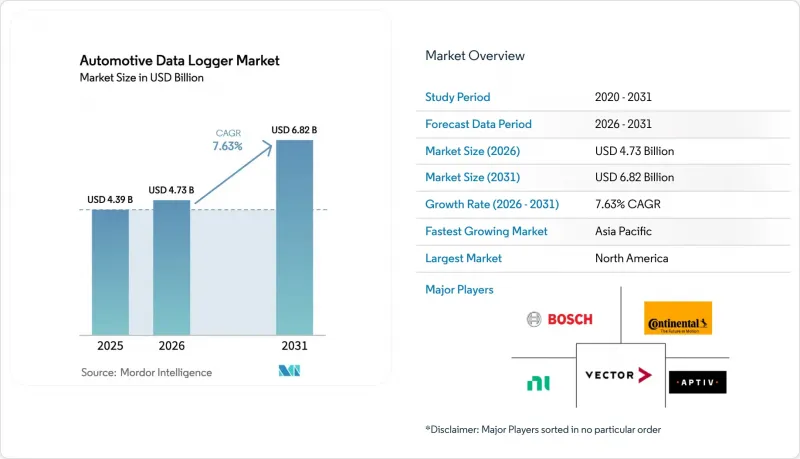
According to Mordor Intelligence, the automotive data logger market size is expected to grow from USD 4.39 billion in 2025 to USD 4.73 billion in 2026 and is forecast to reach USD 6.82 billion by 2031 at 7.63% CAGR over 2026-2031.
This report is Segmented by Application (ADAS and More), Connection Type (USB and More), Hardware Type (Stand-Alone Data Logger and More), Memory Capacity (Less Than 32 GB and More), End-Users (OEMs and More), Channel (OEM-Fitted and More), Vehicle Type (Passenger Cars and More), Propulsion (ICE Vehicles and More), and Geography. The Market Forecasts are Provided in Terms of Value (USD).
Global Automotive Data Logger Market Trends and Insights
Soaring Volume of Sensor-Fusion Data in Level 3+ AD Systems
Modern premium vehicles will need up to 278 GB of embedded memory in 2026 versus 90 GB in 2025, a threefold rise directly tied to multi-sensor ADAS suites. BlackBerry IVY and NXP S32K5 MCUs showcase industry progress in secure multi-sensor data handling. Vehicles employing 60-400 sensors now generate petabyte-scale datasets over their lifetimes, stimulating long-term demand in the automotive data logger market for high-reliability storage and rapid offload capabilities.
Regulatory Push for Autonomous-Ready E/E Architectures
UN ECE Regulation 160 mandates event data recorders that capture discrete vehicle parameters for several seconds pre-incident, driving OEM demand for compliant, high-capacity logging subsystems. Suppliers like Continental respond with scalable software platforms integrating cybersecurity and OTA update readiness. Centralized computing architectures, now demonstrating 30-40% wiring reductions, intensify processing loads and elevate the automotive data logger market requirement for robust throughput and embedded security.
Cyber-Security Risks Driving Data-Access Restrictions
UNECE WP.29 R156 obliges manufacturers to maintain certified cybersecurity management systems, curtailing unauthorized third-party data tapping. China's data-localization rules require on-shore storage and state security assessments for outbound transfers, complicating cross-border R&D collaboration. Providers are embedding Uptane-based secure-update frameworks and hardware root-of-trust elements to satisfy regulators while ensuring business continuity in the automotive data logger market.
Other drivers and restraints analyzed in the detailed report include:
- Usage-Based Insurance Adoption in Emerging Economies
- Real-Time Fleet Health Analytics to Cut TCO for Electrified Fleets
- High Raw-Flash Price Volatility Inflating BOM Cost
For complete list of drivers and restraints, kindly check the Table Of Contents.
Segment Analysis
ADAS accounted for the largest automotive data logger market slice in 2025 at 36.02%. The segment's growth is anchored in regulatory calls for lane-keeping, automated braking, and driver-monitoring functions. In parallel, autonomous-driving R&D is charted to grow at 13.14% CAGR, underpinned by sensor-rich prototypes that create terabytes of daily data. Commercial fleet management continues steady adoption for predictive maintenance, while insurance telematics gains traction in Asia and Latin America. Emerging use cases, such as infotainment analytics and OTA validation, demand continuous logging of user interaction and software execution data. This application convergence positions data-management platforms as multipurpose hubs, enabling OEMs to monetize insights while reducing hardware redundancy.
Across these use cases, developers require deterministic storage, granular time-stamping, and open APIs. The automotive data logger market size for ADAS and infotainment combined commanded half of the total revenues 2025. As Level 3 trials progress, prototypes often employ more than 512 GB of onboard storage. Over the forecast period, the rising deployment of domain-controller architectures and edge analytics will further strengthen the value proposition for integrated logging and processing solutions.
USB dominated the automotive data logger market with a 40.28% share in 2025 because of its ubiquity in test benches and aftermarket retrofits. Yet the bandwidth ceiling of single-lane USB limits its future role in high-resolution sensor data offload. Automotive Ethernet, supported by single-pair variants such as 100BASE-T1, is forecast to post a 10.62% CAGR. Tier-1 suppliers bundle multi-protocol gateways that couple CAN-FD and Ethernet to balance legacy support and future scalability. The Ethernet products' automotive data logger market size is expected to double by 2031 as OEMs migrate to zonal architectures.
Other connection types, such as Cellular 5G connectivity, underpin real-time cloud backhaul for fleet use cases. At the same time, Wi-Fi Direct supports garage or depot offloads where bandwidth costs must be contained. Suppliers are increasingly packaging adaptable transceivers and software-defined radios that allow firmware-based switching between standards, mitigating obsolescence risk.
Stand-alone loggers dominated the automotive data logger market with a 34.01% share in 2025 due to their ruggedness and independence. Cloud-native agents, however, will record the highest growth at 9.11% CAGR as OEMs virtualize electronic control units (ECUs). Continental's vECU Creator exemplifies how developers compile and test software in the cloud before hardware is ready, compressing development cycles. The automotive data logger market share of embedded OEM modules is also rising because regulatory mandates encourage factory integration.
Hardware consolidation yields lower power draw, smaller harnesses, and easier OTA patching. Cloud-linked loggers provide lifecycle cost savings via remote diagnostics and dynamic storage allocation. Suppliers focusing on encryption, compression, and smart-stream selection stand to capture incremental value as data volumes expand.
Complete Report Scope:
- By Application
- ADAS
- Autonomous Driving R&D
- Fleet Management
- Others
- By Connection Type
- USB
- Automotive Ethernet
- Others
- By Hardware Type
- Stand-alone Data Logger
- Plug-in OBD Dongle
- Embedded OEM Module
- Cloud-based Software Agent
- By Memory Capacity
- Less than 32 GB
- 32 - 128 GB
- 128 - 512 GB
- More Than 512 GB
- By End User
- OEMs
- Tier-1 Suppliers
- Fleet Operators & Telematics Providers
- Insurance Companies
- Independent Service Providers
- Regulatory & Testing Agencies
- Research Institutions
- By Channel
- OEM-Fitted
- Aftermarket
- By Vehicle Type
- Passenger Cars
- Light Commercial Vehicles
- Medium and Heavy Commercial Vehicles
- Off-Highway Vehicles
- Two-Wheelers & Micromobility
- By Propulsion
- ICE Vehicles
- Hybrid Vehicles
- Battery Electric Vehicles
- Others
- By Geography
- North America
- United States
- Canada
- Rest of North America
- South America
- Brazil
- Argentina
- Rest of South America
- Europe
- Germany
- United Kingdom
- France
- Italy
- Spain
- Rest of Europe
- Asia-Pacific
- China
- Japan
- India
- South Korea
- Rest of Asia-Pacific
- Middle East and Africa
- Saudi Arabia
- United Arab Emirates
- South Africa
- Rest of Middle East and Africa
- North America
Geography Analysis
North America dominated the automotive data logger market with a 30.92% share in 2025 due to mature fleet telematics adoption and insurer telematics penetration. Regulatory focus centers on privacy and cybersecurity rather than prescriptive device standards, prompting OEM investment in consent management and encryption. Regional fleets increasingly deploy machine-learning-driven predictive maintenance to extend asset life and minimize roadside incidents.
Asia-Pacific is projected to grow at 10.09% CAGR through 2031. China mandates data localization and real-time uploads to government-approved servers for intelligent connected vehicles, reshaping global architecture decisions. Indian commercial fleets are integrating telematics quickly to meet new safety and tax compliance rules, while Japanese regulators emphasize driver-readiness monitoring for advanced autonomy trials. The region's strong uptake of electric vehicles mirrors national industrial policies, amplifying demand for high-capacity loggers able to process battery and ADAS data in concert.
Europe maintains a leading regulatory influence. Regulation 2019/2144 obliges event data recorders in all new cars and vans, and the forthcoming Data Act will open manufacturer data silos to third parties under strict consent rules. German suppliers pioneer privacy-by-design principles, embedding on-device anonymization before transmission. Compliance costs spur collaboration across the value chain, with suppliers like Continental offering turnkey cybersecurity and logging stacks that comply with UN ECE and EU directives.
- Robert Bosch GmbH
- Vector Informatik GmbH
- Continental AG
- Racelogic Ltd
- TTTech Auto AG
- National Instruments Corp.
- Intrepid Control Systems Inc.
- Kontron (MEN Mikro)
- Ipetronik GmbH & Co. KG
- NSM Solutions
- Aptiv PLC
- HARMAN International
- Autel Intelligent Technology
- Verizon Connect
- Danlaw Inc.
- LG Innotek
- NXP Semiconductors
- Qualcomm Technologies
- Huawei Technologies
- TomTom Telematics (Bridgestone)
- Teltonika
- ZF Friedrichshafen AG
- Mobileye
- KPIT Technologies
Additional Benefits:
- The market estimate (ME) sheet in Excel format
- 3 months of analyst support
TABLE OF CONTENTS
1 Introduction
- 1.1 Study Assumptions & Market Definition
- 1.2 Scope of the Study
2 Research Methodology
3 Executive Summary
4 Market Landscape
- 4.1 Market Overview
- 4.2 Market Drivers
- 4.2.1 Soaring Volume of Sensor Fusion Data in Level-3+ AD Systems
- 4.2.2 Regulatory Push for Autonomous-Ready E/E Architectures
- 4.2.3 OEM Shift to Software-Defined Vehicles Demanding Continuous Logging
- 4.2.4 Real-Time Fleet Health Analytics to Cut TCO For Electrified Fleets
- 4.2.5 Usage-Based Insurance Adoption in Emerging Economies
- 4.2.6 Mandated Event Data Recorders (EDR) in Euro-NCAP and China NCAP 2026+
- 4.3 Market Restraints
- 4.3.1 Cyber-Security Risks Driving Data-Access Restrictions
- 4.3.2 High Raw-Flash Price Volatility Inflating BOM Cost
- 4.3.3 Lack Of Unified Data-Format Standards Across OEMs and Regions
- 4.3.4 OEM Reluctance to Expose Vehicle Data to Third-Party Insurers
- 4.4 Value / Supply-Chain Analysis
- 4.5 Regulatory Landscape
- 4.6 Technological Outlook
- 4.7 Porter's Five Forces Analysis
- 4.7.1 Threat of New Entrants
- 4.7.2 Bargaining Power of Buyers/Consumers
- 4.7.3 Bargaining Power of Suppliers
- 4.7.4 Threat of Substitute Products
- 4.7.5 Intensity of Competitive Rivalry
5 Market Size & Growth Forecasts (Value)
- 5.1 By Application
- 5.1.1 ADAS
- 5.1.2 Autonomous Driving R&D
- 5.1.3 Fleet Management
- 5.1.4 Others
- 5.2 By Connection Type
- 5.2.1 USB
- 5.2.2 Automotive Ethernet
- 5.2.3 Others
- 5.3 By Hardware Type
- 5.3.1 Stand-alone Data Logger
- 5.3.2 Plug-in OBD Dongle
- 5.3.3 Embedded OEM Module
- 5.3.4 Cloud-based Software Agent
- 5.4 By Memory Capacity
- 5.4.1 Less than 32 GB
- 5.4.2 32 - 128 GB
- 5.4.3 128 - 512 GB
- 5.4.4 More Than 512 GB
- 5.5 By End User
- 5.5.1 OEMs
- 5.5.2 Tier-1 Suppliers
- 5.5.3 Fleet Operators & Telematics Providers
- 5.5.4 Insurance Companies
- 5.5.5 Independent Service Providers
- 5.5.6 Regulatory & Testing Agencies
- 5.5.7 Research Institutions
- 5.6 By Channel
- 5.6.1 OEM-Fitted
- 5.6.2 Aftermarket
- 5.7 By Vehicle Type
- 5.7.1 Passenger Cars
- 5.7.2 Light Commercial Vehicles
- 5.7.3 Medium and Heavy Commercial Vehicles
- 5.7.4 Off-Highway Vehicles
- 5.7.5 Two-Wheelers & Micromobility
- 5.8 By Propulsion
- 5.8.1 ICE Vehicles
- 5.8.2 Hybrid Vehicles
- 5.8.3 Battery Electric Vehicles
- 5.8.4 Others
- 5.9 By Geography
- 5.9.1 North America
- 5.9.1.1 United States
- 5.9.1.2 Canada
- 5.9.1.3 Rest of North America
- 5.9.2 South America
- 5.9.2.1 Brazil
- 5.9.2.2 Argentina
- 5.9.2.3 Rest of South America
- 5.9.3 Europe
- 5.9.3.1 Germany
- 5.9.3.2 United Kingdom
- 5.9.3.3 France
- 5.9.3.4 Italy
- 5.9.3.5 Spain
- 5.9.3.6 Rest of Europe
- 5.9.4 Asia-Pacific
- 5.9.4.1 China
- 5.9.4.2 Japan
- 5.9.4.3 India
- 5.9.4.4 South Korea
- 5.9.4.5 Rest of Asia-Pacific
- 5.9.5 Middle East and Africa
- 5.9.5.1 Saudi Arabia
- 5.9.5.2 United Arab Emirates
- 5.9.5.3 South Africa
- 5.9.5.4 Rest of Middle East and Africa
- 5.9.1 North America
6 Competitive Landscape
- 6.1 Market Concentration
- 6.2 Strategic Moves
- 6.3 Market Share Analysis
- 6.4 Company Profiles (includes Global level Overview, Market level overview, Core Segments, Financials as available, Strategic Information, Market Rank/Share for key companies, Products & Services, and Recent Developments)
- 6.4.1 Robert Bosch GmbH
- 6.4.2 Vector Informatik GmbH
- 6.4.3 Continental AG
- 6.4.4 Racelogic Ltd
- 6.4.5 TTTech Auto AG
- 6.4.6 National Instruments Corp.
- 6.4.7 Intrepid Control Systems Inc.
- 6.4.8 Kontron (MEN Mikro)
- 6.4.9 Ipetronik GmbH & Co. KG
- 6.4.10 NSM Solutions
- 6.4.11 Aptiv PLC
- 6.4.12 HARMAN International
- 6.4.13 Autel Intelligent Technology
- 6.4.14 Verizon Connect
- 6.4.15 Danlaw Inc.
- 6.4.16 LG Innotek
- 6.4.17 NXP Semiconductors
- 6.4.18 Qualcomm Technologies
- 6.4.19 Huawei Technologies
- 6.4.20 TomTom Telematics (Bridgestone)
- 6.4.21 Teltonika
- 6.4.22 ZF Friedrichshafen AG
- 6.4.23 Mobileye
- 6.4.24 KPIT Technologies
7 Market Opportunities & Future Outlook

