PUBLISHER: Mordor Intelligence | PRODUCT CODE: 2115068

PUBLISHER: Mordor Intelligence | PRODUCT CODE: 2115068
Automotive Printed Circuit Board (PCB) - Market Share Analysis, Industry Trends & Statistics, Growth Forecasts (2026 - 2031)
According to Mordor Intelligence, the automotive printed circuit board market size is expected to grow from USD 12.22 billion in 2025 to USD 12.9 billion in 2026 and is forecast to reach USD 16.91 billion by 2031 at 5.56% CAGR over 2026-2031.
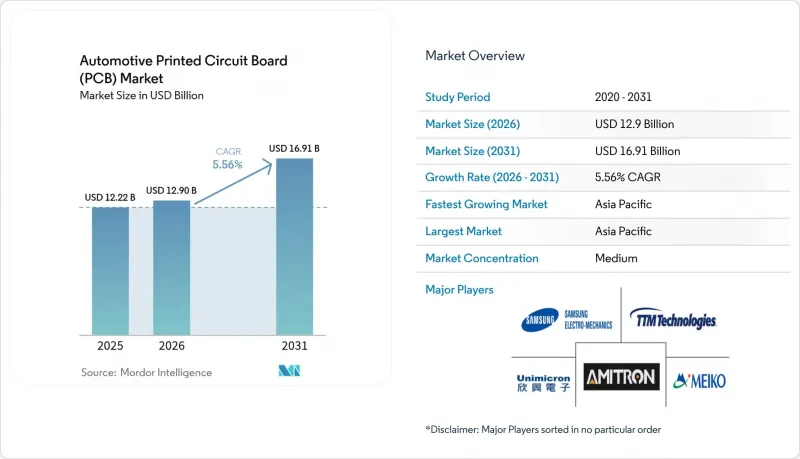
This report is Segmented by Vehicle Type (Passenger Cars and Commercial Vehicles), Propulsion Type (ICE Vehicles and More), PCB Type (Single-Layer and More), Substrate (Rigid (FR-4 and Metal-Core) and More), Application (ADAS and Safety and More), Level of Automation (SAE Level 0-2 and More), and Geography. The Market Forecasts are Provided in Terms of Value (USD) and Volume (Units).
Global Automotive Printed Circuit Board (PCB) Market Trends and Insights
Rising EV Sales to Fuel PCB Demand
Electric vehicles embed three to four times more board area than combustion cars, swelling volumes across the automotive printed circuit board market. Battery-management systems cycle between -40 °C and 85 °C and still uphold sub-millivolt measurement accuracy, forcing the adoption of thermally conductive laminates rated above 160 °C glass-transition. Copper-heavy layouts tackle inverter currents yet intensify material spend, particularly as spot copper prices increase. Programs that migrate to 800 V architectures impose wider creepage gaps, accelerating demand for advanced dielectrics to maintain insulation without expanding board footprint.
Mandatory ADAS and Safety Regulations
The EU's General Safety Regulation II makes automatic emergency braking, lane-keeping, and driver monitoring compulsory from July 2024. Parallel rulemaking in the United States requires AEB on light vehicles by 2029. Radar and lidar assemblies must sustain tight impedance at 77 GHz, driving high-density interconnect uptake. ISO 26262 Automotive Safety Integrity Level D raises documentation and validation thresholds, effectively rewarding incumbent suppliers within the automotive printed circuit board market that already operate qualified lines.
Complex Design and Integration Challenges
Modern vehicles juggle RF, power, and digital subsystems in centimeters of board real estate. Silicon-carbide modules sustain over 175 °C, so materials need low-expansion coefficients. Shortages of engineers versed in automotive functional-safety layout slow time-to-market. Incumbents that automate design-for-reliability cut-and-try loops enlarge their hold on the automotive printed circuit board market.
Other drivers and restraints analyzed in the detailed report include:
- Connected-Infotainment Proliferation
- Transition to 48 V Vehicle Architectures
- Copper-Price Volatility Squeezing Margins
For complete list of drivers and restraints, kindly check the Table Of Contents.
Segment Analysis
Passenger cars accounted for 61.42% of the automotive printed circuit board market size in 2025 and are expanding at a 6.74% CAGR to 2031. Feature-rich cabins, advanced parking assistance, and 48 V networks multiply the board area to more than 5 m2 in premium trims. Commercial fleets emphasise durability, adopting metal-core or thick-copper FR-4 for brake and suspension controllers exposed to vibration. Passenger-car electrification and connectivity motives thus anchor volume growth that reinforces the scale economics of the automotive printed circuit board market.
Commercial vans remain a strategic subsector as e-commerce logistics pivot toward zero-emission zones. Predictive maintenance telematics sparks demand for ruggedised telematics PCBs. The bus and truck segments take longer to shift because of infrastructure gaps. However, when they adopt electric drivelines, board power densities climb sharply, underpinning fresh revenue streams for the automotive printed circuit board market.
ICE vehicles dominated the automotive printed circuit board market size with a 54.96% share in 2025, while battery electric vehicles recorded an 18.29% CAGR, becoming the high-growth engine of the automotive printed circuit board industry. Battery-management, inverter, and on-board-charger boards now require dielectric breakdown strengths above 40 kV/mm to satisfy 800 V systems. Hybrid modules overlay combustion and electric domains, doubling thermal zones and complicating ground isolation. Internal-combustion vehicles remain the majority volume but shift toward turbo-48V mild hybrids, ensuring baseline demand.
In BEVs, thermally conductive yet electrically insulating fillers in prepregs cool power MOSFETs, extending range. Hybrid designs embed isolated gate drivers on the same board as engine controllers, shrinking wiring harnesses. The propulsion mix divergence across regions shapes localised design centre specialisations, all fuelling diversification in the automotive printed circuit board market.
Complete Report Scope:
- By Vehicle Type
- Passenger Cars
- Commercial Vehicles
- By Propulsion Type
- ICE Vehicles
- Battery Electric Vehicles (BEV)
- Hybrid and Plug-in Hybrid Vehicles
- By PCB Type
- Single-Layer
- Double-Layer
- Multi-Layer
- High-Density Interconnect (HDI)
- Rigid-Flex / Flexible
- By Substrate
- Rigid (FR-4 and metal-core)
- Flexible Polyimide
- Rigid-Flex
- By Application
- ADAS and Safety
- Powertrain and Electrification
- Body and Comfort
- Infotainment and Connectivity
- Autonomous Driving Compute
- By Level of Automation
- SAE Level 0 - 2
- SAE Level 3
- SAE Level 4 - 5
- By Geography
- North America
- United States
- Canada
- Rest of North America
- South America
- Brazil
- Arzentina
- Rest of South America
- Europe
- Germany
- United Kingdom
- France
- Russia
- Rest of Europe
- Asia-Pacific
- China
- Japan
- India
- South Korea
- Rest of Asia-Pacific
- Middle East and Africa
- Saudi Arabia
- United Arab Emirates
- Turkey
- South Africa
- Rest of Middle East and Africa
- North America
Geography Analysis
Asia-Pacific captured 60.05% of the automotive printed circuit board market size in 2025 and is forecast to post an 8.18% CAGR to 2031, cementing its status as the volume bedrock of the automotive printed circuit board market. China leads with scaled factories and seasoned operators; yet rising wages and geopolitical tensions drive "China + 1" sourcing. Thailand, Malaysia, and Vietnam roll out incentives and modern fabs capable of HDI and rigid-flex builds, granting OEMs supply-chain resilience.
North America holds a moderate share but owns high-value niches, such as silicon-carbide inverters, radar arrays, and cybersecurity-hardened telematics. Design-service boutiques around Detroit and Austin shorten prototype iterations, which is crucial for start-ups launching electric pickups. Policy incentives that foster domestic substrate and chip output may gradually close the cost gap versus Asia and lift on-shore board bookings, enriching the regional slice of the automotive printed circuit board market.
Europe, on the other hand, remains an engineering powerhouse. Premium German and Swedish marques enforce ISO 26262 traceability and zero-ppm contracts, favouring supply chains with automated optical inspection and X-ray via-fill validation. The continent pioneers 48 V and zonal architectures, keeping domestic design consultancies pivotal to advancing the automotive printed circuit board market. South America and the Middle East/Africa contribute modestly today, but local assembly plants in Brazil and Morocco seek regional board sources to dodge import tariffs.
- Unimicron Technology Corp.
- Chin Poon Industrial Co. Ltd
- Meiko Electronics Co. Ltd
- TTM Technologies Inc.
- Samsung Electro-Mechanics Co. Ltd
- CMK Corporation
- AT&S AG
- Nippon Mektron Ltd
- Zhen Ding Technology Holding
- Shennan Circuits Co. Ltd
- Ibiden Co. Ltd
- Kinwong Electronic Co. Ltd
- Amitron Corporation
- Tripod Technology Corp.
- Daeduck Electronics Co. Ltd
- KCE Electronics PCL
- STMicroelectronics N.V.
- Infineon Technologies AG
- Sanmina Corp.
- Flex Ltd.
Additional Benefits:
- The market estimate (ME) sheet in Excel format
- 3 months of analyst support
TABLE OF CONTENTS
1 Introduction
- 1.1 Study Assumptions & Market Definition
- 1.2 Scope of the Study
2 Research Methodology
3 Executive Summary
4 Market Landscape
- 4.1 Market Overview
- 4.2 Market Drivers
- 4.2.1 Rising EV sales to fuel PCB demand
- 4.2.2 Mandatory ADAS and safety regulations
- 4.2.3 Connected-infotainment proliferation
- 4.2.4 Transition to 48 V vehicle architectures
- 4.2.5 Zonal E/E architectures need HDI and flex boards
- 4.2.6 OEM pursuit of OTA-upgradable ECUs
- 4.3 Market Restraints
- 4.3.1 Complex design and integration challenges
- 4.3.2 Copper-price volatility squeezing margins
- 4.3.3 Thermal-reliability issues with SiC power modules
- 4.3.4 Lengthy ISO 26262 safety-audit cycles for new suppliers
- 4.4 Value / Supply-Chain Analysis
- 4.5 Regulatory Landscape
- 4.6 Technological Outlook
- 4.7 Porter's Five Forces Analysis
- 4.7.1 Threat of New Entrants
- 4.7.2 Bargaining Power of Buyers
- 4.7.3 Bargaining Power of Suppliers
- 4.7.4 Threat of Substitutes
- 4.7.5 Intensity of Competitive Rivalry
5 Market Size & Growth Forecasts (Value (USD) and Volume (Units))
- 5.1 By Vehicle Type
- 5.1.1 Passenger Cars
- 5.1.2 Commercial Vehicles
- 5.2 By Propulsion Type
- 5.2.1 ICE Vehicles
- 5.2.2 Battery Electric Vehicles (BEV)
- 5.2.3 Hybrid and Plug-in Hybrid Vehicles
- 5.3 By PCB Type
- 5.3.1 Single-Layer
- 5.3.2 Double-Layer
- 5.3.3 Multi-Layer
- 5.3.4 High-Density Interconnect (HDI)
- 5.3.5 Rigid-Flex / Flexible
- 5.4 By Substrate
- 5.4.1 Rigid (FR-4 and metal-core)
- 5.4.2 Flexible Polyimide
- 5.4.3 Rigid-Flex
- 5.5 By Application
- 5.5.1 ADAS and Safety
- 5.5.2 Powertrain and Electrification
- 5.5.3 Body and Comfort
- 5.5.4 Infotainment and Connectivity
- 5.5.5 Autonomous Driving Compute
- 5.6 By Level of Automation
- 5.6.1 SAE Level 0 - 2
- 5.6.2 SAE Level 3
- 5.6.3 SAE Level 4 - 5
- 5.7 By Geography
- 5.7.1 North America
- 5.7.1.1 United States
- 5.7.1.2 Canada
- 5.7.1.3 Rest of North America
- 5.7.2 South America
- 5.7.2.1 Brazil
- 5.7.2.2 Arzentina
- 5.7.2.3 Rest of South America
- 5.7.3 Europe
- 5.7.3.1 Germany
- 5.7.3.2 United Kingdom
- 5.7.3.3 France
- 5.7.3.4 Russia
- 5.7.3.5 Rest of Europe
- 5.7.4 Asia-Pacific
- 5.7.4.1 China
- 5.7.4.2 Japan
- 5.7.4.3 India
- 5.7.4.4 South Korea
- 5.7.4.5 Rest of Asia-Pacific
- 5.7.5 Middle East and Africa
- 5.7.5.1 Saudi Arabia
- 5.7.5.2 United Arab Emirates
- 5.7.5.3 Turkey
- 5.7.5.4 South Africa
- 5.7.5.5 Rest of Middle East and Africa
- 5.7.1 North America
6 Competitive Landscape
- 6.1 Market Concentration
- 6.2 Strategic Moves
- 6.3 Market Share Analysis
- 6.4 Company Profiles (includes Global Level Overview, Market Level Overview, Core Segments, Financials as Available, Strategic Information, Market Rank/Share for Key Companies, Products and Services, SWOT Analysis, and Recent Developments)
- 6.4.1 Unimicron Technology Corp.
- 6.4.2 Chin Poon Industrial Co. Ltd
- 6.4.3 Meiko Electronics Co. Ltd
- 6.4.4 TTM Technologies Inc.
- 6.4.5 Samsung Electro-Mechanics Co. Ltd
- 6.4.6 CMK Corporation
- 6.4.7 AT&S AG
- 6.4.8 Nippon Mektron Ltd
- 6.4.9 Zhen Ding Technology Holding
- 6.4.10 Shennan Circuits Co. Ltd
- 6.4.11 Ibiden Co. Ltd
- 6.4.12 Kinwong Electronic Co. Ltd
- 6.4.13 Amitron Corporation
- 6.4.14 Tripod Technology Corp.
- 6.4.15 Daeduck Electronics Co. Ltd
- 6.4.16 KCE Electronics PCL
- 6.4.17 STMicroelectronics N.V.
- 6.4.18 Infineon Technologies AG
- 6.4.19 Sanmina Corp.
- 6.4.20 Flex Ltd.
7 Market Opportunities and Future Outlook

