PUBLISHER: Mordor Intelligence | PRODUCT CODE: 2115076

PUBLISHER: Mordor Intelligence | PRODUCT CODE: 2115076
Asia-Pacific Ready Meals - Market Share Analysis, Industry Trends & Statistics, Growth Forecasts (2026 - 2031)
According to Mordor Intelligence, the Asia-Pacific ready meals market size is expected to grow from USD 30.97 billion in 2025 to USD 32.49 billion in 2026 and is forecast to reach USD 41.34 billion by 2031 at 4.93% CAGR over 2026-2031.
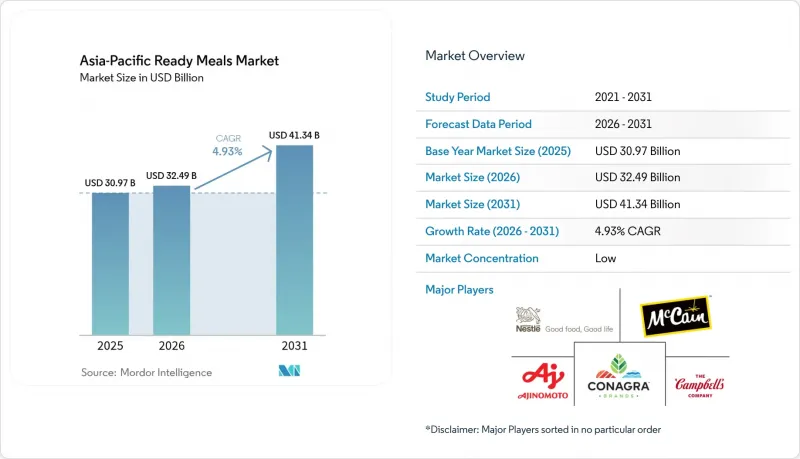
This report is Segmented by Product Type (Frozen Ready Meals, Chilled Ready Meals, and More), Ingredient (Conventional, Free-From), Category (Vegetarian, Non-Vegetarian), Distribution Channel (Supermarkets/Hypermarkets, Convenience Stores, Online Retailers, Other Distribution Channels) and by Geography (China, India, Japan and More). The Market Forecasts are Provided in Terms of Value (USD).
Asia-Pacific Ready Meals Market Trends and Insights
Technological advancements in food preservation
In the Asia-Pacific ready meals market, advanced preservation technologies are not only extending shelf life but also ensuring nutritional integrity and sensory appeal. Governments across the region are actively promoting the adoption of innovative food preservation methods to reduce food waste and enhance food security. For example, the Indian Ministry of Food Processing Industries (MoFPI) has introduced initiatives to modernize food processing infrastructure, including the adoption of advanced preservation methods . Similarly, China's National Development and Reform Commission (NDRC) has emphasized the importance of reducing food waste through technological advancements in food processing and preservation. Moreover, industry associations are playing a crucial role in driving innovation. The Japan Food Industry Association (JFIA) has been actively collaborating with stakeholders to promote research and development in food preservation technologies. These efforts are aimed at addressing the increasing consumer demand for ready meals that offer convenience without compromising on quality or safety.
Sustainability and eco-friendly packaging
The shift towards sustainable packaging is gaining significant momentum across the region, driven by regulatory mandates and the increasing environmental awareness of consumers. Governments in the region are enforcing stricter regulations to reduce plastic waste, while consumers are actively seeking eco-friendly alternatives to align with their values. These efforts have led to the production of carboxymethyl cellulose films, which utilize these agricultural by-products effectively. Additionally, researchers and companies are advancing the development of polylactic acid (PLA) and biogenic vaterite CaCO3-Ag hybrid films. These materials not only exhibit superior antimicrobial properties but also maintain biodegradability, addressing critical concerns related to food safety and environmental sustainability. In markets where sustainability credentials heavily influence purchasing decisions, businesses are capitalizing on this trend. Younger consumers, in particular, are prioritizing eco-friendly options and are willing to pay premium prices for products that align with their environmental values. As a result, the adoption of sustainable packaging solutions is becoming a strategic imperative for companies aiming to thrive in this evolving market landscape.
Strong competition from fresh and home-cooked alternatives
Traditional cooking practices and a strong preference for fresh food continue to hinder the adoption of ready meals across the Asia-Pacific region. This challenge is particularly pronounced in rural areas, where residents actively engage in cooking due to their well-developed skills and ample time availability. Urban food consumption studies highlight a growing trend of dining out; however, home cooking still holds significant cultural value. For example, rural households in Indonesia consistently choose traditional markets and rice mills over modern retail options. Consumer perception research shows that the packaging of ready-to-eat meals often diminishes their appeal and perceived healthiness. However, when consumers evaluate these products without the influence of packaging, their sensory quality can mitigate these negative perceptions. In markets where food preparation is deeply rooted in cultural identity and family traditions, competition remains intense. As a result, ready meal manufacturers are positioning their products as supplements to traditional meals rather than as complete replacements, aiming to align with these cultural practices.
Other drivers and restraints analyzed in the detailed report include:
- Innovation in plant-based and alternative proteins
- Cultural and ethnic diversity
- Short shelf life for premium products
For complete list of drivers and restraints, kindly check the Table Of Contents.
Segment Analysis
Chilled ready meals maintain market leadership with 44.02% share in 2025, benefiting from consumer perception of freshness and superior taste profiles compared to frozen alternatives. However, frozen ready meals are experiencing robust growth at 5.16% CAGR through 2031, driven by technological innovations in preservation and expanding cold chain infrastructure across emerging markets. Shelf stable products serve niche applications in rural areas and emergency preparedness, while freeze-dried ready meals target premium outdoor and military segments with extended shelf life capabilities.
Advanced freezing technologies are transforming frozen product quality, with Japanese companies implementing 3D freezing systems that preserve texture and flavor integrity previously achievable only in fresh products. The convergence of preservation technology and consumer convenience preferences suggests frozen segments will continue gaining market share, particularly as distribution networks expand into underserved geographic regions where fresh product delivery remains challenging.
In 2025, conventional ingredients dominated the market, holding an 81.02% share. This dominance is attributed to well-established supply chains and the cost advantages associated with traditional formulations, which continue to appeal to manufacturers and consumers alike. Meanwhile, "free-from" products are experiencing significant growth, with a robust 5.42% CAGR projected through 2031. This growth is driven by increasing consumer awareness of health and dietary restrictions, as well as a rising preference for products catering to specific needs, such as gluten-free or allergen-free options. The trend is particularly evident in developed markets, where consumers are more inclined to pay a premium for specialized and health-focused ingredients.
Clean-label trends are exerting a transformative influence on both segments. Conversely, synthetic additives are facing growing resistance due to concerns over their potential health impacts. The ingredient landscape is further evolving due to regulatory developments, including China's proposed labeling standards. These standards aim to enforce clearer ingredient disclosures, which could accelerate the industry's shift toward more recognizable and natural components. Such regulatory changes are expected to impact all product categories, pushing manufacturers to reformulate their offerings to align with consumer demand for transparency and natural ingredients.
Complete Report Scope:
- By Product Type
- Frozen Ready Meals
- Chilled Ready Meals
- Shelf Stable
- Freeze-Dried Ready Meals
- By Ingredient
- Conventional
- Free-From
- By Category
- Vegetarian
- Non-vegetarian
- By Distribution Channel
- Supermarkets/Hypermarkets
- Convenience Stores
- Online Retail Stores
- Other Distribution Channels
- By Geography
- China
- India
- Japan
- Australia
- Indonesia
- South Korea
- Thailand
- Singapore
- Rest of Asia-Pacific
List of Companies Covered in this Report:
- Nestle SA
- The Campbell's Company
- Ajinomoto Co., Inc.
- McCain Foods Ltd
- Conagra Brands Inc.
- Nichirei Foods Inc.
- Tingyi (Cayman Islands) Holding Corp.
- Sanquan Food Co.
- ITC Ltd
- MTR Foods Pvt Ltd
- Tasty Bite Eatables Ltd.
- Marumiya Corporation
- Tata Consumer Products Limited
- The Kraft Heinz Company
- Katokichi Co., Ltd.
- Bakkavor Group PLC
- Toyo Suisan Kaisha, Ltd.
- Uni-President Enterprises Corp.
- Freshippo (Hema)
- Indofood Sukses Makmur Tbk PT
- Maruha Nichiro Corporation
Additional Benefits:
- The market estimate (ME) sheet in Excel format
- 3 months of analyst support
TABLE OF CONTENTS
1 INTRODUCTION
- 1.1 Study Assumptions and Market Definition
- 1.2 Scope of the Study
2 RESEARCH METHODOLOGY
3 EXECUTIVE SUMMARY
4 MARKET LANDSCAPE
- 4.1 Market Overview
- 4.2 Market Drivers
- 4.2.1 Technological advancements in food preservation
- 4.2.2 Sustainability and eco-friendly packaging
- 4.2.3 Innovation in plant-based and alternative proteins
- 4.2.4 Cultural and ethnic diversity
- 4.2.5 Flavor and culinary trends
- 4.2.6 Surge in demand for clean-label ready meals
- 4.3 Market Restraints
- 4.3.1 Short shelf life for premium products
- 4.3.2 Strong competition from fresh and home-cooked alternatives
- 4.3.3 Taste and quality perception
- 4.3.4 Limited appeal in rural areas
- 4.4 Consumer Behaviour Analysis
- 4.5 Regulatory Outlook
- 4.6 Porter's Five Forces Analysis
- 4.6.1 Bargaining Power of Suppliers
- 4.6.2 Bargaining Power of Buyers
- 4.6.3 Threat of New Entrants
- 4.6.4 Threat of Substitutes
- 4.6.5 Degree of Competition
5 MARKET SIZE AND GROWTH FORECASTS (VALUE)
- 5.1 By Product Type
- 5.1.1 Frozen Ready Meals
- 5.1.2 Chilled Ready Meals
- 5.1.3 Shelf Stable
- 5.1.4 Freeze-Dried Ready Meals
- 5.2 By Ingredient
- 5.2.1 Conventional
- 5.2.2 Free-From
- 5.3 By Category
- 5.3.1 Vegetarian
- 5.3.2 Non-vegetarian
- 5.4 By Distribution Channel
- 5.4.1 Supermarkets/Hypermarkets
- 5.4.2 Convenience Stores
- 5.4.3 Online Retail Stores
- 5.4.4 Other Distribution Channels
- 5.5 By Geography
- 5.5.1 China
- 5.5.2 India
- 5.5.3 Japan
- 5.5.4 Australia
- 5.5.5 Indonesia
- 5.5.6 South Korea
- 5.5.7 Thailand
- 5.5.8 Singapore
- 5.5.9 Rest of Asia-Pacific
6 COMPETITIVE LANDSCAPE
- 6.1 Market Concentration
- 6.2 Strategic Moves
- 6.3 Market Share Analysis
- 6.4 Company Profiles (Includes Global-level Overview, Market-level Overview, Core Segments, Financials, Strategic Info, Market Rank/Share, Products & Services, Recent Developments)
- 6.4.1 Nestle SA
- 6.4.2 The Campbell's Company
- 6.4.3 Ajinomoto Co., Inc.
- 6.4.4 McCain Foods Ltd
- 6.4.5 Conagra Brands Inc.
- 6.4.6 Nichirei Foods Inc.
- 6.4.7 Tingyi (Cayman Islands) Holding Corp.
- 6.4.8 Sanquan Food Co.
- 6.4.9 ITC Ltd
- 6.4.10 MTR Foods Pvt Ltd
- 6.4.11 Tasty Bite Eatables Ltd.
- 6.4.12 Marumiya Corporation
- 6.4.13 Tata Consumer Products Limited
- 6.4.14 The Kraft Heinz Company
- 6.4.15 Katokichi Co., Ltd.
- 6.4.16 Bakkavor Group PLC
- 6.4.17 Toyo Suisan Kaisha, Ltd.
- 6.4.18 Uni-President Enterprises Corp.
- 6.4.19 Freshippo (Hema)
- 6.4.20 Indofood Sukses Makmur Tbk PT
- 6.4.21 Maruha Nichiro Corporation
7 MARKET OPPORTUNITIES AND FUTURE OUTLOOK

