PUBLISHER: Mordor Intelligence | PRODUCT CODE: 2115087

PUBLISHER: Mordor Intelligence | PRODUCT CODE: 2115087
Vehicle Access Control - Market Share Analysis, Industry Trends & Statistics, Growth Forecasts (2026 - 2031)
According to Mordor Intelligence, the vehicle access control market size is expected to grow from USD 16.82 billion in 2025 to USD 18.88 billion in 2026 and is forecast to reach USD 33.56 billion by 2031 at 12.21% CAGR over 2026-2031.
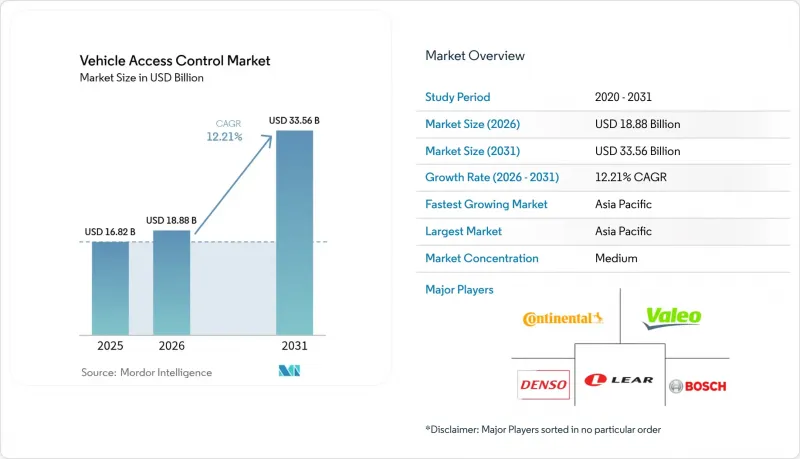
This report is Segmented by System Type (Biometric and Non-Biometric), Technology (RFID, Bluetooth, NFC, Ultra-Wideband (UWB), and More), Vehicle Type (Passenger Cars and Commercial Vehicles), End User (OEM-Installed and More), Sales Channel (Direct To OEM, and More), and Geography (North America, South America, Europe, and More). The Market Forecasts are Provided in Terms of Value (USD).
Global Vehicle Access Control Market Trends and Insights
Rising Demand For Connected And Autonomous-Ready Vehicles
Connected architectures have elevated access control from simple entry to the master authentication gateway for over-the-air updates, diagnostics, and autonomous coordination. BMW's Digital Key Plus proves how UWB-driven spatial awareness enables automated parking and charging while preventing relay attacks. As the Car Connectivity Consortium codifies UWB in Digital Key 3.0, OEMs can justify higher per-unit pricing for secure positioning, accelerating adoption across premium and mass-market segments.
OEM Push Toward Key-As-A-Service Platforms
Subscription-based digital keys transform one-time hardware margins into recurring cloud revenue. Continental's CoSmA allows multi-OEM credential lifecycle management, supporting dynamic feature upgrades that monetize convenience tiers. This model reduces key-fob logistics costs and supports shared-mobility by provisioning and revoking credentials in real time.
Escalating Cybersecurity Vulnerabilities And Zero-Day Exploits
Open-source tools now clone eight remote-keyless protocols, with one fully compromised according to MIT research. Rapid attack evolution outpaces automotive patch cycles, keeping consumer anxiety high and inviting stricter oversight. Tesla's past CVE-2022-37709 phone-key bypass exemplifies how even high-end designs can be undermined within months of launch.
Other drivers and restraints analyzed in the detailed report include:
- Insurance Incentives For Integrated Anti-Theft Analytics
- EU "Digit-Key" Regulation Mandating Tamper-Proof OTA Credentialing
- High BOM Cost For Premium Biometric Modules
For complete list of drivers and restraints, kindly check the Table Of Contents.
Segment Analysis
Non-biometric solutions sustained a 67.62% stronghold in 2025, driven by mature RFID and NFC price points and entrenched supply chains. Biometric alternatives, however, are pacing the vehicle access control market at a 13.63% CAGR as fingerprint and facial recognition find early success in luxury passenger cars. OEM pilots show that biometric modules dramatically cut theft claims, bolstering insurance rebates that erase part of the cost premium.
Volume adoption remains gated by sensor cost and privacy regulation, yet over 100 automakers and Tier-1s are prototyping biometric gateways. Continental's 2025 CES showcase blended facial ID with vital-sign monitoring to detect unauthorized occupants, hinting at a future where access control doubles as a safety platform.
RFID retained 44.95% of 2025 revenue, but UWB's 18.05% CAGR is resetting the competitive arc of the vehicle access control market. BMW, Volkswagen, and Hyundai embed UWB to build centimeter-grade secure zones that block signal amplification attacks. Semiconductor innovation, such as NXP's NCJ29D5 chip, lowers integration hurdles and pushes UWB downmarket.
Bluetooth and NFC persist where cost ceilings matter or physical contact is preferred, for instance, in car-sharing pick-up spots. Wi-Fi and cellular serve background credential synchronization rather than immediate unlock.
Complete Report Scope:
- System Type
- Biometric
- Fingerprint Recognition
- Facial Recognition
- Iris / Retina Recognition
- Non-Biometric
- RFID Tag and Reader
- NFC / Bluetooth Low Energy
- Key Fob / Smart Card
- Biometric
- Technology
- RFID
- Bluetooth
- NFC
- Ultra-Wideband (UWB)
- Wi-Fi / Cellular
- Vehicle Type
- Passenger Cars
- Hatchback
- Sedan
- SUV / Crossover
- Commercial Vehicles
- Light Commercial Vehicles
- Heavy Trucks and Busses
- Passenger Cars
- End User
- OEM-installed
- Aftermarket Retrofit
- Sales Channel (Cross-segmentation)
- Direct to OEM
- Tier-1 Supply
- e-Commerce / Aftermarket
- Geography
- North America
- United States
- Canada
- Mexico
- Rest of North America
- South America
- Brazil
- Argentina
- Rest of South America
- Europe
- Germany
- United Kingdom
- France
- Italy
- Rest of Europe
- Asia-Pacific
- China
- Japan
- India
- South Korea
- Rest of Asia-Pacific
- Middle East and Africa
- Saudi Arabia
- United Arab Emirates
- South Africa
- Rest of Middle East and Africa
- North America
Geography Analysis
The Asia-Pacific's 42.87% share in vehicle access control market in 2025 is rooted in strong EV volume and an integrated supply chain that spans semiconductors to final assembly. China's 8 million EV sales in 2024 required secure keys that coordinate with charging infrastructure, while India's domestic production push fuels demand for cost-optimized modules fueling growth of 13.12% CAGR through 2031. Japan and South Korea drive semiconductor innovation-Renesas and Samsung deliver secure microcontrollers that underpin next-generation credential vaults.
North America records a steady growth, leveraging high vehicle density and robust premium segments that readily pay for biometric and UWB additions. NHTSA guidelines and insurer incentives combine to standardize higher security baselines. The region's leadership in ride-hailing and e-commerce fleets speeds multi-user credential experimentation, shaping global software-as-a-service feature sets.
Europe growth is moderate, but regulatory gravity outstrips raw growth. The Cyber Resilience Act cements tamper-proof OTA updating and post-quantum readiness as ticket-to-play requirements. Continental's rebranding to Aumovio and pivot to software ecosystems reflect how suppliers adapt to regulation-led demand. OEMs often certify to EU standards first and roll the same architecture worldwide, making Europe's policy stance a global bellwether.
- Continental AG
- Robert Bosch GmbH
- Denso Corporation
- Valeo SA
- Lear Corporation
- VOXX Automotive
- Fingerprint Cards AB
- Mitsubishi Electric Corp.
- BorgWarner Inc.
- Nuance Communications
- Thales Group
- Gentex Corporation
- Synaptics Incorporated
- ASSA ABLOY
- dormakaba Holding
- HID Global
- Impinj Inc.
- IDEMIA
- Nedap N.V.
- Smartrac Technology
- Stanley Black and Decker (STANLEY Access)
Additional Benefits:
- The market estimate (ME) sheet in Excel format
- 3 months of analyst support
TABLE OF CONTENTS
1 Introduction
- 1.1 Study Assumptions and Market Definition
- 1.2 Scope of the Study
2 Research Methodology
3 Executive Summary
4 Market Landscape
- 4.1 Market Overview
- 4.2 Market Drivers
- 4.2.1 Rising demand for connected and autonomous-ready vehicles
- 4.2.2 OEM push toward key-as-a-service platforms
- 4.2.3 Insurance incentives for integrated anti-theft analytics
- 4.2.4 EU "Digit-Key" regulation mandating tamper-proof over-the-air (OTA) credentialing
- 4.2.5 Fleet-based e-commerce dark-hour delivery programs
- 4.2.6 Semiconductor foundry shift to integrated secure element (iSE) chipsets
- 4.3 Market Restraints
- 4.3.1 Escalating cybersecurity vulnerabilities and zero-day exploits
- 4.3.2 High BOM cost for premium biometric modules
- 4.3.3 Automotive E/E architecture consolidation limiting aftermarket integration
- 4.3.4 Fragmented credential standards delaying V2X trust frameworks
- 4.4 Value / Supply-Chain Analysis
- 4.5 Regulatory Landscape
- 4.6 Technological Outlook
- 4.7 Porter's Five Forces
- 4.7.1 Threat of New Entrants
- 4.7.2 Bargaining Power of Buyers
- 4.7.3 Bargaining Power of Suppliers
- 4.7.4 Threat of Substitutes
- 4.7.5 Intensity of Competitive Rivalry
5 Market Size and Growth Forecasts (Value)
- 5.1 System Type
- 5.1.1 Biometric
- 5.1.1.1 Fingerprint Recognition
- 5.1.1.2 Facial Recognition
- 5.1.1.3 Iris / Retina Recognition
- 5.1.2 Non-Biometric
- 5.1.2.1 RFID Tag and Reader
- 5.1.2.2 NFC / Bluetooth Low Energy
- 5.1.2.3 Key Fob / Smart Card
- 5.1.1 Biometric
- 5.2 Technology
- 5.2.1 RFID
- 5.2.2 Bluetooth
- 5.2.3 NFC
- 5.2.4 Ultra-Wideband (UWB)
- 5.2.5 Wi-Fi / Cellular
- 5.3 Vehicle Type
- 5.3.1 Passenger Cars
- 5.3.1.1 Hatchback
- 5.3.1.2 Sedan
- 5.3.1.3 SUV / Crossover
- 5.3.2 Commercial Vehicles
- 5.3.2.1 Light Commercial Vehicles
- 5.3.2.2 Heavy Trucks and Busses
- 5.3.1 Passenger Cars
- 5.4 End User
- 5.4.1 OEM-installed
- 5.4.2 Aftermarket Retrofit
- 5.5 Sales Channel (Cross-segmentation)
- 5.5.1 Direct to OEM
- 5.5.2 Tier-1 Supply
- 5.5.3 e-Commerce / Aftermarket
- 5.6 Geography
- 5.6.1 North America
- 5.6.1.1 United States
- 5.6.1.2 Canada
- 5.6.1.3 Mexico
- 5.6.1.4 Rest of North America
- 5.6.2 South America
- 5.6.2.1 Brazil
- 5.6.2.2 Argentina
- 5.6.2.3 Rest of South America
- 5.6.3 Europe
- 5.6.3.1 Germany
- 5.6.3.2 United Kingdom
- 5.6.3.3 France
- 5.6.3.4 Italy
- 5.6.3.5 Rest of Europe
- 5.6.4 Asia-Pacific
- 5.6.4.1 China
- 5.6.4.2 Japan
- 5.6.4.3 India
- 5.6.4.4 South Korea
- 5.6.4.5 Rest of Asia-Pacific
- 5.6.5 Middle East and Africa
- 5.6.5.1 Saudi Arabia
- 5.6.5.2 United Arab Emirates
- 5.6.5.3 South Africa
- 5.6.5.4 Rest of Middle East and Africa
- 5.6.1 North America
6 Competitive Landscape
- 6.1 Market Concentration
- 6.2 Strategic Moves
- 6.3 Market Share Analysis
- 6.4 Company Profiles (Includes Global Level Overview, Market Level Overview, Core Segments, Financials as Available, Strategic Information, Market Rank/Share for Key Companies, Products and Services, SWOT Analysis, and Recent Developments)
- 6.4.1 Continental AG
- 6.4.2 Robert Bosch GmbH
- 6.4.3 Denso Corporation
- 6.4.4 Valeo SA
- 6.4.5 Lear Corporation
- 6.4.6 VOXX Automotive
- 6.4.7 Fingerprint Cards AB
- 6.4.8 Mitsubishi Electric Corp.
- 6.4.9 BorgWarner Inc.
- 6.4.10 Nuance Communications
- 6.4.11 Thales Group
- 6.4.12 Gentex Corporation
- 6.4.13 Synaptics Incorporated
- 6.4.14 ASSA ABLOY
- 6.4.15 dormakaba Holding
- 6.4.16 HID Global
- 6.4.17 Impinj Inc.
- 6.4.18 IDEMIA
- 6.4.19 Nedap N.V.
- 6.4.20 Smartrac Technology
- 6.4.21 Stanley Black and Decker (STANLEY Access)
7 Market Opportunities and Future Outlook
- 7.1 White-space and Unmet-Need Assessment

