PUBLISHER: Mordor Intelligence | PRODUCT CODE: 2115094

PUBLISHER: Mordor Intelligence | PRODUCT CODE: 2115094
Europe Hand Sanitizer - Market Share Analysis, Industry Trends & Statistics, Growth Forecasts (2026 - 2031)
According to Mordor Intelligence, the Europe hand sanitizer market size is expected to grow from USD 258.58 million in 2025 to USD 277.18 million in 2026 and is forecast to reach USD 392.4 million by 2031 at 7.20% CAGR over 2026-2031.
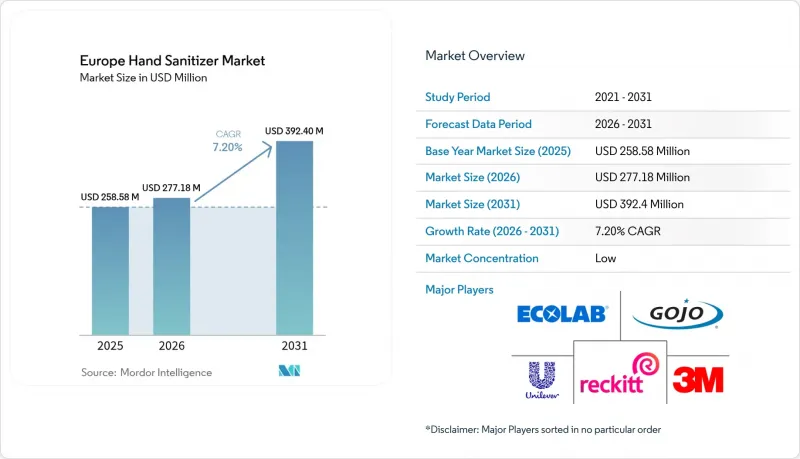
This report is Segmented by Product Type (Gel/Liquid, Spray and Other Product Types), End User (Adult and Kids/Children), Ingredients (Conventional, and Natural and Organic), End Use (Residential and Commercial), and Geography (Germany, United Kingdom, Italy, France, Spain, Netherlands, Poland, Belgium, Sweden, and Rest of Europe). The Market Forecasts are Provided in Terms of Value (USD).
Europe Hand Sanitizer Market Trends and Insights
Growing Emphasis on Hygiene and Sanitation
Growing health awareness has transformed hygiene practices across Europe, leading to a sustained increase in hand sanitizer usage. European health organizations and governments continue to emphasize proper hand hygiene as a crucial preventive measure. The hospitality and tourism sectors have integrated hand sanitizer stations as a standard amenity, further driving market growth. The rising adoption of hand sanitizers in public spaces and transportation hubs demonstrates the region's commitment to maintaining high hygiene standards. The organization's guidelines on hand hygiene have significantly influenced institutional and consumer purchasing patterns. With seasonal influenza affecting approximately 20% of the European population annually, according to the European Centre for Disease Prevention and Control, hand sanitizers have become an essential part of daily routines for European consumers.
Increased Health and Safety Regulations Across Workplaces, Public Institutions, and Healthcare Facilities
The implementation of stringent hygiene protocols across healthcare facilities, educational institutions, and workplaces has established a consistent demand for hand sanitizers in Europe. This demand is further reinforced by alarming healthcare statistics, with the European Centre for Disease Prevention and Control reporting 4.3 million patients in EU/EEA hospitals affected by healthcare-associated infections annually. The UK government's specific guidelines for schools and childcare facilities mandate the availability of alcohol-based hand gels, while also acknowledging their limitations against certain pathogens like norovirus. This has led to increased adoption of multi-modal hygiene solutions incorporating both alcohol-based and non-alcohol formulations. The European Agency for Safety and Health at Work has integrated hand sanitizers as essential components of occupational health frameworks, particularly in healthcare and social work sectors. These regulatory requirements and workplace safety standards have created predictable, long-term demand patterns, enabling suppliers to confidently invest in capacity expansion and product innovation.
Health Concern Over Chemical Ingredients
Consumer awareness regarding potential health risks associated with chemical ingredients in hand sanitizers has emerged as a significant market restraint in Europe. The FDA's classification of benzalkonium chloride as a Category III ingredient, requiring additional safety and effectiveness data, has intensified regulatory scrutiny. European consumers actively examine product labels and seek formulations with minimal synthetic chemicals, a behavior amplified by social media discussions about endocrine-disrupting compounds and long-term exposure effects from frequent sanitizer use. While natural alternatives command higher prices, health-conscious consumers demonstrate willingness to pay premium costs. This shift in consumer preferences has compelled manufacturers to develop "clean chemistry" initiatives focused on eliminating chemicals of concern while maintaining antimicrobial effectiveness.
Other drivers and restraints analyzed in the detailed report include:
- Technological Advancement in Product Formulation
- Consumers Inclination Towards Natural and Organic Sanitizers
- Strong Penetration of Other Hand Cleaning Products
For complete list of drivers and restraints, kindly check the Table Of Contents.
Segment Analysis
Gel and liquid formulations dominate the European hand sanitizer market with an 83.88% share in 2025, driven by widespread consumer acceptance and robust distribution networks across retail and institutional channels. While sprays maintain a moderate market position due to their contactless application benefits, they face growing competition from innovative formats. The other product types segment, including foams, wipes, and spray-dried powders, is witnessing rapid expansion at 7.52% CAGR through 2031, as manufacturers focus on product differentiation through novel delivery mechanisms to capture market share.
Innovation in alternative sanitizer formats has accelerated through scientific advancements that overcome traditional liquid sanitizer limitations. The development of solar-powered sanitization units with ultraviolet technology, supported by the European Space Agency, demonstrates the potential for non-chemical alternatives in the market. This technological progression is reshaping product segmentation as manufacturers increasingly develop hybrid solutions that integrate multiple delivery mechanisms. These innovations aim to enhance both product effectiveness and user experience, indicating a shift toward more sophisticated sanitization solutions in the European market.
Adult hand sanitizer usage commands an 82.96% market share in 2025, driven by workplace hygiene requirements and established institutional purchasing patterns, while the kids and children segment exhibits rapid growth at 7.78% CAGR through 2031. Educational institutions are implementing permanent hygiene protocols that extend beyond pandemic measures, with UK government guidelines mandating alcohol hand gel availability in schools when hands are not visibly soiled. However, the limitations of sanitizers against certain pathogens like norovirus necessitate additional hygiene measures, prompting institutions to adopt comprehensive approaches. The institutional focus on children's hygiene has led to infrastructure adaptations, including child-height dispensers and curriculum-based education programs that establish lasting hygiene habits.
The children's segment growth reflects systematic institutional investment rather than consumer preferences alone, as schools and childcare facilities integrate hygiene education into their core operations. This institutional adoption creates sustained market expansion opportunities since hygiene habits formed during childhood typically continue into adulthood. The segment's development has catalyzed innovation in product formulations that address pediatric safety concerns, particularly regarding sensitive skin and accidental ingestion risks. Educational facilities' commitment to age-appropriate hygiene solutions has created opportunities for premium-priced specialized products that meet stringent safety standards while supporting long-term market growth through established behavioral patterns.
Complete Report Scope:
- By Product Type
- Gel/Liquid
- Spray
- Other Product Types
- By End User
- Adult
- Kids/Children
- By Ingredients
- Conventional
- Natural and Organic
- By End Use
- Residential
- Commercial
- By Geography
- Germany
- United Kingdom
- Italy
- France
- Spain
- Netherlands
- Poland
- Belgium
- Sweden
- Rest of Europe
List of Companies Covered in this Report:
- Reckitt Benckiser Group PLC
- 3M Company
- Unilever PLC
- Ecolab Inc.
- GOJO Industries Inc.
- INEOS Capital Limited
- Henkel AG & co. GaA
- PZ Cussons PLC
- Saraya.Co.Ltd
- EcoHydra Technologies Ltd
- Wrimes Cosmetics Ltd.
- Clarisans
- ANTISEPTICA Dr. Hans-Joachim Molitor GmbH
- Kimberly-Clark Corporation
- The Procter & Gamble Company
- Laboratoires Anios
- ACTO GmbH
- The HARTMANN GROUP
- Beiersdorf AG
- Dr. Schumacher GmbH
Additional Benefits:
- The market estimate (ME) sheet in Excel format
- 3 months of analyst support
TABLE OF CONTENTS
1 INTRODUCTION
- 1.1 Study Assumptions and Market Definition
- 1.2 Scope of the Study
2 RESEARCH METHODOLOGY
3 EXECUTIVE SUMMARY
4 MARKET LANDSCAPE
- 4.1 Market Overview
- 4.2 Market Drivers
- 4.2.1 Growing Emphasis on Hygiene and Sanitation
- 4.2.2 Increased Health and Safety Regulations Across Workplaces, Public Institutions, and Healthcare Facilities
- 4.2.3 Technological Advancement in Product Formulation
- 4.2.4 Consumers Inclination Towards Natural and Organic Sanitizers
- 4.2.5 Growth in Real Estate Sector
- 4.2.6 Social Media Influence and Celebrity Endorsements
- 4.3 Market Restraints
- 4.3.1 Availability of Counterfeit Products
- 4.3.2 Price Fluctuation in Raw Material
- 4.3.3 Health Concern Over Chemical Ingredients
- 4.3.4 Strong Penetration of Other Hand Cleaning Products
- 4.4 Consumer Behaviour Analysis
- 4.5 Regulatory Outlook
- 4.6 Porter's Five Forces Analysis
- 4.6.1 Bargaining Power of Suppliers
- 4.6.2 Bargaining Power of Buyers
- 4.6.3 Threat of New Entrants
- 4.6.4 Threat of Substitutes
- 4.6.5 Degree of Competition
5 MARKET SIZE AND GROWTH FORECASTS (VALUE)
- 5.1 By Product Type
- 5.1.1 Gel/Liquid
- 5.1.2 Spray
- 5.1.3 Other Product Types
- 5.2 By End User
- 5.2.1 Adult
- 5.2.2 Kids/Children
- 5.3 By Ingredients
- 5.3.1 Conventional
- 5.3.2 Natural and Organic
- 5.4 By End Use
- 5.4.1 Residential
- 5.4.2 Commercial
- 5.5 By Geography
- 5.5.1 Germany
- 5.5.2 United Kingdom
- 5.5.3 Italy
- 5.5.4 France
- 5.5.5 Spain
- 5.5.6 Netherlands
- 5.5.7 Poland
- 5.5.8 Belgium
- 5.5.9 Sweden
- 5.5.10 Rest of Europe
6 COMPETITIVE LANDSCAPE
- 6.1 Market Concentration
- 6.2 Strategic Moves
- 6.3 Market Share Analysis
- 6.4 Company Profiles (Includes Global-level Overview, Market-level Overview, Core Segments, Financials (if available), Strategic Info, Market Rank/Share, Products and Services, Recent Developments)
- 6.4.1 Reckitt Benckiser Group PLC
- 6.4.2 3M Company
- 6.4.3 Unilever PLC
- 6.4.4 Ecolab Inc.
- 6.4.5 GOJO Industries Inc.
- 6.4.6 INEOS Capital Limited
- 6.4.7 Henkel AG & co. GaA
- 6.4.8 PZ Cussons PLC
- 6.4.9 Saraya.Co.Ltd
- 6.4.10 EcoHydra Technologies Ltd
- 6.4.11 Wrimes Cosmetics Ltd.
- 6.4.12 Clarisans
- 6.4.13 ANTISEPTICA Dr. Hans-Joachim Molitor GmbH
- 6.4.14 Kimberly-Clark Corporation
- 6.4.15 The Procter & Gamble Company
- 6.4.16 Laboratoires Anios
- 6.4.17 ACTO GmbH
- 6.4.18 The HARTMANN GROUP
- 6.4.19 Beiersdorf AG
- 6.4.20 Dr. Schumacher GmbH
7 MARKET OPPORTUNITIES AND FUTURE OUTLOOK

