PUBLISHER: Mordor Intelligence | PRODUCT CODE: 2115100

PUBLISHER: Mordor Intelligence | PRODUCT CODE: 2115100
Frontotemporal Disorders Treatment - Market Share Analysis, Industry Trends & Statistics, Growth Forecasts (2026 - 2031)
According to Mordor Intelligence, the frontotemporal disorders treatment market size was valued at USD 407.26 million in 2025 and estimated to grow from USD 426.85 million in 2026 to reach USD 539.85 million by 2031, at a CAGR of 4.81% during the forecast period (2026-2031).
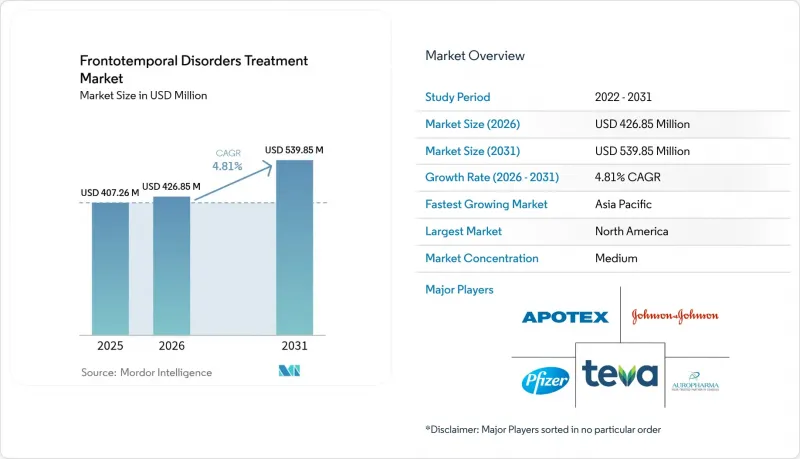
This report is Segmented by Drug Class (Cognitive Enhancers, Antipsychotics, and More), Disease Indication (Frontotemporal Dementia, and More), Distribution Channel (Hospital Pharmacies, Retail Pharmacies, and Online Pharmacies), and Geography (North America, Europe, Asia-Pacific, Middle East & Africa, South America). The Market Forecasts are Provided in Terms of Value (USD).
Global Frontotemporal Disorders Treatment Market Trends and Insights
Rising Global Dementia Burden
Frontotemporal disorder prevalence is accelerating worldwide, with Asia-Pacific now mirroring Western incidence patterns after fast urbanization and increased life expectancy. Health systems respond by embedding biomarker-based triage into neurology pathways, aligning with the FDA's 2024 guidance that encourages surrogate endpoint use in trials. The U.S. GUIDE Dementia Model introduced coordinated caregiver reimbursement, broadening patient support networks. Budget planners warn that delayed diagnosis inflates long-term care costs, creating impetus for earlier screening programs across primary care.
Government Funding and Orphan Drug Incentives
Federal and philanthropic bodies have earmarked significant grants-such as the U.S. Department of Defense's USD 650 million 2025 Alzheimer's Research Program-to stimulate translational dementia studies. Orphan-drug status continues to compress review timelines; latozinemab secured breakthrough status, potentially slicing 6-12 months from evaluation. Global alliances, exemplified by the Treat FTD Fund's USD 10 million extension through 2035, mitigate commercial risk and maintain momentum for rare-disease pipelines.
Limited Disease-Modifying Treatment Approvals
Late-stage attrition remains high; Roche terminated a tau-antibody program after suboptimal efficacy, returning rights to partner UCB. The FDA demands rigorous surrogate-endpoint validation, compelling sponsors to run parallel biomarker studies that extend timelines. Misdiagnosis-estimated near 70% in early FTD referrals-adds enrollment complexity, forcing firms to widen geographic footprints for trials.
Other drivers and restraints analyzed in the detailed report include:
- Advancements in Neurodegenerative Biomarkers
- Pipeline Expansion of Disease-Modifying Therapies
- High Development and Therapy Costs
For complete list of drivers and restraints, kindly check the Table Of Contents.
Segment Analysis
Antipsychotics retained 38.02% revenue share of the frontotemporal disorders treatment market in 2025, cushioning overall sales while clinical practice transitions toward mechanism-based drugs. Uptake persists because behavioral symptoms remain ubiquitous across FTD phenotypes. CNS stimulants post the highest 7.05% CAGR through 2031 as physicians probe executive-function benefits and leverage emerging data on dopaminergic modulation. The frontotemporal disorders treatment market size for stimulants is forecast to outpace legacy sedatives, reflecting broader cognitive-enhancement strategies. Novel cholinergic and O-GlcNAcase modulators anchor early-stage portfolios, but widespread use depends on definitive efficacy beyond symptomatic relief. Biologic entrants-namely sortilin-blocking antibodies-could reorder class dynamics if late-phase readouts confirm disease-slowing benefits.
Precision-therapy momentum complicates formulary decisions: payers view traditional antipsychotics as low-cost stopgaps yet recognize rising off-label expenditures on cognitive agents. Manufacturers respond by bundling digital-monitoring apps that capture patient-reported outcomes, aiming to justify higher prices via real-world performance data. As vaccination-style gene therapies enter specialty pharmacies, dosage frequency shifts from chronic daily pills to single procedures, altering lifetime revenue curves across classes.
Complete Report Scope:
- By Drug Class
- Cognitive Enhancers
- Antipsychotics
- Antidepressants
- CNS Stimulants
- Other Drug Classes
- By Disease Indication
- Frontotemporal Dementia
- Primary Progressive Aphasia
- Movement Disorders
- By Distribution Channel
- Hospital Pharmacies
- Retail Pharmacies
- Online Pharmacies
- Geography
- North America
- United States
- Canada
- Mexico
- Europe
- Germany
- United Kingdom
- France
- Italy
- Spain
- Rest of Europe
- Asia-Pacific
- China
- Japan
- India
- Australia
- South Korea
- Rest of Asia-Pacific
- Middle East & Africa
- GCC
- South Africa
- Rest of Middle East & Africa
- South America
- Brazil
- Argentina
- Rest of South America
- North America
Geography Analysis
North America accounted for 41.10% of global revenue in 2025, supported by early-access pathways such as FDA breakthrough designation and structured Medicare payment models covering cognitive-assessment visits. Strong biopharma clusters in California and Massachusetts anchor high trial density, ensuring that most transformative assets debut locally. Payers leverage real-world data networks to negotiate outcomes-based contracts, smoothing uptake for premium-priced innovations.
Asia-Pacific registers the quickest 6.18% CAGR to 2031, benefiting from aging demographics and rapid neurology infrastructure build-out. China's introduction of blood-based FTD screening kits, pending regulatory clearance, is expected to shorten diagnosis by nearly one year, accelerating therapy initiation. Japanese insurers experiment with bundled payment models for gene-therapy follow-up, setting a precedent for neighboring markets. In India, the rise of urban super-specialty hospitals brings magnet centers capable of handling neurosurgical gene-vector infusions, though unequal rural access persists.
Europe remains an innovation contributor through cross-border research consortia spearheaded by the European Medicines Agency and Horizon Europe grants. Budget constraints lead some national health systems to stagger patient eligibility for high-cost therapies; nonetheless, Germany's AMNOG framework offers predictable price negotiation timelines that attract launches. Regulatory realignment post-Brexit introduces additional dossier preparation for the United Kingdom, yet its accelerated access collaborative continues to prioritize rare neurodegenerative submissions.
- Teva Pharmaceutical Industries
- Pfizer
- AstraZeneca
- Viatris
- Sanofi
- Apotex
- Aurobindo Pharma Ltd.
- Lundbeck A/S
- Biogen
- Ionis Pharmaceuticals
- Alector, Inc.
- Denali Therapeutics
- Eli Lilly and Company
- Roche
- Novartis
- Takeda Pharmaceuticals
- Oryzon Genomics S.A.
- Athira Pharma
- Prilenia Therapeutics B.V.
- AC Immune SA
Additional Benefits:
- The market estimate (ME) sheet in Excel format
- 3 months of analyst support
TABLE OF CONTENTS
1 Introduction
- 1.1 Study Assumptions & Market Definition
- 1.2 Scope Of The Study
2 Research Methodology
3 Executive Summary
4 Market Landscape
- 4.1 Market Overview
- 4.2 Market Drivers
- 4.2.1 Rising Global Dementia Burden
- 4.2.2 Government Funding and Orphan Drug Incentives
- 4.2.3 Advancements in Neurodegenerative Biomarkers
- 4.2.4 Pipeline Expansion of Disease-Modifying Therapies
- 4.2.5 Increasing Venture Capital in Neurotherapeutics
- 4.2.6 Growing Diagnostic Awareness and Screening Programs
- 4.3 Market Restraints
- 4.3.1 Limited Disease-Modifying Treatment Approvals
- 4.3.2 High Development and Therapy Costs
- 4.3.3 Clinical Trial Recruitment Challenges
- 4.3.4 Reimbursement Uncertainties for Novel Therapies
- 4.4 Regulatory Landscape
- 4.5 Porter's Five Forces Analysis
- 4.5.1 Threat Of New Entrants
- 4.5.2 Bargaining Power Of Buyers
- 4.5.3 Bargaining Power Of Suppliers
- 4.5.4 Threat Of Substitutes
- 4.5.5 Competitive Rivalry
5 Market Size & Growth Forecasts (Value, USD)
- 5.1 By Drug Class
- 5.1.1 Cognitive Enhancers
- 5.1.2 Antipsychotics
- 5.1.3 Antidepressants
- 5.1.4 CNS Stimulants
- 5.1.5 Other Drug Classes
- 5.2 By Disease Indication
- 5.2.1 Frontotemporal Dementia
- 5.2.2 Primary Progressive Aphasia
- 5.2.3 Movement Disorders
- 5.3 By Distribution Channel
- 5.3.1 Hospital Pharmacies
- 5.3.2 Retail Pharmacies
- 5.3.3 Online Pharmacies
- 5.4 Geography
- 5.4.1 North America
- 5.4.1.1 United States
- 5.4.1.2 Canada
- 5.4.1.3 Mexico
- 5.4.2 Europe
- 5.4.2.1 Germany
- 5.4.2.2 United Kingdom
- 5.4.2.3 France
- 5.4.2.4 Italy
- 5.4.2.5 Spain
- 5.4.2.6 Rest of Europe
- 5.4.3 Asia-Pacific
- 5.4.3.1 China
- 5.4.3.2 Japan
- 5.4.3.3 India
- 5.4.3.4 Australia
- 5.4.3.5 South Korea
- 5.4.3.6 Rest of Asia-Pacific
- 5.4.4 Middle East & Africa
- 5.4.4.1 GCC
- 5.4.4.2 South Africa
- 5.4.4.3 Rest of Middle East & Africa
- 5.4.5 South America
- 5.4.5.1 Brazil
- 5.4.5.2 Argentina
- 5.4.5.3 Rest of South America
- 5.4.1 North America
6 Competitive Landscape
- 6.1 Market Concentration
- 6.2 Market Share Analysis
- 6.3 Company Profiles (includes Global level Overview, Market level overview, Core Business Segments, Financials, Headcount, Key Information, Market Rank, Market Share, Products and Services, and analysis of Recent Developments)
- 6.3.1 Teva Pharmaceutical Industries Ltd.
- 6.3.2 Pfizer Inc.
- 6.3.3 AstraZeneca PLC
- 6.3.4 Viatris Inc.
- 6.3.5 Sanofi S.A.
- 6.3.6 Apotex Inc.
- 6.3.7 Aurobindo Pharma Ltd.
- 6.3.8 Lundbeck A/S
- 6.3.9 Biogen Inc.
- 6.3.10 Ionis Pharmaceuticals, Inc.
- 6.3.11 Alector, Inc.
- 6.3.12 Denali Therapeutics Inc.
- 6.3.13 Eli Lilly And Company
- 6.3.14 F. Hoffmann-La Roche Ltd.
- 6.3.15 Novartis AG
- 6.3.16 Takeda Pharmaceutical Co. Ltd.
- 6.3.17 Oryzon Genomics S.A.
- 6.3.18 Athira Pharma, Inc.
- 6.3.19 Prilenia Therapeutics B.V.
- 6.3.20 AC Immune SA
7 Market Opportunities & Future Outlook
- 7.1 White-Space & Unmet-Need Assessment

