PUBLISHER: Mordor Intelligence | PRODUCT CODE: 2115107

PUBLISHER: Mordor Intelligence | PRODUCT CODE: 2115107
Asia-Pacific Functional Mushroom - Market Share Analysis, Industry Trends & Statistics, Growth Forecasts (2026 - 2031)
According to Mordor Intelligence, the Asia-Pacific functional mushroom market size is expected to grow from USD 6.18 billion in 2025 to USD 6.66 billion in 2026 and is forecast to reach USD 9.65 billion by 2031 at 7.72% CAGR over 2026-2031.
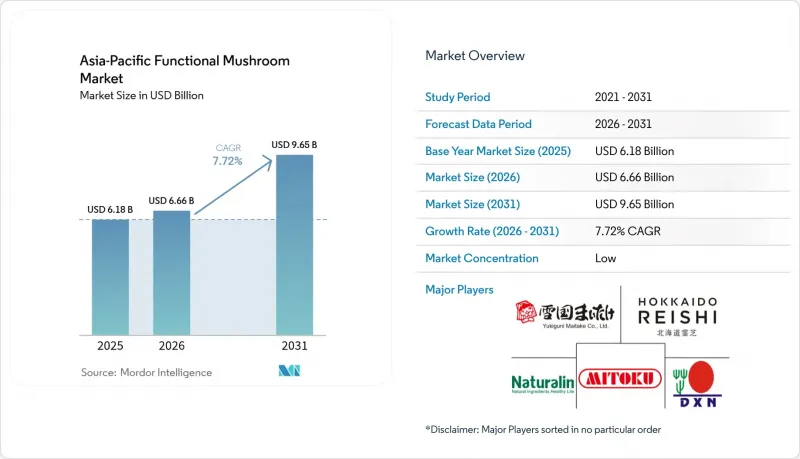
This report is Segmented by Type (Reishi, Cordyceps, Lion's Mane, Shiitake, Turkey Tail, and More), Nature (Conventional, Organic), Form (Powder, Liquid, Others), Application (Dietary Supplements, Food and Beverage, Personal Care and Cosmetics, and More), and Geography (China, Japan, India, Australia, South Korea, Philippines, and More). Market Forecasts are Provided in Terms of Value (USD).
Asia-Pacific Functional Mushroom Market Trends and Insights
Demand for Immune-Boosting Mushroom Supplements
Peer-reviewed trials confirm that Reishi and Turkey Tail polysaccharides stimulate natural killer cells and elevate interferon-gamma, strengthening the case for these fungi as evidence-based immune aids. Japanese and Korean consumers insist on labels showing >=20% beta-glucan, prompting brands to adopt dual extraction methods using both hot water and ethanol. China's regulator cleared 127 new immune-health SKUs in 2024, signaling policy comfort after decades of post-market surveillance. Pandemic-era habits persist in Indonesia and Thailand, where pharmacy sales increased by 35-40% year-over-year. Yet, differing test protocols, Japan uses AOAC 995.16 while China follows GB/T 5009.124, still create cross-border label confusion that undercuts trust.
Rising Adoption of Adaptogenic Ingredients in RTD Beverages and Coffees
Cordyceps and Lion's mane are migrating from capsules to ready-to-drink coffees that sit next to energy drinks in convenience stores. DXN's Lion's Mane Coconut Latte sells at roughly USD 0.96 per sachet, undercutting imports while delivering 300 mg of dual-extracted mycelium per serving. Four Sigmatic localizes flavors, matcha in Japan, turmeric in India, and now serves eight Asia-Pacific markets. Beverage formats mask earthy notes, boosting trial rates among younger shoppers. Japan's IFIA/HFE 2024 expo showcased 12 new mushroom drinks, confirming that liquid innovation is outpacing capsule development.
Fragmented Asia-Pacific Regulations on Novel Foods and Health Claims
Each country sets its own dossier, safety test, and labeling demands, adding USD 50,000-150,000 and 12-18 months per entry. Indonesia requires separate filings for every species in a blended SKU according to the Indonesian Food and Drug Monitoring Agency. Thailand blocks health claims until three years of surveillance have passed, while Vietnam's tiered system treats Cordyceps as a top novel, despite centuries of use. Australia insists on full safety data even for Reishi. This patchwork forces brands to run parallel formulations and hire multiple regulatory consultants, eroding scale economies.
Other drivers and restraints analyzed in the detailed report include:
- Adoption of Mushrooms in Plant-Based Diets
- Rise of Mushrooms in Sports Performance Nutrition
- High Price Premium Versus Conventional Supplements
For complete list of drivers and restraints, kindly check the Table Of Contents.
Segment Analysis
Reishi retained a 34.72% share of the Asia-Pacific functional mushroom market in 2025, thanks to its 2,000-year history of medicinal use and extensive clinical support. Cordyceps is growing at 8.59% CAGR because endurance athletes prize its ATP-boosting cordycepin. The Asia-Pacific functional mushroom market size for Lion's Mane cognitive formulas is increasing in aging Japan and South Korea, while Shiitake maintains steady demand for food and broth. Turkey Tail's PSK enjoys formal cancer-therapy reimbursement in Japan, significantly increasing its value far above the price of supplements. Lesser-known species, such as Tremella and Chaga, collectively hold a nearly 20% share in the beauty and antioxidant niches, according to the Pharmaceuticals and Medical Devices Agency (PMDA), Japan .
Continued multi-species blending signals commoditization of single strains. Regulatory clarity is uneven; cultivated Cordyceps militaris bypasses CITES limits on wild sinensis, supporting a steady supply. Higher-potency extracts and cross-functional positioning in beauty, sports, and immunity help maintain resilient average selling prices, even as volumes grow.
Conventional products accounted for 70.12% of the Asia-Pacific functional mushroom market share in 2025, driven by mega-farms in Fujian and Zhejiang that utilize automated substrate inoculation and fruiting processes. Organic SKUs are scaling at a 10.23% CAGR, driven by concerns over heavy metals and trust marks such as JAS and NASAA. The Asia-Pacific functional mushroom market size for certified organic lines remains constrained by limited clean substrate supply and higher inspection costs.
Governments help: South Korea subsidized 240 organic farms in 2024, and India's Himalayan regions enjoy natural low-pollution advantages. Brands add blockchain QR codes that link field data to test reports, providing retailers with assurance. As testing costs decline, more mid-tier brands are expected to migrate to organic, although price premiums of 25-35% are likely to persist.
Complete Report Scope:
- By Type
- Reishi
- Cordyceps
- Lion's Mane
- Shiitake
- Turkey Tail
- Chaga
- Other Types (Maitake, Tremella, Enoki, etc.)
- By Nature
- Conventional
- Organic
- By Form
- Powder
- Liquid
- Others
- By Application
- Dietary Supplements
- Food and Beverage
- Personal Care and Cosmetics
- Pharmaceutical/Clinical
- Other Applications
- By Country
- China
- Japan
- India
- Australia
- South Korea
- Philippines
- Indonesia
- Thailand
- Malaysia
- Rest of Asia-Pacific
List of Companies Covered in this Report:
- DXN Holdings Berhad
- Hokkaido Reishi Co., Ltd.
- Yukiguni Maitake Co., Ltd.
- Mitoku Co., Ltd.
- Lianfeng (Suizhou) Food Co., Ltd.
- Swadeshi Mushrooms Private Limited
- White Prince Pty Ltd
- Ojas Farms Pvt. Ltd.
- VLD Food Products Pvt. Ltd.
- Biobrette Agro Solutions Pvt. Ltd.
- Naturalin Bio-Resources Co., Ltd.
- Nutra Green Biotechnology Co., Ltd.
- Xi'an Saina Biological Technology Co., Ltd.
- Fungi Perfecti, LLC
- Four Sigmatic
- Real Mushrooms Inc.
- Om Mushroom Superfood
- Aloha Medicinals, Inc.
- Nammex Mushrooms Inc.
- Hokkaido Reishi
Additional Benefits:
- The market estimate (ME) sheet in Excel format
- 3 months of analyst support
TABLE OF CONTENTS
1 INTRODUCTION
- 1.1 Study Assumptions and Market Definition
- 1.2 Scope of the Study
2 RESEARCH METHODOLOGY
3 EXECUTIVE SUMMARY
4 MARKET DYNAMICS
- 4.1 Market Overview
- 4.2 Market Drivers
- 4.2.1 Demand for immune-boosting mushroom supplements
- 4.2.2 Rising adoption of adaptogenic ingredients in RTD beverages and coffees
- 4.2.3 Adoption of mushrooms in plant-based diets
- 4.2.4 Rise of mushrooms in sports performance nutrition
- 4.2.5 Popularity of convenient mushroom-infused beverages
- 4.2.6 Government reseach grants for mycelium biotechnology
- 4.3 Market Restraints
- 4.3.1 Fragmented Asia-Pacific regulations on novel foods and health claims
- 4.3.2 High price premium versus conventional supplements
- 4.3.3 Raw material supply volatility
- 4.3.4 Storage and shelf-life limitations of mushroom products
- 4.4 Supply Chain Analysis
- 4.5 Regulatory Landscape
- 4.6 Technological Outlook
- 4.7 Porter's Five Forces
- 4.7.1 Threat of New Entrants
- 4.7.2 Bargaining Power of Buyers
- 4.7.3 Bargaining Power of Suppliers
- 4.7.4 Threat of Substitute Products
- 4.7.5 Intensity of Competitive Rivalry
5 MARKET SIZE AND GROWTH FORECASTS (VALUE)
- 5.1 By Type
- 5.1.1 Reishi
- 5.1.2 Cordyceps
- 5.1.3 Lion's Mane
- 5.1.4 Shiitake
- 5.1.5 Turkey Tail
- 5.1.6 Chaga
- 5.1.7 Other Types (Maitake, Tremella, Enoki, etc.)
- 5.2 By Nature
- 5.2.1 Conventional
- 5.2.2 Organic
- 5.3 By Form
- 5.3.1 Powder
- 5.3.2 Liquid
- 5.3.3 Others
- 5.4 By Application
- 5.4.1 Dietary Supplements
- 5.4.2 Food and Beverage
- 5.4.3 Personal Care and Cosmetics
- 5.4.4 Pharmaceutical/Clinical
- 5.4.5 Other Applications
- 5.5 By Country
- 5.5.1 China
- 5.5.2 Japan
- 5.5.3 India
- 5.5.4 Australia
- 5.5.5 South Korea
- 5.5.6 Philippines
- 5.5.7 Indonesia
- 5.5.8 Thailand
- 5.5.9 Malaysia
- 5.5.10 Rest of Asia-Pacific
6 COMPETITIVE LANDSCAPE
- 6.1 Market Concentration
- 6.2 Strategic Moves
- 6.3 Market Share Analysis
- 6.4 Company Profiles (includes Global level Overview, Market level overview, Core Segments, Financials, Strategic Information, Market Rank/Share, Products and Services, Recent Developments)
- 6.4.1 DXN Holdings Berhad
- 6.4.2 Hokkaido Reishi Co., Ltd.
- 6.4.3 Yukiguni Maitake Co., Ltd.
- 6.4.4 Mitoku Co., Ltd.
- 6.4.5 Lianfeng (Suizhou) Food Co., Ltd.
- 6.4.6 Swadeshi Mushrooms Private Limited
- 6.4.7 White Prince Pty Ltd
- 6.4.8 Ojas Farms Pvt. Ltd.
- 6.4.9 VLD Food Products Pvt. Ltd.
- 6.4.10 Biobrette Agro Solutions Pvt. Ltd.
- 6.4.11 Naturalin Bio-Resources Co., Ltd.
- 6.4.12 Nutra Green Biotechnology Co., Ltd.
- 6.4.13 Xi'an Saina Biological Technology Co., Ltd.
- 6.4.14 Fungi Perfecti, LLC
- 6.4.15 Four Sigmatic
- 6.4.16 Real Mushrooms Inc.
- 6.4.17 Om Mushroom Superfood
- 6.4.18 Aloha Medicinals, Inc.
- 6.4.19 Nammex Mushrooms Inc.
- 6.4.20 Hokkaido Reishi
7 MARKET OPPORTUNITIES AND FUTURE TRENDS

