PUBLISHER: Mordor Intelligence | PRODUCT CODE: 2115111

PUBLISHER: Mordor Intelligence | PRODUCT CODE: 2115111
Starch Sweetener - Market Share Analysis, Industry Trends & Statistics, Growth Forecasts (2026 - 2031)
According to Mordor Intelligence, the starch sweeteners market size is expected to grow from USD 22.49 billion in 2025 to USD 23.66 billion in 2026 and is forecast to reach USD 30.48 billion by 2031 at 5.20% CAGR over 2026-2031.
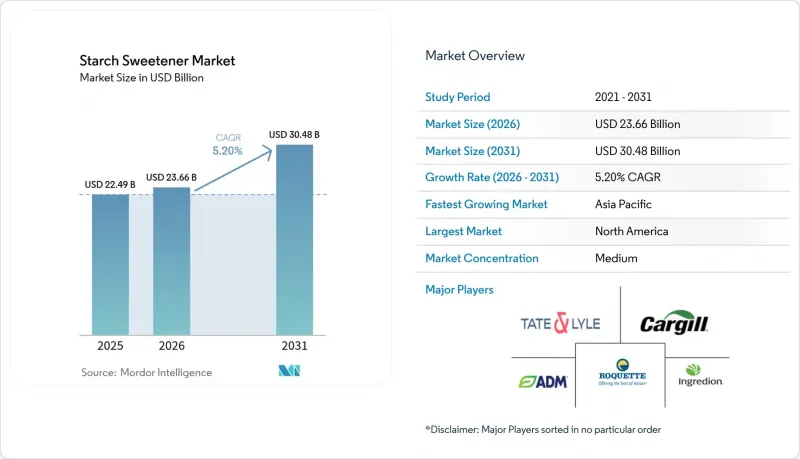
This report is Segmented by Product Type (High-Fructose Corn Syrup (HFCS), Dextrin, Fructose, and More), by Source (Corn, Cassava/Tapioca, and More), by Form (Liquid and Solid), by Application (Food and Beverages, Pharmaceuticals, Personal Care and Cosmetics, and More), and Geography (North America, Europe, and More). The Market Forecasts are Provided in Terms of Value (USD).
Global Starch Sweetener Market Trends and Insights
Expanding Processed Food Industry Drives Market Growth
The global rise in processed and convenience food consumption is a significant driver of growth in the starch sweeteners market. As time-pressed consumers increasingly opt for ready-to-eat meals, snacks, and beverages, manufacturers are seeking ingredients that do more than simply sweeten; they must also enhance texture, support preservation, and maintain product stability throughout shelf life. According to Ayana Bio's 2023 "Ultra-Processed Food Pulse" survey, 82% of U.S. adults regularly consumed ultra-processed foods, underscoring the central role such products play in modern diets . The processed food sector's expansion creates a sustained demand for functional sweeteners, particularly starch-derived options like glucose syrups and high-fructose corn syrup (HFCS), which offer multiple technological benefits. In functional beverages, for instance, glucose syrups are increasingly used not only for sweetness but also as an energy source, particularly in immunity-boosting products gaining momentum in Asia-Pacific markets.
Consumer Shift Toward Healthier Alternatives
The global shift toward healthier food choices is emerging as a powerful driver in the starch sweeteners market, reshaping product innovation and ingredient selection. Consumers are becoming increasingly aware of the link between excessive sugar intake and chronic health conditions, particularly diabetes and obesity. According to the International Diabetes Federation's 2025 report, approximately 589 million adults aged 20-79 were living with diabetes as of 2024, with 81% residing in low- and middle-income countries. Projections indicate this number could rise to 853 million by 2045. The disease claimed 3.4 million lives in 2024 alone and drove global health expenditures beyond USD 1 trillion, a 338% increase over the past 17 years . These sobering figures have placed intense focus on dietary reform, propelling the demand for lower-calorie, healthier sweetening alternatives. In response, starch sweetener manufacturers are diversifying portfolios to include natural and reduced-calorie sweeteners such as stevia, monk fruit, and blends of starch-derived sweeteners with fiber or protein-based ingredients to improve glycemic response.
Health Concerns and Negative Perceptions
Despite their widespread use and functional advantages, starch sweeteners face growing scrutiny due to health concerns and shifting consumer perceptions. The consumption of glucose syrup and high-fructose corn syrup (HFCS) has been associated with health issues, including obesity, type 2 diabetes, and metabolic disorders. These health implications have affected consumer perception, particularly in developed markets where consumers examine product labels and avoid processed ingredients. Global initiatives to reduce sugar consumption and increase awareness of health risks have led consumers and regulatory authorities to demand product reformulations and enhanced labeling requirements. HFCS usage has declined as food and beverage manufacturers remove or substitute it to meet clean-label and low-glycemic index requirements. The market also faces intensified competition from natural and plant-based alternatives such as stevia, monk fruit, and allulose, which consumers generally perceive as healthier options.
Other drivers and restraints analyzed in the detailed report include:
- Rising Demand for Natural Sweeteners
- Technological Advancements in Enzymatic and Fermentation Processes
- Fluctuating Raw Material Prices
For complete list of drivers and restraints, kindly check the Table Of Contents.
Segment Analysis
High-fructose corn syrup holds a 47.72% market share in 2025, supported by its established presence in the beverage and processed food industries and cost-effective production methods. Glucose syrups are projected to grow at a 6.55% CAGR from 2026-2031, primarily due to their applications in pharmaceuticals and alignment with clean-label trends. The adoption of enzymatic production methods for glucose syrups yields better quality and efficiency compared to acid hydrolysis, while raw materials such as cassava, wheat, and sorghum provide varied functional benefits.
Maltose syrup experiences increased adoption in Asian markets due to its moderate sweetness and compatibility with fermentation processes. Dextrin continues to expand its presence in pharmaceutical excipients and food texture modification applications. The market reflects a shift toward health-conscious alternatives while meeting technical requirements across industries. Despite its high sweetening power, fructose usage faces challenges from health-related regulations and product reformulation trends.
In 2025, corn commands a dominant 64.70% market share, underscoring its robust infrastructure and efficient processing. Meanwhile, cassava and tapioca sources are on the rise, boasting the highest growth rate at 6.75% CAGR from 2026 to 2031. This surge is largely attributed to production capacity expansions and sustainability benefits in the Asia-Pacific region. The growing demand for alternative and sustainable starch sources further drives this trend. Wheat sources leverage Europe's processing strengths and a non-GMO stance. In contrast, potato sources grapple with supply challenges due to subpar harvests in Germany, influencing global price dynamics.
The diversification toward alternative sources reflects supply chain resilience strategies and consumer preferences for varied ingredient origins. Unconventional tropical plants like Canna edulis and Xanthosoma sagittifolium emerge as potential starch sources, offering high productivity with minimal agronomic management in tropical regions. Corn steep liquor valorization through biotransformation demonstrates how processors maximize feedstock utilization, producing organic acids, enzymes, and natural pigments from processing byproducts.
Complete Report Scope:
- By Product Type
- High-Fructose Corn Syrup (HFCS)
- Dextrin
- Fructose
- Glucose Syrups
- Maltose Syrup
- Others
- By Source
- Corn
- Wheat
- Cassava/Tapioca
- Potato
- Others
- By Form
- Liquid
- Solid
- By Application
- Food and Beverages
- Bakery and Confectionary
- Dairy and Desserts
- Beverages
- Meat and Poultry
- Other Food and Beverages
- Pharmaceuticals
- Personal Care and Cosmetics
- Other Applications
- Food and Beverages
- By Geography
- North America
- United States
- Canada
- Mexico
- Rest of North America
- Europe
- Germany
- France
- United Kingdom
- Spain
- Netherlands
- Italy
- Sweden
- Poland
- Belgium
- Rest of Europe
- Asia-Pacific
- China
- India
- Japan
- Australia
- South Korea
- Indonesia
- Thailand
- Singapore
- Rest of Asia-Pacific
- South America
- Brazil
- Argentina
- Chile
- Colombia
- Peru
- Rest of South America
- Middle East and Africa
- United Arab Emirates
- South Africa
- Nigeria
- Saudi Arabia
- Egypt
- Morocco
- Turkey
- Rest of Middle East and Africa
- North America
Geography Analysis
North America commands a 45.60% market share in 2025, leveraging established corn processing infrastructure and mature food industry integration. Consumption growth remains steady as mass brands lower regular-sugar usage and roll out mid-calorie variants that rely on tailored glucose-fructose blends. Government partnerships promote regenerative corn cultivation, aligning supply security with environmental goals. The Asia-Pacific region is projected to grow at 6.88% CAGR from 2026 to 2031, driven by increasing health awareness, government sugar-reduction policies, and growing pharmaceutical manufacturing capabilities.
The Asia-Pacific region's agricultural production supports this expansion. The National Bureau of Statistics of China reports that farmers produced 207.5 million metric tons of rice and 140 million metric tons of wheat in 2024, which are essential raw materials for sweetener production. This domestic agricultural output enhances China's ability to manufacture starch-based sweetener alternatives. Moreover, China's revised GB 7718 food labeling regulations, which take effect in 2027, require detailed disclosure of sugar content. This regulatory change is driving manufacturers to use sweeteners derived from cassava, wheat, and rice. In Indonesia, the implementation of the Nutri-Level system is encouraging companies to develop reduced-sugar snacks, increasing the demand for glucose syrup and other sweeteners produced from starches.
Europe maintains steady demand through sustainability-focused initiatives and clean-label requirements. European Food Safety Authority (EFSA)'s clearance of isomaltulose syrup and the bloc's pending eco-design directive drive demand for low-carbon processing technologies. South America benefits from abundant cassava feedstock and newly commissioned Brazilian HFCS lines that export to regional bottlers. The Middle East and Africa represent emerging opportunities as urbanization and processed food consumption increase, though infrastructure limitations constrain immediate growth potential.
- Cargill Incorporated
- Archer Daniels Midland Company
- Tate and Lyle PLC
- Ingredion Inc.
- Tereos SA
- Roquette Freres
- IFF (DuPont Nutrition and Biosciences)
- Sudzucker AG (BENEO)
- Global Sweeteners Holdings Ltd
- Zhucheng Dongxiao Biotechnology Co., Ltd
- Matsutani Chemical Industry Co., Ltd
- Gulshan Polyols Ltd
- Grain Processing Corporation
- SC foods co., ltd.
- Glico Co., Ltd.
- VOGELBUSCH Biocommodities GmbH
- Gateway food products company
- Foodchem International Corporation
- Uniglad Ingredients UK Ltd
- Sweetener Supply Corporation
Additional Benefits:
- The market estimate (ME) sheet in Excel format
- 3 months of analyst support
TABLE OF CONTENTS
1 INTRODUCTION
- 1.1 Study Assumptions and Market Definition
- 1.2 Scope of the Study
2 RESEARCH METHODOLOGY
3 EXECUTIVE SUMMARY
4 MARKET LANDSCAPE
- 4.1 Market Overview
- 4.2 Market Drivers
- 4.2.1 Expanding Processed Food Industry Drives Market Growth
- 4.2.2 Consumer Shift Toward Healthier Alternatives
- 4.2.3 Rising Demand for Natural Sweeteners
- 4.2.4 Abundance and easy Availability of Feedstocks
- 4.2.5 Increased awareness of health and wellness
- 4.2.6 Technological Advancements in Enzymatic and Fermentation Processes
- 4.3 Market Restraints
- 4.3.1 Health Concerns and Negative Perceptions
- 4.3.2 Availability of the close alternatives
- 4.3.3 Fluctuating Raw Material Prices
- 4.3.4 Limited shelf life of certain starch sweetener products
- 4.4 Supply Chain Analysis
- 4.5 Regulatory Outlook
- 4.6 Porter's Five Forces
- 4.6.1 Threat of New Entrants
- 4.6.2 Bargaining Power of Buyers
- 4.6.3 Bargaining Power of Suppliers
- 4.6.4 Threat of Substitute Products
- 4.6.5 Intensity of Competitive Rivalry
5 MARKET SIZE AND GROWTH FORECASTS (VALUE)
- 5.1 By Product Type
- 5.1.1 High-Fructose Corn Syrup (HFCS)
- 5.1.2 Dextrin
- 5.1.3 Fructose
- 5.1.4 Glucose Syrups
- 5.1.5 Maltose Syrup
- 5.1.6 Others
- 5.2 By Source
- 5.2.1 Corn
- 5.2.2 Wheat
- 5.2.3 Cassava/Tapioca
- 5.2.4 Potato
- 5.2.5 Others
- 5.3 By Form
- 5.3.1 Liquid
- 5.3.2 Solid
- 5.4 By Application
- 5.4.1 Food and Beverages
- 5.4.1.1 Bakery and Confectionary
- 5.4.1.2 Dairy and Desserts
- 5.4.1.3 Beverages
- 5.4.1.4 Meat and Poultry
- 5.4.1.5 Other Food and Beverages
- 5.4.2 Pharmaceuticals
- 5.4.3 Personal Care and Cosmetics
- 5.4.4 Other Applications
- 5.4.1 Food and Beverages
- 5.5 By Geography
- 5.5.1 North America
- 5.5.1.1 United States
- 5.5.1.2 Canada
- 5.5.1.3 Mexico
- 5.5.1.4 Rest of North America
- 5.5.2 Europe
- 5.5.2.1 Germany
- 5.5.2.2 France
- 5.5.2.3 United Kingdom
- 5.5.2.4 Spain
- 5.5.2.5 Netherlands
- 5.5.2.6 Italy
- 5.5.2.7 Sweden
- 5.5.2.8 Poland
- 5.5.2.9 Belgium
- 5.5.2.10 Rest of Europe
- 5.5.3 Asia-Pacific
- 5.5.3.1 China
- 5.5.3.2 India
- 5.5.3.3 Japan
- 5.5.3.4 Australia
- 5.5.3.5 South Korea
- 5.5.3.6 Indonesia
- 5.5.3.7 Thailand
- 5.5.3.8 Singapore
- 5.5.3.9 Rest of Asia-Pacific
- 5.5.4 South America
- 5.5.4.1 Brazil
- 5.5.4.2 Argentina
- 5.5.4.3 Chile
- 5.5.4.4 Colombia
- 5.5.4.5 Peru
- 5.5.4.6 Rest of South America
- 5.5.5 Middle East and Africa
- 5.5.5.1 United Arab Emirates
- 5.5.5.2 South Africa
- 5.5.5.3 Nigeria
- 5.5.5.4 Saudi Arabia
- 5.5.5.5 Egypt
- 5.5.5.6 Morocco
- 5.5.5.7 Turkey
- 5.5.5.8 Rest of Middle East and Africa
- 5.5.1 North America
6 COMPETITIVE LANDSCAPE
- 6.1 Market Concentration
- 6.2 Strategic Moves
- 6.3 Market Share Analysis
- 6.4 Company Profiles (includes Global-level Overview, Market-level Overview, Core Segments, Financials as available, Strategic Information, Market Rank/Share for key companies, Products and Services, and Recent Developments)
- 6.4.1 Cargill Incorporated
- 6.4.2 Archer Daniels Midland Company
- 6.4.3 Tate and Lyle PLC
- 6.4.4 Ingredion Inc.
- 6.4.5 Tereos SA
- 6.4.6 Roquette Freres
- 6.4.7 IFF (DuPont Nutrition and Biosciences)
- 6.4.8 Sudzucker AG (BENEO)
- 6.4.9 Global Sweeteners Holdings Ltd
- 6.4.10 Zhucheng Dongxiao Biotechnology Co., Ltd
- 6.4.11 Matsutani Chemical Industry Co., Ltd
- 6.4.12 Gulshan Polyols Ltd
- 6.4.13 Grain Processing Corporation
- 6.4.14 SC foods co., ltd.
- 6.4.15 Glico Co., Ltd.
- 6.4.16 VOGELBUSCH Biocommodities GmbH
- 6.4.17 Gateway food products company
- 6.4.18 Foodchem International Corporation
- 6.4.19 Uniglad Ingredients UK Ltd
- 6.4.20 Sweetener Supply Corporation
7 MARKET OPPORTUNITIES AND FUTURE OUTLOOK

