PUBLISHER: Mordor Intelligence | PRODUCT CODE: 2115116

PUBLISHER: Mordor Intelligence | PRODUCT CODE: 2115116
Safflower Seeds - Market Share Analysis, Industry Trends & Statistics, Growth Forecasts (2026 - 2031)
According to Mordor Intelligence, safflower seeds market size in 2026 is estimated at USD 1.17 billion, growing from 2025 value of USD 1.12 billion with 2031 projections showing USD 1.48 billion, growing at 4.74% CAGR over 2026-2031.
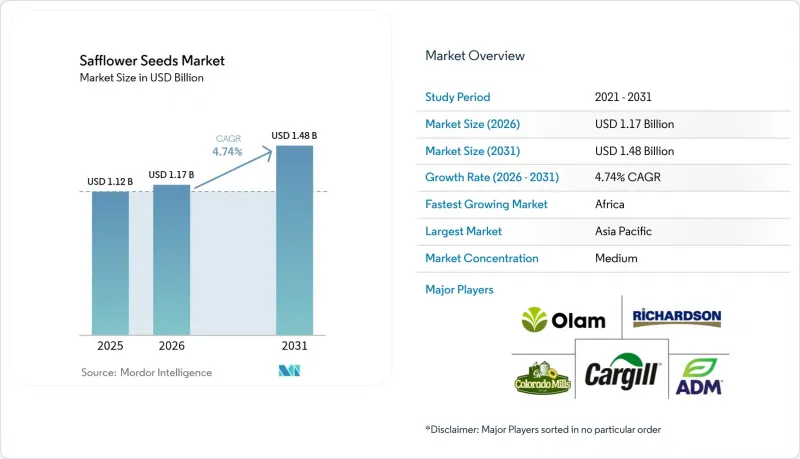
This report is Segmented by Geography (North America, South America, Europe, Asia-Pacific, Middle East, and Africa). The Report Includes Production (Volume), Consumption (Volume and Value), Export (Volume and Value), Import (Volume and Value) and Price Trend Analysis. The Market Forecasts are Provided in Terms of Value (USD) and Volume (Metric Tons).
Global Safflower Seeds Market Trends and Insights
Rising Demand for Plant-Based Oils
Food makers replacing trans-fats are favoring high-oleic safflower oil, which delivers 79% oleic acid and 338 mg/kg tocopherols, matching olive oil stability at a lower cost. OECD-FAO outlook puts vegetable-oil demand growth at 1.8% annually through 2033, with 52% for food and 18% for biodiesel . India's per-capita oil use rises from 11 kg in 2024 to 13 kg by 2034, prompting rabi-season safflower expansion in Maharashtra and Karnataka. Processors, must segregate high-oleic and linoleic lots, adding logistics costs absent in sunflower or canola flows. As health-centric labeling grows, the safflower seeds market secures a durable demand channel even when edible oil prices soften.
Expansion in Cosmetic Formulations
Safflower oil's non-comedogenic profile elevates it from commodity to prestige skincare ingredient. Sharon Personal Care's Hydresia SF2 lowers transepidermal water loss by 18% and allows brands to claim biomimetic hydration without synthetic emulsifiers. Clean-beauty labels, such as Typology, pay USD 8-50/kg for organic, cold-pressed oil, rewarding identity-preserved supply chains. Regulatory alignment with European Cosmetic Regulation 1223/2009 and eases cross-border trade. Yet cosmetics absorb only 2-3% of the global output, so the segment cannot fully buffer crush margins during weak edible oil cycles. Still, the safflower seeds market gains brand visibility that cascades into functional-food and nutraceutical innovation.
Competition from Sunflower and Canola Seeds
Sunflower and canola output of 60 million metric tons and 85 million metric tons dwarfs safflower's 723,873 metric tons, yielding lower per-unit crush costs and stronger processor commitment. Projections indicate that safflower prices will decline to USD 0.185 by 2028, as the stocks-to-use ratio reaches 9.6% . While Black Sea disruptions in 2022-2023 briefly boosted substitution, the normalization of sunflower exports restores their cost advantage in price-sensitive markets. The safflower seeds market, therefore, competes on niche credentials rather than volume economics.
Other drivers and restraints analyzed in the detailed report include:
- Growth of Functional Foods Sector
- Increasing Bird-Feed Consumption
- High Processing Costs
For complete list of drivers and restraints, kindly check the Table Of Contents.
Complete Report Scope:
- By Geography
- North America
- United States
- Production Analysis
- Consumption Analysis (Value and Volume)
- Import Analysis (Value and Volume)
- Export Analysis (Value and Volume)
- Price Trend Analysis
- Mexico
- Production Analysis
- Consumption Analysis (Value and Volume)
- Import Analysis (Value and Volume)
- Export Analysis (Value and Volume)
- Price Trend Analysis
- United States
- South America
- Argentina
- Production Analysis
- Consumption Analysis (Value and Volume)
- Import Analysis (Value and Volume)
- Export Analysis (Value and Volume)
- Price Trend Analysis
- Argentina
- Europe
- Russia
- Production Analysis
- Consumption Analysis (Value and Volume)
- Import Analysis (Value and Volume)
- Export Analysis (Value and Volume)
- Price Trend Analysis
- Spain
- Production Analysis
- Consumption Analysis (Value and Volume)
- Import Analysis (Value and Volume)
- Export Analysis (Value and Volume)
- Price Trend Analysis
- Russia
- Asia-Pacific
- China
- Production Analysis
- Consumption Analysis (Value and Volume)
- Import Analysis (Value and Volume)
- Export Analysis (Value and Volume)
- Price Trend Analysis
- India
- Production Analysis
- Consumption Analysis (Value and Volume)
- Import Analysis (Value and Volume)
- Export Analysis (Value and Volume)
- Price Trend Analysis
- Australia
- Production Analysis
- Consumption Analysis (Value and Volume)
- Import Analysis (Value and Volume)
- Export Analysis (Value and Volume)
- Price Trend Analysis
- China
- Middle East
- Turkey
- Production Analysis
- Consumption Analysis (Value and Volume)
- Import Analysis (Value and Volume)
- Export Analysis (Value and Volume)
- Price Trend Analysis
- Iran
- Production Analysis
- Consumption Analysis (Value and Volume)
- Import Analysis (Value and Volume)
- Export Analysis (Value and Volume)
- Price Trend Analysis
- Turkey
- Africa
- Tanzania
- Production Analysis
- Consumption Analysis (Value and Volume)
- Import Analysis (Value and Volume)
- Export Analysis (Value and Volume)
- Price Trend Analysis
- Ethiopia
- Production Analysis
- Consumption Analysis (Value and Volume)
- Import Analysis (Value and Volume)
- Export Analysis (Value and Volume)
- Price Trend Analysis
- Tanzania
- North America
Geography Analysis
Asia-Pacific holds 33.90% of the 2025 value, reflecting India's subsidy-led rabi-season acreage, China's specialty-oil import pull, and Australia's rotation strategy. India's National Mission on Edible Oils-Oilseeds allocates Rs 10,103 crore (USD 1.2 billion) for 2024-2031 to boost oilseed output, positioning safflower as a water-smart alternative in Maharashtra and Karnataka. China continues to import high-oleic grades, allowing processors like Xinjiang Tianding to capture organic premiums. Australia's plantings remain modest, but Bunge's 2024 multi-oil plant announcement signals future capacity that could integrate safflower on flexible lines.
Africa is projected to post the fastest growth at a 7.68% CAGR through 2031, driven by Tanzania and Ethiopia's export-oriented agricultural expansion, despite logistics gaps. Ethiopian trials have shown seed yields of up to 2,343 kg/ha under irrigation, with oil content increasing to 29.5% under rainfed conditions. Tanzania paradoxically imports sunflower-safflower blends while exporting raw seed, underscoring cold-chain deficits that erode farmgate returns . Unlocking the potential of the safflower seeds market in Africa hinges on the availability of refrigerated storage and financing for rural electrification.
Europe, North America, and the Middle East account for the remainder. Europe's Renewable Energy Directive pulls safflower into renewable-diesel supply chains through the 2025 Bunge-Repsol pact. Russia and Kazakhstan supply over 52% of global production, yet Turkey captures downstream value with USD 120.8 million seed imports in 2023. North America's area declines while prices soften, signaling processors' reluctance to invest in the absence of policy tailwinds. Mexico's 65,760 metric ton harvest satisfies domestic bird feed and crush demand, leaving a limited export surplus. Field trials in Turkey and Iran inform European breeding programs that are exploring high-oleic genetics for the safflower seeds market.
- The market estimate (ME) sheet in Excel format
- 3 months of analyst support
TABLE OF CONTENTS
1 Introduction
- 1.1 Study Assumptions and Market Definition
- 1.2 Scope of the Study
2 Research Methodology
3 Executive Summary
4 Market Landscape
- 4.1 Market Overview
- 4.2 Market Drivers
- 4.2.1 Rising Demand for Plant-Based Oils
- 4.2.2 Expansion in Cosmetic Formulations
- 4.2.3 Growth of Functional Foods Sector
- 4.2.4 Increasing Bird-feed Consumption
- 4.2.5 Adoption in Biolubricants
- 4.2.6 Carbon-Sequestration Crop Programs
- 4.3 Market Restraints
- 4.3.1 Competition from Sunflower and Canola Seeds
- 4.3.2 High Processing Costs
- 4.3.3 Volatile Specialty-Crop Acreage Incentives
- 4.3.4 Limited Cold-Chain Infrastructure in Africa
- 4.4 Regulatory Landscape
- 4.5 Technological Outlook
- 4.6 Value Chain/Supply Chain Analysis
5 Market Size and Growth Forecasts (Value and Volume)
- 5.1 By Geography
- 5.1.1 North America
- 5.1.1.1 United States
- 5.1.1.1.1 Production Analysis
- 5.1.1.1.2 Consumption Analysis (Value and Volume)
- 5.1.1.1.3 Import Analysis (Value and Volume)
- 5.1.1.1.4 Export Analysis (Value and Volume)
- 5.1.1.1.5 Price Trend Analysis
- 5.1.1.2 Mexico
- 5.1.1.2.1 Production Analysis
- 5.1.1.2.2 Consumption Analysis (Value and Volume)
- 5.1.1.2.3 Import Analysis (Value and Volume)
- 5.1.1.2.4 Export Analysis (Value and Volume)
- 5.1.1.2.5 Price Trend Analysis
- 5.1.1.1 United States
- 5.1.2 South America
- 5.1.2.1 Argentina
- 5.1.2.1.1 Production Analysis
- 5.1.2.1.2 Consumption Analysis (Value and Volume)
- 5.1.2.1.3 Import Analysis (Value and Volume)
- 5.1.2.1.4 Export Analysis (Value and Volume)
- 5.1.2.1.5 Price Trend Analysis
- 5.1.2.1 Argentina
- 5.1.3 Europe
- 5.1.3.1 Russia
- 5.1.3.1.1 Production Analysis
- 5.1.3.1.2 Consumption Analysis (Value and Volume)
- 5.1.3.1.3 Import Analysis (Value and Volume)
- 5.1.3.1.4 Export Analysis (Value and Volume)
- 5.1.3.1.5 Price Trend Analysis
- 5.1.3.2 Spain
- 5.1.3.2.1 Production Analysis
- 5.1.3.2.2 Consumption Analysis (Value and Volume)
- 5.1.3.2.3 Import Analysis (Value and Volume)
- 5.1.3.2.4 Export Analysis (Value and Volume)
- 5.1.3.2.5 Price Trend Analysis
- 5.1.3.1 Russia
- 5.1.4 Asia-Pacific
- 5.1.4.1 China
- 5.1.4.1.1 Production Analysis
- 5.1.4.1.2 Consumption Analysis (Value and Volume)
- 5.1.4.1.3 Import Analysis (Value and Volume)
- 5.1.4.1.4 Export Analysis (Value and Volume)
- 5.1.4.1.5 Price Trend Analysis
- 5.1.4.2 India
- 5.1.4.2.1 Production Analysis
- 5.1.4.2.2 Consumption Analysis (Value and Volume)
- 5.1.4.2.3 Import Analysis (Value and Volume)
- 5.1.4.2.4 Export Analysis (Value and Volume)
- 5.1.4.2.5 Price Trend Analysis
- 5.1.4.3 Australia
- 5.1.4.3.1 Production Analysis
- 5.1.4.3.2 Consumption Analysis (Value and Volume)
- 5.1.4.3.3 Import Analysis (Value and Volume)
- 5.1.4.3.4 Export Analysis (Value and Volume)
- 5.1.4.3.5 Price Trend Analysis
- 5.1.4.1 China
- 5.1.5 Middle East
- 5.1.5.1 Turkey
- 5.1.5.1.1 Production Analysis
- 5.1.5.1.2 Consumption Analysis (Value and Volume)
- 5.1.5.1.3 Import Analysis (Value and Volume)
- 5.1.5.1.4 Export Analysis (Value and Volume)
- 5.1.5.1.5 Price Trend Analysis
- 5.1.5.2 Iran
- 5.1.5.2.1 Production Analysis
- 5.1.5.2.2 Consumption Analysis (Value and Volume)
- 5.1.5.2.3 Import Analysis (Value and Volume)
- 5.1.5.2.4 Export Analysis (Value and Volume)
- 5.1.5.2.5 Price Trend Analysis
- 5.1.5.1 Turkey
- 5.1.6 Africa
- 5.1.6.1 Tanzania
- 5.1.6.1.1 Production Analysis
- 5.1.6.1.2 Consumption Analysis (Value and Volume)
- 5.1.6.1.3 Import Analysis (Value and Volume)
- 5.1.6.1.4 Export Analysis (Value and Volume)
- 5.1.6.1.5 Price Trend Analysis
- 5.1.6.2 Ethiopia
- 5.1.6.2.1 Production Analysis
- 5.1.6.2.2 Consumption Analysis (Value and Volume)
- 5.1.6.2.3 Import Analysis (Value and Volume)
- 5.1.6.2.4 Export Analysis (Value and Volume)
- 5.1.6.2.5 Price Trend Analysis
- 5.1.6.1 Tanzania
- 5.1.1 North America
6 Competitive Landscape
- 6.1 List of Stakeholders
- 6.1.1 Archer Daniels Midland Company
- 6.1.2 Cargill Incorporated
- 6.1.3 Olam International Limited
- 6.1.4 Colorado Mills LLC
- 6.1.5 Richardson International Limited
- 6.1.6 United Oilseeds Producers Ltd.
- 6.1.7 Gansu Yasheng Industrial Group Co., Ltd.
- 6.1.8 Soni Safflower Agritech Pvt. Ltd.
- 6.1.9 Bunge Limited
- 6.1.10 Jiuquan Hongda Seed Industry Co., Ltd.
- 6.1.11 Shandong Bohi Industry Co., Ltd.
- 6.1.12 Altai Agro LLC
- 6.1.13 Shenzhen Dingsheng Agricultural Products Co., Ltd.
- 6.1.14 Zhiyuan Food Co., Ltd.
- 6.1.15 Ethiopian Oilseeds Processors Association
7 Market Opportunities and Future Outlook

