PUBLISHER: Mordor Intelligence | PRODUCT CODE: 2115117

PUBLISHER: Mordor Intelligence | PRODUCT CODE: 2115117
United States Access Control - Market Share Analysis, Industry Trends & Statistics, Growth Forecasts (2026 - 2031)
According to Mordor Intelligence, US access control market size in 2026 is estimated at USD 3.94 billion, growing from 2025 value of USD 3.79 billion with 2031 projections showing USD 4.81 billion, growing at 4.05% CAGR over 2026-2031.
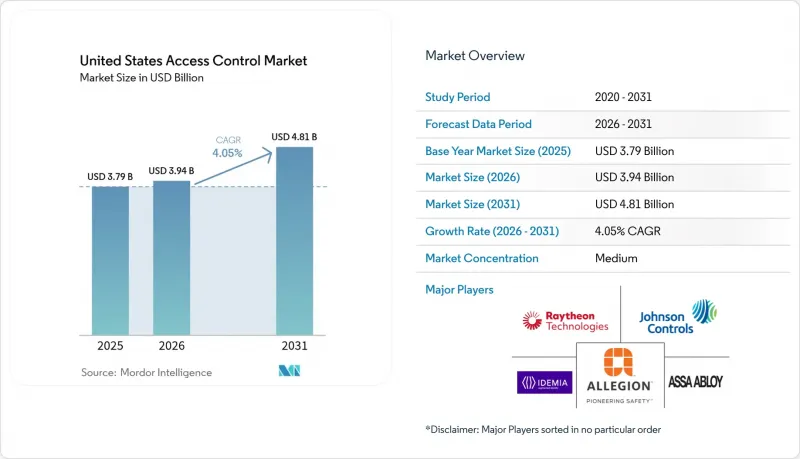
This report is Segmented by Component (Hardware, Software, and Services), Technology (Biometric, Card-Based/Non-Biometric, Mobile Credential, and More), Deployment Model (On-Premises, and Cloud-Based), End-User (Commercial, Government, Industrial, and Residential), and Geography. The Market Forecasts are Provided in Terms of Value (USD).
United States Access Control Market Trends and Insights
Rapid Migration Toward Mobile Credential-Based Systems
Mobile credentials are redefining authentication practices across the US access control market. Organizations appreciate the ability to distribute and revoke digital keys in real time without printing new cards or re-keying locks, which lowers administrative overhead and eliminates card-replacement costs. Federal facilities view smartphone access as a bridge between zero-trust mandates and existing infrastructure, because phones already incorporate hardware security modules and biometric unlock features that strengthen multi-factor workflows. Large enterprises report higher employee satisfaction when users carry only their own devices, and property managers value the audit trails that follow every over-the-air credential change. Adoption is also helped by rising NFC and ultra-wide-band inclusion in mainstream handsets, which allows reliable tap-to-enter experiences even in shielded environments. Implementation demands robust mobile-device-management policies and network segmentation to prevent lateral movement from compromised phones, but integrators note that these security steps align with existing cyber hygiene frameworks rather than adding new requirements.
Growing Federal and State Funding for Critical-Infrastructure Security Upgrades
The federal government allocated USD 279.9 million in cybersecurity grants during 2024, and access control deployments that embed encryption, enhanced logging, and multi-factor authentication qualify for reimbursement. The Nonprofit Security Grant Program supplied an additional USD 454.5 million for facility hardening, extending addressable demand into social-service, healthcare, and faith-based campuses. Distribution rules mandate that 80% of state allocations flow to local government or nonprofit recipients, with 25% preserved for rural areas. Vendors positioned with easy-to-deploy mobile credentials and cloud dashboards see faster sales cycles because grant administrators favour solutions that minimize on-site IT labour. Integrators also highlight that rural hospitals and water utilities are retrofitting older electromechanical locks, creating revenue opportunities outside traditional metropolitan hubs. This broad dispersal of funding supports short-term unit growth while reinforcing medium-term platform subscriptions, given that most grants require solutions to remain operational for at least three years.
Persistent Supply-Chain Volatility in Semiconductor Components
Continued chip scarcity raises lead times for secure microcontrollers, biometric processors, and radio modules, inflating bill-of-materials costs and delaying project schedules. The Department of Commerce has warned that single-site concentration for advanced lithography amplifies exposure to weather and geopolitical shocks, a situation unlikely to resolve before domestic fabs reach volume later this decade. Manufacturers hedge by redesigning boards around more readily available chipsets, yet each redesign reopens certification cycles and quality-assurance testing. Integrators respond with larger safety stock, but warehousing costs weigh on margins. End customers occasionally postpone refresh plans when pricing for secure elements spikes, trimming near-term shipment volumes in the US access control market.
Other drivers and restraints analyzed in the detailed report include:
- Heightened Compliance Needs Under Updated FIPS-201-3 and TSCP Standards
- Demand Surge for Cloud-Native Platforms That Unify Physical and Cyber Access
- Fragmented Legacy Infrastructure Slowing Platform Migrations
For complete list of drivers and restraints, kindly check the Table Of Contents.
Segment Analysis
The component mix shows that hardware supplies the bulk of revenues, yet software delivers the fastest incremental growth. In 2025, hardware represented 53.22% of spending in the US access control market; software is on track for a 7.72% CAGR through 2031. The US access control market size for software grew as agencies sought features like real-time analytics, encrypted credential issuance, and policy-based automation. Hardware remains essential because readers, panels, and locks anchor physical security, but pricing trends reveal compression as commoditized electronics face increased supplier competition. By contrast, subscription bundles for cloud dashboards, AI extensions, and compliance reporting sustain double-digit margin profiles and predictable cash flow. Vendors package over-the-air firmware, advanced threat detection, and emergency lockdown macros as recurring options, converting one-time capital purchases into lifetime customer value.
Services hold the smallest share yet function as an annuity layer across the US access control market. Integrators bundle preventive maintenance, 24/7 monitoring, and managed badge issuance, shifting cost from unpredictable site visits to fixed monthly agreements. Federal grant clauses that require multiyear support encourage agencies to sign extended service contracts, anchoring predictable revenue for channel partners. Software also enables template-based rollouts across franchise chains, where a single configuration can replicate to hundreds of stores overnight, minimizing labour per site. Platform providers emphasize open APIs so third-party building management systems can retrieve occupancy feeds, feeding energy optimization algorithms that help owners meet ESG targets. This interoperable design raises exit barriers and extends the lifespan of software subscriptions within the US access control market.
Card-based and other non-biometric formats accounted for 46.95% of technology revenues in 2025, benefiting from entrenched infrastructure and cross-vendor compatibility. The US access control market size associated with card technology continues to expand modestly, but growth decelerates as users pivot to phone-based credentials at a projected 6.25% CAGR. Mobile keys leverage secure elements and biometric unlock on handsets, achieving multi-factor authentication without additional reader hardware when NFC is enabled. Facility managers appreciate over-the-air issuance and revocation, eliminating the logistics of printing and shipping badges. Apple Wallet and Google Wallet have integrated employee badge protocols, reducing user-training hurdles.
Biometric modalities such as facial or fingerprint readers concentrate in high-security zones where identity assurance outweighs privacy concerns. Legislated consent and data-retention rules damp adoption within states that enforce strict biometric privacy laws, but airport terminals, pharma labs, and defense sites still justify premium sensors. Alternative low-cost formats like keypad or proximity readers serve small businesses with limited budgets, offering modest tamper resistance but acceptable deterrence. Over the forecast period, expect card numbers to decline in absolute count even while revenue stabilizes, since lifecycle replacements sustain order flow. Meanwhile, mobile-credential software and reader firmware upgrades will drive incremental revenue, solidifying the mobile segment as the principal growth lever inside the US access control market.
Complete Report Scope:
- By Component
- Hardware
- Software
- Services
- By Technology
- Biometric
- Card-Based / Non-Biometric
- Mobile Credential
- Others Technologies
- By Deployment Model
- On-Premises
- Cloud-Based
- By End-User
- Commercial
- Government
- Industrial
- Residential
List of Companies Covered in this Report:
- Johnson Controls International plc
- ASSA ABLOY AB
- Allegion plc
- Honeywell International Inc.
- Robert Bosch GmbH
- IDEMIA Group S.A.S.
- dormakaba Holding AG
- Stanley Black and Decker Inc.
- AMAG Technology, Inc.
- Identiv, Inc.
- Gallagher Group Limited
- Axis Communications AB
- Genetec Inc.
- Suprema Inc.
- Brivo Systems LLC
- Vanderbilt Industries
- LenelS2 (Carrier Global Corporation)
- HID Global Corporation
- Verkada Inc.
- Kisi Inc.
Additional Benefits:
- The market estimate (ME) sheet in Excel format
- 3 months of analyst support
TABLE OF CONTENTS
1 INTRODUCTION
- 1.1 Study Assumptions and Market Definition
- 1.2 Scope of the Study
2 RESEARCH METHODOLOGY
3 EXECUTIVE SUMMARY
4 MARKET LANDSCAPE
- 4.1 Market Overview
- 4.2 Market Drivers
- 4.2.1 Rapid migration toward mobile credential-based systems
- 4.2.2 Growing federal and state funding for critical-infrastructure security upgrades
- 4.2.3 Heightened compliance needs under updated FIPS-201-3 and TSCP standards
- 4.2.4 Demand surge for cloud-native platforms that unify physical and cyber access
- 4.2.5 Rise of generative-AI-enabled adaptive threat analytics (under-reported)
- 4.2.6 Convergence with smart-building ESG mandates (under-reported)
- 4.3 Market Restraints
- 4.3.1 Persistent supply-chain volatility in semiconductor components
- 4.3.2 Fragmented legacy infrastructure slowing platform migrations
- 4.3.3 End-user data-privacy litigation risk around biometric identifiers (under-reported)
- 4.3.4 Limited skilled-labor pool for OT-IT security convergence projects (under-reported)
- 4.4 Industry Value-Chain Analysis
- 4.5 Regulatory Landscape
- 4.6 Technological Outlook
- 4.7 Impact of Macroeconomic Factors
- 4.8 Porter's Five Forces Analysis
- 4.8.1 Threat of New Entrants
- 4.8.2 Bargaining Power of Suppliers
- 4.8.3 Bargaining Power of Buyers
- 4.8.4 Threat of Substitutes
- 4.8.5 Competitive Rivalry
5 MARKET SIZE AND GROWTH FORECASTS (VALUE)
- 5.1 By Component
- 5.1.1 Hardware
- 5.1.2 Software
- 5.1.3 Services
- 5.2 By Technology
- 5.2.1 Biometric
- 5.2.2 Card-Based / Non-Biometric
- 5.2.3 Mobile Credential
- 5.2.4 Others Technologies
- 5.3 By Deployment Model
- 5.3.1 On-Premises
- 5.3.2 Cloud-Based
- 5.4 By End-User
- 5.4.1 Commercial
- 5.4.2 Government
- 5.4.3 Industrial
- 5.4.4 Residential
6 COMPETITIVE LANDSCAPE
- 6.1 Market Concentration
- 6.2 Strategic Moves
- 6.3 Market Share Analysis
- 6.4 Company Profiles (includes Global level Overview, Market level overview, Core Segments, Financials as available, Strategic Information, Market Rank/Share for key companies, Products and Services, and Recent Developments)
- 6.4.1 Johnson Controls International plc
- 6.4.2 ASSA ABLOY AB
- 6.4.3 Allegion plc
- 6.4.4 Honeywell International Inc.
- 6.4.5 Robert Bosch GmbH
- 6.4.6 IDEMIA Group S.A.S.
- 6.4.7 dormakaba Holding AG
- 6.4.8 Stanley Black and Decker Inc.
- 6.4.9 AMAG Technology, Inc.
- 6.4.10 Identiv, Inc.
- 6.4.11 Gallagher Group Limited
- 6.4.12 Axis Communications AB
- 6.4.13 Genetec Inc.
- 6.4.14 Suprema Inc.
- 6.4.15 Brivo Systems LLC
- 6.4.16 Vanderbilt Industries
- 6.4.17 LenelS2 (Carrier Global Corporation)
- 6.4.18 HID Global Corporation
- 6.4.19 Verkada Inc.
- 6.4.20 Kisi Inc.
7 MARKET OPPORTUNITIES AND FUTURE OUTLOOK
- 7.1 White-Space and Unmet-Need Assessment

