PUBLISHER: Mordor Intelligence | PRODUCT CODE: 2115130

PUBLISHER: Mordor Intelligence | PRODUCT CODE: 2115130
China Shrimp - Market Share Analysis, Industry Trends & Statistics, Growth Forecasts (2026 - 2031)
According to Mordor Intelligence, the China shrimp market size is expected to grow from USD 19.5 billion in 2025 to USD 20.56 billion in 2026 and is forecast to reach USD 26.78 billion by 2031 at 5.43% CAGR over 2026-2031.
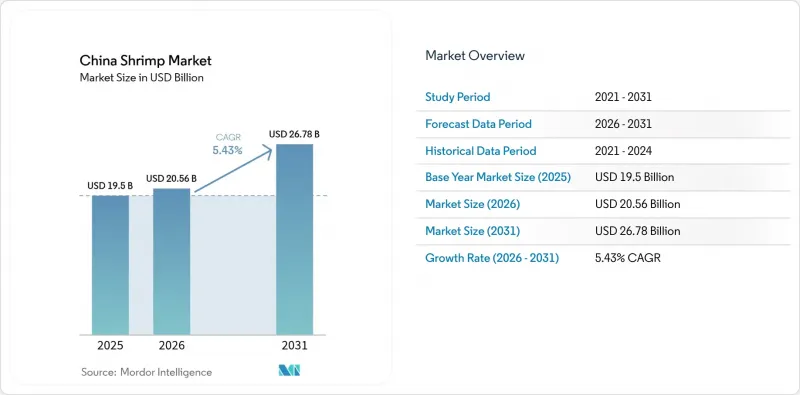
This report is Segmented by Production Analysis (Volume), Consumption Analysis (Value and Volume), Export Analysis (Value and Volume), Import Analysis (Value and Volume), and Price Trend Analysis. The Market Forecasts are Provided in Terms of Value (USD) and Volume (Metric Tons).
China Shrimp Market Trends and Insights
Rising Disposable Income and Preference for Lean Protein
Household consumption reached 39% of national GDP in 2024 and is projected to rise 3%-4% annually to 2035, creating a broad base of purchasing power for premium seafood. Per-capita meat intake doubled between the mid-1990s and 2024, and shrimp is gaining share because urban millennials favor low-fat protein that aligns with fitness trends. Foodservice revenue expanded 8.4% year-over-year in the first five months of 2024 as restaurants aggressively featured shrimp in quick-service menus. E-commerce data show that even amid 12% average price deflation during 2023, premium shrimp maintained stable margins, indicating buyers will pay for traceability and perceived freshness. The demographic engine behind this demand, millennials and Gen Z, has higher disposable income, is digitally savvy, and values sustainability credentials, giving suppliers that adopt Environmental, Social and Governance (ESG) labeling a clear advantage. As middle-class households migrate inland, cold-chain growth is extending its reach, stimulating demand beyond coastal cities.
Government Incentives for Modern Recirculating Aquaculture Systems
Provincial subsidies and low-interest loans are accelerating recirculating aquaculture system (RAS) roll-outs that recycle water and slash pathogen exposure. Hubei made substantial investments in 2024 to support in constructing of greenhouse facilities, while Shandong offers tax rebates covering 30% of capital expenditure for farms that meet biosecurity benchmarks . The recirculating aquaculture system (RAS) units achieve 3-5 times higher stocking density and cut water use by 90%, satisfying strict discharge rules while maximizing land productivity . The systems also enable year-round cycles, smoothing seasonal price swings that previously reached 60%. Payback periods of 4-6 years are proving attractive for mid-sized farms with credit access. Suppliers of filtration membranes and sensor suites are benefitting from a wave of retrofit orders. Over time, recirculating aquaculture system (RAS) adoption should raise national output without expanding coastal footprints, supporting the long-run competitiveness of the China shrimp market.
Recurring Acute Hepatopancreatic Necrosis Disease Outbreaks
Acute Hepatopancreatic Necrosis Disease Outbreaks (AHPND), driven by Vibrio parahaemolyticus bearing the pirAB toxin genes, routinely causes 40%-100% pond mortality within 20-30 days post-stocking at water temperatures above 28 °C. Biosecurity practices, water filtration, probiotics, and quarantine remain the only defense because no approved therapeutics exist. White spot syndrome virus compounds the burden in many coastal sites. Transitioning to RAS facilities can cut infection vectors, yet demands USD 70,000-280,000 per hectare, a barrier for smallholders who still account for roughly 60% of output. Insurance uptake hovers below 15%, leaving most growers exposed to catastrophic losses. Disease flare-ups, therefore, dampen stocking confidence, delay harvests, and temper the medium-term expansion of the China shrimp market.
Other drivers and restraints analyzed in the detailed report include:
- Strategic Pivot to Disease-Resistant Specific Pathogen Free (SPF) Broodstock
- Vertical Integration of Processing and Cold-Chain Logistics
- Volatile Feed Ingredient Costs (Soybean, Fishmeal)
For complete list of drivers and restraints, kindly check the Table Of Contents.
Complete Report Scope:
- By Country
- Production Analysis (Volume)
- Consumption Analysis (Volume and Value)
- Import Analysis (Volume and Value)
- Export Analysis (Volume and Value)
- Price Trend Analysis
List of Companies Covered in this Report:
- List of Stakeholders
Additional Benefits:
- The market estimate (ME) sheet in Excel format
- 3 months of analyst support
TABLE OF CONTENTS
1 Introduction
- 1.1 Study Assumptions and Market Definition
- 1.2 Scope of the Study
2 Research Methodology
3 Executive Summary
4 Market Dynamics
- 4.1 Market Overview
- 4.2 Market Drivers
- 4.2.1 Rising disposable income and preference for lean protein
- 4.2.2 Government incentives for modern recirculating aquaculture systems
- 4.2.3 Strategic pivot to disease-resistant Specific Pathogen free (SPF) broodstock
- 4.2.4 Vertical integration of processing and cold-chain logistics
- 4.2.5 Growing online B2B seafood procurement platforms
- 4.2.6 Synergies with solar-aquaculture infrastructure
- 4.3 Market Restraints
- 4.3.1 Recurring acute hepatopancreatic necrosis disease outbreaks
- 4.3.2 Volatile feed ingredient costs (soybean, fishmeal)
- 4.3.3 Strict coastal discharge and ecological regulations
- 4.3.4 Intensifying competition from low-cost Ecuadorian imports
- 4.4 Regulatory Landscape
- 4.5 Technological Outlook
- 4.6 Value / Supply Chain Analysis
- 4.7 PESTLE Analysis
5 Market Size and Growth Forecasts (Value and Volume)
- 5.1 By Country
- 5.1.1 Production Analysis (Volume)
- 5.1.2 Consumption Analysis (Volume and Value)
- 5.1.3 Import Analysis (Volume and Value)
- 5.1.4 Export Analysis (Volume and Value)
- 5.1.5 Price Trend Analysis
6 Competitive Landscape
- 6.1 List of Stakeholders
- 6.1.1 Shandong Haodangjia Marine Development Co., Ltd.
- 6.1.2 Zhanjiang Guolian Aquatic Products Co., Ltd.
- 6.1.3 Guangdong HAID Group Co., Ltd.
- 6.1.4 Zhanjiang Evergreen Aquatic Product Science & Technology Co.,Ltd.
- 6.1.5 Zoneco Group Co., Ltd.
- 6.1.6 Jiangsu Hongcheng Marine Technology Co.,Ltd
- 6.1.7 Shandong Oriental Ocean Group Ltd.
- 6.1.8 Hainan Xiangtai Fishery Co.,Ltd.
- 6.1.9 Zhoushan Haiwang Seafood Co., Ltd.
- 6.1.10 Ningbo Today Food Co., Ltd.
- 6.1.11 Zhejiang Ocean Family Co., Ltd.
- 6.1.12 Fujian Anjoy Foods Co., Ltd.
7 Market Opportunities and Future Outlook

