PUBLISHER: Mordor Intelligence | PRODUCT CODE: 2115137

PUBLISHER: Mordor Intelligence | PRODUCT CODE: 2115137
India Micro Irrigation Systems - Market Share Analysis, Industry Trends & Statistics, Growth Forecasts (2026 - 2031)
According to Mordor Intelligence, India micro irrigation systems market size in 2026 is estimated at USD 786.25 million, growing from 2025 value of USD 710 million with 2031 projections showing USD 1.31 billion, growing at 10.74% CAGR over 2026-2031.
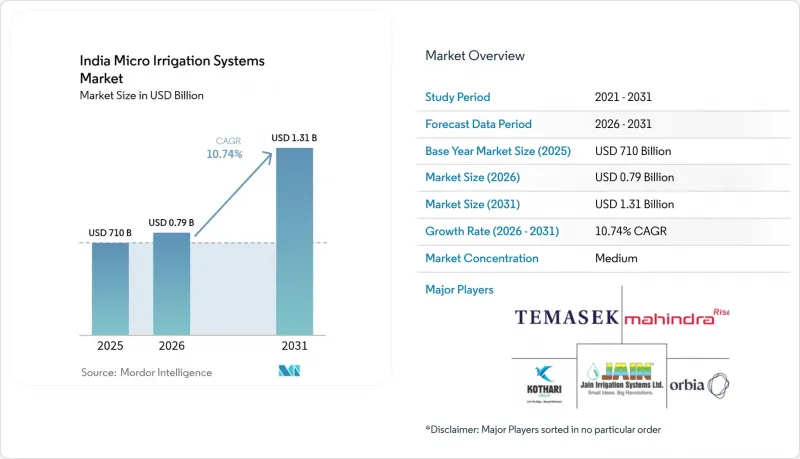
This report is Segmented by Mechanism Type (Drip Irrigation System and More), by Application Type (Field Crops, Vegetables, Plantation Crops, and More), by End User (Open Field Farms, Greenhouses, and Vertical Farms), and by State (Rajasthan, Maharashtra, Andhra Pradesh, Karnataka, Gujarat, Tamil Nadu, Madhya Pradesh, and More). The Market Forecasts are Provided in Terms of Value (USD).
India Micro Irrigation Systems Market Trends and Insights
Government Subsidies Are Scaling Micro Irrigation Adoption
The Union Budget 2025-26 lifted the agriculture allocation to USD 21.1 billion (INR 1.75 trillion). The Micro Irrigation Fund has approved USD 569 million ( INR 4,724.74 crore) in low-interest loans that states leverage for 50%-95% equipment subsidies. The Cabinet-cleared Modernisation of Command Area Development and Water Management scheme added USD 192 million (INR 1,600 crore) for pressurized pipe networks, cutting conveyance losses by 25%. Demonstration plots under the Per Drop More Crop initiative show 50%-90% water savings, encouraging peer adoption. Together, these fiscal tools compress payback to fewer than three seasons for high-value crops and enlarge the India micro irrigation systems market.
Accelerating Groundwater Stress in West-Central India
Annual withdrawals near 230 billion cubic meters have lowered aquifers by 1.5 centimeters per year, curbing streamflow into the Bay of Bengal by 1,200 cubic meters per second. Maharashtra irrigates just 18% of its farmland despite having India's highest dam density, exposing a stark demand-supply gap. Policy responses such as Punjab's ban on water-intensive hybrid paddy underscore a nationwide pivot toward efficient irrigation. Farmers in depletion hotspots now view precision watering as insurance against pumping-ban risk, boosting the India micro irrigation systems market.
High Upfront Installation Cost
Complete drip packages cost between USD 361-361,000 (INR 30,000-30 lakh) depending on acreage and automation, a heavy lift for the 86% of farmers who own under two hectares. Even after a 50% subsidy, the payback for cereals can exceed five years, deterring adoption. Declining hardware costs and volume discounts are narrowing the gap, but demand elasticity remains sensitive to credit availability, slowing India micro irrigation systems market growth.
Other drivers and restraints analyzed in the detailed report include:
- Solar-Powered Pump Bundling Cuts Operating Expenditure
- Peri-Urban Export-Oriented Horticulture Clusters
- Frequent Clogging and Maintenance Issues
For complete list of drivers and restraints, kindly check the Table Of Contents.
Segment Analysis
Drip irrigation retained a 44.35% India micro irrigation systems market share in 2025, delivering 12%-84% water savings and 20%-50% yield gains across cereals, cotton, and horticulture. Smart automation players such as Jain Irrigation Systems Ltd's JAIN LOGIC integrate soil-moisture telemetry and weather data, lifting water-productivity ratios by 30%. Sprinkler sets continue serving broadacre staples where uniform canopy wetting is critical, but growth trails fogging, which is rising 16.98% CAGR to 2031 on greenhouse demand. Fogging enables sub-4°C canopy cooling, vital for lettuce and exotic herbs grown inside vertical farms. IoT-ready controllers across all mechanisms add predictive maintenance capabilities, further expanding the India micro irrigation systems market size for premium kits.
Commercial greenhouse operators report significant output increases and substantial extra water savings after upgrading to sensor-controlled solenoid valves. Continuous research and development in anti-clog labyrinth design, pressure-compensating emitters, and UV-resistant polymers is extending field life, bolstering total cost-of-ownership economics. Consequently, the India micro irrigation systems market is shifting from simple gravity-fed lateral lines toward data-centric, low-maintenance architectures.
Complete Report Scope:
- By Mechanism Type
- Drip Irrigation System
- Sprinkler Irrigation System
- Fogging
- By Application Type
- Field Crops
- Plantation Crops
- Vegetable Crops
- Orchards and Vineyards
- Turfs and Ornamentals
- By End User
- Open Field Farms
- Greenhouses
- Vertical Farms
- By State
- Rajasthan
- Maharashtra
- Andhra Pradesh
- Karnataka
- Gujarat
- Tamil Nadu
- Madhya Pradesh
- Uttar Pradesh
- Telangana
- Rest of India
List of Companies Covered in this Report:
- Jain Irrigation Systems Ltd
- Netafim (Orbia Advance Corporation)
- Mahindra & Mahindra Ltd
- Rivulis (Temasek)
- Kothari Group
- Finolex Plasson
- Rain Bird Corporation
- Valley Irrigation (Valmont Industries, Inc.)
- Lindsay Corporation
- The Toro Company
- Supreme Industries Limited
- Captain Polyplast Ltd
- Blurain
Additional Benefits:
- The market estimate (ME) sheet in Excel format
- 3 months of analyst support
TABLE OF CONTENTS
1 Introduction
- 1.1 Study Assumptions and Market Definition
- 1.2 Scope of the Study
2 Research Methodology
3 Executive Summary
4 Market Landscape
- 4.1 Market Overview
- 4.2 Market Drivers
- 4.2.1 Government Subsidies Are Scaling Micro Irrigation Adoption
- 4.2.2 Accelerating Groundwater Stress in West-Central India
- 4.2.3 Rapid Shift to Fertigation in Fruit Belts
- 4.2.4 Solar-Powered Pump Bundling Cuts Operating Expenditure
- 4.2.5 Peri-Urban Export-Oriented Horticulture Clusters
- 4.2.6 Ag-Fintech Buy-Now-Pay-Later (BNPL) Models Easing Capital Expense
- 4.3 Market Restraints
- 4.3.1 High Upfront Installation Cost
- 4.3.2 Frequent Clogging and Maintenance Issues
- 4.3.3 Fragmented After-Sales Service Network
- 4.3.4 Emerging Groundwater Extraction Caps in Dark-Zone Blocks
- 4.4 Regulatory Landscape
- 4.5 Technological Outlook
- 4.6 Porter's Five Forces Analysis
- 4.6.1 Bargaining Power of Suppliers
- 4.6.2 Bargaining Power of Buyers
- 4.6.3 Threat of New Entrants
- 4.6.4 Threat of Substitute Products
- 4.6.5 Intensity of Competitive Rivalry
5 Market Size and Growth Forecasts (Value)
- 5.1 By Mechanism Type
- 5.1.1 Drip Irrigation System
- 5.1.2 Sprinkler Irrigation System
- 5.1.3 Fogging
- 5.2 By Application Type
- 5.2.1 Field Crops
- 5.2.2 Plantation Crops
- 5.2.3 Vegetable Crops
- 5.2.4 Orchards and Vineyards
- 5.2.5 Turfs and Ornamentals
- 5.3 By End User
- 5.3.1 Open Field Farms
- 5.3.2 Greenhouses
- 5.3.3 Vertical Farms
- 5.4 By State
- 5.4.1 Rajasthan
- 5.4.2 Maharashtra
- 5.4.3 Andhra Pradesh
- 5.4.4 Karnataka
- 5.4.5 Gujarat
- 5.4.6 Tamil Nadu
- 5.4.7 Madhya Pradesh
- 5.4.8 Uttar Pradesh
- 5.4.9 Telangana
- 5.4.10 Rest of India
6 Competitive Landscape
- 6.1 Market Concentration
- 6.2 Strategic Moves
- 6.3 Market Share Analysis
- 6.4 Company Profiles (Includes Global Level Overview, Market Level Overview, Core Segments, Financials as Available, Strategic Information, Market Rank/Share, Products and Services, and Recent Developments)
- 6.4.1 Jain Irrigation Systems Ltd
- 6.4.2 Netafim (Orbia Advance Corporation)
- 6.4.3 Mahindra & Mahindra Ltd
- 6.4.4 Rivulis (Temasek)
- 6.4.5 Kothari Group
- 6.4.6 Finolex Plasson
- 6.4.7 Rain Bird Corporation
- 6.4.8 Valley Irrigation (Valmont Industries, Inc.)
- 6.4.9 Lindsay Corporation
- 6.4.10 The Toro Company
- 6.4.11 Supreme Industries Limited
- 6.4.12 Captain Polyplast Ltd
- 6.4.13 Blurain
7 Market Opportunities and Future Outlook

