PUBLISHER: Mordor Intelligence | PRODUCT CODE: 2115163

PUBLISHER: Mordor Intelligence | PRODUCT CODE: 2115163
Emollient Esters - Market Share Analysis, Industry Trends & Statistics, Growth Forecasts (2026 - 2031)
According to Mordor Intelligence, the emollient esters market size was valued at USD 606.30 million in 2025 and estimated to grow from USD 632.37 million in 2026 to reach USD 780.61 million by 2031, at a CAGR of 4.30% during the forecast period (2026-2031).
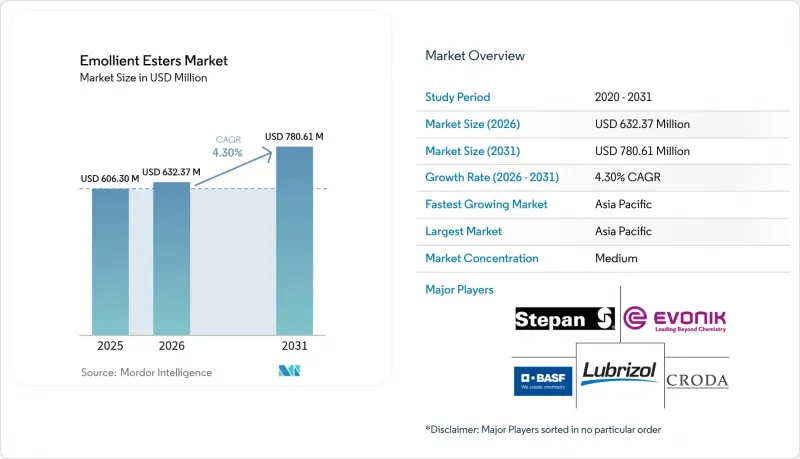
This report Segments the Industry by Product Type (Isopropyl Myristate, C12-15 Alkyl Benzoate, and More), Source (Plant-Derived, Petrochemical-Derived, and More), End-User Industry (Skin Care, Hair Care, and More), and Geography (Asia-Pacific, North America, and More). The Market Forecasts are Provided in Terms of Value (USD).
Global Emollient Esters Market Trends and Insights
Increasing Demand for Personal Care & Cosmetic Products
E-commerce penetration in tier-2 cities accounts for 55% of prestige beauty sales, broadening access to premium formulations. Gen Z and millennial consumers favor clinically backed ingredients, sustaining demand for caprylic/capric triglyceride and other multifunctional esters. The result is consistent volume growth and improved average selling prices across the global emollient esters market.
Rising Preference for Naturally Derived Emollient Esters
Plant-based grades already dominate but continue to gain share as leading suppliers launch biodegradable, sustainably sourced lines, such as BASF's new portfolio of natural betaines. Evonik's enzymatic routes achieve full-scale CO2 reductions, aligning with brand pledges for climate neutrality. With REACH restrictions tightening, bio-based esters enjoy regulatory advantages, reinforcing their long-term growth trajectory within the emollient esters market.
Volatility in Fatty-Acid & Alcohol Feedstock Prices
Palm-oil-derived alcohol costs rose 12% in 2024, while cocoa products doubled on adverse weather, squeezing margins for ester producers dependent on these commodities. Smaller firms lacking hedging capacity face liquidity pressure, prompting investment in diversified feedstocks and enzymatic processes that tolerate variable raw-material inputs, yet near-term profitability remains vulnerable.
Other drivers and restraints analyzed in the detailed report include:
- Growth in Dermatology & Topical-Pharma Formulations
- Expansion of Premium Beauty Brands in Emerging Economies
- Stringent REACH & Global Cosmetic-Safety Regulations
For complete list of drivers and restraints, kindly check the Table Of Contents.
Segment Analysis
Isopropyl myristate retained 23.92% of 2025 revenue, anchoring the emollient esters market through its broad utility in skin, hair, and color cosmetics. Caprylic/capric triglyceride's 5.38% CAGR demonstrates a migration toward multifunctional ingredients that combine emolliency with antimicrobial action. Its popularity supports premium shelf prices and improved profitability for formulators relying on a single ingredient to deliver multiple claims.
Enzymatically produced specialty esters enable up to 60% lower carbon footprints, letting suppliers capture brand sustainability budgets. Novel C12-15 alkyl benzoate grades tailor spreading profiles for sun care, while cetyl palmitate gains relevance in solid moisturizers. Patent filings for ultra-long-chain sugar alcohol esters indicate an innovation pipeline geared toward stability and bioactivity improvements that will diversify product offerings within the emollient esters market.
Complete Report Scope:
- By Product Type
- Isopropyl Myristate
- C12-15 Alkyl Benzoate
- Caprylic/Capric Triglyceride
- Cetyl Palmitate
- Other Specialty Esters(Myristyl Myristate, etc.)
- By Source
- Plant-derived
- Petrochemical-derived
- Up-cycled / By-product-derived
- By End-User Industry
- Skin Care
- Hair Care
- Color Cosmetics
- Oral Care
- Other End-User Industries (Pharma & Topical OTC, Baby Care, etc.)
- By Geography
- Asia-Pacific
- China
- India
- Japan
- South Korea
- Rest of Asia-Pacific
- North America
- United States
- Canada
- Mexico
- Europe
- Germany
- United Kingdom
- France
- Italy
- Rest of Europe
- South America
- Brazil
- Argentina
- Rest of South America
- Middle East and Africa
- Saudi Arabia
- South Africa
- Rest of Middle East and Africa
- Asia-Pacific
Geography Analysis
Asia-Pacific captured 34.62% of 2025 revenue and is forecast for a 5.05% CAGR. Domestic investments such as Evonik's enzymatic line elevate regional self-sufficiency, shorten lead times, and reduce import tariffs, strengthening competitiveness across the emollient esters market.
North America exhibits mature but innovation-driven demand. Consumers pay premiums for natural, traceable ingredients, encouraging suppliers to widen bio-based offerings. Regulatory clarity by the FDA plus state-level disclosures increase documentation needs, giving technologically advanced producers an edge. Mexico's rising contract manufacturing base benefits from near-shoring dynamics and preferential trade agreements with the United States, underpinning future growth.
Europe's stringent environmental framework drives market evolution. REACH pushes reformulations toward low-carbon and microplastic-free esters. Germany, France, the United Kingdom, and Italy house sophisticated laboratories focused on sensory innovation and green chemistry, fostering high-value downstream demand.
South America shows early-stage expansion led by Brazil's increasing disposable income and local beauty entrepreneurship.
The Middle East and Africa remain small yet promising, especially in Saudi Arabia and South Africa where retail modernization and social-media exposure stimulate upmarket personal care adoption.
- AAK AB
- ABITEC
- Ashland
- BASF
- Croda International plc
- Evonik Industries AG
- Innospec
- IOI Oleo GmbH
- Lonza
- Indorama Ventures
- Phoenix Chemical Inc.
- SEPPIC
- Stepan Company
- The Lubrizol Corporation
- Vantage Specialty Chemicals, Inc.
Additional Benefits:
- The market estimate (ME) sheet in Excel format
- 3 months of analyst support
TABLE OF CONTENTS
1 Introduction
- 1.1 Study Assumptions & Market Definition
- 1.2 Scope of the Study
2 Research Methodology
3 Executive Summary
4 Market Landscape
- 4.1 Market Overview
- 4.2 Market Drivers
- 4.2.1 Increasing demand for personal care & cosmetic products
- 4.2.2 Rising preference for naturally derived emollient esters
- 4.2.3 Growth in dermatology & topical-pharma formulations
- 4.2.4 Expansion of premium beauty brands in emerging economies
- 4.2.5 Shift toward solid & water-free beauty formats boosting high-melting esters
- 4.3 Market Restraints
- 4.3.1 Volatility in fatty-acid & alcohol feedstock prices
- 4.3.2 Stringent REACH & global cosmetic-safety regulations
- 4.3.3 Rising substitution by silicone-free texturizers & polymers
- 4.4 Value Chain Analysis
- 4.5 Porter's Five Forces
- 4.5.1 Threat of New Entrants
- 4.5.2 Bargaining Power of Buyers
- 4.5.3 Bargaining Power of Suppliers
- 4.5.4 Threat of Substitute Products
- 4.5.5 Degree of Competition
5 Market Size & Growth Forecasts (Value)
- 5.1 By Product Type
- 5.1.1 Isopropyl Myristate
- 5.1.2 C12-15 Alkyl Benzoate
- 5.1.3 Caprylic/Capric Triglyceride
- 5.1.4 Cetyl Palmitate
- 5.1.5 Other Specialty Esters(Myristyl Myristate, etc.)
- 5.2 By Source
- 5.2.1 Plant-derived
- 5.2.2 Petrochemical-derived
- 5.2.3 Up-cycled / By-product-derived
- 5.3 By End-User Industry
- 5.3.1 Skin Care
- 5.3.2 Hair Care
- 5.3.3 Color Cosmetics
- 5.3.4 Oral Care
- 5.3.5 Other End-User Industries (Pharma & Topical OTC, Baby Care, etc.)
- 5.4 By Geography
- 5.4.1 Asia-Pacific
- 5.4.1.1 China
- 5.4.1.2 India
- 5.4.1.3 Japan
- 5.4.1.4 South Korea
- 5.4.1.5 Rest of Asia-Pacific
- 5.4.2 North America
- 5.4.2.1 United States
- 5.4.2.2 Canada
- 5.4.2.3 Mexico
- 5.4.3 Europe
- 5.4.3.1 Germany
- 5.4.3.2 United Kingdom
- 5.4.3.3 France
- 5.4.3.4 Italy
- 5.4.3.5 Rest of Europe
- 5.4.4 South America
- 5.4.4.1 Brazil
- 5.4.4.2 Argentina
- 5.4.4.3 Rest of South America
- 5.4.5 Middle East and Africa
- 5.4.5.1 Saudi Arabia
- 5.4.5.2 South Africa
- 5.4.5.3 Rest of Middle East and Africa
- 5.4.1 Asia-Pacific
6 Competitive Landscape
- 6.1 Market Concentration
- 6.2 Strategic Moves
- 6.3 Market Share(%)/Ranking Analysis
- 6.4 Company Profiles {(includes Global level Overview, Market level overview, Core Segments, Financials as available, Strategic Information, Market Rank/Share for key companies, Products & Services, and Recent Developments)}
- 6.4.1 AAK AB
- 6.4.2 ABITEC
- 6.4.3 Ashland
- 6.4.4 BASF
- 6.4.5 Croda International plc
- 6.4.6 Evonik Industries AG
- 6.4.7 Innospec
- 6.4.8 IOI Oleo GmbH
- 6.4.9 Lonza
- 6.4.10 Indorama Ventures
- 6.4.11 Phoenix Chemical Inc.
- 6.4.12 SEPPIC
- 6.4.13 Stepan Company
- 6.4.14 The Lubrizol Corporation
- 6.4.15 Vantage Specialty Chemicals, Inc.
7 Market Opportunities & Future Outlook
- 7.1 White-space & Unmet-need Assessment

