PUBLISHER: Mordor Intelligence | PRODUCT CODE: 2115167

PUBLISHER: Mordor Intelligence | PRODUCT CODE: 2115167
Fatty Acid Methyl Ester - Market Share Analysis, Industry Trends & Statistics, Growth Forecasts (2026 - 2031)
According to Mordor Intelligence, the fatty acid methyl ester market size is expected to grow from 1.60 million tons in 2025 to 1.63 million tons in 2026 and is forecast to reach 1.79 million tons by 2031 at a 1.94% CAGR over 2026-2031.
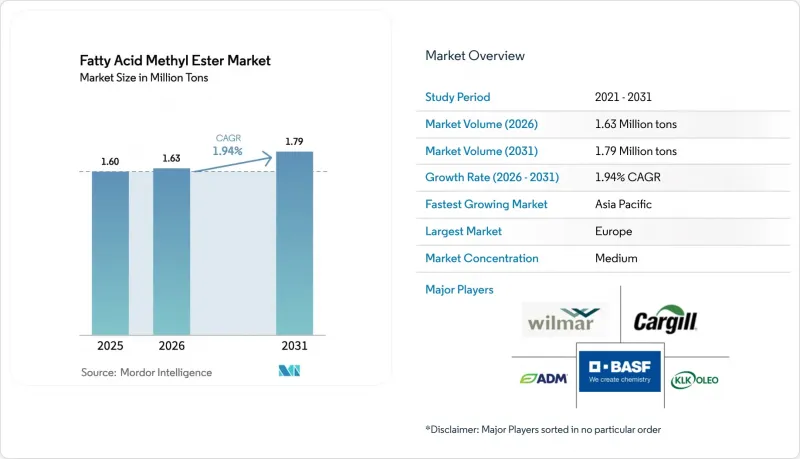
This report is Segmented by Type (Rapeseed, Soy, Palm Oil, Other Types), Application (Fuel, Lubricants, Coatings, Food and Agriculture, Personal Care Products, Other Applications), and Geography (Asia-Pacific, North America, Europe, South America, Middle East and Africa). The Market Forecasts are Provided in Terms of Volume (Tons).
Global Fatty Acid Methyl Ester Market Trends and Insights
Escalating Biodiesel Blend Mandates
Indonesia will introduce a B50 requirement in 2026 that is expected to absorb about 11 million tons of palm oil annually, insulating domestic producers from export volatility. Brazil's phased move to B15 adds 1.5 billion liters of incremental demand under RenovaBio, while the United States proposes biomass-based diesel volumes of 7.12-7.50 billion RINs but intends to discount credits tied to imported feedstocks. In Europe, RED III preserves a 29% transport-energy target yet caps crop-based biofuels at 7%, nudging investments toward waste-oil esters. Certification schemes such as ISCC and REDcert-EU now cover more than 15,000 sites, shaping global trade access.
Increasing Feedstock Availability and Cost Competitiveness
Municipal collection programs lifted China's used-cooking-oil exports to the EU to 1.2 million tons in 2024, supported by ISCC approvals. Double-counting credits under RED III keeps European UCO economical despite the average 2024 prices of EUR 950 per ton. Palm oil eased to MYR 3,800-4,000 per ton by late-2024, boosting margins for Southeast Asian producers holding long-term contracts. However, weather shifts in South America or palm-export quotas in Indonesia can swiftly reverse the cost advantage, underscoring the feedstock risk embedded in the Fatty Acid Methyl Ester market.
Vegetable-Oil Price Volatility
Palm-oil futures swung from MYR 5,200 per ton in early 2023 to MYR 3,800 per ton by December 2024, slicing FAME margins by as much as 20 percentage points for producers lacking hedges. Soybean oil prices saw a similar pattern in the United States, peaking at 68 cents per pound in March 2024, then sliding to 42 cents by October as Brazilian harvests surged. With feedstock accounting for up to 85% of production cost, such volatility can erode profitability swiftly.
Other drivers and restraints analyzed in the detailed report include:
- Rising Demand for Low-Sulfur Renewable Diesel Substitutes
- Maritime Bio-Bunkering Pilots Adopting FAME Blends
- Competition from Alternative Biofuels and Renewable Diesel
For complete list of drivers and restraints, kindly check the Table Of Contents.
Segment Analysis
Other Types - spanning waste-oil, animal-fat, and algal-oil methyl esters - are set to expand at a 2.76% CAGR through 2031, outpacing the overall Fatty Acid Methyl Ester market. Waste-oil ester output in China totaled 1.8 million tons in 2024, with Sinopec and COFCO exporting certified cargoes to Rotterdam and Hamburg. North American renderers such as Darling Ingredients supplied 400,000 tons of tallow-based FAME, leveraging vertically integrated collection networks.
Rapeseed methyl ester retained 45.12% global volume in 2025 due to Europe's 8 million-ton refining base and cold-flow advantages that align with EN 14214 norms, while soy methyl ester dominated the Americas. Palm-oil esters, concentrated in Indonesia and Malaysia, face EU ILUC caps that freeze import quotas at 2019 levels. Certification under ISCC and REDcert is therefore pivotal for market access, and producers unable to document zero-deforestation supply chains risk exclusion.
Complete Report Scope:
- By Type
- Rapeseed Methyl Ester
- Soy Methyl Ester
- Palm Oil Methyl Ester
- Other Types (Waste-Oil Methyl Ester, Animal-Fat-Derived Methyl Ester, Algal-Oil Methyl Ester)
- By Application
- Fuel
- Lubricants
- Coatings
- Food and Agriculture
- Personal Care Products
- Other Applications (Plasticizers and Surfactants,Metalworking Fluids)
- By Geography
- Asia-Pacific
- China
- India
- Japan
- South Korea
- ASEAN Countries
- Rest of Asia-Pacific
- North America
- United States
- Canada
- Mexico
- Europe
- Germany
- United Kingdom
- France
- Italy
- Spain
- NORDIC Countries
- Rest of Europe
- South America
- Brazil
- Argentina
- Rest of South America
- Middle-East and Africa
- Saudi Arabia
- United Arab Emirates
- South Africa
- Nigeria
- Rest of Middle-East and Africa
- Asia-Pacific
Geography Analysis
Europe commanded 38.92% of global volume in 2025, yet renewable diesel plants and advanced-biofuel quotas are siphoning feedstocks away from traditional FAME. Germany's 2024 output slipped 4% to 2.8 million tons as UCO shortages pressed margins, while France held flat at 1.6 million tons thanks to Saipol's integrated rapeseed assets. The United Kingdom issued 1.2 million Renewable Transport Fuel Certificates for FAME in 2024, 8% lower than the prior year as refiners pivoted toward HVO. Nordic demand remains modest but is shifting quickly to waste-based alternatives, reinforcing Europe's structural feedstock shift.
Asia-Pacific is primed for a 3.54% CAGR through 2031. Malaysia exported surplus volumes to the Philippines and Thailand, but softer palm prices narrowed refinery spreads. China's domestic output is centered on municipal waste-oil programs, with 80% of production exported to the EU, where double-counting incentives prevail. India lags due to ethanol-blend priorities, while Japan and South Korea import modest cargoes to deliver corporate sustainability pledges.
North America accounted for a significant market share in 2025. The United States led with outstanding volume consumption anchored by rapidly scaled soybean-oil refining in Iowa and Illinois. Canada consumed 320,000 tons under its Clean Fuel Regulations, and Mexico relied on imports for 180,000 tons. South America supplied 3.2 million tons in 2024, with Brazil's B12 rule absorbing 6.3 billion liters and Argentina exporting 1.2 million tons after trade disputes eased. The Middle East and Africa remain nascent but show potential as Saudi Arabia channels USD 500 million into a 300,000-ton waste-oil project slated for 2026.
- Archer Daniels Midland Co.
- BASF
- Cargill, Incorporated.
- Emery Oleochemicals
- Godrej Industries Limited
- IOI Oleochemical
- KLK OLEO
- ABITEC, Larodan Research Grade Lipids
- Louis Dreyfus Company
- Mewah Group
- Chevron
- Tokyo Chemical Industry Pvt. Ltd.
- VERBIO North America LLC
- Wilmar International Ltd
Additional Benefits:
- The market estimate (ME) sheet in Excel format
- 3 months of analyst support
TABLE OF CONTENTS
1 Introduction
- 1.1 Study Assumptions and Market Definition
- 1.2 Scope of the Study
2 Research Methodology
3 Executive Summary
4 Market Landscape
- 4.1 Market Overview
- 4.2 Market Drivers
- 4.2.1 Escalating biodiesel blend mandates
- 4.2.2 Increasing feedstock availability and cost competitiveness
- 4.2.3 Rising demand for low-sulfur renewable diesel substitutes
- 4.2.4 Maritime bio-bunkering pilots adopting FAME blends
- 4.2.5 Increasing demand from personal care industry
- 4.3 Market Restraints
- 4.3.1 Vegetable-oil price volatility
- 4.3.2 Competition from Alternative Biofuels and Renewable Diesel
- 4.3.3 Regulatory Uncertainty and Policy Dependence
- 4.4 Value Chain Analysis
- 4.5 Porter's Five Forces
- 4.5.1 Bargaining Power of Buyers
- 4.5.2 Bargaining Power of Suppliers
- 4.5.3 Threat of New Entrants
- 4.5.4 Threat of Substitutes
- 4.5.5 Degree of Competition
5 Market Size and Growth Forecasts (Volume)
- 5.1 By Type
- 5.1.1 Rapeseed Methyl Ester
- 5.1.2 Soy Methyl Ester
- 5.1.3 Palm Oil Methyl Ester
- 5.1.4 Other Types (Waste-Oil Methyl Ester, Animal-Fat-Derived Methyl Ester, Algal-Oil Methyl Ester)
- 5.2 By Application
- 5.2.1 Fuel
- 5.2.2 Lubricants
- 5.2.3 Coatings
- 5.2.4 Food and Agriculture
- 5.2.5 Personal Care Products
- 5.2.6 Other Applications (Plasticizers and Surfactants,Metalworking Fluids)
- 5.3 By Geography
- 5.3.1 Asia-Pacific
- 5.3.1.1 China
- 5.3.1.2 India
- 5.3.1.3 Japan
- 5.3.1.4 South Korea
- 5.3.1.5 ASEAN Countries
- 5.3.1.6 Rest of Asia-Pacific
- 5.3.2 North America
- 5.3.2.1 United States
- 5.3.2.2 Canada
- 5.3.2.3 Mexico
- 5.3.3 Europe
- 5.3.3.1 Germany
- 5.3.3.2 United Kingdom
- 5.3.3.3 France
- 5.3.3.4 Italy
- 5.3.3.5 Spain
- 5.3.3.6 NORDIC Countries
- 5.3.3.7 Rest of Europe
- 5.3.4 South America
- 5.3.4.1 Brazil
- 5.3.4.2 Argentina
- 5.3.4.3 Rest of South America
- 5.3.5 Middle-East and Africa
- 5.3.5.1 Saudi Arabia
- 5.3.5.2 United Arab Emirates
- 5.3.5.3 South Africa
- 5.3.5.4 Nigeria
- 5.3.5.5 Rest of Middle-East and Africa
- 5.3.1 Asia-Pacific
6 Competitive Landscape
- 6.1 Market Concentration
- 6.2 Strategic Moves
- 6.3 Market Share(%)/Ranking Analysis
- 6.4 Company Profiles (includes Global level Overview, Market level overview, Core Segments, Financials as available, Strategic Information, Market Rank/Share, Products and Services, Recent Developments)
- 6.4.1 Archer Daniels Midland Co.
- 6.4.2 BASF
- 6.4.3 Cargill, Incorporated.
- 6.4.4 Emery Oleochemicals
- 6.4.5 Godrej Industries Limited
- 6.4.6 IOI Oleochemical
- 6.4.7 KLK OLEO
- 6.4.8 ABITEC, Larodan Research Grade Lipids
- 6.4.9 Louis Dreyfus Company
- 6.4.10 Mewah Group
- 6.4.11 Chevron
- 6.4.12 Tokyo Chemical Industry Pvt. Ltd.
- 6.4.13 VERBIO North America LLC
- 6.4.14 Wilmar International Ltd
7 Market Opportunities and Future Outlook
- 7.1 White-space and Unmet-Need Assessment
- 7.2 Catalyst and process-intensification breakthroughs

