PUBLISHER: Mordor Intelligence | PRODUCT CODE: 2115170

PUBLISHER: Mordor Intelligence | PRODUCT CODE: 2115170
Hydroxypropionic Acid - Market Share Analysis, Industry Trends & Statistics, Growth Forecasts (2026 - 2031)
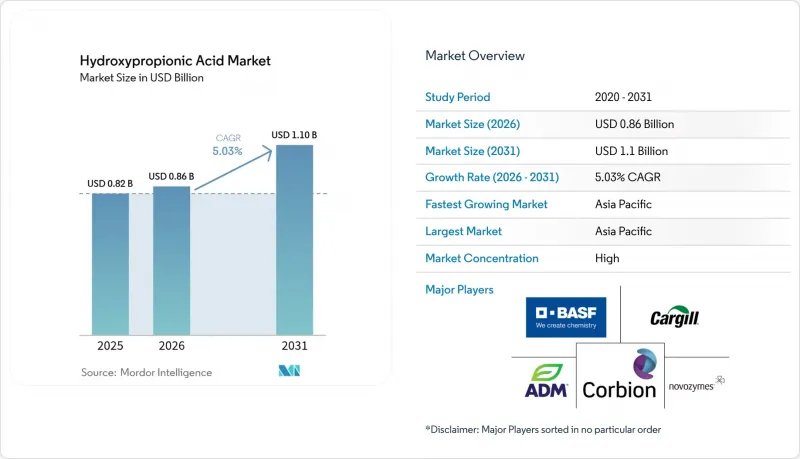
According to Mordor Intelligence, the hydroxypropionic acid market size was valued at USD 0.82 billion in 2025 and estimated to grow from USD 0.86 billion in 2026 to reach USD 1.10 billion by 2031, at a CAGR of 5.03% during the forecast period (2026-2031).
This report Segments the Industry by Product Form (Powder and Liquid), Production Technology (Chemical Synthesis (B-Propiolactone Hydrolysis, Etc. ), Microbial Fermentation - Glycerol Route, and More), Application (Paints and Coatings, Polymer, and More), and Geography (Asia-Pacific, North America, and More). The Market Forecasts are Provided in Terms of Value (USD).
Global Hydroxypropionic Acid Market Trends and Insights
Industrial Shift To Bio-Acrylic Intermediates
Commercial rollout of bio-acrylic acid from 3-hydroxypropionic acid by LG Chem in 2025 has validated scale economics and secured 100% bio-based certification. Transition momentum rises as downstream users in cosmetics, hygiene films, and super-absorbents adopt the new feedstock to lock in Scope-3 emission cuts. Process intensification has lifted fermentation titers toward 120 g/L, trimming downstream purification costs and narrowing the parity gap with petro-routes. Carbon border adjustments in the EU and the United States sharpen the incentive to localize bio-routes that carry lower embedded emissions. Producers that master integrated fermentation and dehydration lines are positioned to command premium margins while accessing incentive pools tied to renewable carbon content.
Expanding Demand In High-Performance Paints & Coatings
Formulators of aerospace, automotive, and marine coatings have escalated trials of hydroxypropionic-based epoxy hardeners after studies showed better crosslink density and enhanced salt-spray resistance than conventional amines. Regulatory caps such as the U.S. EPA's 50 g/L VOC limit for flat architectural paint accelerate reformulation cycles. Producers highlight lower curing temperature windows that cut energy use during OEM finishing. Early adopters report material savings because higher functionality enables lower hardener loadings. Market pull will likely intensify once major tier-one coating suppliers certify the additive for water-borne systems aimed at electric-vehicle battery housings, an application that demands both chemical resilience and low outgassing.
High Downstream Conversion Costs Vs. Propionic & Acrylic Acid
Current fermentation pathways yield production costs near USD 6.1/kg, roughly 25% above legacy petrochemical routes. The penalty reflects multi-step purification, high energy inputs for evaporation, and acid recovery inefficiencies. Process models show profitability demands volumetric productivity above 2 g/L*h and titers beyond 100 g/L. Until those thresholds become common, price-sensitive adhesive and preservative markets remain tethered to propionic and acrylic acid. Larger bio-plants scheduled for 2027 may deliver scale economies that reset the cost curve, yet investors remain wary of margin dilution if carbon credit schemes weaken.
Other drivers and restraints analyzed in the detailed report include:
- Adoption In UV-Curable & Water-Borne Polymer Systems
- Regulatory Push For Low-VOC, Sustainable Additives
- Volatility In Glycerol Feedstock Pricing
For complete list of drivers and restraints, kindly check the Table Of Contents.
Segment Analysis
The hydroxypropionic acid market size for liquid formulations captured 54.88% hydroxypropionic acid market share. Demand is anchored in paints, polymer dispersions, and adhesive blends that value pumpable consistency, low impurity load, and seamless dosing into continuous reactors. Producers capitalize on lower logistics costs by shipping concentrated aqueous blends that avoid crystallization. Capacity additions in China and Malaysia further consolidate supply, reinforcing the segment's scale advantage.
Powder grades are projected to grow at a 6.03% CAGR through 2031. Uptake accelerates where moisture sensitivity or ultraprecision dosing is crucial, notably in cell-culture media and controlled-release fertilizers. The hydroxypropionic acid market positions powder as an enabler for high-purity applications because spray-drying removes trace salts that compromise downstream reactions. Producers invest in low-energy agitated thin-film dryers to cut operational costs and meet rising GMP standards. Market penetration will deepen once contract manufacturers in India and Singapore validate large-scale lyophilization lines able to deliver kilogram-scale batches with sub-0.1% residual moisture.
Complete Report Scope:
- By Product Form
- Powder
- Liquid
- By Production Technology
- Chemical Synthesis (B-propiolactone hydrolysis, etc.)
- Microbial Fermentation - Glycerol Route
- Microbial Fermentation - Glucose Route
- Electro-chemical CO2 Reduction
- Other Emerging Routes
- By Application
- Paints and Coatings
- Polymer
- Adhesives and Sealants
- Other Applications (Chemical Intermediates, Bioplastics, etc.)
- By Geography
- Asia-Pacific
- China
- Japan
- India
- South Korea
- Rest of Asia-Pacific
- North America
- United States
- Canada
- Mexico
- Europe
- Germany
- United Kingdom
- France
- Italy
- Rest of Europe
- South America
- Brazil
- Argentina
- Rest of South America
- Middle East and Africa
- Saudi Arabia
- South Africa
- Rest of Middle East and Africa
- Asia-Pacific
Geography Analysis
Asia-Pacific is the epicenter of demand, commanding a 47.21% hydroxypropionic acid market share in 2025. Regional revenue stood at USD 387.1 million and is forecast to rise at a 5.78% CAGR to 2031. China anchors consumption as paint formulators and plasticizers pivot to bio-routes aligned with its dual-carbon goals. Provincial grants for bio-based chemical parks in Jiangsu and Zhejiang include interest-free loans for fermentation lines and expedited environmental approvals. Japan contributes high-margin volume through electronics and medical device polymers that prize ultrahigh purity. India's national bio-economy policy incentivizes domestic fermentation projects, attracting joint ventures between local agro-processors and European specialty firms.
In North America, Regulatory certainty under the U.S. Clean Air Act, alongside corporate science-based targets, channels steady procurement into automotive OEM coating lines. Feedstock security weighed in favor of the region when Dow secured cellulosic ethanol-derived ethylene via a 2024 offtake agreement. Canada's forestry residues enter the supply chain through pilot glycerol-to-hydroxypropionic routes at Quebec's bio-refineries. The regional growth trajectory aligns with decarbonization mandates in federal procurement that privilege low-emission material inputs.
Stringent REACH regulations in Europe and the forthcoming revision of the IED keep demand oriented toward bio-based compliance solutions. Germany's Leuna bio-refinery investment by UPM will supply hydroxy-derived intermediates at 220,000 tons per year starting mid-2025. Scandinavia and the Benelux strengthen the regional innovation pipeline through public-private consortia that fund catalyst discovery and enzyme engineering. Despite cost headwinds from elevated energy prices, downstream users pay premiums for assured traceability and eco-label eligibility.
Latin America and the Middle East & Africa share a smaller footprint but post rising uptake tied to biodiesel coproduct utilization and food-grade plastic packaging mandates. Brazil leverages abundant sugarcane syrup to trial glucose-fed fermentation lines, while Saudi Arabia's industrial clusters probe salt-tolerant strains to capitalize on coastal desalination infrastructure.
- ADM
- Alfa Aesar (Thermo Fisher)
- BASF
- Capot Chemical
- Cargill
- Corbion
- DSM-Firmenich
- DuPont de Nemours
- Genomatica
- Ginkgo Bioworks
- Kaneka Corporation
- LG Chem
- Metabolic Explorer
- Novozymes
- Oakwood Products
- Sigma-Aldrich (Merck)
- Spectrum Chemical
- SynQuest Laboratories
- Toronto Research Chemicals
- Zhejiang Jiang Chemical
Additional Benefits:
- The market estimate (ME) sheet in Excel format
- 3 months of analyst support
TABLE OF CONTENTS
1 Introduction
- 1.1 Study Assumptions & Market Definition
- 1.2 Scope of the Study
2 Research Methodology
3 Executive Summary
4 Market Landscape
- 4.1 Market Overview
- 4.2 Market Drivers
- 4.2.1 Industrial shift to bio-acrylic intermediates
- 4.2.2 Expanding demand in high-performance paints & coatings
- 4.2.3 Adoption in UV-curable & water-borne polymer systems
- 4.2.4 Regulatory push for low-VOC, sustainable additives
- 4.2.5 Rising use as pH-neutral lactate substitute in cell-culture media
- 4.3 Market Restraints
- 4.3.1 High downstream conversion costs vs. propionic & acrylic acid
- 4.3.2 Volatility in glycerol feedstock pricing
- 4.3.3 Enzyme deactivation in high-salinity bioreactors limiting scale-up
- 4.4 Value Chain Analysis
- 4.5 Porter's Five Forces
- 4.5.1 Threat of New Entrants
- 4.5.2 Bargaining Power of Buyers
- 4.5.3 Bargaining Power of Suppliers
- 4.5.4 Threat of Substitutes
- 4.5.5 Degree of Competition
5 Market Size & Growth Forecasts (Value)
- 5.1 By Product Form
- 5.1.1 Powder
- 5.1.2 Liquid
- 5.2 By Production Technology
- 5.2.1 Chemical Synthesis (B-propiolactone hydrolysis, etc.)
- 5.2.2 Microbial Fermentation - Glycerol Route
- 5.2.3 Microbial Fermentation - Glucose Route
- 5.2.4 Electro-chemical CO2 Reduction
- 5.2.5 Other Emerging Routes
- 5.3 By Application
- 5.3.1 Paints and Coatings
- 5.3.2 Polymer
- 5.3.3 Adhesives and Sealants
- 5.3.4 Other Applications (Chemical Intermediates, Bioplastics, etc.)
- 5.4 By Geography
- 5.4.1 Asia-Pacific
- 5.4.1.1 China
- 5.4.1.2 Japan
- 5.4.1.3 India
- 5.4.1.4 South Korea
- 5.4.1.5 Rest of Asia-Pacific
- 5.4.2 North America
- 5.4.2.1 United States
- 5.4.2.2 Canada
- 5.4.2.3 Mexico
- 5.4.3 Europe
- 5.4.3.1 Germany
- 5.4.3.2 United Kingdom
- 5.4.3.3 France
- 5.4.3.4 Italy
- 5.4.3.5 Rest of Europe
- 5.4.4 South America
- 5.4.4.1 Brazil
- 5.4.4.2 Argentina
- 5.4.4.3 Rest of South America
- 5.4.5 Middle East and Africa
- 5.4.5.1 Saudi Arabia
- 5.4.5.2 South Africa
- 5.4.5.3 Rest of Middle East and Africa
- 5.4.1 Asia-Pacific
6 Competitive Landscape
- 6.1 Market Concentration
- 6.2 Strategic Moves
- 6.3 Market Share(%)/Ranking Analysis
- 6.4 Company Profiles (includes Global Level Overview, Market Level Overview, Core Segments, Financials as available, Strategic Information, Market Rank/Share for key companies, Products & Services, and Recent Developments)
- 6.4.1 ADM
- 6.4.2 Alfa Aesar (Thermo Fisher)
- 6.4.3 BASF
- 6.4.4 Capot Chemical
- 6.4.5 Cargill
- 6.4.6 Corbion
- 6.4.7 DSM-Firmenich
- 6.4.8 DuPont de Nemours
- 6.4.9 Genomatica
- 6.4.10 Ginkgo Bioworks
- 6.4.11 Kaneka Corporation
- 6.4.12 LG Chem
- 6.4.13 Metabolic Explorer
- 6.4.14 Novozymes
- 6.4.15 Oakwood Products
- 6.4.16 Sigma-Aldrich (Merck)
- 6.4.17 Spectrum Chemical
- 6.4.18 SynQuest Laboratories
- 6.4.19 Toronto Research Chemicals
- 6.4.20 Zhejiang Jiang Chemical
7 Market Opportunities & Future Outlook
- 7.1 White-Space & Unmet-Need Assessment
- 7.2 Increasing Consumer Inclination towards Eco-Friendly Product

