PUBLISHER: Mordor Intelligence | PRODUCT CODE: 2115176

PUBLISHER: Mordor Intelligence | PRODUCT CODE: 2115176
US Organic Skin Care - Market Share Analysis, Industry Trends & Statistics, Growth Forecasts (2026 - 2031)
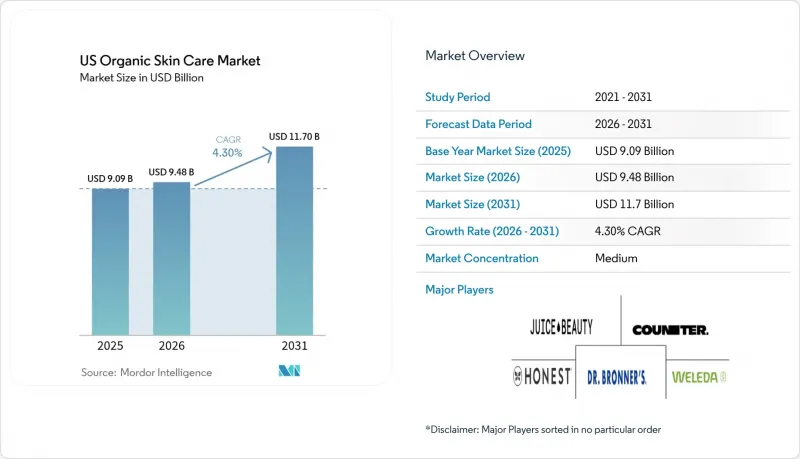
According to Mordor Intelligence, the US organic skincare market size was valued at USD 9.09 billion in 2025 and estimated to grow from USD 9.48 billion in 2026 to reach USD 11.7 billion by 2031, at a CAGR of 4.30% during the forecast period (2026-2031).
This report is Segmented by Product Type (Facial Care, Lip Care, and Body Care), by Category (Premium Products and Mass Products), by End User (Adults and Kids/Children), and by Distribution Channel (Supermarket/Hypermarkets, Specialty Stores, Online Retail Stores, and Other Distribution Channels). The Market Forecasts are Provided in Terms of Value (USD).
US Organic Skin Care Market Trends and Insights
Growing Awareness About Environmental Sustainability
Environmental consciousness has evolved beyond surface-level marketing to drive fundamental purchasing decisions, with consumers willing to pay more for personal care products with natural ingredients. This shift reflects deeper concerns about climate change and resource depletion, prompting brands to invest heavily in sustainable sourcing and circular economy principles. L'Oreal's commitment to source 95% of its formula ingredients from bio-based sources by 2030 exemplifies this transformation, supported by partnerships with biotechnology firms like Abolis to develop next-generation sustainable ingredients . The sustainability imperative is reshaping supply chains, with companies like Unilever investing USD 120 million in joint ventures to create plant-based alternatives to palm oil derivatives. This trend extends beyond ingredients to packaging innovation, where brands are adopting biodegradable materials and refillable containers to address consumer demands for comprehensive environmental responsibility. The regulatory landscape is reinforcing this shift, with Extended Producer Responsibility laws in multiple states requiring companies to manage packaging waste disposal, creating additional incentives for sustainable practices.
Influence of Social Media Platforms on Purchasing Decisions
Social media platforms have transformed how consumers discover and purchase products, with TikTok becoming a significant influence on organic skincare preferences among younger consumers. According to the Organic Trade Association, social media's impact has helped drive a 7% increase in sustainable personal care product sales, reaching USD 1.3 billion . These platforms facilitate rapid trend dissemination and enable consumers to share authentic product experiences. TikTok's algorithm-based content distribution system allows smaller organic brands to gain widespread visibility without substantial marketing investments, creating more market access opportunities and increasing competition for established companies. Research indicates that social media engagement directly influences purchase decisions for organic cosmetics by enhancing consumer perception of product quality and value. A 2024 University of Portsmouth survey indicated that 60% of consumers trusted influencer recommendations, while nearly half of all purchasing decisions were influenced by these endorsements .Consumer preference for genuine, relatable influencer content over traditional brand messaging has prompted companies to revise their marketing approaches. This shift has created a market environment where effective social media presence and influencer partnerships have become essential factors alongside product quality in determining market position.
Regulatory Gaps Fuel Growth of Uncertified Organic and Natural Products
The personal care sector operates with less stringent regulations compared to the food industry regarding organic certification, which allows brands to market products as organic or natural without formal certification. This regulatory environment has resulted in a significant increase of uncertified products that specifically target the growing consumer demand for clean beauty alternatives without meeting verified organic standards, leading to potential market distortions and authenticity concerns in the industry. The lack of a legal definition for "natural" in US cosmetics regulations creates substantial market ambiguity and uncertainty. This regulatory gap enables non-organic products to compete using unclear claims, which significantly affects the premium positioning of certified organic brands. Companies frequently use terms like "naturally inspired" or "natural-based" without meeting organic certification requirements, creating intense price competition that impacts authentic organic brands in the marketplace. The United States Department of Agriculture (USDA)'s National Organic Program faces considerable resource constraints for comprehensive market oversight, delegating much of the regulation to organic certifiers and trade associations. This delegation results in inconsistent enforcement across the market segments. The widespread confusion between organic and natural claims reduces consumer willingness to pay premium prices for certified products, as many consumers continue to struggle with differentiating between genuine organic formulations and marketing-based natural claims in the personal care sector.
Other drivers and restraints analyzed in the detailed report include:
- Growing Concerns Over the Effects of Synthetic Products on the Body
- Growth of Organic Skincare in Men's and Gender-Neutral Categories
- Strong Penetration of Synthetic Products in the Retail Shelves
For complete list of drivers and restraints, kindly check the Table Of Contents.
Segment Analysis
In 2025, facial care products took the lead in the organic skincare market, capturing a dominant 71.02% share. Projections indicate a steady growth at a CAGR of 4.66% through 2031. This dominance underscores a shift in consumer behavior, with face-specific formulations now viewed as daily essentials. The influence of social media is evident, promoting multi-step skincare regimens and boosting the demand for potent organic cleansers, moisturizers, and serums. Brands like Juice Beauty and OSEA are at the forefront, offering clinically backed natural solutions targeting acne, aging, and sensitive skin, in tune with rising consumer expectations. Meanwhile, body care products, including organic lotions and washes, enjoy consistent demand due to their everyday utility. Lip care, though a niche, remains steady, with seasonal lip balms and natural tints riding the wave of clean cosmetic trends.
Personalized skincare is rapidly emerging as the industry's fastest-growing segment, driven by technological advancements and a surge in demand for bespoke, clean formulations. Innovations like L'Oreal's Cell BioPrint device, which delivers rapid skin diagnostics through proteomic analysis, are reshaping the engagement strategies of organic skincare brands. This evolution is fueling a heightened demand for smart, ingredient-focused formulations that promise visible results. Brands such as Typology and Herbivore Botanicals are pioneering this shift, seamlessly blending organic ingredients with scientific precision to cater to individual skin concerns. With consumers placing a premium on transparency, safety, and customization, this segment is set for explosive growth, mirroring a broader industry trend towards efficacy-driven organic beauty solutions that harmonize wellness with performance.
In 2025, mass-market organic skincare products captured a commanding 67.71% market share, underscoring their widespread availability and seamless integration into daily retail outlets. This surge in dominance is largely attributed to mass retailers, such as Walmart, broadening their organic selections. By introducing a variety of certified, affordable brands, these retailers have made organic skincare more accessible, especially to budget-conscious consumers. Heightened awareness regarding ingredient safety has bolstered this segment, with brands like Burt's Bees and Avalon Organics leading the charge, offering effective yet wallet-friendly formulations. A notable shift in retail dynamics sees mass-premium and mid-range brands eclipsing traditional luxury lines, further propelling this trend. As the appetite for clean and transparent products grows, mass-market organic brands are leveraging expansive retail collaborations. They manage to uphold their organic ethos and competitive pricing, positioning them as pivotal players in the category's growth.
Premium organic skincare is emerging as the fastest-growing segment, boasting a 4.84% CAGR. Digital advancements, a commitment to sustainable sourcing, and a brand focus on transparency drive this growth. U.S. consumers are increasingly gravitating towards high-performance products that resonate with their wellness ideals. In response, premium brands are bolstering their omnichannel approaches. A testament to this trend, Origins unveiled over 70 products on Amazon's Premium Beauty platform in May 2025, illustrating how digital avenues can enhance visibility while maintaining a luxury allure. Brands such as Herbivore Botanicals and True Botanicals are at the forefront of this expansion, presenting clinically validated organic solutions paired with compelling brand narratives. Certifications in clean beauty and eco-conscious packaging amplify consumer confidence. With a pronounced shift towards online shopping and an emphasis on product integrity, the premium organic segment is poised for rapid acceleration, harmonizing elegance, efficacy, and environmental mindfulness.
Complete Report Scope:
- By Product Type
- Skin Care
- Facial Care
- Cleansers
- Moisturizers and Oils/Serums
- Other Facial Care Product
- Body Care
- Body Lotions
- Body Wash
- Other Body Care Products
- Lip Care
- Facial Care
- Skin Care
- By Category
- Premium Products
- Mass Products
- By End User
- Adult
- Kids/Children
- By Distribution Channel
- Supermarkets/Hypermarket
- Specialty Stores
- Online Retail Stores
- Others Distribution Channel
List of Companies Covered in this Report:
- Youth To The People Inc.
- Tata's Natural Alchemy, LLC
- Dr. Hauschka Skin Care, Inc.
- The Clorox Co. (Burt's Bees)
- Koco Life, LLC
- KORA Organics
- Indie Lee Incorporated
- Rose Marie Swift, Inc
- The Body Shop International Limited
- The Honest Company, Inc.
- Counter Brands, LLC
- Dr. Bronner's Magic Soaps, Inc
- Juice Beauty, Inc.
- Herbivore Botanicals, LLC
- Pacifica Beauty, LLC
- Unilever Plc (Tatcha)
- Weleda, Inc.
- Eminence Organic Skin Care, Inc.
- Thesis Beauty, LLC
- Laboratoires Phyt's USA
Additional Benefits:
- The market estimate (ME) sheet in Excel format
- 3 months of analyst support
TABLE OF CONTENTS
1 INTRODUCTION
- 1.1 Study Assumptions and Market Definition
- 1.2 Scope of the Study
2 RESEARCH METHODOLOGY
3 EXECUTIVE SUMMARY
4 MARKET LANDSCAPE
- 4.1 Market Overview
- 4.2 Market Drivers
- 4.2.1 Growing awareness about environmental sustainability
- 4.2.2 Influence of Social Media Platforms on Purchasing Decisions
- 4.2.3 Growing concerns over the effects of synthetic products on the body
- 4.2.4 Growth of Organic Skincare in Men's and Gender-Neutral Categories
- 4.2.5 Millennial and Gen Z Preference for Ethical Products
- 4.2.6 Awareness of Vegan and Cruelty-Free Beauty Products
- 4.3 Market Restraints
- 4.3.1 Regulatory Gaps Fuel Growth of Uncertified Organic and Natural Products
- 4.3.2 Strong Penetration of Synthetic Products in the Retail Shelves
- 4.3.3 Competitive Pressure from "Naturally Inspired" but Non-Organic Brands
- 4.3.4 Scalability Issues for Certified Organic Ingredient Supply Chains
- 4.4 Consumer Behaviour Analysis
- 4.5 Regulatory Outlook
- 4.6 Porter's Five Forces Analysis
- 4.6.1 Bargaining Power of Suppliers
- 4.6.2 Bargaining Power of Buyers
- 4.6.3 Threat of New Entrants
- 4.6.4 Threat of Substitutes
- 4.6.5 Degree of Competition
5 MARKET SIZE AND GROWTH FORECASTS (VALUE)
- 5.1 By Product Type
- 5.1.1 Skin Care
- 5.1.1.1 Facial Care
- 5.1.1.1.1 Cleansers
- 5.1.1.1.2 Moisturizers and Oils/Serums
- 5.1.1.1.3 Other Facial Care Product
- 5.1.1.2 Body Care
- 5.1.1.2.1 Body Lotions
- 5.1.1.2.2 Body Wash
- 5.1.1.2.3 Other Body Care Products
- 5.1.1.3 Lip Care
- 5.1.1.1 Facial Care
- 5.1.1 Skin Care
- 5.2 By Category
- 5.2.1 Premium Products
- 5.2.2 Mass Products
- 5.3 By End User
- 5.3.1 Adult
- 5.3.2 Kids/Children
- 5.4 By Distribution Channel
- 5.4.1 Supermarkets/Hypermarket
- 5.4.2 Specialty Stores
- 5.4.3 Online Retail Stores
- 5.4.4 Others Distribution Channel
6 COMPETITIVE LANDSCAPE
- 6.1 Market Concentration
- 6.2 Strategic Moves
- 6.3 Market Share Analysis
- 6.4 Company Profiles (Includes Global-level Overview, Market-level Overview, Core Segments, Financials, Strategic Info, Market Rank/Share, Products and Services, Recent Developments)
- 6.4.1 Youth To The People Inc.
- 6.4.2 Tata's Natural Alchemy, LLC
- 6.4.3 Dr. Hauschka Skin Care, Inc.
- 6.4.4 The Clorox Co. (Burt's Bees)
- 6.4.5 Koco Life, LLC
- 6.4.6 KORA Organics
- 6.4.7 Indie Lee Incorporated
- 6.4.8 Rose Marie Swift, Inc
- 6.4.9 The Body Shop International Limited
- 6.4.10 The Honest Company, Inc.
- 6.4.11 Counter Brands, LLC
- 6.4.12 Dr. Bronner's Magic Soaps, Inc
- 6.4.13 Juice Beauty, Inc.
- 6.4.14 Herbivore Botanicals, LLC
- 6.4.15 Pacifica Beauty, LLC
- 6.4.16 Unilever Plc (Tatcha)
- 6.4.17 Weleda, Inc.
- 6.4.18 Eminence Organic Skin Care, Inc.
- 6.4.19 Thesis Beauty, LLC
- 6.4.20 Laboratoires Phyt's USA
7 MARKET OPPORTUNITIES AND FUTURE OUTLOOK

