PUBLISHER: Mordor Intelligence | PRODUCT CODE: 2115197

PUBLISHER: Mordor Intelligence | PRODUCT CODE: 2115197
Autonomous Data Platform - Market Share Analysis, Industry Trends & Statistics, Growth Forecasts (2026 - 2031)
According to Mordor Intelligence, the autonomous data platform market size is expected to grow from USD 2.13 billion in 2025 to USD 2.55 billion in 2026 and is forecast to reach USD 6.27 billion by 2031 at 19.72% CAGR over 2026-2031.
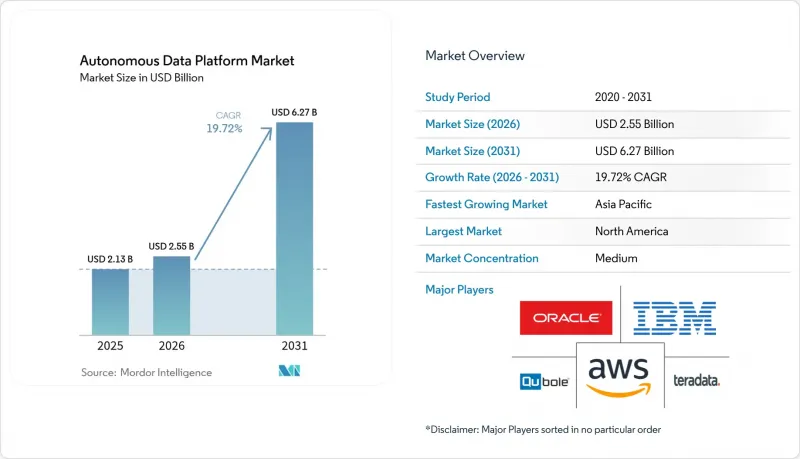
This report is Segmented by Organization Size (Large Enterprises, and Small and Medium-Sized Enterprises (SMEs)), Deployment Type (Public Cloud, Private Cloud and More), End-User Vertical (BFSI. Healthcare and Life Sciences and More), Component (Platform / Solution and Services), Data Type (Structured Data and Semi-Structured Data), and Geography. The Market Forecasts are Provided in Terms of Value (USD).
Global Autonomous Data Platform Market Trends and Insights
AI-first data-ops strategies adopted by cloud hyperscalers
Cloud providers have begun embedding autonomous optimization, self-patching, and self-scaling directly into baseline services. Amazon earmarked USD 100 billion for AWS AI infrastructure in 2025, signalling that autonomy is now table stakes for large-scale data operations. Snowflake's partnership with NVIDIA makes specialized retrieval and inference tooling available inside the data platform, removing the traditional gap between storage and model execution. Oracle's autonomous database revenue jumped 104% year-over-year in fiscal 2025 as firms moved away from manual optimization to real-time, self-tuning services. These developments cut administration costs and shorten analytics cycles from hours to minutes, enabling frontline teams to run live experiments on production-grade datasets.
Rapid fall in storage cost enabling petabyte-scale ingestion
The National Academies projects installed storage capacity will cross 26.3 zettabytes by 2030 while cost per terabyte keeps dropping. Enterprises can now keep historical video, sensor, and document archives online, raising AI model accuracy without prohibitive budgets. Western Digital research shows hard-disk drives still deliver favourable total cost of ownership for bulk data, so firms maintain cold-tier lakes without sacrificing margin. TELUS migrated 14 petabytes to Google BigQuery, shed 30% obsolete data, and optimized 200 pipelines that feed new Gen-AI use cases. Lower storage barriers push the autonomous data platform market toward always-on ingestion that fuels predictive systems and multimodal AI.
Ongoing skills gap for composite AI and MLOps orchestration
End-to-end autonomous systems need niche skills covering distributed architectures, model governance, and real-time streaming. Upskilling programs such as IVADO's MLOps boot camp attempt to shrink the gap yet demand still outstrips supply. A Fortune 100 healthcare firm relied on TrueFoundry specialists to deploy 30+ LLM use cases, cutting time-to-value but underscoring workforce dependence on outside talent. Without internal expertise, organizations struggle to operationalize autonomous features at scale, dampening ROI and adoption pace.
Other drivers and restraints analyzed in the detailed report include:
- Rising enterprise move toward data-mesh and data-fabric architectures
- Mandatory sovereignty rules in Europe and APAC
- Escalating cloud egress fees impacting TCO
For complete list of drivers and restraints, kindly check the Table Of Contents.
Segment Analysis
Large enterprises currently generate most revenue with a market share of 61.35%, yet small and medium-sized firms fuel the fastest expansion of the autonomous data platform market. The autonomous data platform market size attributable to SMEs is projected to widen swiftly thanks to natural-language copilots that replace code-heavy interfaces. Prophecy's transformation assistant lets functional teams at consumer-focused brands orchestrate data flows without engineering backlogs. Meanwhile, mega-enterprises rely on federated data-mesh rollouts across geographies and business units, driving complex governance implementations that sustain platform vendors' enterprise licensing streams.
SMEs view autonomous data tools as an equalizer that shortens innovation cycles. Case studies such as F45 Training's deployment with Fiveonefour illustrate tangible returns, reporting 50% cost reductions and 10X faster development cycles on consumer analytics pipelines. As accessible pricing tiers spread, the autonomous data platform market gains a broader long-tail customer base, challenging vendors to maintain usability while preserving advanced enterprise functionality.
Public-cloud services deliver the bulk of current spending, yet hybrid models expand at a pace that reshapes the autonomous data platform market. Sovereignty concerns and performance optimization drive enterprises to keep sensitive workloads on-premises while bursting analytics and AI training to scalable public resources. Deutsche Bank's phased data-platform migration blended on-premises systems with Google Cloud services for 20 million customers, proving hybrid's compliance value.
The autonomous data platform market size tied to hybrid deployments is forecast to accelerate as frameworks such as the EU Data Act compel portability. Oracle's Cloud@Customer nodal offering appeals to firms seeking public-cloud autonomy inside private facilities, indicating that location-agnostic control planes will define competitive positioning. Pure private-cloud growth slows because in-house hardware and skills cannot match public-cloud innovation velocity, nudging firms toward hybrid compromises.
Complete Report Scope:
- By Organization Size
- Large Enterprises
- Small and Medium-Sized Enterprises (SMEs)
- By Deployment Type
- Public Cloud
- Private Cloud
- Hybrid Cloud
- By End-user Vertical
- Banking, Financial Services and Insurance (BFSI)
- Healthcare and Life Sciences
- Retail and Consumer Goods
- Media and Telecommunications
- Government and Public Sector
- Manufacturing
- By Component
- Platform / Solution
- Services
- Professional Services
- Managed Services
- By Data Type
- Structured Data
- Semi-Structured Data
- Unstructured Data
- By Geography
- North America
- United States
- Canada
- Mexico
- South America
- Brazil
- Argentina
- Rest of South America
- Europe
- United Kingdom
- Germany
- France
- Italy
- Spain
- Russia
- Rest of Europe
- Asia-Pacific
- China
- Japan
- India
- South Korea
- Australia and New Zealand
- Rest of Asia-Pacific
- Middle East and Africa
- Middle East
- Saudi Arabia
- United Arab Emirates
- Turkey
- Rest of Middle East
- Africa
- South Africa
- Rest of Africa
- Middle East
- North America
Geography Analysis
North America commanded 40.60% of autonomous data platform market share in 2025, underpinned by early adoption of AI-first strategies and substantial data-center investments. Amazon alone plans USD 150 billion for additional facilities that will run GPU clusters needed for large language models. Oracle's infrastructure revenue surged 70% year-over-year in fiscal 2025 as enterprises embraced self-tuning databases that meet stringent uptime and compliance standards. A mature venture ecosystem funds specialized startups focusing on data observability, cataloging, and real-time AI, further enriching the regional technology stack.
The Asia-Pacific region shows the fastest CAGR at 22.54%, driven by India's data-protection framework and Japan's AI Basic Law proposal, both of which require tightly governed yet innovation-friendly platforms. Government programs funding digital public infrastructure shorten procurement cycles, letting firms adopt autonomous solutions early in their modernization journeys. Hyperscalers rapidly expand local zones to meet residency rules, while regional service providers create sovereign platforms that integrate with global clouds through standardized APIs.
Europe sustains growth through privacy leadership and the new Data Act, which mandates vendor-agnostic portability. Platform providers respond with open-format catalogs and zero-copy data-sharing innovations to reduce exit friction. The region's insistence on explainability and audit trails favors autonomous platforms that embed lineage tracking and AI model governance by default. South America, the Middle East, and Africa trail in current adoption but show high project pipelines as telecom operators, banks, and public agencies pursue cloud-first roadmaps that leapfrog legacy infrastructure.
- Oracle Corporation
- International Business Machines Corporation
- Amazon Web Services, Inc.
- Teradata Corporation
- Qubole, Inc.
- MapR Technologies, Inc.
- Snowflake Inc.
- Microsoft Corporation
- Google LLC
- Cloudera, Inc.
- Databricks, Inc.
- Alteryx, Inc.
- Ataccama Corporation
- Gemini Data, Inc.
- Denodo Technologies, Inc.
- Zaloni, Inc.
- Informatica Inc.
- Paxata, Inc.
- Dremio Corporation
- Talend Inc.
Additional Benefits:
- The market estimate (ME) sheet in Excel format
- 3 months of analyst support
TABLE OF CONTENTS
1 INTRODUCTION
- 1.1 Study Assumptions and Market Definition
- 1.2 Scope of the Study
2 RESEARCH METHODOLOGY
3 EXECUTIVE SUMMARY
4 MARKET LANDSCAPE
- 4.1 Market Overview
- 4.2 Market Drivers
- 4.2.1 AI-first data-ops strategies adopted by cloud hyperscalers
- 4.2.2 Rapid fall in data-storage cost enabling petabyte-scale ingestion
- 4.2.3 Rising enterprise move toward data-mesh and fabric architectures
- 4.2.4 Mandatory data-residency/sovereign-cloud rules in Europe and APAC
- 4.2.5 Integration of Gen-AI copilots for low-code data engineering
- 4.2.6 Industry-specific packaged analytics accelerators (banking, life-science)
- 4.3 Market Restraints
- 4.3.1 Ongoing skills gap for composite AI and MLOps orchestration
- 4.3.2 Escalating cloud egress fees impacting TCO
- 4.3.3 Persistent security debt from legacy ETL pipelines
- 4.3.4 Vendor lock-in concerns hindering multicloud portability
- 4.4 Value / Supply-Chain Analysis
- 4.5 Regulatory Landscape
- 4.6 Technological Outlook
- 4.7 Porter's Five Forces Analysis
- 4.7.1 Threat of New Entrants
- 4.7.2 Bargaining Power of Buyers
- 4.7.3 Bargaining Power of Suppliers
- 4.7.4 Threat of Substitutes
- 4.7.5 Intensity of Competitive Rivalry
5 MARKET SIZE AND GROWTH FORECASTS (VALUE)
- 5.1 By Organization Size
- 5.1.1 Large Enterprises
- 5.1.2 Small and Medium-Sized Enterprises (SMEs)
- 5.2 By Deployment Type
- 5.2.1 Public Cloud
- 5.2.2 Private Cloud
- 5.2.3 Hybrid Cloud
- 5.3 By End-user Vertical
- 5.3.1 Banking, Financial Services and Insurance (BFSI)
- 5.3.2 Healthcare and Life Sciences
- 5.3.3 Retail and Consumer Goods
- 5.3.4 Media and Telecommunications
- 5.3.5 Government and Public Sector
- 5.3.6 Manufacturing
- 5.4 By Component
- 5.4.1 Platform / Solution
- 5.4.2 Services
- 5.4.2.1 Professional Services
- 5.4.2.2 Managed Services
- 5.5 By Data Type
- 5.5.1 Structured Data
- 5.5.2 Semi-Structured Data
- 5.5.3 Unstructured Data
- 5.6 By Geography
- 5.6.1 North America
- 5.6.1.1 United States
- 5.6.1.2 Canada
- 5.6.1.3 Mexico
- 5.6.2 South America
- 5.6.2.1 Brazil
- 5.6.2.2 Argentina
- 5.6.2.3 Rest of South America
- 5.6.3 Europe
- 5.6.3.1 United Kingdom
- 5.6.3.2 Germany
- 5.6.3.3 France
- 5.6.3.4 Italy
- 5.6.3.5 Spain
- 5.6.3.6 Russia
- 5.6.3.7 Rest of Europe
- 5.6.4 Asia-Pacific
- 5.6.4.1 China
- 5.6.4.2 Japan
- 5.6.4.3 India
- 5.6.4.4 South Korea
- 5.6.4.5 Australia and New Zealand
- 5.6.4.6 Rest of Asia-Pacific
- 5.6.5 Middle East and Africa
- 5.6.5.1 Middle East
- 5.6.5.1.1 Saudi Arabia
- 5.6.5.1.2 United Arab Emirates
- 5.6.5.1.3 Turkey
- 5.6.5.1.4 Rest of Middle East
- 5.6.5.2 Africa
- 5.6.5.2.1 South Africa
- 5.6.5.2.2 Rest of Africa
- 5.6.5.1 Middle East
- 5.6.1 North America
6 COMPETITIVE LANDSCAPE
- 6.1 Market Concentration
- 6.2 Strategic Moves
- 6.3 Market Share Analysis
- 6.4 Company Profiles (includes Global level Overview, Market level overview, Core Segments, Financials as available, Strategic Information, Market Rank/Share for key companies, Products and Services, and Recent Developments)
- 6.4.1 Oracle Corporation
- 6.4.2 International Business Machines Corporation
- 6.4.3 Amazon Web Services, Inc.
- 6.4.4 Teradata Corporation
- 6.4.5 Qubole, Inc.
- 6.4.6 MapR Technologies, Inc.
- 6.4.7 Snowflake Inc.
- 6.4.8 Microsoft Corporation
- 6.4.9 Google LLC
- 6.4.10 Cloudera, Inc.
- 6.4.11 Databricks, Inc.
- 6.4.12 Alteryx, Inc.
- 6.4.13 Ataccama Corporation
- 6.4.14 Gemini Data, Inc.
- 6.4.15 Denodo Technologies, Inc.
- 6.4.16 Zaloni, Inc.
- 6.4.17 Informatica Inc.
- 6.4.18 Paxata, Inc.
- 6.4.19 Dremio Corporation
- 6.4.20 Talend Inc.
7 MARKET OPPORTUNITIES AND FUTURE OUTLOOK
- 7.1 White-space and Unmet-Need Assessment

