PUBLISHER: Mordor Intelligence | PRODUCT CODE: 2115198

PUBLISHER: Mordor Intelligence | PRODUCT CODE: 2115198
Tungsten Carbide Powder - Market Share Analysis, Industry Trends & Statistics, Growth Forecasts (2026 - 2031)
According to Mordor Intelligence, the tungsten carbide powder market size was valued at USD 16.25 billion in 2025 and estimated to grow from USD 17.06 billion in 2026 to reach USD 21.74 billion by 2031, at a CAGR of 4.98% during the forecast period (2026-2031).
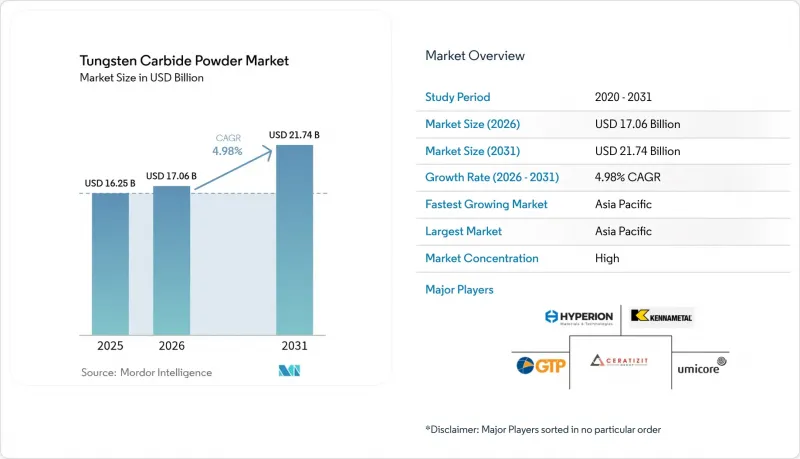
This report Segments the Industry by Product Grade (WC-Co (Cobalt-Bonded), WC-Ni (Nickel-Bonded), WC-Fe (Iron-Bonded), and More), Application (Machining Tools, Ammunition, and More), End-User Industry (Automotive, Aerospace and Defense, and More), and Geography (Asia-Pacific, North America, Europe, South America, and Middle-East, and Africa). The Market Forecasts are Provided in Terms of Value (USD).
Global Tungsten Carbide Powder Market Trends and Insights
Surging Demand for Precision Cutting and Machining Tools
Manufacturers facing ever-tighter tolerances rely on tungsten carbide inserts to preserve edge integrity during high-speed operations. Longer tool life limits unplanned stoppages and supports continuous, lights-out production. In CNC environments connected through Industry 4.0 networks, consistent insert performance is essential for predictive-maintenance algorithms that trigger tool changes only when statistically justified. Recent TiC surface-engineering techniques have raised Vickers hardness from 1,317 HV30 to 1,496 HV30, extending wear intervals in mass-production lines. Demand clustering in Asia-Pacific and the United States anchors short-term volume growth for the tungsten carbide powder market.
Rapid Expansion of EV and Renewable Energy Component Machining
Battery housings, e-motor shafts, and power-electronic enclosures require micro-tolerance machining that favors cemented-carbide tooling. Wind-turbine gearboxes and solar-tracker drive units add a steady stream of hardened-steel components that conventional HSS tools cannot machine economically. Oak Ridge National Laboratory recently printed crack-free tungsten structures with an electron-beam process, signaling a pathway to fusion-reactor and extreme-environment parts that will use high-purity powder feedstock. Localized EV supply chains in North America and Europe translate that technical success into regional pull for the tungsten carbide powder market.
Volatility in Tungsten Ore (APT) Prices Due to Supply Concentration
Western buyers scramble for long-term contracts, yet alternative mines need multi-year development cycles, limiting near-term relief. Price swings complicate project budgeting for aerospace and defense primes that rely on indexed contracts, creating a drag on the tungsten carbide powder market.
Other drivers and restraints analyzed in the detailed report include:
- Shift Toward Wear-Resistant Powders in Oil-Sand and Fracking Equipment
- Government-Funded Critical Minerals and Defense Stockpiling Programs
- High Manufacturing and Processing Cost
For complete list of drivers and restraints, kindly check the Table Of Contents.
Segment Analysis
WC-Co grades anchored 68.74% of 2025 shipments owing to mature supply chains, broad-spectrum toughness, and an installed base of sintering furnaces optimized for cobalt binders. Even so, binder safety and cobalt price volatility spur the development of nickel-, iron-, and hybrid-binder systems. Carbide-rhenium alloys exhibit a compelling 6.08% CAGR curve as aerospace burners and hypersonic-vehicle parts demand elevated hot-hardness thresholds. Binder-less nano-WC powders push hardness beyond 2,200 HV30 and satisfy micro-tool manufacturers chasing sub-50 µm tip diameters.
Complete Report Scope:
- By Product Grade
- WC-Co (Cobalt-bonded)
- WC-Ni (Nickel-bonded)
- WC-Fe (Iron-bonded)
- Carbide-Rhenium Alloys
- Binder-less Nano WC
- Recycled / Reclaimed WC Powders
- By Application
- Machining Tools
- Ammunition
- Wear and Die Parts
- Mining and Drilling Tools
- Other Applications (Additive Manufacturing, Thermal Spray Coatings, etc.)
- By End-User Industry
- Automotive
- Aerospace and Defense
- Mining and Construction
- Oil and Gas
- Healthcare
- Other End-User Industries (Electronics and Semiconductors,Industrial Manufacturing, etc.)
- By Geography
- Asia-Pacific
- China
- Japan
- India
- South Korea
- Rest of Asia-Pacific
- North America
- United States
- Canada
- Mexico
- Europe
- Germany
- United Kingdom
- France
- Italy
- Rest of Europe
- South America
- Brazil
- Argentina
- Rest of South America
- Middle-East and Africa
- Saudi Arabia
- South Africa
- Rest of Middle-East and Africa
- Asia-Pacific
Geography Analysis
Asia-Pacific held 53.82% of global revenue in 2025 and continues to outpace the field with a 6.36% CAGR through 2031. China's mine head grades decline, yet process-efficiency gains and state incentives prolong its leadership position, even as export restrictions reshape the destination mix of downstream powders.
North America benefits from strategic-mineral legislation and defense sourcing rules that rank tungsten alongside rare earths and niobium. The USD 15.8 million US Department of Defense grant to Fireweed Metals accelerates feasibility studies at Mactung and locks in offtake expectations for domestic powder compaction lines.
Europe, though volume-constrained, preserves a technology-rich customer base in automotive, medical, and precision engineering. The tungsten carbide powder market in Europe remains sensitive to energy-cost spikes, yet the bloc's net-zero mandates enhance the appeal of long-life carbide tooling that reduces resource intensity over multiple product cycles.
- A.L.M.T. Corp.
- CERATIZIT S.A.
- China Tungsten
- CNPC Powder
- Edgetech Industries LLC
- EQ Resources Limited
- Global Tungsten & Powders
- H.C. Starck Tungsten
- Hyperion Materials & Technologies
- Japan New Metals Co., Ltd.
- Jiangxi Yaosheng Tungsten Co., Ltd.
- Kennametal
- Merck
- Metaltech
- Sandvik AB
- Serena
- Sumitomo Electric Industries, Ltd.
- Umicore
- Wall Colmonoy
- Zhuzhou Cemented Carbide Group Corp. Ltd.
Additional Benefits:
- The market estimate (ME) sheet in Excel format
- 3 months of analyst support
TABLE OF CONTENTS
1 Introduction
- 1.1 Study Assumptions and Market Definition
- 1.2 Scope of the Study
2 Research Methodology
3 Executive Summary
4 Market Landscape
- 4.1 Market Overview
- 4.2 Market Drivers
- 4.2.1 Surging Demand for Precision Cutting and Machining Tools
- 4.2.2 Rapid Expansion of EV and Renewable Energy Component Machining
- 4.2.3 Shift Toward Wear-resistant Powders in Oil-Sand and Fracking Equipment
- 4.2.4 Integration of Tungsten Carbide Powders in High-Speed Additive Manufacturing
- 4.2.5 Government-Funded Critical Minerals and Defense Stockpiling Programs
- 4.3 Market Restraints
- 4.3.1 Volatility in Tungsten Ore (APT) Prices Due to Supply Concentration
- 4.3.2 High Manufacturing and Processing Cost
- 4.3.3 Capital-intensive Powder Metallurgy Equipment for Nano-Grades
- 4.3.4 Competitive Threat from Advanced Ceramics and Cermets in Wear Parts
- 4.4 Value Chain Analysis
- 4.5 Porter's Five Forces
- 4.5.1 Bargaining Power of Suppliers
- 4.5.2 Bargaining Power of Consumers
- 4.5.3 Threat of New Entrants
- 4.5.4 Threat of Substitute Products and Services
- 4.5.5 Degree of Competition
5 Market Size and Growth Forecasts (Value)
- 5.1 By Product Grade
- 5.1.1 WC-Co (Cobalt-bonded)
- 5.1.2 WC-Ni (Nickel-bonded)
- 5.1.3 WC-Fe (Iron-bonded)
- 5.1.4 Carbide-Rhenium Alloys
- 5.1.5 Binder-less Nano WC
- 5.1.6 Recycled / Reclaimed WC Powders
- 5.2 By Application
- 5.2.1 Machining Tools
- 5.2.2 Ammunition
- 5.2.3 Wear and Die Parts
- 5.2.4 Mining and Drilling Tools
- 5.2.5 Other Applications (Additive Manufacturing, Thermal Spray Coatings, etc.)
- 5.3 By End-User Industry
- 5.3.1 Automotive
- 5.3.2 Aerospace and Defense
- 5.3.3 Mining and Construction
- 5.3.4 Oil and Gas
- 5.3.5 Healthcare
- 5.3.6 Other End-User Industries (Electronics and Semiconductors,Industrial Manufacturing, etc.)
- 5.4 By Geography
- 5.4.1 Asia-Pacific
- 5.4.1.1 China
- 5.4.1.2 Japan
- 5.4.1.3 India
- 5.4.1.4 South Korea
- 5.4.1.5 Rest of Asia-Pacific
- 5.4.2 North America
- 5.4.2.1 United States
- 5.4.2.2 Canada
- 5.4.2.3 Mexico
- 5.4.3 Europe
- 5.4.3.1 Germany
- 5.4.3.2 United Kingdom
- 5.4.3.3 France
- 5.4.3.4 Italy
- 5.4.3.5 Rest of Europe
- 5.4.4 South America
- 5.4.4.1 Brazil
- 5.4.4.2 Argentina
- 5.4.4.3 Rest of South America
- 5.4.5 Middle-East and Africa
- 5.4.5.1 Saudi Arabia
- 5.4.5.2 South Africa
- 5.4.5.3 Rest of Middle-East and Africa
- 5.4.1 Asia-Pacific
6 Competitive Landscape
- 6.1 Market Concentration
- 6.2 Strategic Moves
- 6.3 Market Share(%)/Ranking Analysis
- 6.4 Company Profiles {(includes Global level Overview, Market level overview, Core Segments, Financials as available, Strategic Information, Market Rank/Share for key companies, Products and Services, and Recent Developments)}
- 6.4.1 A.L.M.T. Corp.
- 6.4.2 CERATIZIT S.A.
- 6.4.3 China Tungsten
- 6.4.4 CNPC Powder
- 6.4.5 Edgetech Industries LLC
- 6.4.6 EQ Resources Limited
- 6.4.7 Global Tungsten & Powders
- 6.4.8 H.C. Starck Tungsten
- 6.4.9 Hyperion Materials & Technologies
- 6.4.10 Japan New Metals Co., Ltd.
- 6.4.11 Jiangxi Yaosheng Tungsten Co., Ltd.
- 6.4.12 Kennametal
- 6.4.13 Merck
- 6.4.14 Metaltech
- 6.4.15 Sandvik AB
- 6.4.16 Serena
- 6.4.17 Sumitomo Electric Industries, Ltd.
- 6.4.18 Umicore
- 6.4.19 Wall Colmonoy
- 6.4.20 Zhuzhou Cemented Carbide Group Corp. Ltd.
7 Market Opportunities and Future Outlook
- 7.1 White-space and Unmet-Need Assessment

