PUBLISHER: Mordor Intelligence | PRODUCT CODE: 2115199

PUBLISHER: Mordor Intelligence | PRODUCT CODE: 2115199
Butylated Triphenyl Phosphate - Market Share Analysis, Industry Trends & Statistics, Growth Forecasts (2026 - 2031)
According to Mordor Intelligence, the butylated triphenyl phosphate market size is expected to grow from USD 28.61 million in 2025 to USD 29.61 million in 2026 and is forecast to reach USD 35.15 million by 2031 at 3.49% CAGR over 2026-2031.
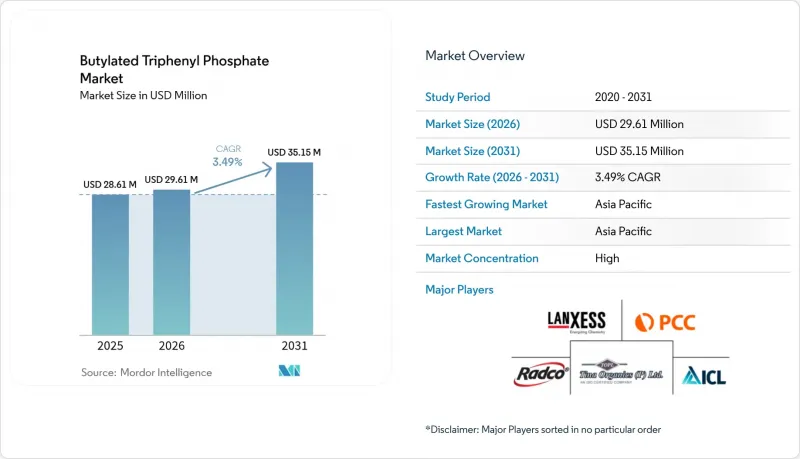
This report is Segmented by Function (Fire Retardant and Plasticizer), Application (Lubricants, PVC Compounds and Resins, and Other Applications), End-User Industry (Automotive and Transportation, Aerospace and Defense, and More), and Geography (Asia-Pacific, North America, Europe, South America, and Middle-East and Africa). The Market Forecasts are Provided in Terms of Value (USD).
Global Butylated Triphenyl Phosphate Market Trends and Insights
Regulatory Phase-Out of Halogenated Flame Retardants
Comprehensive bans now enforce tight compliance deadlines in several jurisdictions. New York's restriction on flame retardants in furniture and electronic displays took effect in December 2024, while the United States EPA updated its Persistent, Bioaccumulative and Toxic Chemicals rule in November 2024 to curb decabromodiphenyl ether and allied compounds. Canada added further substances to its Schedule 1 toxic list in February 2025, intensifying reformulation pressure. As manufacturers re-engineer product lines simultaneously across regions, short-term demand spikes emerge for compliant organophosphorus alternatives. Electronics and furniture suppliers face the most urgent deadlines, whereas industrial users still enjoy longer transition windows that spread procurement over several years. Companies able to guarantee consistent quality and documentation earn preferred-supplier status.
Surging Demand for Fire-Resistant Lubricants and Hydraulic Fluids
High-temperature machinery in metalworking, mining, and offshore platforms increasingly specifies flame-retardant lubricants to lower insurance costs and meet stricter safety audits. Perimeter Solutions' 2024 SEC filing underscored the role of phosphorus pentasulfide in anti-wear additives that raise lubricant flash points. Asian steel mills and shipyards are major adopters because confined spaces magnify fire risk. Although premium prices slow uptake in cost-sensitive segments, buyers cite lower downtime and regulatory compliance as compelling benefits. Suppliers who provide in-house testing data and rapid technical support shorten customer qualification cycles. Long-term growth is expected to align with the build-out of renewable power plants, which run at elevated operating temperatures.
Toxicological and Eco-Tox Concerns Driving Stricter Regulations
Peer-reviewed work in 2025 confirmed that organophosphate flame retardants can disrupt endocrine, hepatic, and neurological functions. Washington State enacted rules in 2025 that presume intentional addition if organophosphate flame retardants appear above specific thresholds. Regulators indicate that organophosphates could follow the same tightening path as halogenated products, injecting uncertainty into long-term planning. Brands are therefore funding trials of bio-based or polymeric substitutes that cannot migrate out of end products. While this trend caps growth for legacy chemistries, it creates headroom for innovation among suppliers that can demonstrate reduced toxicity without compromising performance.
Other drivers and restraints analyzed in the detailed report include:
- Rapid Growth of Flexible PVC in Construction and Wire-Cable
- Safety-Driven Uptake in Automotive and Aerospace Interiors
- Volatile Prices of Phenol and Phosphorus Oxychloride Feedstocks
For complete list of drivers and restraints, kindly check the Table Of Contents.
Segment Analysis
The flame-retardant function captured 51.78% of the Butylated Triphenyl Phosphate market share in 2025, a position cemented by mandatory fire-safety codes in furniture, electronics, and construction. Growth, however, shifts toward lubricant and hydraulic additive roles, which are forecast to expand at 4.84% through 2031 as factories modernize and safety audits intensify. The Butylated Triphenyl Phosphate market size tied to lubricant uses is poised to widen because high-temperature equipment and offshore platforms insist on fluid that self-extinguishes quickly. Leading suppliers tailor phosphorus content and viscosity modifiers to meet OEM equipment standards, and they bundle technical guidance that shortens plant trials from months to weeks.
Complete Report Scope:
- By Function
- Fire Retardant
- Plasticizer
- By Application
- Lubricants
- Polyvinyl Compounds and Resins
- Other Applications (Engineering Plastics, Coatings and Adhesives, etc.)
- By End-user Industry
- Automotive and Transportation
- Aerospace and Defense
- Electrical and Electronics
- Building and Construction
- Industrial Machinery and Metalworking
- Marine and Offshore
- Consumer Goods
- By Geography
- Asia-Pacific
- China
- India
- Japan
- South Korea
- Rest of Asia-Pacific
- North America
- United States
- Canada
- Mexico
- Europe
- Germany
- United Kingdom
- France
- Italy
- Rest of Europe
- South America
- Brazil
- Argentina
- Rest of South America
- Middle-East and Africa
- Saudi Arabia
- South Africa
- Rest of Middle-East and Africa
- Asia-Pacific
Geography Analysis
Asia-Pacific controlled 38.10% of the Butylated Triphenyl Phosphate market in 2025 and is projected to grow at a 4.10% CAGR through 2031. China anchors regional demand with its electronics manufacturing base and ongoing urban construction that absorbs flame-retarded PVC. Japan and South Korea prioritize aerospace-grade materials, relying on established chemical clusters for phenol and phosphorus intermediates.
North America is buoyed by early regulatory moves that accelerate substitution. New York's product ban that began in December 2024 set a high bar, while Canada's February 2025 toxic-substances listing reinforced momentum toward organophosphates. Europe traces a flatter trajectory because the region already enforces the world's strictest chemical rules. Producers pivot to bio-based and polymeric options, illustrated by ALTANA AG's equity stake in Finnish innovator NORDTREAT.
South America and the Middle-East, and Africa remain emerging pockets, where infrastructure build-outs create fresh demand, yet regulatory enforcement remains nascent. Multinationals usually serve these territories via imports to avoid over-investment until policy clarity improves.
- ADEKA Corporation
- China Zhang Jia Gang YaRui Chemical Co., Ltd
- ICL
- LANXESS
- PCC Group
- Radco Industries, Inc.
- Shandong Ruixing Flame Retardant Technology Co. LTD.
- Tina Organics ( P ) Ltd.
- Zhangjiagang Fortune Chemical Co., Ltd.
- ZhangJiaGang YaRui Chemical Co. Ltd.
- Zhejiang Wansheng Co., Ltd.
Additional Benefits:
- The market estimate (ME) sheet in Excel format
- 3 months of analyst support
TABLE OF CONTENTS
1 Introduction
- 1.1 Study Assumptions and Market Definition
- 1.2 Scope of the Study
2 Research Methodology
3 Executive Summary
4 Market Landscape
- 4.1 Market Overview
- 4.2 Market Drivers
- 4.2.1 Regulatory Phase-Out of Halogenated Flame Retardants
- 4.2.2 Surging Demand for Fire-Resistant Lubricants and Hydraulic Fluids
- 4.2.3 Rapid Growth of Flexible Polyvinyl Chloride in Construction and Wire-Cable
- 4.2.4 Safety-Driven Uptake in Automotive and Aerospace Interiors
- 4.2.5 Adoption in High-Voltage Lithium-Ion Battery Electrolytes
- 4.3 Market Restraints
- 4.3.1 Toxicological Concerns Driving Stricter Regulations
- 4.3.2 Volatile Prices of Phenol and Phosphorus Oxychloride Feedstocks
- 4.3.3 Equipment Corrosion and Hydrolysis Maintenance Costs in Lubricant Circuits
- 4.4 Value Chain Analysis
- 4.5 Porter's Five Forces
- 4.5.1 Threat of New Entrants
- 4.5.2 Bargaining Power of Suppliers
- 4.5.3 Bargaining Power of Buyers
- 4.5.4 Threat of Substitutes
- 4.5.5 Competitive Rivalry
5 Market Size and Growth Forecasts (Value)
- 5.1 By Function
- 5.1.1 Fire Retardant
- 5.1.2 Plasticizer
- 5.2 By Application
- 5.2.1 Lubricants
- 5.2.2 Polyvinyl Compounds and Resins
- 5.2.3 Other Applications (Engineering Plastics, Coatings and Adhesives, etc.)
- 5.3 By End-user Industry
- 5.3.1 Automotive and Transportation
- 5.3.2 Aerospace and Defense
- 5.3.3 Electrical and Electronics
- 5.3.4 Building and Construction
- 5.3.5 Industrial Machinery and Metalworking
- 5.3.6 Marine and Offshore
- 5.3.7 Consumer Goods
- 5.4 By Geography
- 5.4.1 Asia-Pacific
- 5.4.1.1 China
- 5.4.1.2 India
- 5.4.1.3 Japan
- 5.4.1.4 South Korea
- 5.4.1.5 Rest of Asia-Pacific
- 5.4.2 North America
- 5.4.2.1 United States
- 5.4.2.2 Canada
- 5.4.2.3 Mexico
- 5.4.3 Europe
- 5.4.3.1 Germany
- 5.4.3.2 United Kingdom
- 5.4.3.3 France
- 5.4.3.4 Italy
- 5.4.3.5 Rest of Europe
- 5.4.4 South America
- 5.4.4.1 Brazil
- 5.4.4.2 Argentina
- 5.4.4.3 Rest of South America
- 5.4.5 Middle-East and Africa
- 5.4.5.1 Saudi Arabia
- 5.4.5.2 South Africa
- 5.4.5.3 Rest of Middle-East and Africa
- 5.4.1 Asia-Pacific
6 Competitive Landscape
- 6.1 Market Concentration
- 6.2 Strategic Moves
- 6.3 Market Share(%)/Ranking Analysis
- 6.4 Company Profiles (includes Global level Overview, Market level overview, Core Segments, Financials as available, Strategic Information, Market Rank/Share for key companies, Products and Services, and Recent Developments)
- 6.4.1 ADEKA Corporation
- 6.4.2 China Zhang Jia Gang YaRui Chemical Co., Ltd
- 6.4.3 ICL
- 6.4.4 LANXESS
- 6.4.5 PCC Group
- 6.4.6 Radco Industries, Inc.
- 6.4.7 Shandong Ruixing Flame Retardant Technology Co. LTD.
- 6.4.8 Tina Organics ( P ) Ltd.
- 6.4.9 Zhangjiagang Fortune Chemical Co., Ltd.
- 6.4.10 ZhangJiaGang YaRui Chemical Co. Ltd.
- 6.4.11 Zhejiang Wansheng Co., Ltd.
7 Market Opportunities and Future Outlook
- 7.1 White-space and Unmet-Need Assessment

