PUBLISHER: Mordor Intelligence | PRODUCT CODE: 2115200

PUBLISHER: Mordor Intelligence | PRODUCT CODE: 2115200
Methyl Ester Ethoxylate - Market Share Analysis, Industry Trends & Statistics, Growth Forecasts (2026 - 2031)
According to Mordor Intelligence, the methyl ester ethoxylate market size is estimated at USD 151.90 million in 2026, and is expected to reach USD 181.98 million by 2031, at a CAGR of 3.68% during the forecast period (2026-2031).
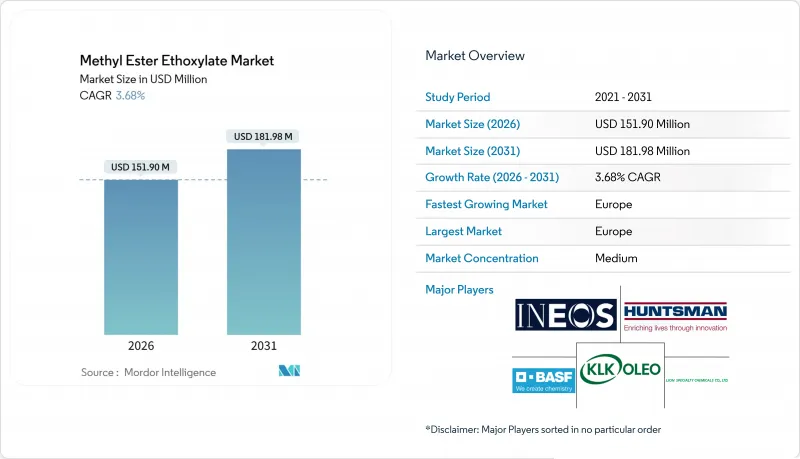
This report is Segmented by Application (Detergents and Industrial Cleaning Agents, Personal Care and Cosmetics, and Others) and Geography (Asia-Pacific, North America, Europe, South America, and Middle-East and Africa). The Market Forecasts are Provided in Terms of Value (USD).
Global Methyl Ester Ethoxylate Market Trends and Insights
Rising Demand from Personal Care and Cosmetics
Methyl ester ethoxylates provide foam stability without the irritation often associated with anionic surfactants. This quality makes them a preferred choice for sulfate-free shampoos, body washes, and leave-on treatments, especially among clean-beauty consumers. The medium-term influence of this trend can be attributed to formulators striving to balance cost, sensory attributes, and eco-label compliance. While methyl ester ethoxylates are cost-competitive in mass-market hair-care and body-wash products, they find themselves in competition with amino-acid surfactants and alkyl polyglucoside (APG) blends in ultra-luxury skincare lines.
Growth of Low-Foam, Single-Wash Detergent Formats
Across Southeast Asia, institutional laundries and conveyor dishwashers are increasingly adopting single-wash, low-foam systems, leading to reduced water consumption and shorter cycle times. Kao reported a surge in sales of institutional detergents in the region, attributing the boost to their new formulation. This formulation, enhanced with methyl ester ethoxylates, enzymes, and chelants, ensures effective one-pass soil removal. In water-scarce nations like India, the introduction of appliance-efficiency labels is indirectly incentivizing the use of low-foam surfactant packages, hastening their adoption. This rapid embrace of low-foam systems is now making waves in the Middle East's hospitality sector, where soaring water tariffs are pushing hotel operators to overhaul their laundry practices.
Competition from More Efficient Alternative Surfactants
In 2024, Evonik launched a rhamnolipid plant in Slovakia. The biosurfactant produced there biodegrades faster than traditional methyl ester ethoxylates in anaerobic conditions and achieves the same wetting effect at reduced dosage. Also in 2024, BASF boosted its APG capacity, promoting a glucose-based nonionic that surpasses methyl ester ethoxylates in both cold-water detergency and foam control. Producers like Elevance, specializing in sophorolipids, achieve lower surface tensions, allowing for a reduction in total surfactant load. Despite price advantages for methyl ester ethoxylates in volume-driven institutional markets, rising fermentation yields and decreasing capital costs are heightening competitive pressures in Europe and North America.
Other drivers and restraints analyzed in the detailed report include:
- Regulatory Push for Biodegradable Surfactants
- Expansion of Industrial and Institutional Cleaning in Asia-Pacific
- Oleochemical Feedstock Price Volatility
For complete list of drivers and restraints, kindly check the Table Of Contents.
Segment Analysis
The detergents and industrial-cleaning segment captured 65.18% of 2025 revenue, and its share of the methyl ester ethoxylate market size is projected to expand at a 3.98% CAGR through 2031. Growth rests on institutional laundries and conveyor dishwashers that prize low-foam, hard-water-tolerant surfactant systems capable of one-pass soil removal in high-throughput tunnels. Methyl ester ethoxylates pair well with alkaline builders, enzymes, and chlorine sanitizers, sustaining their role as drop-in workhorses for commercial dishwashing, hospitality laundering, and food-service floor cleaning across Asia-Pacific and the Middle East.
Demand in household laundry remains sizable yet moderating in mature markets as concentrated pods and unit-dose sachets favor higher-activity blends of APG and linear alkylbenzene sulfonates. Nevertheless, value-added formats such as ultra-low-dose powders for mechanized laundries are opening margin-rich niches where methyl ester ethoxylates' foam control provides cycle-time advantages. Adoption of enzymatic pre-treatment concentrates further integrates the surfactant into broader cleaning packages that cut chemical load without sacrificing whiteness.
While personal care and cosmetics lag in volume, they consistently command premium margins, often pricing above their detergent-grade counterparts. The methyl ester ethoxylate market for this segment is projected to grow, buoyed by sulfate-free and mild-surfactant claims that appeal to consumers with sensitive skin. Nonionic backbones not only stabilize foam and maintain viscosity in clear shampoos and body washes, but they also mitigate irritation concerns commonly associated with anionic surfactants. Prestige beauty houses are securing COSMOS-certified supply chains, yet they grapple with competition from amino-acid surfactants and APG blends, which boast even milder dermatological profiles and a higher bio-based content.
Complete Report Scope:
- By Application
- Detergents and Industrial Cleaning Agents
- Personal Care and Cosmetics
- Others
- By Geography
- Asia-Pacific
- China
- India
- Japan
- South Korea
- ASEAN Countries
- Rest of Asia-Pacific
- North America
- United States
- Canada
- Mexico
- Europe
- Germany
- United Kingdom
- France
- Italy
- Spain
- Rest of Europe
- South America
- Brazil
- Argentina
- Rest of South America
- Middle-East and Africa
- Saudi Arabia
- South Africa
- Rest of Middle-East and Africa
- Asia-Pacific
Geography Analysis
Europe, accounting for 37.53% of 2025 revenue, leads the methyl ester ethoxylate market share and is forecast to grow at a 4.39% CAGR, the highest regional rate. Demand is anchored in Germany, the United Kingdom, and France, where Blue Angel and Nordic Swan eco-labels steer formulators toward readily biodegradable nonionics. Southern European hospitality booms are elevating low-residue cleaning requisites, notably in Spain and Italy. Eastern Europe remains underpenetrated, yet rising hygiene standards and the gradual rollout of EU-aligned regulations signal medium-term upside for suppliers prepared to navigate fragmented distributors.
By 2025, the Asia-Pacific region is set to account for a significant share of global revenue, boasting a projected growth. In 2025, China's commercial cleaning services saw robust growth, driven by retailers and hotels opting for outsourced custodial services, with a shift towards standardized, surface-friendly, low-foam cleansers. Meanwhile, India is testing energy-efficiency labels that prioritize water-saving laundry cycles, inadvertently promoting the use of methyl ester ethoxylate. Japan and South Korea are witnessing steady growth, focusing on cleaning products for personal care and electronics. The hospitality sector in ASEAN is rebounding from the pandemic, leading to increased demand for floor-care and hard-surface cleaners. Simultaneously, government hygiene mandates in educational and healthcare institutions are driving up demand.
North America is projected to account for a significant share of the 2025 revenue, with steady growth. The EPA's Safer Choice initiative is steering formulators towards biodegradable surfactants. However, the growth potential is tempered by the maturity of the household detergent market. In Canada and Mexico, there's a swift adoption of eco-labeled cleaners in institutions, bolstered by cross-border supply chains that simplify compliance. South America, along with the Middle East and Africa, is expected to capture a notable portion of the 2025 turnover. Key players include Brazil and Argentina in South America, and Saudi Arabia and South Africa in the Middle East and Africa. While currency fluctuations, tariff changes, and underdeveloped regulations introduce volatility, the trends of urbanization and heightened hygiene standards suggest a long-term alignment with the demands of more developed markets.
- BASF SE
- Clariant AG
- Croda International
- Dow
- Elevance Renewable Sciences Inc.
- Evonik Industries
- Galaxy Surfactants
- Huntsman Corporation
- India Glycols Ltd
- INEOS
- Jet Technologies
- Kao Corporation
- KLK OLEO
- Lion Specialty Chemicals Co. Ltd
- Sasol Ltd
- Shell Chemicals
- Sino-Japan Chemical Co. Ltd
- Solvay SA
- Stepan Company
- Venus Ethoxyethers Pvt Ltd
Additional Benefits:
- The market estimate (ME) sheet in Excel format
- 3 months of analyst support
TABLE OF CONTENTS
1 Introduction
- 1.1 Study Assumptions and Market Definition
- 1.2 Scope of the Study
2 Research Methodology
3 Executive Summary
4 Market Landscape
- 4.1 Market Overview
- 4.2 Market Drivers
- 4.2.1 Rising demand from personal care and cosmetics
- 4.2.2 Growth of low-foam, single-wash detergent formats
- 4.2.3 Regulatory push for biodegradable surfactants
- 4.2.4 Expansion of industrial and institutional cleaning in Asia-Pacific
- 4.2.5 Enzymatic ethoxylation lowering carbon footprint
- 4.3 Market Restraints
- 4.3.1 Competition from more efficient alternative surfactants
- 4.3.2 Oleochemical feedstock price volatility
- 4.3.3 Supply-chain certification (RSPO, traceability) costs
- 4.4 Value Chain Analysis
- 4.5 Porter's Five Forces Analysis
- 4.5.1 Bargaining Power of Suppliers
- 4.5.2 Bargaining Power of Buyers
- 4.5.3 Threat of New Entrants
- 4.5.4 Threat of Substitutes
- 4.5.5 Degree of Competitive Rivalry
5 Market Size and Growth Forecasts (Value)
- 5.1 By Application
- 5.1.1 Detergents and Industrial Cleaning Agents
- 5.1.2 Personal Care and Cosmetics
- 5.1.3 Others
- 5.2 By Geography
- 5.2.1 Asia-Pacific
- 5.2.1.1 China
- 5.2.1.2 India
- 5.2.1.3 Japan
- 5.2.1.4 South Korea
- 5.2.1.5 ASEAN Countries
- 5.2.1.6 Rest of Asia-Pacific
- 5.2.2 North America
- 5.2.2.1 United States
- 5.2.2.2 Canada
- 5.2.2.3 Mexico
- 5.2.3 Europe
- 5.2.3.1 Germany
- 5.2.3.2 United Kingdom
- 5.2.3.3 France
- 5.2.3.4 Italy
- 5.2.3.5 Spain
- 5.2.3.6 Rest of Europe
- 5.2.4 South America
- 5.2.4.1 Brazil
- 5.2.4.2 Argentina
- 5.2.4.3 Rest of South America
- 5.2.5 Middle-East and Africa
- 5.2.5.1 Saudi Arabia
- 5.2.5.2 South Africa
- 5.2.5.3 Rest of Middle-East and Africa
- 5.2.1 Asia-Pacific
6 Competitive Landscape
- 6.1 Market Concentration
- 6.2 Strategic Moves
- 6.3 Market Share(%)/Ranking Analysis
- 6.4 Company Profiles (includes Global level Overview, Market level overview, Core Segments, Financials as available, Strategic Information, Market Rank/Share for key companies, Products and Services, and Recent Developments)
- 6.4.1 BASF SE
- 6.4.2 Clariant AG
- 6.4.3 Croda International
- 6.4.4 Dow
- 6.4.5 Elevance Renewable Sciences Inc.
- 6.4.6 Evonik Industries
- 6.4.7 Galaxy Surfactants
- 6.4.8 Huntsman Corporation
- 6.4.9 India Glycols Ltd
- 6.4.10 INEOS
- 6.4.11 Jet Technologies
- 6.4.12 Kao Corporation
- 6.4.13 KLK OLEO
- 6.4.14 Lion Specialty Chemicals Co. Ltd
- 6.4.15 Sasol Ltd
- 6.4.16 Shell Chemicals
- 6.4.17 Sino-Japan Chemical Co. Ltd
- 6.4.18 Solvay SA
- 6.4.19 Stepan Company
- 6.4.20 Venus Ethoxyethers Pvt Ltd
7 Market Opportunities and Future Outlook
- 7.1 White-space and Unmet-Need Assessment

