PUBLISHER: Mordor Intelligence | PRODUCT CODE: 2115201

PUBLISHER: Mordor Intelligence | PRODUCT CODE: 2115201
Global GMO Testing - Market Share Analysis, Industry Trends & Statistics, Growth Forecasts (2026 - 2031)
According to Mordor Intelligence, the GMO testing market size is expected to grow from USD 3.83 billion in 2025 to USD 4.03 billion in 2026 and is forecast to reach USD 5.18 billion by 2031 at 5.17% CAGR over 2026-2031.
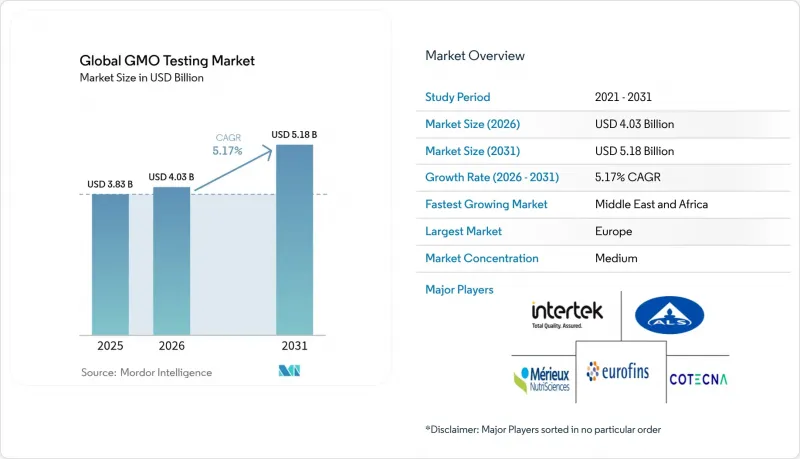
This report is Segmented by Technology (Polymerase Chain Reaction (PCR), Immunoassay, and More), Crop Type (Corn, Soybean, Cotton, and More), by Application (Processed Food, Animal Feed, Seed Testing, and Others), and by Geography (North America, Europe, Asia-Pacific, South America, and Middle East and Africa). The Market Forecasts are Provided in Terms of Value (USD).
Global GMO Testing Market Trends and Insights
Stringent Government Regulations for GMO Labeling
The Food and Drug Administration (FDA)'s February 2024 guidance on genome-edited plants established a risk-based assessment approach for both genetically engineered and conventional foods. The National Bioengineered Food Disclosure Standard requires labeling for products with bioengineered ingredients, while the United States Department of Agriculture (USDA) performs annual reviews of bioengineered foods to maintain regulatory alignment. In September 2024, China expanded regulations for genetically modified microorganisms in food processing, requiring safety evaluations for GMM-derived products used as food raw materials. The European Union's Regulation 2023/915 sets maximum contaminant levels in food, requiring precise testing methods to ensure compliance and consumer safety. These regulatory frameworks across multiple jurisdictions drive continuous demand for food testing services as manufacturers work to meet compliance requirements.
Rising Consumer Awareness and Demand for GMO-Free Products
The global GMO testing market is primarily driven by increasing consumer demand for GMO-free and clearly labeled food products. Consumers are becoming more health-conscious, environmentally aware, and ethically minded, leading to greater scrutiny of food production practices, particularly regarding genetically modified organisms (GMOs). Public perception of GMOs remains cautious, with concerns about potential long-term health and environmental effects. This awareness has increased the demand for organic and non-GMO labeled foods, requiring food manufacturers and suppliers to verify their products' non-GMO status through comprehensive testing. According to the Food Standards Agency (UK) in 2024, 28% of respondents in England, Wales, and Northern Ireland expressed significant concerns about genetically modified foods . This data indicates a substantial portion of the population seeking food safety assurance, directly contributing to the increased demand for GMO testing services and verification systems.
High Cost of Advanced GMO Testing Technologies
The GMO testing market faces significant constraints due to the substantial capital investments required for advanced testing methodologies. Next-generation sequencing platforms and digital PCR systems present major entry barriers for smaller laboratories and emerging market participants. The detection of stacked traits and novel genomic techniques requires sophisticated instrumentation and specialized expertise, creating cost pressures that restrict market access. Bio-Rad Laboratories reported total sales of USD 2.67 billion in 2023, demonstrating the scale of investment required by testing companies to maintain competitive capabilities in molecular diagnostics. Regulatory compliance adds further financial burden, as testing laboratories must maintain certifications and validation protocols that necessitate continuous investment in quality systems and personnel training.
Other drivers and restraints analyzed in the detailed report include:
- Rising cultivation of GM corn, soy, cotton, and canola globally is driving demand for seed and field-level testing
- Technological Advancements in Testing
- Lack of Global Method Harmonisation
For complete list of drivers and restraints, kindly check the Table Of Contents.
Segment Analysis
PCR technology holds 62.65% market share in 2025, maintaining its dominant position due to its reliability, cost-effectiveness, and widespread adoption in global testing laboratories. The technology's effectiveness in qualitative and quantitative GMO detection makes it the primary choice for compliance testing, especially in developing markets where cost efficiency is essential. Next-generation sequencing shows the highest growth rate at 6.32% CAGR through 2031, driven by increased regulatory acceptance for molecular characterization submissions and its ability to analyze complex genetic modifications. Immunoassay technologies, including ELISA and lateral flow assays, fulfill specific market requirements where rapid screening takes precedence over detailed analysis, particularly in field testing and initial screening procedures.
Biosensor-based rapid tests meet the increasing need for on-site testing capabilities, providing real-time monitoring in agricultural and food processing facilities. The International Conference on GMO Analysis and NGTs in March 2024 highlighted the requirement for enhanced detection methods to address new genomic technique challenges. This development reflects the technology segment's progression toward advanced analytical methods. LGC Biosearch Technologies' IntelliQube automated PCR instrument exemplifies the industry's emphasis on high-throughput multiplexing capabilities, delivering efficient genetic testing and GMO detection with improved sensitivity and consistency.
Complete Report Scope:
- By Technology
- Polymerase Chain Reaction (PCR)
- Immunoassay
- ELISA
- Lateral Flow
- Next-Generation Sequencing
- Biosensor-based Rapid Tests
- By Crop Type
- Corn
- Soybean
- Cotton
- Canola
- Potato
- Wheat
- Rice
- Others
- By Application
- Processed Food
- Animal Feed
- Seed Testing
- Others
- By Geography
- North America
- United States
- Canada
- Mexico
- Rest of North America
- Europe
- Germany
- United Kingdom
- Italy
- France
- Spain
- Netherlands
- Poland
- Belgium
- Sweden
- Rest of Europe
- Asia-Pacific
- China
- India
- Japan
- Australia
- Indonesia
- South Korea
- Thailand
- Singapore
- Rest of Asia-Pacific
- South America
- Brazil
- Argentina
- Colombia
- Chile
- Peru
- Rest of South America
- Middle East and Africa
- South Africa
- Saudi Arabia
- United Arab Emirates
- Nigeria
- Egypt
- Morocco
- Turkey
- Rest of Middle East and Africa
- North America
Geography Analysis
Europe holds a dominant 30.95% market share in 2025, driven by the European Union's comprehensive regulatory framework. This framework mandates labeling for products containing more than 0.9% GMO content and requires thorough safety assessments through the European Food Safety Authority (EFSA)'s evaluation protocols . The region's established regulatory environment generates consistent testing demand as food manufacturers comply with requirements across member states, each with distinct consumer preferences and market dynamics.
The Middle East and Africa region demonstrates the highest growth rate at 6.78% CAGR through 2031. This growth stems from increased agricultural biotechnology adoption and developing regulatory frameworks as countries aim to strengthen food security through enhanced crop varieties. African nations are implementing biosafety regulations for genetic engineering, with varying levels of progress across different countries.
North America maintains a significant market presence, with the United States as the primary global GM crop producer and Canada as a major canola and wheat producer. The region's risk-based regulatory approach through the Coordinated Framework for Biotechnology differs from the European Union's precautionary principle, affecting market dynamics and testing protocols. In Asia-Pacific, China's Ministry of Agriculture approved 37 GM corn and 14 GM soybean varieties in October 2023, creating new testing requirements. Japan continues to implement strict monitoring protocols despite positive safety assessments. South America generates substantial testing demand, with Argentina and Brazil leading GM crop production. These countries require extensive testing services due to exports to markets with diverse GMO acceptance levels and regulatory requirements.
- Eurofins Scientific SE
- Intertek Group plc
- ALS Limited
- Merieux NutriSciences Corp.
- Cotecna Group
- Bio-Rad Laboratories Inc.
- Thermo Fisher Scientific Inc.
- QIAGEN N V
- N.H.P. Laboratories Inc.
- Neogen Corporation
- Bia Diagnostics
- Envirologix Inc.
- Neotron Pharma
- TUV SUD
- FoodChain ID
- SGS Societe Generale de Surveillance SA.
- LGC Group
- Microbac Laboratories Inc.
- Vimta Labs Limited
- Randox Food Diagnostics
Additional Benefits:
- The market estimate (ME) sheet in Excel format
- 3 months of analyst support
TABLE OF CONTENTS
1 INTRODUCTION
- 1.1 Study Assumptions and Market Definition
- 1.2 Scope of the Study
2 RESEARCH METHODOLOGY
3 EXECUTIVE SUMMARY
4 MARKET LANDSCAPE
- 4.1 Market Overview
- 4.2 Market Drivers
- 4.2.1 Stringent Government Regulations for GMO Labeling
- 4.2.2 Rising Consumer Awareness and Demand for GMO-Free Products
- 4.2.3 Rising Global Cultivation of GM Corn, Soy, Cotton, and Canola Drives Demand for Seed and Field-level Testing
- 4.2.4 Technological Advancements in Testing
- 4.2.5 Rising Adoption of Non-GMO Labels by Food Brands
- 4.2.6 Food Safety and Allergen Concerns Linked to GMOs
- 4.3 Market Restraints
- 4.3.1 High Cost of Advanced GMO Testing Technologies
- 4.3.2 Lack of Global Method Harmonisation
- 4.3.3 Technical Complexity of Detecting Stacked Traits
- 4.3.4 Inconsistent Sampling and Quality Control Practices
- 4.4 Regulatory Landscape
- 4.5 Technological Outlook
- 4.6 Porter's Five Forces
- 4.6.1 Threat of New Entrants
- 4.6.2 Bargaining Power of Buyers
- 4.6.3 Bargaining Power of Suppliers
- 4.6.4 Threat of Substitutes
- 4.6.5 Competitive Rivalry
5 MARKET SIZE AND GROWTH FORECASTS (VALUE)
- 5.1 By Technology
- 5.1.1 Polymerase Chain Reaction (PCR)
- 5.1.2 Immunoassay
- 5.1.2.1 ELISA
- 5.1.2.2 Lateral Flow
- 5.1.3 Next-Generation Sequencing
- 5.1.4 Biosensor-based Rapid Tests
- 5.2 By Crop Type
- 5.2.1 Corn
- 5.2.2 Soybean
- 5.2.3 Cotton
- 5.2.4 Canola
- 5.2.5 Potato
- 5.2.6 Wheat
- 5.2.7 Rice
- 5.2.8 Others
- 5.3 By Application
- 5.3.1 Processed Food
- 5.3.2 Animal Feed
- 5.3.3 Seed Testing
- 5.3.4 Others
- 5.4 By Geography
- 5.4.1 North America
- 5.4.1.1 United States
- 5.4.1.2 Canada
- 5.4.1.3 Mexico
- 5.4.1.4 Rest of North America
- 5.4.2 Europe
- 5.4.2.1 Germany
- 5.4.2.2 United Kingdom
- 5.4.2.3 Italy
- 5.4.2.4 France
- 5.4.2.5 Spain
- 5.4.2.6 Netherlands
- 5.4.2.7 Poland
- 5.4.2.8 Belgium
- 5.4.2.9 Sweden
- 5.4.2.10 Rest of Europe
- 5.4.3 Asia-Pacific
- 5.4.3.1 China
- 5.4.3.2 India
- 5.4.3.3 Japan
- 5.4.3.4 Australia
- 5.4.3.5 Indonesia
- 5.4.3.6 South Korea
- 5.4.3.7 Thailand
- 5.4.3.8 Singapore
- 5.4.3.9 Rest of Asia-Pacific
- 5.4.4 South America
- 5.4.4.1 Brazil
- 5.4.4.2 Argentina
- 5.4.4.3 Colombia
- 5.4.4.4 Chile
- 5.4.4.5 Peru
- 5.4.4.6 Rest of South America
- 5.4.5 Middle East and Africa
- 5.4.5.1 South Africa
- 5.4.5.2 Saudi Arabia
- 5.4.5.3 United Arab Emirates
- 5.4.5.4 Nigeria
- 5.4.5.5 Egypt
- 5.4.5.6 Morocco
- 5.4.5.7 Turkey
- 5.4.5.8 Rest of Middle East and Africa
- 5.4.1 North America
6 COMPETITIVE LANDSCAPE
- 6.1 Market Concentration
- 6.2 Strategic Moves
- 6.3 Market Ranking Analysis
- 6.4 Company Profiles (includes Global level Overview, Market level overview, Core Segments, Financials (if available), Strategic Information, Market Rank/Share for key companies, Products and Services, Recent Developments)
- 6.4.1 Eurofins Scientific SE
- 6.4.2 Intertek Group plc
- 6.4.3 ALS Limited
- 6.4.4 Merieux NutriSciences Corp.
- 6.4.5 Cotecna Group
- 6.4.6 Bio-Rad Laboratories Inc.
- 6.4.7 Thermo Fisher Scientific Inc.
- 6.4.8 QIAGEN N V
- 6.4.9 N.H.P. Laboratories Inc.
- 6.4.10 Neogen Corporation
- 6.4.11 Bia Diagnostics
- 6.4.12 Envirologix Inc.
- 6.4.13 Neotron Pharma
- 6.4.14 TUV SUD
- 6.4.15 FoodChain ID
- 6.4.16 SGS Societe Generale de Surveillance SA.
- 6.4.17 LGC Group
- 6.4.18 Microbac Laboratories Inc.
- 6.4.19 Vimta Labs Limited
- 6.4.20 Randox Food Diagnostics
7 Market Opportunities and Future Outlook

