PUBLISHER: Mordor Intelligence | PRODUCT CODE: 2115202

PUBLISHER: Mordor Intelligence | PRODUCT CODE: 2115202
Nano-Magnetic Devices - Market Share Analysis, Industry Trends & Statistics, Growth Forecasts (2026 - 2031)
According to Mordor Intelligence, the nano-magnetic devices market size is expected to grow from USD 1.12 billion in 2025 to USD 1.17 billion in 2026 and is forecast to reach USD 1.43 billion by 2031 at 4.20% CAGR over 2026-2031.
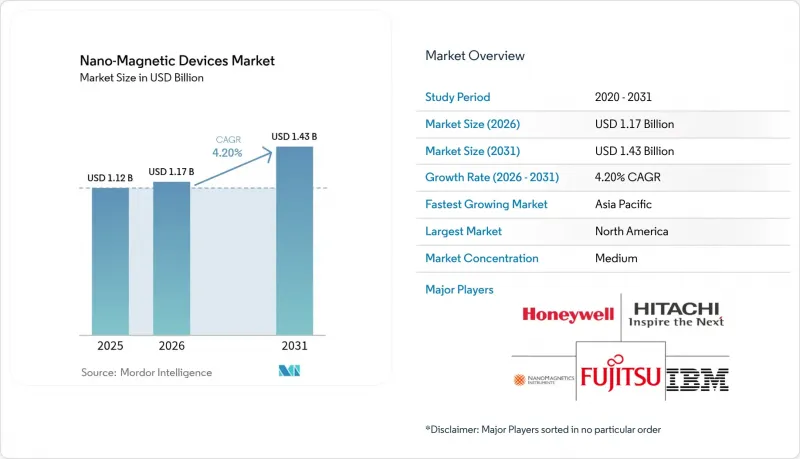
This report is Segmented by Type (Sensors, Data Storage Devices, Imaging Devices, Actuators and Logic Devices, and More), Technology (Magneto-Resistive, Spin-Transfer Torque (STT), Voltage-Controlled Magnetic Anisotropy (VCMA), and More), End-Use Vertical (IT and Telecom (Data Centers), Energy and Utilities, and More), and Geography. The Market Forecasts are Provided in Terms of Value (USD).
Global Nano-Magnetic Devices Market Trends and Insights
Automotive Qualification of MRAM for OTA Firmware Updates
Automotive OEMs now certify MRAM that endures unlimited write cycles, eliminating the wear-out concerns of flash memory in software-defined vehicles. TSMC's embedded MRAM enables microcontrollers that manage frequent over-the-air patches without data corruption. TDK reinforced momentum by unveiling the TAS8240 redundant TMR angle sensor that complies with ASIL D safety norms while operating up to 150 °C. Electric-vehicle production is projected to rise 27%, intensifying demand for magnetic sensing in battery and drivetrain modules. Together, robust memory endurance and high-precision sensing cement the nano-magnetic devices market as a core enabler for future automotive electronics.
300 mm Fab Upgrades for GMR/TMR Sensor IC Production
East-Asian foundries have validated 99.6% yield for spin-orbit-torque MTJs on 300 mm wafers, with switching currents of 680 µA at 2 ns and TMR ratios above 119%. These yields drive down unit costs and let manufacturers integrate multi-axis sensors on a single die. Tohoku University guidelines on single-nanometer MTJs secure data retention beyond 10 years at 150 °C while retaining sub-10 ns speed. EUV lithography now reaches 5 nm resolution, guiding further miniaturization. Cost-competitive high-density sensors broaden adoption in consumer electronics and industrial automation, accelerating the nano-magnetic devices market.
Critical Mineral Export Controls on Cobalt and Gallium
China supplies 98% of global gallium, so potential export bans could shave USD 3.4 billion from U.S. GDP and lift gallium prices more than 150%. Gallium arsenide and gallium nitride devices often co-package with magnetic sensors in RF modules, so shortages reverberate through the nano-magnetic devices market. The Pentagon's radar modernization that relies on GaN further heightens strategic exposure. Recycling initiatives and AI-guided magnet design aim to mitigate risk, but near-term volatility persists.
Other drivers and restraints analyzed in the detailed report include:
- Radiation-Hard Spintronic Memory Demand for Deep-Space Missions
- Shift to NdFeB Nano-Composite Magnets in Chinese Wind Turbines
- Sub-10 nm Patterning Yield Losses in Nano-Magnet Fabrication
For complete list of drivers and restraints, kindly check the Table Of Contents.
Segment Analysis
Sensors dominated 41.05% of the nano-magnetic devices market in 2025, anchored in automotive, industrial, and mobile products. Data storage devices, however, clock a 6.01% CAGR, propelling the nano-magnetic devices market size for storage from USD 0.24 billion in 2026 to USD 0.33 billion by 2031. MRAM's non-volatility and radiation tolerance underpin adoption in space probes and electric vehicles. Imaging devices gain traction thanks to ultra-sensitive xMR components that capture biomagnetic signals, creating new revenue pools.
MRAM's unlimited endurance outperforms flash, removing OTA bottlenecks in passenger vehicles. Breakthrough 3-D magnetic recording promises 10 Tbit/in2 capacities, sustaining HDD relevance. Emerging spin-logic integrates memory and compute, foreshadowing in-memory processing paradigms.
Hall-effect sensors held 41.08% of sensor revenue in 2025 due to low cost and mature supply chains. TMR sensors expand at 5.61% CAGR, narrowing the price gap as 300 mm fabs ramp volume. The TAS8240 redundant angle sensor meets ISO 26262 ASIL D, signaling automotive readiness.
GMR occupies mid-tier niches, balancing sensitivity with affordability. Magnetostrictive sensors excel in aerospace hydraulic controls where EMI immunity is vital. TMR-based digital compasses slash azimuth errors from 4.18° to 0.46° after calibration, improving drone navigation. A new 3-axis silicon Hall sensor with offset cancellation lifts sensitivity to 198 V A-1 T-1, showing the Hall family can still innovate.
Complete Report Scope:
- By Type
- Sensors
- Magnetic Field Sensors
- Hall-Effect Sensors
- GMR Sensors
- TMR Sensors
- Magnetostrictive Sensors
- Data Storage Devices
- MRAM
- Spintronic HDD Read Heads
- Tape Storage Heads
- Imaging Devices
- Magnetic Particle Imaging Systems
- Nano-MRI Coils
- Actuators and Logic Devices
- Spintronic Logic/Transistors
- Micromotors and Actuators
- Other Nano-Magnetic Components
- Antenna and RF Devices
- Sensors
- By Technology
- Magnetoresistive
- Spin-Transfer Torque (STT)
- Voltage-Controlled Magnetic Anisotropy (VCMA)
- Superparamagnetic Nanoparticles
- By End-use Vertical
- Consumer Electronics
- IT and Telecom (Data Centers)
- Automotive and Transportation
- Aerospace and Defense
- Healthcare and Medical Devices
- Energy and Utilities (Wind, Power Converters)
- Industrial Automation and Robotics
- Others (Research and Education)
- By Geography
- North America
- United States
- Canada
- Mexico
- Europe
- Germany
- United Kingdom
- France
- Nordics
- Rest of Europe
- South America
- Brazil
- Rest of South America
- Asia-Pacific
- China
- Japan
- India
- South-East Asia
- Rest of Asia-Pacific
- Middle East and Africa
- Middle East
- Gulf Cooperation Council Countries
- Turkey
- Rest of Middle East
- Africa
- South Africa
- Rest of Africa
- Middle East
- North America
Geography Analysis
North America captured 31.25% of the nano-magnetic devices market in 2025, propelled by defense and space programs requiring radiation-tolerant MRAM. Robust university-industry collaborations harness CHIPS Act funding to prototype neuromorphic spintronic chips. The region's aerospace supply chain values memory endurance over cost, supporting premium pricing.
Asia-Pacific is projected to post a 4.83% CAGR, benefitting from 300 mm fab ramps in Japan, Korea, and China. China's shift to NdFeB nano-composite magnets strengthens domestic turbine makers and sparks global trickle-down effects. Deployment of 3-D LiDAR-magnetic fusion sensors in Japanese and Korean AMRs underpins smart-factory expansion.
Europe allocates EUR 15.8 billion for Chips Joint Undertaking projects, carving a niche in skyrmionic neuromorphic computing. Germany's automotive ecosystem demands ASIL D-compliant TMR sensors, while French and Belgian institutes spearhead High-NA EUV lithography. Emerging regions in South America and the Middle East embrace nano-magnetic devices for grid stability and industrial automation, leveraging technology transfer from multinational OEMs.
- IBM Corporation
- Intel Corporation
- Everspin Technologies Inc.
- Honeywell International Inc.
- NVE Corporation
- Avalanche Technology Inc.
- Fujitsu Limited
- Siemens AG
- Infineon Technologies AG
- TDK Corporation
- Hitachi Metals Ltd.
- Samsung Electronics Co., Ltd.
- Western Digital Technologies Inc.
- Seagate Technology PLC
- Crocus Nano Electronics
- Spin Transfer Technologies
- Analog Devices Inc.
- NXP Semiconductors N.V.
- Micron Technology Inc.
- Bosch Sensortec GmbH
- Renesas Electronics Corporation
- STMicroelectronics N.V.
Additional Benefits:
- The market estimate (ME) sheet in Excel format
- 3 months of analyst support
TABLE OF CONTENTS
1 INTRODUCTION
- 1.1 Study Assumptions and Market Definition
- 1.2 Scope of the Study
2 RESEARCH METHODOLOGY
3 EXECUTIVE SUMMARY
4 MARKET LANDSCAPE
- 4.1 Market Overview
- 4.2 Market Drivers
- 4.2.1 Automotive Qualification of MRAM for OTA Firmware Updates in EU and United States Vehicles
- 4.2.2 300 mm Fab Upgrades for GMR/TMR Sensor IC Production in East Asia
- 4.2.3 Radiation-Hard Spintronic Memory Demand for Deep-Space Missions in North America and Europe
- 4.2.4 Shift to NdFeB Nano-Composite Magnets in Chinese Wind Turbines
- 4.2.5 CHIPS and Science Act + EU Chips Act Funding Allocated to Spintronics R&D
- 4.2.6 Deployment of 3-D Lidar-Magnetic Fusion Sensors in Japanese and Korean AMRs
- 4.3 Market Restraints
- 4.3.1 Critical Mineral Export Controls on Cobalt and Gallium
- 4.3.2 Sub-10 nm Patterning Yield Losses in Nano-Magnet Fabrication
- 4.3.3 Areal Density Limits (Less than 3 Tb/sq. inch) for Next-Gen HDDs
- 4.3.4 Lack of IEC/JEDEC Standards for TMR-Sensor Reliability
- 4.4 Industry Ecosystem Analysis
- 4.5 Technological Outlook
- 4.6 Porter's Five Forces Analysis
- 4.6.1 Threat of New Entrants
- 4.6.2 Bargaining Power of Buyers/Consumers
- 4.6.3 Bargaining Power of Suppliers
- 4.6.4 Threat of Substitute Products
- 4.6.5 Intensity of Competitive Rivalry
5 Market Size and Growth Forecasts
- 5.1 By Type
- 5.1.1 Sensors
- 5.1.1.1 Magnetic Field Sensors
- 5.1.1.2 Hall-Effect Sensors
- 5.1.1.3 GMR Sensors
- 5.1.1.4 TMR Sensors
- 5.1.1.5 Magnetostrictive Sensors
- 5.1.2 Data Storage Devices
- 5.1.2.1 MRAM
- 5.1.2.2 Spintronic HDD Read Heads
- 5.1.2.3 Tape Storage Heads
- 5.1.3 Imaging Devices
- 5.1.3.1 Magnetic Particle Imaging Systems
- 5.1.3.2 Nano-MRI Coils
- 5.1.4 Actuators and Logic Devices
- 5.1.4.1 Spintronic Logic/Transistors
- 5.1.4.2 Micromotors and Actuators
- 5.1.5 Other Nano-Magnetic Components
- 5.1.5.1 Antenna and RF Devices
- 5.1.1 Sensors
- 5.2 By Technology
- 5.2.1 Magnetoresistive
- 5.2.2 Spin-Transfer Torque (STT)
- 5.2.3 Voltage-Controlled Magnetic Anisotropy (VCMA)
- 5.2.4 Superparamagnetic Nanoparticles
- 5.3 By End-use Vertical
- 5.3.1 Consumer Electronics
- 5.3.2 IT and Telecom (Data Centers)
- 5.3.3 Automotive and Transportation
- 5.3.4 Aerospace and Defense
- 5.3.5 Healthcare and Medical Devices
- 5.3.6 Energy and Utilities (Wind, Power Converters)
- 5.3.7 Industrial Automation and Robotics
- 5.3.8 Others (Research and Education)
- 5.4 By Geography
- 5.4.1 North America
- 5.4.1.1 United States
- 5.4.1.2 Canada
- 5.4.1.3 Mexico
- 5.4.2 Europe
- 5.4.2.1 Germany
- 5.4.2.2 United Kingdom
- 5.4.2.3 France
- 5.4.2.4 Nordics
- 5.4.2.5 Rest of Europe
- 5.4.3 South America
- 5.4.3.1 Brazil
- 5.4.3.2 Rest of South America
- 5.4.4 Asia-Pacific
- 5.4.4.1 China
- 5.4.4.2 Japan
- 5.4.4.3 India
- 5.4.4.4 South-East Asia
- 5.4.4.5 Rest of Asia-Pacific
- 5.4.5 Middle East and Africa
- 5.4.5.1 Middle East
- 5.4.5.1.1 Gulf Cooperation Council Countries
- 5.4.5.1.2 Turkey
- 5.4.5.1.3 Rest of Middle East
- 5.4.5.2 Africa
- 5.4.5.2.1 South Africa
- 5.4.5.2.2 Rest of Africa
- 5.4.5.1 Middle East
- 5.4.1 North America
6 COMPETITIVE LANDSCAPE
- 6.1 Market Concentration
- 6.2 Strategic Moves
- 6.3 Market Share Analysis
- 6.4 Company Profiles {(includes Global level Overview, Market level overview, Core Segments, Financials as available, Strategic Information, Market Rank/Share for key companies, Products and Services, and Recent Developments)}
- 6.4.1 IBM Corporation
- 6.4.2 Intel Corporation
- 6.4.3 Everspin Technologies Inc.
- 6.4.4 Honeywell International Inc.
- 6.4.5 NVE Corporation
- 6.4.6 Avalanche Technology Inc.
- 6.4.7 Fujitsu Limited
- 6.4.8 Siemens AG
- 6.4.9 Infineon Technologies AG
- 6.4.10 TDK Corporation
- 6.4.11 Hitachi Metals Ltd.
- 6.4.12 Samsung Electronics Co., Ltd.
- 6.4.13 Western Digital Technologies Inc.
- 6.4.14 Seagate Technology PLC
- 6.4.15 Crocus Nano Electronics
- 6.4.16 Spin Transfer Technologies
- 6.4.17 Analog Devices Inc.
- 6.4.18 NXP Semiconductors N.V.
- 6.4.19 Micron Technology Inc.
- 6.4.20 Bosch Sensortec GmbH
- 6.4.21 Renesas Electronics Corporation
- 6.4.22 STMicroelectronics N.V.
7 MARKET OPPORTUNITIES AND FUTURE OUTLOOK
- 7.1 White-Space and Unmet-Need Assessment

