PUBLISHER: Mordor Intelligence | PRODUCT CODE: 2115203

PUBLISHER: Mordor Intelligence | PRODUCT CODE: 2115203
Law Enforcement Software - Market Share Analysis, Industry Trends & Statistics, Growth Forecasts (2026 - 2031)
According to Mordor Intelligence, the law enforcement software market size is expected to grow from USD 19.60 billion in 2025 to USD 21.18 billion in 2026 and is forecast to reach USD 31.23 billion by 2031 at 8.07% CAGR over 2026-2031.
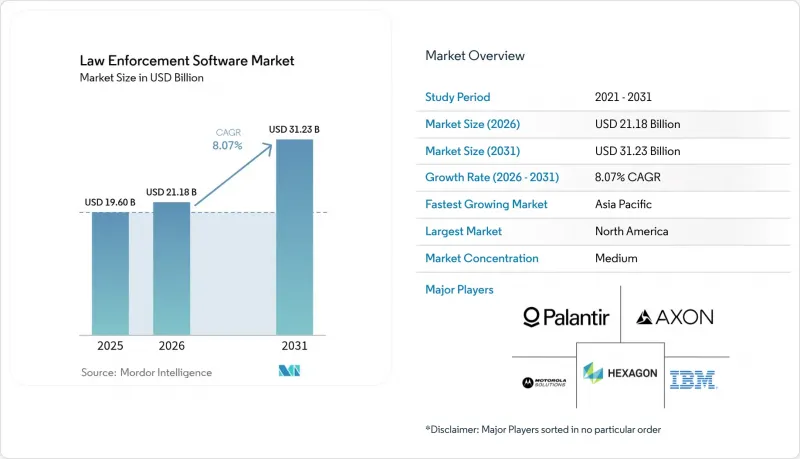
This report is Segmented by Solution (Records Management Systems, Computer-Aided Dispatch, Jail Management, Evidence Management, GIS/Mapping, and More), Deployment Mode (Cloud, On-Premise, Hybrid), Component (Software, Services), End-User Agency (Federal, State, Municipal, and More), and by Geography. The Market Forecasts are Provided in Terms of Value (USD).
Global Law Enforcement Software Market Trends and Insights
Expansion of National Real-Time Crime Centers in North America
Real-time crime centers are evolving from reactive monitoring hubs into predictive-intelligence platforms that merge body-worn-camera streams, license-plate recognition and social-media feeds to deliver situational awareness within seconds. The Los Angeles Police Department's deployment of premier CAD and Command Point mobile systems illustrates how large agencies centralize call-taking and field coordination. Follow-on investments such as Motorola Solutions' USD 12 million command-center order with the Las Vegas Metropolitan Police Department underscore the momentum behind integrated intelligence hubs. Federal incentives are amplifying uptake; the COPS Technology and Equipment Program allocated USD 247 million in 2024 to extend advanced command-center capabilities to smaller jurisdictions. As more centers embed AI models for pattern detection, agencies report double-digit gains in response precision and officer safety.
Mandatory Body-Worn-Camera Evidence-Management Mandates in Europe
European regulators now require comprehensive video workflows that link officer-worn devices with CJIS-compliant digital-evidence vaults. Puerto Rico's expansion of Axon Body 4 cameras, featuring live-streaming and geolocation, demonstrates how functionality has shifted beyond accountability toward real-time officer support. New procurement frameworks in the United Kingdom for live facial-recognition modules further widen addressable demand, accelerating vendor innovation in automated redaction, transcription and metadata tagging. Competing suppliers are fast-tracking AI-assisted report-writing tools that can summarise multi-hour footage in minutes, freeing detectives to focus on investigative tasks.
Fragmented Procurement Cycles in Municipal Agencies
City departments often operate discrete budgeting calendars for police, fire and emergency-medical services, forcing multi-year alignments before a comprehensive software upgrade can be approved. Joint-procurement models offer relief: CentralSquare Technologies delivered a consolidated CAD platform to Boulder Regional Emergency Telephone Service Authority that now services police, fire and EMS across five counties. Similarly, El Paso County's scalable CAD deployment covering 39 public-safety entities allowed smaller districts to access enterprise-grade dispatch while sharing capital expense
Other drivers and restraints analyzed in the detailed report include:
- Federal Grant Acceleration for Cloud-First Public-Safety Platforms (U.S.)
- Asia-Pacific Smart-City Spend Pivoting to Public-Safety Software
- Data-Sovereignty Regulations Limiting Cross-Border SaaS Deployments
For complete list of drivers and restraints, kindly check the Table Of Contents.
Segment Analysis
The computer-aided dispatch segment captured 24.55% of 2025 revenue, underscoring its centrality to incident routing and resource optimisation within the law enforcement software market size. Successive hardware refresh cycles and Next-Generation 911 mandates are renewing interest in GIS-rich CAD modules that integrate seamlessly with AVL, mobile data terminals and drone feeds. In parallel, predictive-analytics platforms are scaling at a 9.45% CAGR to 2031 as agencies pivot toward data-guided deployment models that anticipate hotspots a shift that is reshaping the broader law enforcement software market. Vendors are embedding machine-learning libraries directly inside CAD dashboards, allowing shift supervisors to see historical crime correlations alongside live call loads, narrowing response lags.
Growing appetite for integrated suites is also blurring traditional product boundaries. Motorola Solutions' acquisition of RapidDeploy expanded its offering into cloud-native NG911 mapping and analytics, giving the firm cross-sell latitude across its radio and body-camera customer base. Evidence-management, facial-recognition and digital-forensics modules are being folded into single license agreements, reducing stitching costs for buyers while increasing stickiness for providers.
On-premise installations retained 58.35% of the law enforcement software market share in 2025, a testament to entrenched concerns over data-control and air-gapped integrations with legacy radio networks. Yet cloud instances are registering a 10.25% CAGR, propelled by shrinking capital budgets and the perception that FedRAMP-high authorisations now meet or exceed many local security benchmarks. This switch is enlarging the addressable law enforcement software market as small agencies adopt subscription models that once seemed out-of-reach. Disaster resiliency is another catalyst: the New Orleans Police Department's move to a cloud-native RMS maintained continuity throughout the 2024 hurricane season, reinforcing cloud's operational case among hurricane-prone states.
Hybrid architectures have emerged as an interim waypoint. Sensitive evidence files remain at the edge under agency control, while SaaS dashboards supply analytics, workflow automation and mobile accessibility. Vendors are deploying "sovereign cloud" regions with geo-fenced support teams to appease EU watchdogs, although certification cycles still stretch procurement timelines. Over the forecast horizon, machine-learning inference conducted at the edge combined with heavy-compute model training in the cloud is expected to normalise hybrid topologies across the law enforcement software market.
Complete Report Scope:
- By Solution
- Records Management Systems
- Computer-Aided Dispatch (CAD)
- Jail Management
- Evidence / Digital Evidence Management
- GIS / Mapping
- Emergency Response
- Video Analytics and Facial Recognition
- Mobile / Field Reporting
- Predictive and Crime-Analytics Platforms
- By Deployment Mode
- Cloud
- On-Premise
- Hybrid
- By Component
- Software
- Services
- By End-User Agency
- Federal and National Police
- State and Provincial Police
- Municipal / Local Agencies
- Special-Jurisdiction and Tribal Forces
- By Geography
- North America
- United States
- Canada
- Mexico
- South America
- Brazil
- Argentina
- Rest of South America
- Europe
- Germany
- United Kingdom
- France
- Italy
- Spain
- Rest of Europe
- Asia Pacific
- China
- Japan
- India
- South Korea
- Australia
- New Zealand
- Rest of Asia Pacific
- Middle East and Africa
- Middle East
- Saudi Arabia
- United Arab Emirates
- Turkey
- Rest of Middle East
- Africa
- South Africa
- Nigeria
- Rest of Africa
- Middle East
- North America
Geography Analysis
North America continues to anchor the law enforcement software market with 36.85% revenue share in 2025. Federal funding streams such as the Edward Byrne Memorial Justice Assistance Grant funnel USD 419 million in 2025 into technology upgrades for smaller departments, ensuring that even rural agencies access enterprise-grade solutions. The region's well-developed integrator ecosystem accelerates complex rollouts, while CJIS cloud-authorisation frameworks give procurement officers confidence to migrate core workloads.
Asia-Pacific is the fastest-growing territory with a 9.42% CAGR projected through 2031. Japan's Crime Nabi pilot and South Korea's Incheon Free Economic Zone illustrate how smart-city budgets earmark predictive policing and AI-enhanced surveillance. Regional governments bundle public-safety procurement with broader digital-governance initiatives, unlocking multi-year financing and fostering public-private partnerships. China's mass-deployment of AI-assisted video analytics creates enormous scale for algorithm refinement, while India's cloud-first e-governance schemes entice SaaS vendors with multi-state roll-out opportunities. Australia and New Zealand focus on evidence-management modernisation to counter rising cyber-enabled crime, further enlarging regional demand.
Europe records steady albeit more measured growth as data-sovereignty and privacy mandates dictate deployment architectures. The United Kingdom's GBP 20 million framework for live facial-recognition underscores appetite for advanced analytics, yet stipulates stringent audit and bias-mitigation requirements. Germany's leadership in shaping the EU Artificial Intelligence Act informs vendor roadmaps, compelling them to embed explainability into predictive models from inception. Sovereign-cloud build-outs by hyperscalers combine local data residency with elastic compute, encouraging agencies previously bound to on-premise servers to experiment with hybrid deployments.
- Motorola Solutions Inc.
- Hexagon AB
- Axon Enterprise Inc.
- IBM Corporation
- Palantir Technologies
- Oracle Corporation
- Accenture plc
- ESRI
- Tyler Technologies Inc.
- CentralSquare Technologies
- NICE Ltd.
- Genetec Inc.
- Mark43 Inc.
- Omnigo Software
- Nuance Communications Inc.
- Cisco Systems Inc.
- Qognify Inc.
- Benchmark Analytics
- Flock Safety
- RapidDeploy Inc.
- CivicEye
- JusticeTrax
- Safariland Group (Digital division)
- Forensic Logic
Additional Benefits:
- The market estimate (ME) sheet in Excel format
- 3 months of analyst support
TABLE OF CONTENTS
1 INTRODUCTION
- 1.1 Study Assumptions and Market Definition
- 1.2 Scope of the Study
2 RESEARCH METHODOLOGY
3 EXECUTIVE SUMMARY
4 MARKET LANDSCAPE
- 4.1 Market Overview
- 4.2 Market Drivers
- 4.2.1 Expansion of National Real-Time Crime Centers in North America
- 4.2.2 Mandatory Body-Worn-Camera Evidence-Management Mandates in Europe
- 4.2.3 Federal Grant Acceleration for Cloud-First Public-Safety Platforms (U.S.)
- 4.2.4 Asia-Pacific Smart-City Spend Pivoting to Public-Safety Software
- 4.2.5 Inter-agency Data-Sharing Frameworks Boosting CAD/RMS Upgrades (U.K.)
- 4.2.6 Digital-Evidence Backlogs Driving AI Video-Analytics Investments
- 4.3 Market Restraints
- 4.3.1 Fragmented Procurement Cycles in Municipal Agencies
- 4.3.2 Data-Sovereignty Regulations Limiting Cross-Border SaaS Deployments
- 4.3.3 Resistance to Legacy System Migration Among State Police Forces
- 4.3.4 Budget Volatility from Crime-Rate-Linked Allocations (Latin America)
- 4.4 Value / Supply-Chain Analysis
- 4.5 Regulatory Outlook
- 4.6 Technological Outlook
- 4.7 Porter's Five Forces Analysis
- 4.7.1 Bargaining Power of Suppliers
- 4.7.2 Bargaining Power of Buyers
- 4.7.3 Threat of New Entrants
- 4.7.4 Threat of Substitutes
- 4.7.5 Intensity of Competitive Rivalry
5 MARKET SIZE AND GROWTH FORECASTS (VALUE)
- 5.1 By Solution
- 5.1.1 Records Management Systems
- 5.1.2 Computer-Aided Dispatch (CAD)
- 5.1.3 Jail Management
- 5.1.4 Evidence / Digital Evidence Management
- 5.1.5 GIS / Mapping
- 5.1.6 Emergency Response
- 5.1.7 Video Analytics and Facial Recognition
- 5.1.8 Mobile / Field Reporting
- 5.1.9 Predictive and Crime-Analytics Platforms
- 5.2 By Deployment Mode
- 5.2.1 Cloud
- 5.2.2 On-Premise
- 5.2.3 Hybrid
- 5.3 By Component
- 5.3.1 Software
- 5.3.2 Services
- 5.4 By End-User Agency
- 5.4.1 Federal and National Police
- 5.4.2 State and Provincial Police
- 5.4.3 Municipal / Local Agencies
- 5.4.4 Special-Jurisdiction and Tribal Forces
- 5.5 By Geography
- 5.5.1 North America
- 5.5.1.1 United States
- 5.5.1.2 Canada
- 5.5.1.3 Mexico
- 5.5.2 South America
- 5.5.2.1 Brazil
- 5.5.2.2 Argentina
- 5.5.2.3 Rest of South America
- 5.5.3 Europe
- 5.5.3.1 Germany
- 5.5.3.2 United Kingdom
- 5.5.3.3 France
- 5.5.3.4 Italy
- 5.5.3.5 Spain
- 5.5.3.6 Rest of Europe
- 5.5.4 Asia Pacific
- 5.5.4.1 China
- 5.5.4.2 Japan
- 5.5.4.3 India
- 5.5.4.4 South Korea
- 5.5.4.5 Australia
- 5.5.4.6 New Zealand
- 5.5.4.7 Rest of Asia Pacific
- 5.5.5 Middle East and Africa
- 5.5.5.1 Middle East
- 5.5.5.1.1 Saudi Arabia
- 5.5.5.1.2 United Arab Emirates
- 5.5.5.1.3 Turkey
- 5.5.5.1.4 Rest of Middle East
- 5.5.5.2 Africa
- 5.5.5.2.1 South Africa
- 5.5.5.2.2 Nigeria
- 5.5.5.2.3 Rest of Africa
- 5.5.5.1 Middle East
- 5.5.1 North America
6 COMPETITIVE LANDSCAPE
- 6.1 Market Concentration
- 6.2 Strategic Moves
- 6.3 Market Share Analysis
- 6.4 Company Profiles (includes Global-level Overview, Market-level Overview, Core Segments, Financials as available, Strategic Information, Market Rank/Share for key companies, Products and Services, and Recent Developments)
- 6.4.1 Motorola Solutions Inc.
- 6.4.2 Hexagon AB
- 6.4.3 Axon Enterprise Inc.
- 6.4.4 IBM Corporation
- 6.4.5 Palantir Technologies
- 6.4.6 Oracle Corporation
- 6.4.7 Accenture plc
- 6.4.8 ESRI
- 6.4.9 Tyler Technologies Inc.
- 6.4.10 CentralSquare Technologies
- 6.4.11 NICE Ltd.
- 6.4.12 Genetec Inc.
- 6.4.13 Mark43 Inc.
- 6.4.14 Omnigo Software
- 6.4.15 Nuance Communications Inc.
- 6.4.16 Cisco Systems Inc.
- 6.4.17 Qognify Inc.
- 6.4.18 Benchmark Analytics
- 6.4.19 Flock Safety
- 6.4.20 RapidDeploy Inc.
- 6.4.21 CivicEye
- 6.4.22 JusticeTrax
- 6.4.23 Safariland Group (Digital division)
- 6.4.24 Forensic Logic
7 MARKET OPPORTUNITIES AND FUTURE OUTLOOK
- 7.1 White-space and Unmet-Need Assessment

