PUBLISHER: Mordor Intelligence | PRODUCT CODE: 2115206

PUBLISHER: Mordor Intelligence | PRODUCT CODE: 2115206
United States Botanical Supplements - Market Share Analysis, Industry Trends & Statistics, Growth Forecasts (2026 - 2031)
According to Mordor Intelligence, the United States botanical supplements market size is expected to grow from USD 15.36 billion in 2025 to USD 16.45 billion in 2026 and is forecast to reach USD 23.2 billion by 2031 at 7.12% CAGR over 2026-2031.
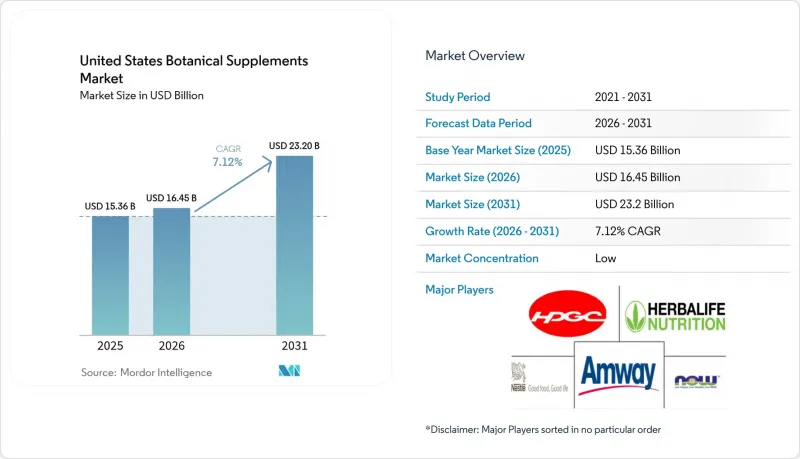
This report is Segmented by Type (Single Botanical, Combination Botanical), Form (Tablets, Capsules/Softgels, and More), Functionality (Digestive and Gut Health, Stress, Sleep and Cognitive Health, Immune Support, Others), Distribution Channel (Supermarkets/Hypermarkets, Online Retailers, and More). The Market Forecasts are Provided in Terms of Value (USD).
United States Botanical Supplements Market Trends and Insights
Increasing consumer interest in holistic wellness approaches and traditional medicinal practices
The integration of traditional medicine with modern wellness practices is driving significant demand for botanical supplements, as consumers increasingly seek alternatives to conventional healthcare approaches. According to the Council for Responsible Nutrition Survey 2023, 74% of adults in the United States use dietary supplements. Companies are incorporating centuries-old Ayurvedic and Chinese medicine principles while adhering to stringent modern quality standards and safety protocols, enabling them to position products in premium market segments. Rising disposable income levels in health-conscious urban areas continue to support market expansion, while FDA recognition of botanical drugs strengthens their credibility and acceptance among healthcare professionals. Companies that effectively demonstrate product authenticity through transparent sourcing practices, documented supply chains, and scientifically proven effectiveness gain better retail shelf placement and enhanced online visibility across digital commerce platforms and social media channels.
Endorsement of herbal products by public figures and social media influencers
Social media is driving the mainstream adoption of botanical products, particularly among younger consumers who value peer recommendations over traditional medical advice. Influencer endorsements on social platforms have increased product awareness and sales, with platforms like Instagram and TikTok becoming primary channels. This trend presents both opportunities and challenges, as regulators increase their scrutiny of health claims made on social media. The FDA's monitoring of supplement marketing has intensified, requiring companies to implement comprehensive compliance protocols. Companies that effectively balance influencer partnerships with FDA compliance requirements gain competitive advantages through established legal frameworks and transparent marketing practices. Celebrity endorsements have notably increased the popularity of premium botanical products, such as functional gummies, which offer both social media appeal and ease of use. The influence-driven market segment remains volatile, with product demand shifting based on trending health topics rather than established clinical evidence, creating uncertainty in long-term market stability and consumer retention.
Risk of contamination and adulteration in raw botanicals hinders growth
Quality control challenges in botanical supply chains create significant barriers to market expansion, as contamination and adulteration issues affect consumer confidence and regulatory compliance. The industry faces systemic quality concerns, particularly regarding botanical extract overdilution, where manufacturers use excessive excipients and resell spent biomass. With FDA inspections covering only 5% of known dietary supplement facilities annually, enforcement gaps allow substandard products to enter the market. Botanicals sourced from regions with limited quality control infrastructure face higher contamination risks, requiring companies to make substantial investments in testing and verification systems. Growing consumer awareness of adulteration issues has increased demand for third-party certifications and transparent supply chain documentation, benefiting companies with comprehensive quality assurance programs. In response, the industry is adopting new authentication technologies, such as DNA barcoding and spectroscopic analysis, which increase operational costs but enable product differentiation.
Other drivers and restraints analyzed in the detailed report include:
- Consumer preference shifting toward plant-based ingredients as alternatives to synthetic compounds
- Expanding elderly demographic seeks natural alternatives for managing chronic health conditions
- Seasonal and regional variability affects raw botanical supply
For complete list of drivers and restraints, kindly check the Table Of Contents.
Segment Analysis
Single botanicals account for 51.58% of the United States botanicals market in 2025, as consumers increasingly gravitate toward products with transparent and easily understandable benefit statements. Extensive scientific research and clinical validation supporting key ingredients like ashwagandha, elderberry, and turmeric continue to drive consistent consumer repurchases. While combination products represent a smaller market share, they are projected to grow at an 8.63% CAGR by offering comprehensive adaptogenic blends that simultaneously address multiple health concerns, including stress management, digestive wellness, and immune system support in single formulations.
Single-ingredient products provide manufacturers with streamlined FDA compliance processes compared to multi-component formulations, which must navigate more complex notification requirements and regulatory frameworks. However, combination formulas enable retailers to enhance sales performance through strategically positioned multi-benefit products and potentially higher average order values in the United States botanicals market. Manufacturers develop sophisticated targeted combinations such as ashwagandha with L-theanine and magnesium for comprehensive stress management, or curcumin with Boswellia for complete joint support, effectively addressing consumers' increasingly complex and interconnected health concerns.
Tablets account for 33.74% of the United States botanicals market share in 2025, driven by their cost efficiency and precise dosing capabilities. The tablet format offers manufacturers significant advantages in production scalability and shelf stability. They remain the primary format for curcumin and herbal extracts that require standardized high-milligram doses, particularly for ingredients sensitive to moisture and oxidation. The gummies and chews segment is experiencing rapid growth at a 8.88% CAGR through 2031, as manufacturers address bioavailability challenges and reduce sugar content while maintaining palatability and consumer appeal.
Advancements in gummy production incorporate pectin bases, vegan colorants, and microencapsulated active ingredients that maintain stability during high-temperature manufacturing processes. These technological improvements enable better nutrient retention and enhanced absorption rates. Capsules and softgels maintain their market position through features such as odor-masking coatings and immediate-release shells, offering superior protection for volatile compounds and oils. Powder formats attract fitness enthusiasts who incorporate adaptogens into their smoothies, providing flexibility in serving size and blend customization. The diverse range of delivery formats in the United States botanicals market accommodates various consumer preferences and daily routines, from convenience-oriented users to those seeking specific therapeutic benefits.
Complete Report Scope:
- By Type
- Single Botanical
- Turmeric
- Cannabidiol
- Mushrooms
- Ashwagandha
- Psyllium
- Elderberry
- Apple Cider Vinegar
- Cranberry
- Others
- Combination Botanical
- Single Botanical
- By Form
- Tablets
- Capsules/Softgels
- Gummies and Chews
- Powders
- Others
- By Functionality/Health Benefits
- Digestive and Gut Health
- Stress, Sleep and Cognitive Health
- Immune Support
- Others
- By Distribution Channel
- Supermarkets/Hypermarkets
- Specialty and Health Stores
- Online Retailers
- Other Distribution Channels
List of Companies Covered in this Report:
- Nestle S.A.
- Harbin Pharmaceutical Group
- Herbalife Nutrition Ltd.
- Amway Corporation
- NOW Foods (NOW Health Group, Inc)
- Gaia Herbs, Inc.
- Otsuka Pharmaceutical Co., Ltd
- Swanson Health Products
- Nutricost
- Standard Process Inc.
- 21st Century HealthCare, Inc.
- Dr. Willmar Schwabe GmbH & Co. KG
- PipingRock Health Products, Inc.
- Life Extension Foundation Buyers Club, Inc.
- Better Being Co.
- Mason Vitamins Inc.
- Jamieson Wellness Inc.
- Vytalogy Wellness
- Doctor's Best, Inc.
- MRO MaryRuth, LLC
Additional Benefits:
- The market estimate (ME) sheet in Excel format
- 3 months of analyst support
TABLE OF CONTENTS
1 INTRODUCTION
- 1.1 Study Assumptions and Market Definition
- 1.2 Scope of the Study
2 RESEARCH METHODOLOGY
3 EXECUTIVE SUMMARY
4 MARKET LANDSCAPE
- 4.1 Market Overview
- 4.2 Market Drivers
- 4.2.1 Increasing consumer interest in holistic wellness approaches and traditional medicinal practices
- 4.2.2 Endorsement of herbal products by public figures and social media influencers
- 4.2.3 Consumer preference shifting toward plant-based ingredients as alternatives to synthetic compounds
- 4.2.4 Expanding elderly demographic seeks natural alternatives for managing chronic health conditions
- 4.2.5 Scientific research and clinical studies demonstrate the effectiveness of botanical ingredients
- 4.2.6 Enhanced Regulatory Oversight and FDA Support for Botanical Ingredient Standards
- 4.3 Market Restraints
- 4.3.1 Risk of contamination and adulteration in raw botanicals hinders growth
- 4.3.2 Seasonal and regional variability affects raw botanical supply
- 4.3.3 Presence of counterfeit products restricts growth
- 4.3.4 Competition from alternative supplements hinders growth
- 4.4 Supply-Chain Analysis
- 4.5 Porter's Five Forces
- 4.5.1 Threat of New Entrants
- 4.5.2 Bargaining Power of Buyers/Consumers
- 4.5.3 Bargaining Power of Suppliers
- 4.5.4 Threat of Substitute Products
- 4.5.5 Intensity of Competitive Rivalry
5 MARKET SIZE AND GROWTH FORECASTS (VALUE)
- 5.1 By Type
- 5.1.1 Single Botanical
- 5.1.1.1 Turmeric
- 5.1.1.2 Cannabidiol
- 5.1.1.3 Mushrooms
- 5.1.1.4 Ashwagandha
- 5.1.1.5 Psyllium
- 5.1.1.6 Elderberry
- 5.1.1.7 Apple Cider Vinegar
- 5.1.1.8 Cranberry
- 5.1.1.9 Others
- 5.1.2 Combination Botanical
- 5.1.1 Single Botanical
- 5.2 By Form
- 5.2.1 Tablets
- 5.2.2 Capsules/Softgels
- 5.2.3 Gummies and Chews
- 5.2.4 Powders
- 5.2.5 Others
- 5.3 By Functionality/Health Benefits
- 5.3.1 Digestive and Gut Health
- 5.3.2 Stress, Sleep and Cognitive Health
- 5.3.3 Immune Support
- 5.3.4 Others
- 5.4 By Distribution Channel
- 5.4.1 Supermarkets/Hypermarkets
- 5.4.2 Specialty and Health Stores
- 5.4.3 Online Retailers
- 5.4.4 Other Distribution Channels
6 COMPETITIVE LANDSCAPE
- 6.1 Market Concentration
- 6.2 Strategic Moves
- 6.3 Market Ranking
- 6.4 Company Profiles (includes Global level Overview, Market level overview, Core Segments, Financials as available, Strategic Information, Market Rank/Share for key companies, Products and Services, and Recent Developments)
- 6.4.1 Nestle S.A.
- 6.4.2 Harbin Pharmaceutical Group
- 6.4.3 Herbalife Nutrition Ltd.
- 6.4.4 Amway Corporation
- 6.4.5 NOW Foods (NOW Health Group, Inc)
- 6.4.6 Gaia Herbs, Inc.
- 6.4.7 Otsuka Pharmaceutical Co., Ltd
- 6.4.8 Swanson Health Products
- 6.4.9 Nutricost
- 6.4.10 Standard Process Inc.
- 6.4.11 21st Century HealthCare, Inc.
- 6.4.12 Dr. Willmar Schwabe GmbH & Co. KG
- 6.4.13 PipingRock Health Products, Inc.
- 6.4.14 Life Extension Foundation Buyers Club, Inc.
- 6.4.15 Better Being Co.
- 6.4.16 Mason Vitamins Inc.
- 6.4.17 Jamieson Wellness Inc.
- 6.4.18 Vytalogy Wellness
- 6.4.19 Doctor's Best, Inc.
- 6.4.20 MRO MaryRuth, LLC
7 MARKET OPPORTUNITIES AND FUTURE OUTLOOK

