PUBLISHER: Mordor Intelligence | PRODUCT CODE: 2115207

PUBLISHER: Mordor Intelligence | PRODUCT CODE: 2115207
Electric Traction Motor - Market Share Analysis, Industry Trends & Statistics, Growth Forecasts (2026 - 2031)
According to Mordor Intelligence, the electric traction motor market size was valued at USD 15.87 billion in 2025 and is estimated to grow from USD 17.35 billion in 2026 to reach USD 26.33 billion by 2031, at a CAGR of 8.70% during the forecast period (2026-2031).
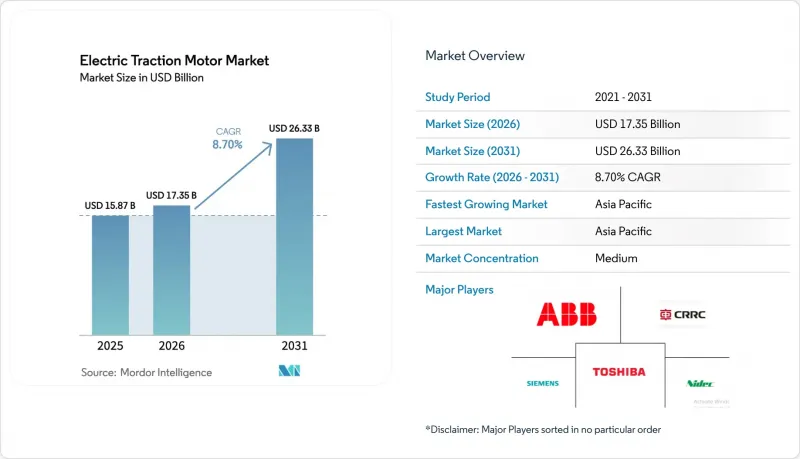
This report is Segmented by Type (Alternating Current and Direct Current), Power Rating (Below 200kW, 200 To 400kW, and Above 400kW), Cooling Type (Air-Cooled, Liquid-Cooled, and Self-Ventilated), Voltage Class (Below 1 KV, 1 To 3 KV, and Above 3 KV), Application (Railway, Electric Vehicle, and Others), and Geography (North America, Europe, Asia-Pacific, South America, and Middle East and Africa).
Global Electric Traction Motor Market Trends and Insights
Surge in High-Speed Rail Electrification Projects Across Asia
Governments in China, India, and Southeast Asia are accelerating high-speed rail corridors to lower aviation emissions and ease highway congestion. China's CR450 prototype entered trial runs in 2025 at 400 kilometers per hour using permanent-magnet motors that add 22 megawatts of continuous power over the CR400 platform. India's Mumbai-Ahmedabad corridor is ordering 24 trainsets that carry 305-kilowatt motors per axle for delivery by 2028. Japan's N700S expansion uses silicon-carbide inverters that trim traction energy by 7% relative to legacy systems. Thailand, Malaysia, and Indonesia have open tenders that reward suppliers able to localize assembly under IEC 60349 rules.
OEM Shift Toward In-House 800-V E-Axle Integration in Premium EVs
Premium automakers are adopting e-axle design to secure thermal control, software optimization, and bill-of-materials savings. BMW's Gen6 eDrive reduced system mass by 30 kilograms and lifted efficiency to 93% across the duty cycle in models launched during 2024. Volkswagen's unified e-axle platform, produced at Kassel and Salzgitter, targets a 15% cost cut and pushes over-the-air calibration updates across multiple brands. Stellantis committed EUR 500 million to produce 800-volt motors in France for 1 million units yearly by 2027.
Limited Rare-Earth Recycling Infrastructure Constraining Permanent-Magnet Motor Supply in Europe
Recycling plants in Europe process less than 2% of end-of-life motor magnets. Solvay's pilot facility in France handled only 50 tons in 2024. The Critical Raw Materials Act calls for 15% recycled content by 2030, yet collection and sorting networks remain fragmented. Metrea opened a 1,200-ton plant in Belgium in 2025, but is ramping slowly due to inconsistent feedstock quality.
Other drivers and restraints analyzed in the detailed report include:
- Adoption of Silicon-Carbide Inverters for Sub-70 kg Motors
- Government-Backed Localization Mandates in India and EU CBAM
- Thermal Management Challenges Above 400 kW in Compact EV Platforms
For complete list of drivers and restraints, kindly check the Table Of Contents.
Segment Analysis
Alternating-current machines held 65.3% of the electric traction motor market share in 2025 and are advancing at a 12.1% CAGR on the back of permanent-magnet synchronous designs that exceed 96% peak efficiency. Model 3, BYD Seal, and many rail sets rely on these high-density rotors. Induction units still serve industrial hoists and freight locomotives because they shrug off voltage transients and need little maintenance. Switched-reluctance motors attract cost-sensitive buyers by removing magnets, although torque ripple keeps them out of luxury models.
Direct-current machines fill legacy metro cars and niche drones where simple control outweighs efficiency loss. Brushed units in Delhi Metro's early phases will be swapped for AC drives by 2027. Brushless DC propulsors power eVTOL aircraft such as Joby's S4, where low weight and smooth thrust are critical. As more operators retrofit aging fleets with variable-frequency drives, the AC segment is slated to widen its lead.
Sub-200-kilowatt motors commanded a 55.2% share of the electric traction motor market size in 2025. Passenger cars and light rail favor this range because cost and packaging take priority. Economies of scale stem from annual automotive volumes above 10 million units. The 200-kilowatt to 400-kilowatt bracket is set to rise at a 10.2% CAGR as delivery vans, buses, and medium trucks electrify. Volvo's FH Electric combines twin 250-kilowatt units to match diesel payloads.
Motors above 400 kilowatts remain a premium niche, under 10% of shipments, yet command high margins under IEC 60349 certification rules. CRRC's CR400 trainset uses eight 550-kilowatt motors for 350 kilometers per hour service. Demand for continuous high power without derating is steering commercial fleets toward dual-motor layouts rather than single ultra-high-power units.
Complete Report Scope:
- By Type
- Alternating Current (Induction, Permanent-Magnet Synchronous, Switched Reluctance)
- Direct Current (Brushed, Brushless DC)
- By Power Rating
- Below 200 kW
- 200 to 400 kW
- Above 400 kW
- By Cooling Type
- Air-Cooled
- Liquid-Cooled
- Self-Ventilated
- By Voltage Class
- Below 1 kV
- 1 to 3 kV
- Above 3 kV
- By Application
- Railway
- Electric Vehicles
- Industrial Machinery
- Other Applications (Drones, eVTOL)
- By Geography
- North America
- United States
- Canada
- Mexico
- Europe
- Germany
- France
- United Kingdom
- Italy
- Spain
- Netherlands
- Rest of Europe
- Asia-Pacific
- China
- Japan
- South Korea
- India
- ASEAN Countries
- Rest of Asia-Pacific
- South America
- Brazil
- Argentina
- Rest of South America
- Middle East and Africa
- Saudi Arabia
- United Arab Emirates
- South Africa
- Egypt
- Rest of Middle East and Africa
- North America
Geography Analysis
Asia-Pacific led the electric traction motor market with 49.5% share in 2025 and is on track for a 10.0% CAGR. China's CR450 testing employed permanent-magnet motors rated at 550 kilowatts per axle and moved into revenue trials on the Beijing-Shanghai line in late 2025. India reserved USD 3.5 billion for advanced components under its PLI plan, unlocking large domestic capacity additions. Japan's rail operators are retrofitting silicon-carbide inverters to cut energy by up to 10%. ASEAN metro tenders now specify local assembly clauses, opening room for joint ventures.
Europe keeps the second-largest share. The Carbon Border Adjustment Mechanism, which starts full enforcement in 2026, adds 8-12% cost on motors shipped from outside the bloc. Volkswagen ramped in-house capacity to 1.2 million motors per year by the end of 2025. Germany, France, and Italy are converting diesel loco fleets to battery-electric for branch lines, giving traction to modular retrofit kits.
North America is adding plants in Mexico and the southern United States. GM's joint venture with LG is targeting 1 million motors a year by 2027. Tesla's Texas factory shipped 1.8 million units in 2024. Freight rail trials use four 500-kilowatt motors in Wabtec's FLXdrive locomotive. South American demand remains cyclical, and the Middle East and Africa still account for modest volume, with Saudi Arabia's Riyadh Metro providing the main near-term lift.
- ABB Ltd
- Siemens AG
- CRRC Corporation Limited
- Toshiba Corporation
- Nidec Corporation
- WEG SA
- Mitsubishi Electric Corporation
- General Electric Company
- Robert Bosch GmbH
- Hitachi Ltd
- TECO Electric & Machinery Co. Ltd
- Bharat Heavy Electricals Limited (BHEL)
- CG Power & Industrial Solutions Ltd
- Kirloskar Electric Company Ltd
- Traktionssysteme Austria GmbH
- Alstom SA
- Skoda Transportation a.s.
- Dana TM4 Inc.
- Magnetek (Columbus McKinnon)
- Valeo SA
- Yaskawa Electric Corporation
- Brook Crompton Holdings
Additional Benefits:
- The market estimate (ME) sheet in Excel format
- 3 months of analyst support
TABLE OF CONTENTS
1 Introduction
- 1.1 Study Assumptions & Market Definition
- 1.2 Scope of the Study
2 Research Methodology
3 Executive Summary
4 Market Landscape
- 4.1 Market Overview
- 4.2 Market Drivers
- 4.2.1 Surge in High-Speed Rail Electrification Projects Across Asia
- 4.2.2 OEM Shift Toward In-House e-Axle Integration Using 800-V Traction Motors in Premium EVs
- 4.2.3 Adoption of Silicon Carbide (SiC) Inverters Enabling Higher-Frequency Motors Below 70 kg
- 4.2.4 Government-Backed Localisation Mandates for Motor Manufacturing in India and EU CBAM
- 4.2.5 Rapid Decline in NdFeB Magnet Prices Post-China Supply Diversification
- 4.3 Market Restraints
- 4.3.1 Limited Rare-Earth Recycling Infrastructure Constraining Permanent-Magnet Motor Supply in Europe
- 4.3.2 Thermal Management Challenges Above 400 kW in Compact EV Platforms
- 4.3.3 Fragmented Rail Procurement Cycles Causing Lumpy Demand in South America
- 4.3.4 High Certification Costs under EN 45545-2 Fire Safety for Rail Traction Motors
- 4.4 Supply-Chain Analysis
- 4.5 Regulatory Outlook
- 4.6 Technological Outlook
- 4.7 Porter's Five Forces
- 4.7.1 Bargaining Power of Suppliers
- 4.7.2 Bargaining Power of Consumers
- 4.7.3 Threat of New Entrants
- 4.7.4 Threat of Substitute Products and Services
- 4.7.5 Intensity of Competitive Rivalry
5 Market Size & Growth Forecasts
- 5.1 By Type
- 5.1.1 Alternating Current (Induction, Permanent-Magnet Synchronous, Switched Reluctance)
- 5.1.2 Direct Current (Brushed, Brushless DC)
- 5.2 By Power Rating
- 5.2.1 Below 200 kW
- 5.2.2 200 to 400 kW
- 5.2.3 Above 400 kW
- 5.3 By Cooling Type
- 5.3.1 Air-Cooled
- 5.3.2 Liquid-Cooled
- 5.3.3 Self-Ventilated
- 5.4 By Voltage Class
- 5.4.1 Below 1 kV
- 5.4.2 1 to 3 kV
- 5.4.3 Above 3 kV
- 5.5 By Application
- 5.5.1 Railway
- 5.5.2 Electric Vehicles
- 5.5.3 Industrial Machinery
- 5.5.4 Other Applications (Drones, eVTOL)
- 5.6 By Geography
- 5.6.1 North America
- 5.6.1.1 United States
- 5.6.1.2 Canada
- 5.6.1.3 Mexico
- 5.6.2 Europe
- 5.6.2.1 Germany
- 5.6.2.2 France
- 5.6.2.3 United Kingdom
- 5.6.2.4 Italy
- 5.6.2.5 Spain
- 5.6.2.6 Netherlands
- 5.6.2.7 Rest of Europe
- 5.6.3 Asia-Pacific
- 5.6.3.1 China
- 5.6.3.2 Japan
- 5.6.3.3 South Korea
- 5.6.3.4 India
- 5.6.3.5 ASEAN Countries
- 5.6.3.6 Rest of Asia-Pacific
- 5.6.4 South America
- 5.6.4.1 Brazil
- 5.6.4.2 Argentina
- 5.6.4.3 Rest of South America
- 5.6.5 Middle East and Africa
- 5.6.5.1 Saudi Arabia
- 5.6.5.2 United Arab Emirates
- 5.6.5.3 South Africa
- 5.6.5.4 Egypt
- 5.6.5.5 Rest of Middle East and Africa
- 5.6.1 North America
6 Competitive Landscape
- 6.1 Market Concentration
- 6.2 Strategic Moves (M&A, Partnerships, PPAs)
- 6.3 Market Share Analysis (Market Rank/Share for key companies)
- 6.4 Company Profiles (includes Global level Overview, Market level overview, Core Segments, Financials as available, Strategic Information, Products & Services, and Recent Developments)
- 6.4.1 ABB Ltd
- 6.4.2 Siemens AG
- 6.4.3 CRRC Corporation Limited
- 6.4.4 Toshiba Corporation
- 6.4.5 Nidec Corporation
- 6.4.6 WEG SA
- 6.4.7 Mitsubishi Electric Corporation
- 6.4.8 General Electric Company
- 6.4.9 Robert Bosch GmbH
- 6.4.10 Hitachi Ltd
- 6.4.11 TECO Electric & Machinery Co. Ltd
- 6.4.12 Bharat Heavy Electricals Limited (BHEL)
- 6.4.13 CG Power & Industrial Solutions Ltd
- 6.4.14 Kirloskar Electric Company Ltd
- 6.4.15 Traktionssysteme Austria GmbH
- 6.4.16 Alstom SA
- 6.4.17 Skoda Transportation a.s.
- 6.4.18 Dana TM4 Inc.
- 6.4.19 Magnetek (Columbus McKinnon)
- 6.4.20 Valeo SA
- 6.4.21 Yaskawa Electric Corporation
- 6.4.22 Brook Crompton Holdings
7 Market Opportunities & Future Outlook
- 7.1 White-space & Unmet-Need Assessment

