PUBLISHER: Mordor Intelligence | PRODUCT CODE: 2115214

PUBLISHER: Mordor Intelligence | PRODUCT CODE: 2115214
Terminal Tractor - Market Share Analysis, Industry Trends & Statistics, Growth Forecasts (2026 - 2031)
According to Mordor Intelligence, terminal tractor market size in 2026 is estimated at USD 1.41 billion, growing from 2025 value of USD 1.35 billion with 2031 projections showing USD 1.78 billion, growing at 4.7% CAGR over 2026-2031.
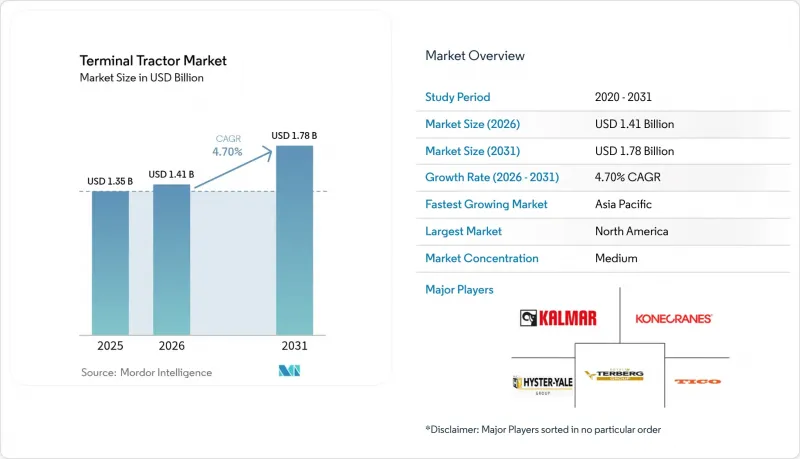
This report is Segmented by Fuel Type (Diesel, Hybrid and More), Vehicle Type (Manual, Semi-Automated and More), Drive Configuration (4x2, 4x4 and More), Tonnage Capacity (Less Than 50 Ton and More), End-Use Industry (Food and Beverages, and More), and by Geography. The Market Sizes and Forecasts are Provided in Terms of Value (USD).
Global Terminal Tractor Market Trends and Insights
E-Commerce-Driven Trailer Turnover Escalating Terminal Tractor Cycles
Surging online retail volumes push North American mega-fulfillment centers to process trailer moves at 2.77 times the pace seen in legacy retail hubs, a shift that elevates duty cycles and hastens fleet replacement. Electric models gain favor because their maintenance expense runs 60-75% lower than diesel equivalents , letting operators sustain round-the-clock shifts without lengthy service breaks. Fleet managers now specify high-durability frames, reinforced driveline components, and smart yard management software to handle 24/7 traffic peaks. The resulting jump in utilization makes premium-priced units financially viable, thereby reinforcing the ongoing migration toward alternative propulsion in the terminal tractor market. Comparable patterns emerge in European postal distribution hubs, signaling a broadening geographic ripple.
Stringent IMO & CARB Emission Mandates Catalyzing Electric Yard Truck Adoption
California's 2025 Mobile Source Strategy enforces a 90% cut in NOx and an 80% cut in diesel particulate matter from cargo-handling equipment by 2026. Similar targets appear in the IMO 2023 decarbonization strategy, pressuring global ports to overhaul diesel fleets. With compliance deadlines looming, electric terminal tractors offer a near-term pathway because they require less infrastructural overhaul than quay cranes or shore-power retrofits. The Port of Long Beach integrates zero-emission yard trucks while still processing record container volumes, demonstrating feasibility under high-throughput conditions . These regulations compress decision windows, pushing procurement teams to lock in battery-electric models despite higher purchase prices, driving measurable expansion across the terminal tractor market.
High up-front CAPEX of BEV/FC terminal tractors vs. diesel equivalents
Battery-electric yard trucks list between USD 275,000-350,000, nearly triple a diesel unit's USD 100,000-125,000 cost, which stretches payback beyond five years in moderate-utilization fleets lacking incentives. Hydrogen fuel-cell models face an even steeper hurdle as bespoke components keep sticker prices 250-300% higher. Smaller logistics providers struggle to secure financing that matches 3-5 year replacement cycles , especially in countries without subsidy schemes. Although total cost of ownership trends now tilt in favor of electric when annual hours exceed 5,000, upfront sticker shock continues to trim addressable demand, tempering overall progress in the terminal tractor market.
Other drivers and restraints analyzed in the detailed report include:
- Green Hydrogen Pilots In EU Ports Enabling Fuel-Cell Terminal Tractors
- Rise Of Rental-Model Warehousing In India Accelerating Short-Tenure Tractor Leasing
- Fragmented power infrastructure at brownfield ports delaying fast-charge roll-out
For complete list of drivers and restraints, kindly check the Table Of Contents.
Segment Analysis
Diesel technology accounted for a 62.65% terminal tractor market share in 2025, anchored by its extensive installed base and lower acquisition cost. Electric models, however, are projected to post an 17.6% CAGR from 2026-2031 as regulatory pressure stiffens and battery pricing eases. Early adopters in California, British Columbia, and Guangdong report maintenance savings that counterbalance higher purchase prices within four operating years. Hybrid and CNG/LNG variants fill specific compliance windows where fuel availability or duty cycle characteristics favor flexible propulsion. Hydrogen fuel-cell prototypes, though representing low single-digit volumes today, attract EU funding as range and cold-weather resilience gain strategic weight. Across the terminal tractor market, propulsion choice is increasingly bound to port-specific carbon targets, electricity tariffs, and incentive stacks, reinforcing a regionally divergent adoption curve.
Electric penetration also influences parts supply and resale dynamics. OEMs bundle battery warranties, telematics, and preventive maintenance contracts to de-risk lifetime costs for buyers. As diesel emission systems grow more complex, downtime linked to after-treatment adds operating risk that further tips preference toward battery-electric. The coming half-decade therefore signals a progressive shift where diesel's share declines but remains material in emerging economies without robust grid capacity, keeping the global fleet in a dual-propulsion state through at least 2030.
Manual tractors retained 74.55% of the terminal tractor market share in 2025 because many yards still demand human judgment in mixed-traffic scenarios. Yet autonomous units, rising at a 21.2% CAGR, re-shape operational economics by cutting labor costs and extending duty hours. Controlled environments, container stack shuttles, automotive marshalling yards, and high-security air cargo aprons offer ideal testbeds where geo-fencing ensures predictable routes. The terminal tractor market now hosts new entrants from robotics and AI, including Forterra and FERNRIDE, who supply drive-by-wire kits and remote-teleoperation platforms that retrofit OEM chassis. Traditional manufacturers answer with factory-ready autonomy interfaces, shortening integration cycles.
Roll-out speed links tightly to labor availability and local regulatory clarity. European Machinery Directive certification, achieved by FERNRIDE in 2025, provides a harmonized framework likely to accelerate deployments across EU member states. North American OEMs focus on modular upgrades, allowing fleets to shift between supervised and unsupervised modes. As AI perception stacks mature, cost curves bend downward, enabling smaller terminals to adopt autonomy sooner than previously expected. That trajectory cements self-driving functionality as a mainstream spec line-item by the late 2020s.
Complete Report Scope:
- By Propulsion Type
- Diesel
- Hybrid
- Electric (BEV)
- CNG / LNG
- Hydrogen Fuel-Cell
- By Vehicle Type
- Manual
- Semi-Automated
- Fully Autonomous
- By Drive Configuration
- 4x2
- 4x4
- 6x4
- By Tonnage Capacity
- Less than 50 Ton
- 50-100 Ton
- Greater than 100 Ton
- By End-Use Industry
- Retail & E-commerce 3PL
- Food & Beverages
- Heavy Industry & Manufacturing
- Automotive OEM Yards
- Marine Ports Industry
- Oil and Gas Industry
- Logistics Industry
- Others (Rail Logistics Yards, etc.)
- By Geography
- North America
- United States
- Canada
- Rest of North America
- South America
- Brazil
- Argentina
- Rest of South America
- Europe
- Germany
- United Kingdom
- France
- Italy
- Spain
- Russia
- Rest of Europe
- Asia-Pacific
- China
- India
- Japan
- South Korea
- Indonesia
- Vietnam
- Philippines
- Australia
- New Zealand
- Rest of Asia-Pacific
- Middle East and Africa
- Saudi Arabia
- United Arab Emirates
- Turkey
- South Africa
- Nigeria
- Egypt
- Rest of Middle East and Africa
- North America
Geography Analysis
North America represented 36.30% of the terminal tractor market revenue in 2025, anchored by extensive Gulf and West Coast port capacity and aggressive zero-emission rules. California drives early adoption, but Canada scales procurement as Prince Rupert and Vancouver deepen terminals to absorb Pacific trade diversions. The region demonstrates rapid software uptake as Aurora Innovation's highway platooning algorithms cross-pollinate into yard automation platforms, foreshadowing a broader autonomy wave. Electricity pricing variability nonetheless affects rollout speed; utilities in Texas and Georgia deploy preferential industrial tariffs to lure battery-electric conversions.
Asia-Pacific logs the fastest regional expansion at a 6.9% CAGR through 2031, buoyed by Chinese smart-port funding and India's GatiShakti infrastructure drive. Guangzhou Port recently expanded its intelligent guided vehicle fleet to 158 units, illustrating state-backed scale on automation. Japan and South Korea mature toward hybrid electrification models to offset high electricity tariffs, while Southeast Asian corridors-Thailand's Eastern Economic Corridor and Vietnam's Cai Mep cluster-order tractors primarily for new-build terminals rather than retrofit programs, giving OEMs greenfield specification flexibility.
Europe sustains high adoption of low-carbon propulsion through harmonized EU Green Deal incentives, making it a launchpad for fuel-cell pilots at Wilhelmshaven and Rotterdam. Nordic countries pave the road for all-weather 4x4 electric fleets, leveraging hydropower-sourced electricity to claim lifecycle emission savings. Central and Eastern European hubs, led by Poland's Gdansk, invest in redundancy to capture Baltic trans-shipment traffic, expanding addressable demand. Elsewhere, the Middle East and Africa witness stepped-up investment in Saudi Arabia's Jeddah port and South Africa's Durban expansion, revealing fresh opportunities as these hubs chase trans-shipment share from capacity-constrained Suez routes across the terminal tractor market.
- Kalmar (Cargotec Corp.)
- Konecranes Inc.
- Terberg Group BV
- TICO Tractors
- Mafi Transport-Systeme GmbH
- Sany Heavy Industry Co. Ltd.
- Volvo AB
- Mol CY nv
- BYD Auto Co. Ltd.
- Orange EV
- Hoist Liftruck Mfg.
- Trelleborg AB (Yard Systems)
- Autocar LLC
Additional Benefits:
- The market estimate (ME) sheet in Excel format
- 3 months of analyst support
TABLE OF CONTENTS
1 Introduction
- 1.1 Study Assumptions & Market Definition
- 1.2 Scope of the Study
2 Research Methodology
3 Executive Summary
4 Market Landscape
- 4.1 Market Overview
- 4.2 Market Drivers
- 4.2.1 E-commerce-Driven Trailer Turnover Escalating Terminal Tractor Cycles (North America)
- 4.2.2 Stringent IMO & CARB Emission Mandates Catalyzing Electric Yard Truck Adoption (Ports)
- 4.2.3 Green Hydrogen Pilots in EU Ports Enabling Fuel-Cell Terminal Tractors
- 4.2.4 Rise of Rental-Model Warehousing in India Accelerating Short-Tenure Tractor Leasing
- 4.2.5 4x4 Drive Demand From Intermodal Rail Yards in Nordics Boosting Premium Tractor Sales
- 4.2.6 AI-Enabled Fleet Optimization Software Increasing Utilization Rates & Replacement Cycles
- 4.3 Market Restraints
- 4.3.1 High Up-Front Capex of BEV/FC Terminal Tractors vs. Diesel Equivalents
- 4.3.2 Fragmented Power Infrastructure at Brownfield Ports Delaying Fast-Charge Roll-out
- 4.3.3 Volatile Battery-Grade Nickel & Lithium Prices Inflating TCO Forecasts
- 4.3.4 Limited Skilled Technicians for Autonomous Tractor Maintenance in Emerging Markets
- 4.4 Porter's Five Forces Analysis
- 4.4.1 Bargaining Power of Buyers
- 4.4.2 Bargaining Power of Suppliers
- 4.4.3 Threat of New Entrants
- 4.4.4 Threat of Substitute Products
- 4.4.5 Intensity of Competitive Rivalry
5 Market Size & Growth Forecasts (Value)
- 5.1 By Propulsion Type
- 5.1.1 Diesel
- 5.1.2 Hybrid
- 5.1.3 Electric (BEV)
- 5.1.4 CNG / LNG
- 5.1.5 Hydrogen Fuel-Cell
- 5.2 By Vehicle Type
- 5.2.1 Manual
- 5.2.2 Semi-Automated
- 5.2.3 Fully Autonomous
- 5.3 By Drive Configuration
- 5.3.1 4x2
- 5.3.2 4x4
- 5.3.3 6x4
- 5.4 By Tonnage Capacity
- 5.4.1 Less than 50 Ton
- 5.4.2 50-100 Ton
- 5.4.3 Greater than 100 Ton
- 5.5 By End-Use Industry
- 5.5.1 Retail & E-commerce 3PL
- 5.5.2 Food & Beverages
- 5.5.3 Heavy Industry & Manufacturing
- 5.5.4 Automotive OEM Yards
- 5.5.5 Marine Ports Industry
- 5.5.6 Oil and Gas Industry
- 5.5.7 Logistics Industry
- 5.5.8 Others (Rail Logistics Yards, etc.)
- 5.6 By Geography
- 5.6.1 North America
- 5.6.1.1 United States
- 5.6.1.2 Canada
- 5.6.1.3 Rest of North America
- 5.6.2 South America
- 5.6.2.1 Brazil
- 5.6.2.2 Argentina
- 5.6.2.3 Rest of South America
- 5.6.3 Europe
- 5.6.3.1 Germany
- 5.6.3.2 United Kingdom
- 5.6.3.3 France
- 5.6.3.4 Italy
- 5.6.3.5 Spain
- 5.6.3.6 Russia
- 5.6.3.7 Rest of Europe
- 5.6.4 Asia-Pacific
- 5.6.4.1 China
- 5.6.4.2 India
- 5.6.4.3 Japan
- 5.6.4.4 South Korea
- 5.6.4.5 Indonesia
- 5.6.4.6 Vietnam
- 5.6.4.7 Philippines
- 5.6.4.8 Australia
- 5.6.4.9 New Zealand
- 5.6.4.10 Rest of Asia-Pacific
- 5.6.5 Middle East and Africa
- 5.6.5.1 Saudi Arabia
- 5.6.5.2 United Arab Emirates
- 5.6.5.3 Turkey
- 5.6.5.4 South Africa
- 5.6.5.5 Nigeria
- 5.6.5.6 Egypt
- 5.6.5.7 Rest of Middle East and Africa
- 5.6.1 North America
6 Competitive Landscape
- 6.1 Market Concentration
- 6.2 Strategic Moves
- 6.3 Market Share Analysis
- 6.4 Company Profiles {(includes Global level Overview, Market level overview, Core Segments, Financials as available, Strategic Information, Market Rank/Share for key companies, Products & Services, and Recent Developments)}
- 6.4.1 Kalmar (Cargotec Corp.)
- 6.4.2 Konecranes Inc.
- 6.4.3 Terberg Group BV
- 6.4.4 TICO Tractors
- 6.4.5 Mafi Transport-Systeme GmbH
- 6.4.6 Sany Heavy Industry Co. Ltd.
- 6.4.7 Volvo AB
- 6.4.8 Mol CY nv
- 6.4.9 BYD Auto Co. Ltd.
- 6.4.10 Orange EV
- 6.4.11 Hoist Liftruck Mfg.
- 6.4.12 Trelleborg AB (Yard Systems)
- 6.4.13 Autocar LLC
7 Market Opportunities & Future Outlook
- 7.1 White-space & Unmet-need Assessment

