PUBLISHER: Mordor Intelligence | PRODUCT CODE: 2115228

PUBLISHER: Mordor Intelligence | PRODUCT CODE: 2115228
Italy Home Furniture - Market Share Analysis, Industry Trends & Statistics, Growth Forecasts (2026 - 2031)
According to Mordor Intelligence, the Italy home furniture market size is projected to expand from USD 16.20 billion in 2025 and USD 16.74 billion in 2026 to USD 19.86 billion by 2031, registering a CAGR of 3.48% between 2026 to 2031.
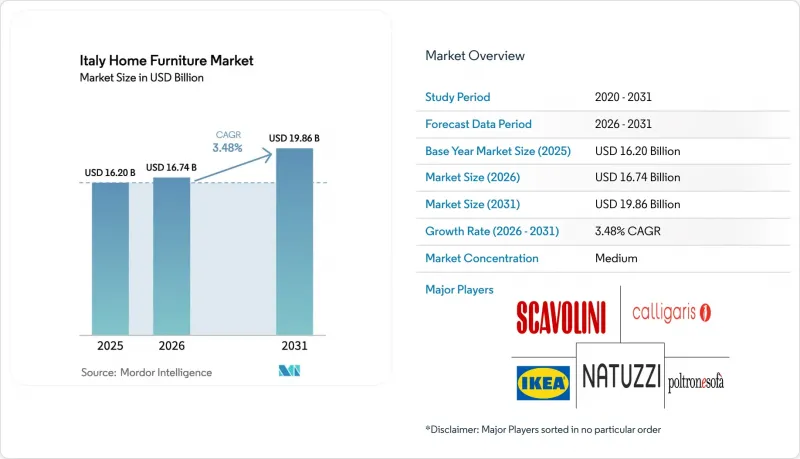
This report is Segmented by Product (Living Room & Dining Room, Bedroom, Kitchen, Home Office, Bathroom, Outdoor, Other Furniture), Material (Wood, Metal, Plastic & Polymer, Others), Price Range (Economy, Mid Range, Premium), Distribution Channel (Home Centers, Specialty Stores, Online, Others), and Geography (North Italy, Central Italy, South Italy & Islands). Market Forecasts are in Value (USD).
Italy Home Furniture Market Trends and Insights
Extension of "Furniture Bonus" Tax Relief
The Furniture bonus remains active through December 31, 2025, maintaining a 50% personal income tax deduction for purchases linked to renovation with a maximum eligible spend of EUR 5,000 (USD 5207.8) per household, which keeps replacement cycles steady even as new-build activity moderates. Budget rules confirm the deduction structure and multi-year installment mechanism, which sustains affordability and supports the Italy home furniture market during a period of macro normalization. Istat recorded a contraction in housing investment in early 2025 due to the phaseout of broader construction incentives; however, non-residential investment increased strongly, which stabilized order flow for contract and office producers while household demand remained anchored by the Furniture Bonus. Eligibility requirements and traceable payment rules channel consumer decisions toward compliant models and energy-efficient appliances that often trigger coordinated purchases of kitchens, bedrooms, and living room sets in the Italy home furniture market. Regions with higher incomes, notably in the North and parts of the Center, benefit more from the incentive's structure because households can pre-finance renovation and then recover deductions over time, which reinforces the regional concentration of sales in the Italy home furniture market.
Growing Penetration of Online Furniture Retail
Digital infrastructure, improved last-mile services, and richer visualization tools are making online purchasing more practical for large items, which supports the steady expansion of e-commerce in the Italy home furniture market. Online platforms are subject to EU product safety and traceability requirements, including the presence of a responsible person established in the EU and standardized compliance documentation, which raises trust and aligns with consumer expectations for safety and sustainability. Compliance with REACH reporting through the SCIP database also increases chemical transparency for upholstered seating, storage, and children's furniture, which has become an important reassurance for digital buyers who cannot evaluate products physically before purchase in the Italy home furniture market. Retailers that integrate delivery to the floor, assembly options, and flexible returns narrow the experiential gap with stores, which is especially relevant for urban households that prioritize convenience. As these service layers standardize, purchase friction declines, and steady share gains for online channels continue to layer on top of the core base of specialty stores in the Italy home furniture market.
Volatile Prices of Lumber, Metals, and Upholstery Inputs
Producers face persistent volatility across wood, metal, and textile inputs, which complicates pricing and compresses margins in the Italy home furniture market when retail pass-through is limited. Firms use long-term contracts, selective vertical integration, and greater use of recycled materials to mitigate cost shocks, which helps stabilize panel-based lines and reduces exposure to virgin inputs. Strengthening domestic capabilities through 2025 measures targeting machinery, digitalization, and sustainable processing for wood and forestry operations should also help build resilience over time in the Italy home furniture market. Italy's high circular material use and strong recovered wood flows into chipboard panels support cost control strategies for case goods, which helps balance commodity cycles. Over the forecast period, the combination of recycled inputs and targeted investments should temper the restraint on the Italy home furniture market even as global commodity conditions remain variable.
Other drivers and restraints analyzed in the detailed report include:
- Upsurge in Demand for Modular, Space-Saving Solutions
- Ageing Population Driving Demand for Senior-Friendly Ergonomics
- Shortage of Skilled Artisans Inflating Labour Costs
For complete list of drivers and restraints, kindly check the Table Of Contents.
Segment Analysis
Living room and dining room furniture accounts for 29.91% share in 2025, reflecting the central place of social and hosting spaces in Italian households and sustained aesthetic spending in the Italy home furniture market. The bedroom segment holds a smaller base in 2025 but has the fastest trajectory with a 3.84% CAGR through 2031 as hybrid work increases the need for multipurpose layouts in the Italy home furniture market. Category design and specification continue to align with public procurement rules for materials and emissions, which indirectly shape private market expectations on quality and sustainability. Steady household income trends and renovation incentives reinforce coordinated purchases across seating, tables, storage, and bedroom systems in the Italy home furniture market.
Bedroom's growth reflects a blend of sleeping and working needs, prioritizing ergonomics, integrated storage, and light-footprint desks that do not overcrowd smaller rooms in the Italy home furniture market. Home office furniture adjacent to the bedroom upgrades benefits from attention to posture, mobility, and material performance, consistent with a broader shift toward functional comfort. Kitchen and bathroom lines maintain stable replacement cycles closely tied to renovations and incentive-driven upgrades, while outdoor lines retain a loyal base with seasonal patterns well understood by retailers. The Italy home furniture industry competes on design, finish quality, and compliance alongside price, and this balance continues to define category strategies in the forecast period. As the Italy home furniture market matures, product differentiation centers on adaptability and easy maintenance, which enhance longevity and repeat purchase satisfaction.
Wood leads with 52.23% share in 2025, supported by strong recycled wood panel flows that reduce dependence on virgin timber and underpin competitive case goods in the Italy home furniture market. Italy's circular material systems channel recovered wood into chipboard, with a high recycling performance that sustains the panel supply needed by furniture producers. Certification and low-emission requirements in public procurement have become baseline expectations across many residential lines, which raises the material quality bar. Solid wood lines remain positioned in premium and heritage-led ranges where durability, repairability, and tactile value justify higher prices in the Italy home furniture market.
Plastics and polymers post the fastest growth with a 4.08% CAGR through 2031, driven by innovations in recycled and bio-based resins that align with circularity targets and industrial regeneration. Producers are integrating polymer components in seating, storage, and accessories to achieve strength-to-weight benefits and streamlined maintenance while improving end of life outcomes through design for disassembly. Metals continue to serve contract, office, and outdoor applications where durability and corrosion resistance are essential, and coatings shift toward low VOC and water based finishes. The Italy home furniture industry balances multi material construction with simpler disassembly pathways to meet procurement and eco design expectations. Over the forecast period, material strategy will remain a lever for differentiation in the Italy home furniture market, especially where recycled content and emissions profiles factor into buyer criteria.
Complete Report Scope:
- By Product
- Living Room & Dining Room Furniture
- Bedroom Furniture
- Kitchen Furniture
- Home Office Furniture
- Bathroom Furniture
- Outdoor Furniture
- Other Furniture
- By Material
- Wood
- Metal
- Plastic & Polymer
- Others
- By Price Range
- Economy
- Mid-Range
- Premium
- By Distribution Channel
- Home Centers
- Specialty Furniture Stores
- Online
- Other Distribution Channels
- By Geography
- North Italy
- Central Italy
- South Italy & Islands
List of Companies Covered in this Report:
- IKEA Italia
- Natuzzi S.p.A.
- Poltronesof S.p.A.
- Scavolini S.p.A.
- Calligaris S.p.A.
- Gruppo Lube
- B&B Italia
- Molteni&C
- Poliform S.p.A.
- Arredo3 S.r.l.
- Kartell
- Snaidero Rino S.p.A.
- Veneta Cucine
- Lago S.p.A.
- Divani&Divani by Natuzzi
- Driade
- Rimadesio
- Riva 1920
- Giessegi
- Mondo Convenienza
Additional Benefits:
- The market estimate (ME) sheet in Excel format
- 3 months of analyst support
TABLE OF CONTENTS
1 Introduction
- 1.1 Study Assumptions & Market Definition
- 1.2 Scope of the Study
2 Research Methodology
3 Executive Summary
4 Market Landscape
- 4.1 Market Overview
- 4.2 Market Drivers
- 4.2.1 Extension of "Furniture Bonus" tax relief
- 4.2.2 Growing penetration of online furniture retail
- 4.2.3 Rising renovation activity in historic housing stock
- 4.2.4 Upsurge in demand for modular, space-saving solutions
- 4.2.5 Ageing population driving demand for senior-friendly ergonomics
- 4.2.6 National circular-economy targets boosting recycled-material furniture
- 4.3 Market Restraints
- 4.3.1 Volatile prices of lumber, metals and upholstery inputs
- 4.3.2 Global supply-chain disruptions lengthening lead times
- 4.3.3 Shrinking average dwelling sizes limiting bulky furniture demand
- 4.3.4 Shortage of skilled artisans inflating labour costs
- 4.4 Industry Value Chain Analysis
- 4.5 Porter's Five Forces Analysis
- 4.5.1 Threat of New Entrants
- 4.5.2 Bargaining Power of Suppliers
- 4.5.3 Bargaining Power of Buyers
- 4.5.4 Threat of Substitutes
- 4.5.5 Competitive Rivalry
- 4.6 Insights into the Latest Trends and Innovations in the Market
- 4.7 Insights on Recent Developments (New Product Launches, Strategic Initiatives, Investments, Partnerships, JVs, Expansion, M&As, etc.) in the Market
5 Market Size & Growth Forecasts (Value)
- 5.1 By Product
- 5.1.1 Living Room & Dining Room Furniture
- 5.1.2 Bedroom Furniture
- 5.1.3 Kitchen Furniture
- 5.1.4 Home Office Furniture
- 5.1.5 Bathroom Furniture
- 5.1.6 Outdoor Furniture
- 5.1.7 Other Furniture
- 5.2 By Material
- 5.2.1 Wood
- 5.2.2 Metal
- 5.2.3 Plastic & Polymer
- 5.2.4 Others
- 5.3 By Price Range
- 5.3.1 Economy
- 5.3.2 Mid-Range
- 5.3.3 Premium
- 5.4 By Distribution Channel
- 5.4.1 Home Centers
- 5.4.2 Specialty Furniture Stores
- 5.4.3 Online
- 5.4.4 Other Distribution Channels
- 5.5 By Geography
- 5.5.1 North Italy
- 5.5.2 Central Italy
- 5.5.3 South Italy & Islands
6 Competitive Landscape
- 6.1 Market Concentration
- 6.2 Strategic Moves
- 6.3 Market Share Analysis
- 6.4 Company Profiles (includes Global level Overview, Market level overview, Core Segments, Financials as available, Strategic Information, Market Rank/Share for key companies, Products & Services, and Recent Developments)
- 6.4.1 IKEA Italia
- 6.4.2 Natuzzi S.p.A.
- 6.4.3 Poltronesof S.p.A.
- 6.4.4 Scavolini S.p.A.
- 6.4.5 Calligaris S.p.A.
- 6.4.6 Gruppo Lube
- 6.4.7 B&B Italia
- 6.4.8 Molteni&C
- 6.4.9 Poliform S.p.A.
- 6.4.10 Arredo3 S.r.l.
- 6.4.11 Kartell
- 6.4.12 Snaidero Rino S.p.A.
- 6.4.13 Veneta Cucine
- 6.4.14 Lago S.p.A.
- 6.4.15 Divani&Divani by Natuzzi
- 6.4.16 Driade
- 6.4.17 Rimadesio
- 6.4.18 Riva 1920
- 6.4.19 Giessegi
- 6.4.20 Mondo Convenienza
7 Market Opportunities & Future Outlook
- 7.1 Modular Eco-Luxury Product Lines
- 7.2 Rising Demand for Sustainable and Made-in-Italy Premium Furniture

