PUBLISHER: Mordor Intelligence | PRODUCT CODE: 2115235

PUBLISHER: Mordor Intelligence | PRODUCT CODE: 2115235
Sterile Filtration - Market Share Analysis, Industry Trends & Statistics, Growth Forecasts (2026 - 2031)
According to Mordor Intelligence, sterile filtration market size in 2026 is estimated at USD 9.95 billion, growing from 2025 value of USD 9.1 billion with 2031 projections showing USD 15.58 billion, growing at 9.38% CAGR over 2026-2031.
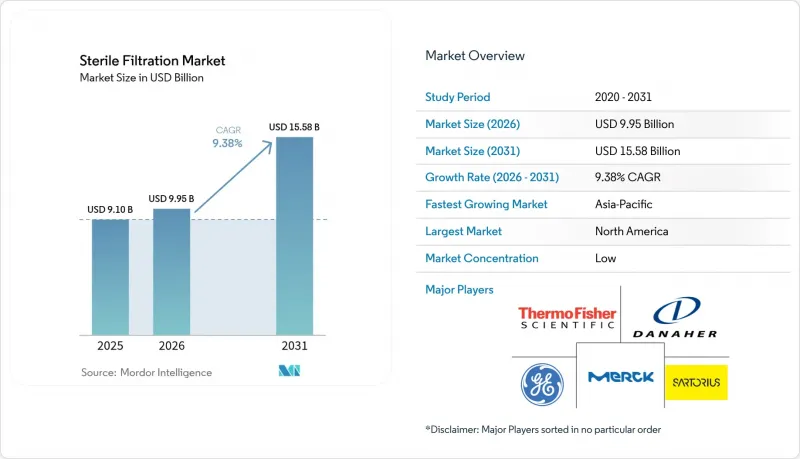
This report is Segmented by Product (Cartridge Filters, Capsule Filters, and More), Membrane Material (PES, PVDF, and More), Filtration Technique (Microfiltration, and More), Application (Final Fill/Finish, Buffer, and More), End User (Pharmaceutical and Biopharmaceutical Companies, and More), and Geography (North America, Europe, and More). The Market Sizes and Forecasts are Provided in Terms of Value (USD).
Global Sterile Filtration Market Trends and Insights
Growing Burden of Chronic & Rare Diseases
Orphan drugs represented nearly 50% of FDA-recognized therapeutics in 2024, anchoring sustained demand for final fill/finish filtration and driving long-run volume growth in the sterile filtration market. Capsule formats benefit most because they match low-volume, high-value production, while expedited approval pathways compress timelines and increase readiness pressure. Aging populations in developed economies, alongside improved access in emerging regions, hard-wire this demand driver into long-term health-care infrastructure.
Expansion of Global Biopharmaceutical Manufacturing Capacity
Total installed biopharma capacity rose from 16.5 million L in 2018 to 17.4 million L in 2025, with Samsung Biologics and MilliporeSigma committing multi-billion-dollar programs in South Korea. CDMOs are forecast to control 54% of global biologics capacity by 2028, underscoring the importance of standardized, validated filtration lines that can switch rapidly between client projects while meeting harmonized regulatory demands.
High Total Cost of Ownership of Validated Sterile Filters
EU Annex 1 compliance has increased filtration-related costs by as much as 30%, a burden that smaller biopharma firms struggle to absorb. Fixed validation expenses encourage outsourcing to CDMOs with established platforms, creating scale advantages for larger players and raising entry barriers for novel filter formats that require extensive re-qualification.
Other drivers and restraints analyzed in the detailed report include:
- Shift Toward Single-Use and Modular Production Facilities
- Stricter Global GMP & Annex 1 Revisions Tightening Filter Validation
- Membrane Fouling & Integrity Test Failures Causing Downtime
For complete list of drivers and restraints, kindly check the Table Of Contents.
Segment Analysis
Cartridge filters dominated 2025 with 31.45% revenue, confirming their incumbency in high-volume plant operations. Capsule filters, however, are forecast to log a 10.22% CAGR owing to flexible batch scalability for personalized therapies. This momentum anchors the sterile filtration market size expansion for ATMP producers that need rapid changeovers without re-cleaning. Cytiva's Emflon II gamma-compatible modules exemplify single-use advances that eliminate CIP validation burdens.
Syringe filters keep laboratory and clinical trial workflows moving even though their growth remains modest. Accessories such as holders, vent filters, and assemblies provide incremental gains as manufacturers emphasize closed-system integration to limit contamination events. This is a critical concern for regulators enforcing Annex 1 clarity on aseptic connections.
Polyethersulfone membranes held a 24.95% share in 2025 due to low protein binding and robust throughput, cementing their status for final fill/finish lines. PVDF variants are projected to grow 10.03% annually until 2031, driven by chemical resistance, yet pending PFAS restrictions in Europe threaten long-term accessibility. PES suppliers invest in next-generation grades to capture capacity migrating from PVDF.
PTFE, nylon, and mixed cellulose ester membranes fill application niches spanning gas filtration to low-cost buffer prep. The sterile filtration market is expected to witness accelerated R&D in fluoropolymer-free chemistries as customers look to de-risk material compliance and avoid costly system re-validation.
Complete Report Scope:
- By Product
- Cartridge Filters
- Capsule Filters
- Syringe Filters
- Other Membrane Filters
- Accessories
- By Membrane Material
- PES
- PVDF
- PTFE
- Nylon & MCE
- Others (PP, RC, etc.)
- By Filtration Technique
- Microfiltration
- Ultrafiltration
- Nanofiltration & Reverse Osmosis
- By Application
- Final Fill / Finish
- Buffer & Media Preparation
- Water-for-Injection & Utilities
- Air & Gas Sterilization
- Others
- By End User
- Pharmaceutical & Biopharmaceutical Companies
- Contract Development & Manufacturing Organizations (CDMOs)
- Academic & Government Research Labs
- Food & Beverage Manufacturers
- Geography
- North America
- United States
- Canada
- Mexico
- Europe
- Germany
- United Kingdom
- France
- Italy
- Spain
- Rest of Europe
- Asia Pacific
- China
- Japan
- India
- South Korea
- Australia
- Rest of Asia Pacific
- Middle East & Africa
- GCC
- South Africa
- Rest of Middle East & Africa
- South America
- Brazil
- Argentina
- North America
Geography Analysis
North America and Europe command the lion's share of 2025 revenue owing to entrenched biopharmaceutical clusters, advanced regulatory oversight, and a strong pipeline of injectable therapeutics. U.S. capacity expansions from Novo Nordisk's USD 4.1 billion site in North Carolina to Eli Lilly's USD 2 billion Concord investment embed long-run demand for filtration hardware and validation services. Europe's Annex 1 revisions, now the global contamination-control benchmark, compel every drug maker exporting into the region to align filtration strategies.
Asia Pacific, led by South Korea, delivers the fastest-growing sterile filtration market through 2031 because of major greenfield projects such as Cytiva's USD 326 million Incheon plant and Samsung Biologics' multi-billion-dollar campus. China and India scale facilities that meet FDA and EMA standards, while Japan's materials expertise buttresses membrane R&D, reinforcing regional self-sufficiency goals. MilliporeSigma's EUR 300 million Daejeon center underlines incumbent suppliers' commitment to localizing production.
Middle East & Africa and South America remain emerging but strategic territories. Brazil and Argentina advance fill/finish lines to curb import reliance, and GCC nations embed pharmaceutical manufacture within diversification plans. Technology transfer initiatives and government incentives ease skills gaps and build the regulatory foundations needed for future sterile filtration market penetration.
- 3M
- Danaher (Pall & Cytiva)
- Sartorius
- Merck KGaA (MilliporeSigma)
- Thermo Fisher Scientific
- GE Healthcare
- Eaton
- Cole-Parmer Instrument Company
- Porvair Filtration Group
- Sterlitech
- Koch Separation Solutions
- Prominent
- Donaldson Company
- Parker Hannifin (Bioscience Division)
- Saint-Gobain Life Sciences
- Repligen
- Meissner Filtration Products
- Advantec MFS
- GVS Group
- Cytiva (see Danaher)
- Alfa Laval
- Donaldson Ultrafilter
- W. L. Gore & Associates
- Amazon Filters
- Cobetter Filtration
Additional Benefits:
- The market estimate (ME) sheet in Excel format
- 3 months of analyst support
TABLE OF CONTENTS
1 Introduction
- 1.1 Study Assumptions & Market Definition
- 1.2 Scope of the Study
2 Research Methodology
3 Executive Summary
4 Market Landscape
- 4.1 Market Overview
- 4.2 Market Drivers
- 4.2.1 Growing Burden Of Chronic & Rare Diseases
- 4.2.2 Expansion Of Global Biopharmaceutical Manufacturing Capacity
- 4.2.3 Shift Toward Single-Use And Modular Production Facilities
- 4.2.4 Stricter Global GMP & Annex 1 Revisions Tightening Filter Validation
- 4.2.5 Surge In Advanced-Therapy Medicinal Products (ATMPs) Needing Low-Volume Sterile Runs
- 4.2.6 AI-Driven Predictive Maintenance Reducing Filtration Failure Risk
- 4.3 Market Restraints
- 4.3.1 High Total Cost Of Ownership Of Validated Sterile Filters
- 4.3.2 Membrane Fouling & Integrity Test Failures Causing Downtime
- 4.3.3 Long Lead-Times For Regulatory Re-Validation After Filter Or Process Change
- 4.3.4 Emerging PFAS Regulations Threatening PTFE/PVDF Membrane Supply
- 4.4 Supply Chain Analysis
- 4.5 Regulatory Landscape
- 4.6 Technological Outlook
- 4.7 Porter's Five Forces Analysis
- 4.7.1 Threat of New Entrants
- 4.7.2 Bargaining Power of Buyers
- 4.7.3 Bargaining Power of Suppliers
- 4.7.4 Threat of Substitutes
- 4.7.5 Intensity of Competitive Rivalry
5 Market Size & Growth Forecasts (Value)
- 5.1 By Product
- 5.1.1 Cartridge Filters
- 5.1.2 Capsule Filters
- 5.1.3 Syringe Filters
- 5.1.4 Other Membrane Filters
- 5.1.5 Accessories
- 5.2 By Membrane Material
- 5.2.1 PES
- 5.2.2 PVDF
- 5.2.3 PTFE
- 5.2.4 Nylon & MCE
- 5.2.5 Others (PP, RC, etc.)
- 5.3 By Filtration Technique
- 5.3.1 Microfiltration
- 5.3.2 Ultrafiltration
- 5.3.3 Nanofiltration & Reverse Osmosis
- 5.4 By Application
- 5.4.1 Final Fill / Finish
- 5.4.2 Buffer & Media Preparation
- 5.4.3 Water-for-Injection & Utilities
- 5.4.4 Air & Gas Sterilization
- 5.4.5 Others
- 5.5 By End User
- 5.5.1 Pharmaceutical & Biopharmaceutical Companies
- 5.5.2 Contract Development & Manufacturing Organizations (CDMOs)
- 5.5.3 Academic & Government Research Labs
- 5.5.4 Food & Beverage Manufacturers
- 5.6 Geography
- 5.6.1 North America
- 5.6.1.1 United States
- 5.6.1.2 Canada
- 5.6.1.3 Mexico
- 5.6.2 Europe
- 5.6.2.1 Germany
- 5.6.2.2 United Kingdom
- 5.6.2.3 France
- 5.6.2.4 Italy
- 5.6.2.5 Spain
- 5.6.2.6 Rest of Europe
- 5.6.3 Asia Pacific
- 5.6.3.1 China
- 5.6.3.2 Japan
- 5.6.3.3 India
- 5.6.3.4 South Korea
- 5.6.3.5 Australia
- 5.6.3.6 Rest of Asia Pacific
- 5.6.4 Middle East & Africa
- 5.6.4.1 GCC
- 5.6.4.2 South Africa
- 5.6.4.3 Rest of Middle East & Africa
- 5.6.5 South America
- 5.6.5.1 Brazil
- 5.6.5.2 Argentina
- 5.6.1 North America
6 Competitive Landscape
- 6.1 Market Concentration
- 6.2 Market Share Analysis
- 6.3 Company Profiles (includes Global level overview, Market level overview, Core Segments, Financials as available, Strategic Information, Market Rank/Share, Products & Services, Recent Developments)
- 6.3.1 3M
- 6.3.2 Danaher (Pall & Cytiva)
- 6.3.3 Sartorius AG
- 6.3.4 Merck KGaA (MilliporeSigma)
- 6.3.5 Thermo Fisher Scientific
- 6.3.6 GE Healthcare
- 6.3.7 Eaton Corporation
- 6.3.8 Cole-Parmer Instrument Company
- 6.3.9 Porvair Filtration Group
- 6.3.10 Sterlitech Corporation
- 6.3.11 Koch Separation Solutions
- 6.3.12 Prominent GmbH
- 6.3.13 Donaldson Company
- 6.3.14 Parker Hannifin (Bioscience Division)
- 6.3.15 Saint-Gobain Life Sciences
- 6.3.16 Repligen Corporation
- 6.3.17 Meissner Filtration Products
- 6.3.18 Advantec MFS
- 6.3.19 GVS Group
- 6.3.20 Cytiva (see Danaher)
- 6.3.21 Alfa Laval
- 6.3.22 Donaldson Ultrafilter
- 6.3.23 W. L. Gore & Associates
- 6.3.24 Amazon Filters
- 6.3.25 Cobetter Filtration
7 Market Opportunities & Future Outlook
- 7.1 White-space & Unmet-need Assessment

