PUBLISHER: Mordor Intelligence | PRODUCT CODE: 2115237

PUBLISHER: Mordor Intelligence | PRODUCT CODE: 2115237
Metagenomics - Market Share Analysis, Industry Trends & Statistics, Growth Forecasts (2026 - 2031)
According to Mordor Intelligence, metagenomics market size in 2026 is estimated at USD 3.76 billion, growing from 2025 value of USD 3.28 billion with 2031 projections showing USD 7.41 billion, growing at 14.57% CAGR over 2026-2031.
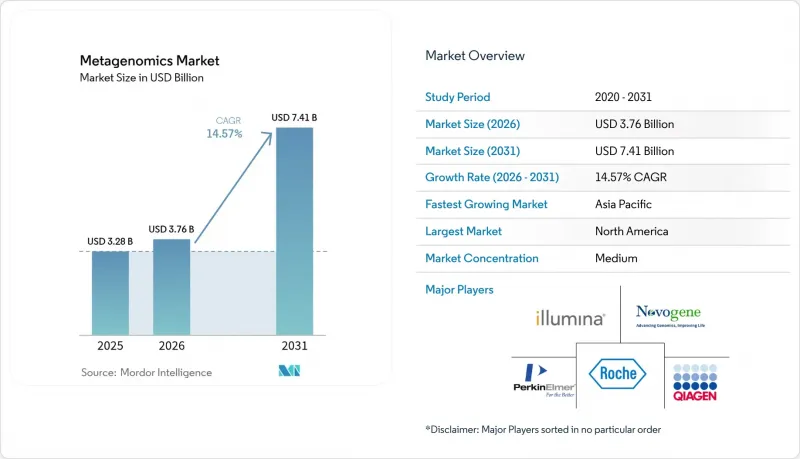
This report is Segmented by Product (Sequencing & Data Analytics Services, and More), Technology (Sequencing-Driven, Function-Driven, and More), Application (Human Health, Environmental Monitoring, and More), End User (Academic, Clinical Diagnostic Laboratories, and More), and Geography (North America, Europe, Asia Pacific, and More). The Market Sizes and Forecasts are Provided in Terms of Value (USD).
Global Metagenomics Market Trends and Insights
Increasing R&D Expenditure in Metagenomics
Pharmaceutical and biotechnology enterprises amplify metagenomics investments because microbial targets increasingly underpin novel drug discovery programs. Thermo Fisher Scientific earmarked USD 40-50 billion for acquisitions that strengthen metagenomics-adjacent capabilities, signaling boardroom conviction that next-generation therapeutics demand microbiome-centric data. The NIH's Human Virome Program directs roughly USD 2.5 million toward 2026 tool development, fostering academic-industry alliances that accelerate clinical translation.Government grants such as the NSF Ecology and Evolution of Infectious Diseases initiative, with a USD 32 million budget for FY 2025, encourage multidisciplinary research linking metagenomics with computational modeling.
Declining Cost of High-Throughput Sequencing
Whole-genome sequencing prices plunged to USD 600 in 2024, unlocking widespread clinical deployment. Ultima Genomics further disrupted norms by achieving a USD 100 genome at Q60 accuracy, forcing incumbents to compress margins and accelerate product cycles. Additional price cuts, such as the University of Minnesota's Element AVITI platform, now position next-generation sequencing below Illumina's flagship NovaSeq for comparable throughput. Budgetary shifts away from capital equipment toward bioinformatics expertise reshape laboratory cost structures.
High Overall Cost of Comprehensive Metagenomic Workflows
Although sequencing itself is cheaper, total ownership costs remain high once computational infrastructure, storage, and accreditation are included. A Pentagon pilot concluded that daily metagenomic biosurveillance remains 10-100 times too costly for routine use unless sample pooling and virtualization mature further. Low- and middle-income regions pay up to USD 4,500 per genome because logistics and customs fees inflate consumable prices.
Other drivers and restraints analyzed in the detailed report include:
- Continuous Improvements in Library-Prep & Bioinformatics Pipelines
- Emergence of Ultra-Long-Read Sequencing Enabling Strain-Level Insights
- Shortage of Skilled Bioinformaticians for Data Interpretation
For complete list of drivers and restraints, kindly check the Table Of Contents.
Segment Analysis
Kits & reagents retained 44.60% of 2025 revenue because every sequencing run consumes standardized consumables that ensure reproducible results. However, sequencing & data analytics services are scaling at an 17.85% CAGR, reflecting laboratories' preference to outsource compute-intensive steps to specialized providers. The metagenomics market size for services is projected to increase more than threefold by 2031. Instruments & consumables maintain steady replacement demand, whereas cloud-delivered software pipelines lower barriers for resource-constrained facilities.
Outsourcing momentum intensifies as regulators demand auditable pipelines that small laboratories rarely build in-house. QIAGEN's Digital Insights partnership with major cloud vendors illustrates how service ecosystems capture recurring fees, while Novogene's high-throughput model offers competitive pricing tiers for academic consortia. This combination of compliance burden and bioinformatics talent shortage should sustain double-digit growth for managed services over the forecast horizon.
Sequencing-driven workflows represented 62.10% of the metagenomics market share in 2025, yet third-generation long-read platforms are expanding at 20.90% CAGR. Long reads assemble complete microbial genomes, reveal plasmid-borne resistance genes, and quantify epigenetic modifications in real time. Function-driven protocols remain niche but essential for bioprocess optimization, while amplicon-based approaches persist in cost-sensitive surveillance. The metagenomics market size for long-read applications should surpass USD 2.28 billion by 2031, catalyzed by hospital infection-control programs and large-scale environmental projects.
Real-time nanopore sequencing enables field-deployable diagnostics at border checkpoints and remote farms. Researchers combining long-read DNA and RNA sequencing now correlate active gene expression with genomic context, a capability expected to unlock new anti-infective targets. Meanwhile, platform vendors seek standards harmonization so that hybrid assemblies merge the depth of short reads with the context of long ones.
Complete Report Scope:
- By Product
- Sequencing & Data Analytics Services
- Kits & Reagents
- Instruments & Consumables
- Software & Pipeline Tools
- Others
- By Technology
- Sequencing-Driven Metagenomics
- Function-Driven Metagenomics
- Third-Generation Long-Read Sequencing
- Amplicon-Based Targeted Sequencing
- Metatranscriptomics
- By Application
- Human Health
- Environmental Monitoring & Bioremediation
- Agriculture & Food Safety Testing
- Others
- By End-User
- Academic & Research Institutes
- Pharmaceutical & Biotechnology Companies
- Clinical Diagnostic Laboratories
- Environmental & Food Testing Labs
- CROs & Service Providers
- By Geography
- North America
- United States
- Canada
- Mexico
- Europe
- Germany
- United Kingdom
- France
- Italy
- Spain
- Rest of Europe
- Asia Pacific
- China
- Japan
- India
- South Korea
- Australia
- Rest of Asia Pacific
- Middle East and Africa
- GCC
- South Africa
- Rest of Middle East and Africa
- South America
- Brazil
- Argentina
- Rest of South America
- North America
Geography Analysis
North America controlled 46.20% of global revenue in 2025 due to established sequencing infrastructure, dense biotech clusters, and favorable reimbursement. Federal projects such as the NIH All of Us Research Program continue to channel funding into microbiome-heavy protocols, sustaining domestic demand. Canada's Precision Health Initiative further bolsters regional sequencing volumes.
Europe maintains a robust position, benefiting from the Horizon Europe funding stream and the European Medicines Agency's supportive stance on real-world microbiome data. Cross-border clinical trials increasingly incorporate metagenomic endpoints, encouraging standardized data pipelines across European reference labs. The region also houses several leading bioinformatics software vendors that export platforms globally.
Asia Pacific represents the fastest-growing geography at 16.20% CAGR through 2031. China's National GeneBank expansion and India's Genome India initiative exemplify government-funded programs that aim to leapfrog legacy infrastructure. Domestic players such as BGI leverage cost-efficient platforms like DNBSEQ-T7 to drive local adoption while exporting solutions to Africa and Latin America. Singapore and South Korea invest heavily in AI-enabled precision medicine pilots, positioning the broader region as a testbed for end-to-end metagenomics ecosystems. The Middle East and Africa show nascent but rising interest as public-health agencies embrace wastewater surveillance for early outbreak alerts-South America partners with European labs to transfer protocols and build local talent pipelines.
- Illumina
- Thermo Fisher Scientific
- QIAGEN
- Roche
- BGI
- Novogene Co., Ltd.
- PerkinElmer
- Eurofins
- Oxford Nanopore Technologies plc
- Pacific Bioscience
- Agilent Technologies
- Bio-Rad Laboratories
- Promega
- Merck
- Takara Bio
- Zymo Research
- Genewiz (Azenta Life Sciences)
- CosmosID Inc.
- Genscript Biotech Corporation
- Brooks Life Sciences (Cell & Gene Solutions)
Additional Benefits:
- The market estimate (ME) sheet in Excel format
- 3 months of analyst support
TABLE OF CONTENTS
1 Introduction
- 1.1 Study Assumptions & Market Definition
- 1.2 Scope of the Study
2 Research Methodology
3 Executive Summary
4 Market Landscape
- 4.1 Market Overview
- 4.2 Market Drivers
- 4.2.1 Increasing R&D Expenditure In Metagenomics
- 4.2.2 Declining Cost Of High-Throughput Sequencing
- 4.2.3 Continuous Improvements In Library-Prep & Bioinformatics Pipelines
- 4.2.4 Emergence Of Ultra-Long-Read Sequencing Enabling Strain-Level Insights
- 4.2.5 AI-Powered Point-Of-Care Infectious-Disease Metagenomics Platforms
- 4.2.6 National Microbiome Data-Commons Initiatives Releasing Open Datasets
- 4.3 Market Restraints
- 4.3.1 High Overall Cost Of Comprehensive Metagenomic Workflows
- 4.3.2 Shortage Of Skilled Bioinformaticians For Data Interpretation
- 4.3.3 Data-Privacy & Ethical Concerns Over Incidental Human Genomic Findings
- 4.3.4 Export-Control Risks Disrupting Enzyme & Reagent Supply Chains
- 4.4 Supply-Chain Analysis
- 4.5 Regulatory Landscape
- 4.6 Technological Outlook
- 4.7 Porter's Five Forces Analysis
- 4.7.1 Threat of New Entrants
- 4.7.2 Bargaining Power of Buyers
- 4.7.3 Bargaining Power of Suppliers
- 4.7.4 Threat of Substitutes
- 4.7.5 Intensity of Competitive Rivalry
5 Market Size & Growth Forecasts (Value)
- 5.1 By Product
- 5.1.1 Sequencing & Data Analytics Services
- 5.1.2 Kits & Reagents
- 5.1.3 Instruments & Consumables
- 5.1.4 Software & Pipeline Tools
- 5.1.5 Others
- 5.2 By Technology
- 5.2.1 Sequencing-Driven Metagenomics
- 5.2.2 Function-Driven Metagenomics
- 5.2.3 Third-Generation Long-Read Sequencing
- 5.2.4 Amplicon-Based Targeted Sequencing
- 5.2.5 Metatranscriptomics
- 5.3 By Application
- 5.3.1 Human Health
- 5.3.2 Environmental Monitoring & Bioremediation
- 5.3.3 Agriculture & Food Safety Testing
- 5.3.4 Others
- 5.4 By End-User
- 5.4.1 Academic & Research Institutes
- 5.4.2 Pharmaceutical & Biotechnology Companies
- 5.4.3 Clinical Diagnostic Laboratories
- 5.4.4 Environmental & Food Testing Labs
- 5.4.5 CROs & Service Providers
- 5.5 By Geography
- 5.5.1 North America
- 5.5.1.1 United States
- 5.5.1.2 Canada
- 5.5.1.3 Mexico
- 5.5.2 Europe
- 5.5.2.1 Germany
- 5.5.2.2 United Kingdom
- 5.5.2.3 France
- 5.5.2.4 Italy
- 5.5.2.5 Spain
- 5.5.2.6 Rest of Europe
- 5.5.3 Asia Pacific
- 5.5.3.1 China
- 5.5.3.2 Japan
- 5.5.3.3 India
- 5.5.3.4 South Korea
- 5.5.3.5 Australia
- 5.5.3.6 Rest of Asia Pacific
- 5.5.4 Middle East and Africa
- 5.5.4.1 GCC
- 5.5.4.2 South Africa
- 5.5.4.3 Rest of Middle East and Africa
- 5.5.5 South America
- 5.5.5.1 Brazil
- 5.5.5.2 Argentina
- 5.5.5.3 Rest of South America
- 5.5.1 North America
6 Competitive Landscape
- 6.1 Market Concentration
- 6.2 Market Share Analysis
- 6.3 Company Profiles (includes Global level Overview, Market level overview, Core Segments, Financials as available, Strategic Information, Market Rank/Share for key companies, Products & Services, and Recent Developments)
- 6.3.1 Illumina Inc.
- 6.3.2 Thermo Fisher Scientific Inc.
- 6.3.3 QIAGEN N.V.
- 6.3.4 F. Hoffmann-La Roche Ltd
- 6.3.5 BGI Group
- 6.3.6 Novogene Co., Ltd.
- 6.3.7 PerkinElmer Inc.
- 6.3.8 Eurofins Scientific SE
- 6.3.9 Oxford Nanopore Technologies plc
- 6.3.10 Pacific Biosciences of California, Inc.
- 6.3.11 Agilent Technologies, Inc.
- 6.3.12 Bio-Rad Laboratories, Inc.
- 6.3.13 Promega Corporation
- 6.3.14 Merck KGaA
- 6.3.15 Takara Bio Inc.
- 6.3.16 Zymo Research Corporation
- 6.3.17 Genewiz (Azenta Life Sciences)
- 6.3.18 CosmosID Inc.
- 6.3.19 Genscript Biotech Corporation
- 6.3.20 Brooks Life Sciences (Cell & Gene Solutions)
7 Market Opportunities & Future Outlook
- 7.1 White-space & Unmet-Need Assessment

