PUBLISHER: Mordor Intelligence | PRODUCT CODE: 2115238

PUBLISHER: Mordor Intelligence | PRODUCT CODE: 2115238
Spine Biologics - Market Share Analysis, Industry Trends & Statistics, Growth Forecasts (2026 - 2031)
According to Mordor Intelligence, the spine biologics market size is expected to grow from USD 3.82 billion in 2025 to USD 4.01 billion in 2026 and is forecast to reach USD 5.14 billion by 2031 at 5.08% CAGR over 2026-2031.
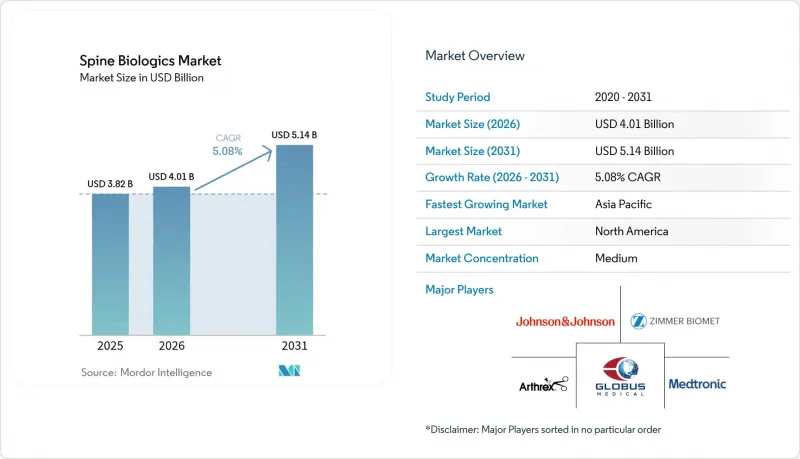
This report is Segmented by Product Type (Bone Graft Substitutes [Bone Morphogenetic Proteins and More], Spinal Allografts [Machined Structural Allografts and More], Cell-Based Matrices, and More), Surgery Type (Anterior Cervical Discectomy & Fusion and More), End-User (Hospitals and More), and Geography (North America, Europe, and More). The Market Forecasts are Provided in Terms of Value (USD).
Global Spine Biologics Market Trends and Insights
Aging Population with Degenerative Spine Disorders
More individuals live beyond 65 and present multi-level degenerative pathology, underpinning recurrent demand across the spine biologics market. In China, annual spine surgery volumes surged 12.32% between 2003 and 2016, with mean patient age rising by almost five years. Older bone biology imposes longer healing times, so surgeons increasingly prefer recombinant proteins and cellular matrices with stronger osteoinductive cues. Osteoporosis-related complications already influence 80% of Latin American spine practices, illustrating demographic reach. Manufacturers respond with lower-dose, collagen-binding BMPs and stem-cell-enriched matrices that compensate for poor host biology. As aging intersects with lifestyle-related disc degeneration in urban Asia-Pacific, overall procedure volumes-and biologic graft consumption-remain on an upward path over the entire forecast window.
Surge in Minimally-Invasive Spine Procedures
More fusions now rely on tubular retractors and endoscopic corridors that limit graft volume and visibility. Among Medicare beneficiaries, spine cases in ambulatory surgical centers climbed 193% while hospital outpatient volumes grew 9.9% in the same period. Shorter incisions necessitate biologics that deliver rapid, predictable fusion in smaller packages, catalyzing R&D in moldable putties and ready-to-use strip formats. Cost models reinforce the trend: minimally-invasive pathways trim 9.6% from 45-day episode costs, translating to USD 2,563 in average savings. Robotic navigation further standardizes implant alignment, prompting graft makers to develop cartridges and syringes that integrate with power-assisted delivery arms. The blended effect is a durable boost to demand for premium yet workflow-friendly biologics across the spine biologics market.
High Cost & Limited Reimbursement
Payers increasingly demand head-to-head cost-effectiveness data before approving expensive biologics add-ons in elective spine surgery. Medicare bundling has compressed separate billing for recombinant proteins, while several private insurers list BMP-2 as "investigational" for one-level cervical fusions. In emerging economies, list prices already consume a high proportion of procedure budgets, curbing adoption outside Tier-1 hospitals. Economic modeling shows revision surgeries for failed fusions average USD 23,702, yet insurers often focus on immediate invoice totals rather than downstream savings. These dynamics restrict premium uptake and lower the achievable CAGR for the spine biologics market over the medium term.
Other drivers and restraints analyzed in the detailed report include:
- Rising Prevalence of Spinal Deformities & Trauma
- Regulatory Approvals of Next-Gen BMPs
- Safety Concerns Around Recombinant Proteins
For complete list of drivers and restraints, kindly check the Table Of Contents.
Segment Analysis
Allografts captured 55.88% of spine biologics market share in 2025, reflecting stable reimbursement and long clinical track records that keep surgeons loyal to demineralized bone matrix sheets and machined cortical spacers. Within this pool, processed structural grafts dominate because standard dimensions streamline instrument pairing and reduce theatre time. Manufacturers refine freeze-drying techniques that preserve osteoinductive proteins, further defending share within the spine biologics market.
Cell-based matrices, however, are posting the fastest growth, with a 6.55% CAGR to 2031. Mesenchymal stem cell-seeded putties showed 100% fusion in prospective trials, outperforming legacy grafts and drawing interest at high-miss centers managing smokers and osteoporotic patients. Peptide-enhanced synthetics such as i-FACTOR deliver 98.6% six-year fusion while bypassing recombinant protein complications, signalling a near-term pivot. Synthetic ceramics and bioactive glass, boosted by 3D printing that permits patient-specific porosity, extend options for surgeons seeking fully mineral solutions. Collectively these innovations are reshaping buying algorithms across the spine biologics market.
Complete Report Scope:
- By Product Type
- Bone Graft Substitutes
- Bone Morphogenetic Proteins
- Synthetic Ceramics & Bioactive Glass
- Peptide-based & PTH-enhanced Grafts
- Spinal Allografts
- Machined Structural Allografts
- Demineralized Bone Matrix (DBM)
- Cellular Bone Matrices
- Cell-Based Matrices
- Platelet-Rich Plasma (PRP)
- Bone Marrow Aspirate Concentrate (BMAC)
- Others
- Bone Graft Substitutes
- By Surgery Type
- Anterior Cervical Discectomy & Fusion (ACDF)
- Transforaminal/Posterior Lumbar Interbody Fusion (TLIF/PLIF)
- Anterior/Extreme Lumbar Interbody Fusion (ALIF/XLIF)
- Minimally-Invasive Posterolateral Fusion
- Cervical Disc Replacement with Biologics Adjuncts
- By End-User
- Hospitals
- Ambulatory Surgical Centers
- Specialty Clinics
- Academic & Research Institutes
- By Geography
- North America
- United States
- Canada
- Mexico
- Europe
- Germany
- United Kingdom
- France
- Italy
- Spain
- Rest of Europe
- Asia-Pacific
- China
- India
- Japan
- Australia
- South Korea
- Rest of Asia-Pacific
- Middle East and Africa
- GCC
- South Africa
- Rest of Middle East and Africa
- South America
- Brazil
- Argentina
- Rest of South America
- North America
Geography Analysis
North America presently generates 41.98% of the global spine biologics market share. Widespread insurance coverage for elective spine interventions, paired with robust ASC penetration, sustains high biologic use per capita. Mature reimbursement, however, slows value growth to 4.29% CAGR as cost-containment policies and safety debates restrain premium adoption.
Asia-Pacific records the strongest 6.21% CAGR, driven by rising life expectancy, middle-class expansion, and hospital investment across China, India, and Southeast Asia. China alone experienced a 12.32% average annual rise in spine surgeries, fueling graft demand that now outpaces global averages. Japan and Australia bring sophisticated regulatory frameworks that clear advanced peptides and 3-D printed scaffolds, while emerging ASEAN countries emphasize cost-sensitive synthetics and locally processed allografts.
Europe posts a 4.91% growth rate, balancing stringent MDR compliance costs with consistent procedure volume in Germany, France, and the United Kingdom. CE mark alignment grants suppliers access across 27 states, yet reimbursement differs by payer, nudging firms toward tiered product lines.
Latin America shows a 5.39% trajectory as Brazil and Argentina update trauma guidelines to include biologic augmentation, though currency volatility modulates average selling prices.
Middle East and Africa achieve 5.73% growth through medical tourism in the Gulf and state-funded centers in South Africa, albeit from a lower starting base.
- AlloSource
- Alphatec Holdings
- Arthrex
- B. Braun
- Baxter
- BioHorizons Vivigen
- Biosenic SA
- CoreLink Holdings, LLC
- Globus Medical
- Highridge Inc.
- Johnson & Johnson
- Kuros Biosciences
- Medtronic
- Orthofix
- RTI Surgical Holdings
- SeaSpine Holdings
- Spinal Elements, Inc.
- Spine Wave Inc.
- Stryker
- Tissue Regenix Group
- Xtant Medical Holdings
- Zimmer Biomet
Additional Benefits:
- The market estimate (ME) sheet in Excel format
- 3 months of analyst support
TABLE OF CONTENTS
1 Introduction
- 1.1 Study Assumptions & Market Definition
- 1.2 Scope of the Study
2 Research Methodology
3 Executive Summary
4 Market Landscape
- 4.1 Market Overview
- 4.2 Market Drivers
- 4.2.1 Aging population with degenerative spine disorders
- 4.2.2 Surge in minimally-invasive spine procedures
- 4.2.3 Rising prevalence of spinal deformities & trauma
- 4.2.4 Rapid ASC adoption demanding fast-setting biologics
- 4.2.5 Regulatory approvals of next-gen BMPs
- 4.2.6 3-D bioprinted patient-specific grafts
- 4.3 Market Restraints
- 4.3.1 High cost & limited reimbursement
- 4.3.2 Safety concerns around recombinant proteins
- 4.3.3 Tissue-donor supply bottlenecks
- 4.3.4 Surgeon learning curve for cell-based matrices
- 4.4 Supply Chain Analysis
- 4.5 Regulatory Landscape
- 4.6 Technological Outlook
- 4.7 Porter's Five Forces Analysis
- 4.7.1 Threat of New Entrants
- 4.7.2 Bargaining Power of Buyers
- 4.7.3 Bargaining Power of Suppliers
- 4.7.4 Threat of Substitutes
- 4.7.5 Intensity of Competitive Rivalry
5 Market Size & Growth Forecasts (Value)
- 5.1 By Product Type
- 5.1.1 Bone Graft Substitutes
- 5.1.1.1 Bone Morphogenetic Proteins
- 5.1.1.2 Synthetic Ceramics & Bioactive Glass
- 5.1.1.3 Peptide-based & PTH-enhanced Grafts
- 5.1.2 Spinal Allografts
- 5.1.2.1 Machined Structural Allografts
- 5.1.2.2 Demineralized Bone Matrix (DBM)
- 5.1.2.3 Cellular Bone Matrices
- 5.1.3 Cell-Based Matrices
- 5.1.4 Platelet-Rich Plasma (PRP)
- 5.1.5 Bone Marrow Aspirate Concentrate (BMAC)
- 5.1.6 Others
- 5.1.1 Bone Graft Substitutes
- 5.2 By Surgery Type
- 5.2.1 Anterior Cervical Discectomy & Fusion (ACDF)
- 5.2.2 Transforaminal/Posterior Lumbar Interbody Fusion (TLIF/PLIF)
- 5.2.3 Anterior/Extreme Lumbar Interbody Fusion (ALIF/XLIF)
- 5.2.4 Minimally-Invasive Posterolateral Fusion
- 5.2.5 Cervical Disc Replacement with Biologics Adjuncts
- 5.3 By End-User
- 5.3.1 Hospitals
- 5.3.2 Ambulatory Surgical Centers
- 5.3.3 Specialty Clinics
- 5.3.4 Academic & Research Institutes
- 5.4 By Geography
- 5.4.1 North America
- 5.4.1.1 United States
- 5.4.1.2 Canada
- 5.4.1.3 Mexico
- 5.4.2 Europe
- 5.4.2.1 Germany
- 5.4.2.2 United Kingdom
- 5.4.2.3 France
- 5.4.2.4 Italy
- 5.4.2.5 Spain
- 5.4.2.6 Rest of Europe
- 5.4.3 Asia-Pacific
- 5.4.3.1 China
- 5.4.3.2 India
- 5.4.3.3 Japan
- 5.4.3.4 Australia
- 5.4.3.5 South Korea
- 5.4.3.6 Rest of Asia-Pacific
- 5.4.4 Middle East and Africa
- 5.4.4.1 GCC
- 5.4.4.2 South Africa
- 5.4.4.3 Rest of Middle East and Africa
- 5.4.5 South America
- 5.4.5.1 Brazil
- 5.4.5.2 Argentina
- 5.4.5.3 Rest of South America
- 5.4.1 North America
6 Competitive Landscape
- 6.1 Market Concentration
- 6.2 Competitive Benchmarking
- 6.3 Market Share Analysis
- 6.4 Company Profiles (includes Global level Overview, Market level overview, Core Segments, Financials as available, Strategic Information, Market Rank/Share for key companies, Products & Services, and Recent Developments)
- 6.4.1 AlloSource
- 6.4.2 Alphatec Holdings
- 6.4.3 Arthrex Inc.
- 6.4.4 B. Braun Melsungen AG
- 6.4.5 Baxter International
- 6.4.6 BioHorizons Vivigen
- 6.4.7 Biosenic SA
- 6.4.8 CoreLink Holdings, LLC
- 6.4.9 Globus Medical
- 6.4.10 Highridge Inc.
- 6.4.11 Johnson & Johnson Services, Inc.
- 6.4.12 Kuros Biosciences
- 6.4.13 Medtronic plc
- 6.4.14 Orthofix Medical Inc.
- 6.4.15 RTI Surgical Holdings
- 6.4.16 SeaSpine Holdings
- 6.4.17 Spinal Elements, Inc.
- 6.4.18 Spine Wave Inc.
- 6.4.19 Stryker Corporation
- 6.4.20 Tissue Regenix Group
- 6.4.21 Xtant Medical Holdings
- 6.4.22 Zimmer Biomet Holdings
7 Market Opportunities & Future Outlook
- 7.1 White-space & Unmet-Need Assessment

