PUBLISHER: Mordor Intelligence | PRODUCT CODE: 2115248

PUBLISHER: Mordor Intelligence | PRODUCT CODE: 2115248
Polyarylsulfone - Market Share Analysis, Industry Trends & Statistics, Growth Forecasts (2026 - 2031)
According to Mordor Intelligence, polyarylsulfone market size in 2026 is estimated at USD 1.83 billion, growing from 2025 value of USD 1.73 billion with 2031 projections showing USD 2.46 billion, growing at 6.07% CAGR over 2026-2031.
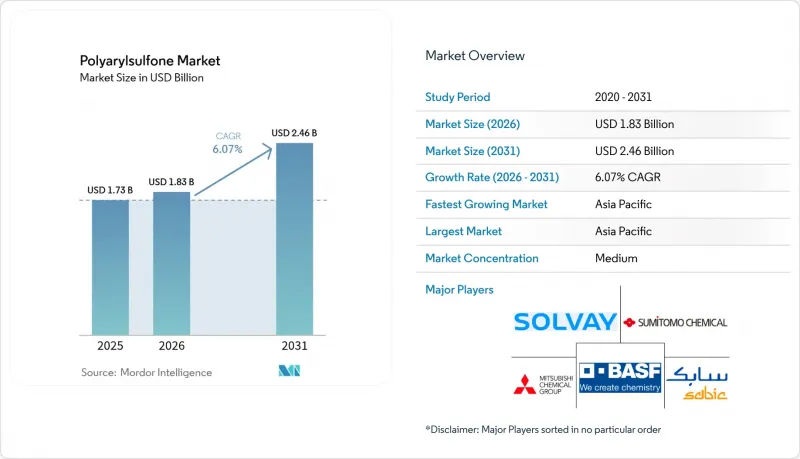
This report is Segmented by Type (Polysulfone (PSU), Polyethersulfone (PESU), Polyphenylsulfone (PPSU), Polyetherimide (PEI)), End-User Industry (Automotive, Aerospace, Electronics, Medical, Mechanical, Others), and Geography (Asia-Pacific, North America, Europe, South America, Middle East and Africa). The Market Forecasts are Provided in Terms of Value (USD).
Global Polyarylsulfone Market Trends and Insights
Rapid Lightweighting Push in EV & E-mobility Platforms
Electric-vehicle producers are using polyarylsulfone in battery enclosures that demonstrate 20% weight reduction versus conventional aluminum housings, a milestone shown in SABIC's multi-material pack program. The polymer's heat-deflection temperature allows thin-wall structures that survive thermal runaway events, while intrinsic chemical resistance shields components from electrolyte spills. Tier-1 suppliers highlight tooling productivity gains because complex geometries can be injection-molded in one shot, lowering assembly cost. Automakers also exploit the resin's dielectric strength to design integrated cooling plates that double as electrical insulators. As pack energy density rises, these combined advantages translate into longer driving range, reinforcing adoption momentum.
Medical OEM Pivot Toward Reusable, Steam-Sterilizable Components
Hospitals are shifting from single-use to reusable surgical sets to reduce per-procedure expenditure by up to 60%, and polyarylsulfone meets repeated autoclave cycles without loss of clarity or toughness. ISO 10993-1 biocompatibility clearance for Udel PSU and Radel PPSU simplifies device registration in the United States and European Union. Instrument suppliers now specify transparent grades so clinicians can visually inspect internal channels, cutting downtime linked to hidden contamination. Pigmented variants for color-coded trays streamline workflow and lower identification errors in the operating room. With health systems pursuing both cost containment and sustainability, demand from surgical tools, sterilization cases, and dental equipment remains robust.
Volatile Bisphenol-A & Diphenylsulfone Prices
Feedstock volatility narrows producer margins because bisphenol-A spot prices swing with benzene and phenol supply cycles. California's listing of bisphenol S as a reproductive toxicant adds uncertainty, prompting formulators to resource-shift or requalify grades at extra cost. Contract hedging only partially offsets price spikes, so processors push surcharges downstream, raising finished good pricing and dampening substitution in cost-sensitive sectors. Vertical integration helps majors absorb shocks; however, independent compounders face inventory-finance strain during up-cycles.
Other drivers and restraints analyzed in the detailed report include:
- Membrane Retrofits in Industrial & Municipal Water Treatment
- Mainstream Shift from Metals to High-Performance Polymers in Aerospace Interiors
- Delayed Regulatory Approvals for Food-Contact Grades
For complete list of drivers and restraints, kindly check the Table Of Contents.
Segment Analysis
Polysulfone segment captured 39.33% of the global market share in 2025, emphasizing its significant contribution to overall revenue. Medical, filtration, and aerospace programs lean on PSU's well-documented datasheets, which limit qualification time. Producers emphasize melt-flow consistency that supports multi-cavity tooling, and this reliability keeps cost-of-quality low for high-volume disposables. Meanwhile, supply-chain alliances between resin makers and compounders bring pre-colored PSU pellets directly to device molders, eliminating masterbatch steps.
Polyphenylsulfone commands premium pricing yet is on track to outpace every other grade at a 6.63% CAGR by 2031. PPSU's impact strength allows thinner battery module frames than PEI or PEEK can deliver at comparable cost. Syensqo cites a 207 °C heat-deflection rating that safeguards under-hood brackets near turbochargers while absorbing vibration without micro-cracks. Polyethersulfone, in contrast, targets membrane casting and transparent lab ware, offering a cost-performance midpoint that appeals to price-sensitive Asian OEMs. Collectively, these differentiated value propositions lock in long-term offtake agreements and deter commoditization.
Complete Report Scope:
- By Type
- Polysulfone (PSU)
- Polyethersulfone (PESU)
- Polyphenylsulfone (PPSU)
- Polyetherimide (PEI)
- By End-User Industry
- Automotive
- Aerospace
- Electronics
- Medical
- Mechanical
- Others
- By Geography
- Asia-Pacific
- China
- India
- Japan
- South Korea
- Rest of Asia-Pacific
- North America
- United States
- Canada
- Mexico
- Europe
- Germany
- United Kingdom
- France
- Italy
- Rest of Europe
- South America
- Brazil
- Argentina
- Rest of South America
- Middle East and Africa
- Saudi Arabia
- South Africa
- Rest of Middle East and Africa
- Asia-Pacific
Geography Analysis
Asia Pacific held 41.85% of the polyarylsulfone market share in 2025, supported by China's 5.48 million t/y bisphenol-A capacity and regional government incentives for high-tech plastics. Local converters integrate vertically from BPA to sulfone monomers, compressing conversion costs and shortening lead times to electronics and EV clusters. Japanese producers refine ultra-high-purity grades for surgical lighting lenses and semiconductor quartz replacements, reinforcing the region's advanced-manufacturing pedigree. Supply-chain concentration, however, exposes Western OEMs to geopolitical risk, prompting dual-sourcing strategies with Korean and Indian suppliers.
North America remains a value-added hub focused on FDA-cleared medical disposables and FAA-certified aerospace interiors. Resin producers invest in compounding plants near major med-tech corridors in Minnesota and Massachusetts, cutting transit carbon. OEM preference for recycled content pushes suppliers to pilot solvent-based depolymerization that reclaims monomers at 95% yield. Federal procurement policies tied to Buy American clauses may accelerate localized capacity, cushioning the market from Asian supply disruptions.
Europe's policy mix balances REACH chemical scrutiny with circular-economy targets. German automakers embed polyarylsulfone in thermal-management manifolds for battery electric vehicles, aiming to halve component weight versus aluminum. Continental water utilities retrofit hollow-fiber membranes to comply with the Drinking Water Directive's stricter PFAS limits, and EU recovery funds earmarked for green infrastructure underpin volume growth. Eastern Europe offers cost-competitive molding, drawing inward investment from Western compounders seeking tariff-free access to the single market.
South America and the Middle East & Africa trail in volume but show double-digit demand in water treatment and oil-gas applications. Governments favor durable membranes to offset capital constraints, and climate-driven droughts make desalination capacity urgent. Gulf-region petrochemical majors evaluate backward-integration into sulfones, leveraging existing phenol production, which could shift global trade flows post-2027 if projects proceed.
- Arkema
- BASF SE
- Celanese Corporation
- Ensinger
- Evonik Industries AG
- Mitsubishi Chemical Corporation
- Polymer Dynamix
- Polymer Industries
- Quadrant Plastics Composites AG
- RTP Company
- SABIC
- Solvay
- Sumitomo Chemical Co., Ltd.
- Syensqo
- Techmer PM
- Westlake Corporation
Additional Benefits:
- The market estimate (ME) sheet in Excel format
- 3 months of analyst support
TABLE OF CONTENTS
1 Introduction
- 1.1 Study Assumptions and Market Definition
- 1.2 Scope of the Study
2 Research Methodology
3 Executive Summary
4 Market Landscape
- 4.1 Market Overview
- 4.2 Market Drivers
- 4.2.1 Rapid lightweight-ing push in EV and e-mobility platforms
- 4.2.2 Medical OEM pivot toward reusable, steam-sterilizable components
- 4.2.3 Membrane retrofits in industrial and municipal water treatment
- 4.2.4 Mainstream shift from metals to high-performance polymers in aerospace interiors
- 4.2.5 Rising demand for solvent-resistant housings in next-gen semiconductor tools
- 4.3 Market Restraints
- 4.3.1 Volatile bisphenol-A and diphenylsulfone prices
- 4.3.2 Delayed regulatory approvals for food-contact grades
- 4.3.3 Recycling infrastructure gap for high-temperature thermoplastics
- 4.4 Value Chain Analysis
- 4.5 Porter's Five Forces
- 4.5.1 Threat of New Entrants
- 4.5.2 Bargaining Power of Suppliers
- 4.5.3 Bargaining Power of Buyers
- 4.5.4 Threat of Substitute Products
- 4.5.5 Degree of Competition
5 Market Size and Growth Forecasts (Value)
- 5.1 By Type
- 5.1.1 Polysulfone (PSU)
- 5.1.2 Polyethersulfone (PESU)
- 5.1.3 Polyphenylsulfone (PPSU)
- 5.1.4 Polyetherimide (PEI)
- 5.2 By End-User Industry
- 5.2.1 Automotive
- 5.2.2 Aerospace
- 5.2.3 Electronics
- 5.2.4 Medical
- 5.2.5 Mechanical
- 5.2.6 Others
- 5.3 By Geography
- 5.3.1 Asia-Pacific
- 5.3.1.1 China
- 5.3.1.2 India
- 5.3.1.3 Japan
- 5.3.1.4 South Korea
- 5.3.1.5 Rest of Asia-Pacific
- 5.3.2 North America
- 5.3.2.1 United States
- 5.3.2.2 Canada
- 5.3.2.3 Mexico
- 5.3.3 Europe
- 5.3.3.1 Germany
- 5.3.3.2 United Kingdom
- 5.3.3.3 France
- 5.3.3.4 Italy
- 5.3.3.5 Rest of Europe
- 5.3.4 South America
- 5.3.4.1 Brazil
- 5.3.4.2 Argentina
- 5.3.4.3 Rest of South America
- 5.3.5 Middle East and Africa
- 5.3.5.1 Saudi Arabia
- 5.3.5.2 South Africa
- 5.3.5.3 Rest of Middle East and Africa
- 5.3.1 Asia-Pacific
6 Competitive Landscape
- 6.1 Market Concentration
- 6.2 Strategic Moves
- 6.3 Market Share Analysis
- 6.4 Company Profiles (includes Global level Overview, Market level overview, Core Segments, Financials as available, Strategic Information, Market Rank/Share for key companies, Products and Services, and Recent Developments)
- 6.4.1 Arkema
- 6.4.2 BASF SE
- 6.4.3 Celanese Corporation
- 6.4.4 Ensinger
- 6.4.5 Evonik Industries AG
- 6.4.6 Mitsubishi Chemical Corporation
- 6.4.7 Polymer Dynamix
- 6.4.8 Polymer Industries
- 6.4.9 Quadrant Plastics Composites AG
- 6.4.10 RTP Company
- 6.4.11 SABIC
- 6.4.12 Solvay
- 6.4.13 Sumitomo Chemical Co., Ltd.
- 6.4.14 Syensqo
- 6.4.15 Techmer PM
- 6.4.16 Westlake Corporation
7 Market Opportunities and Future Outlook
- 7.1 White-space and Unmet-Need Assessment
- 7.2 Growing Demand of Polyarylsulfone as Membrane in Water Treatment Facilities

